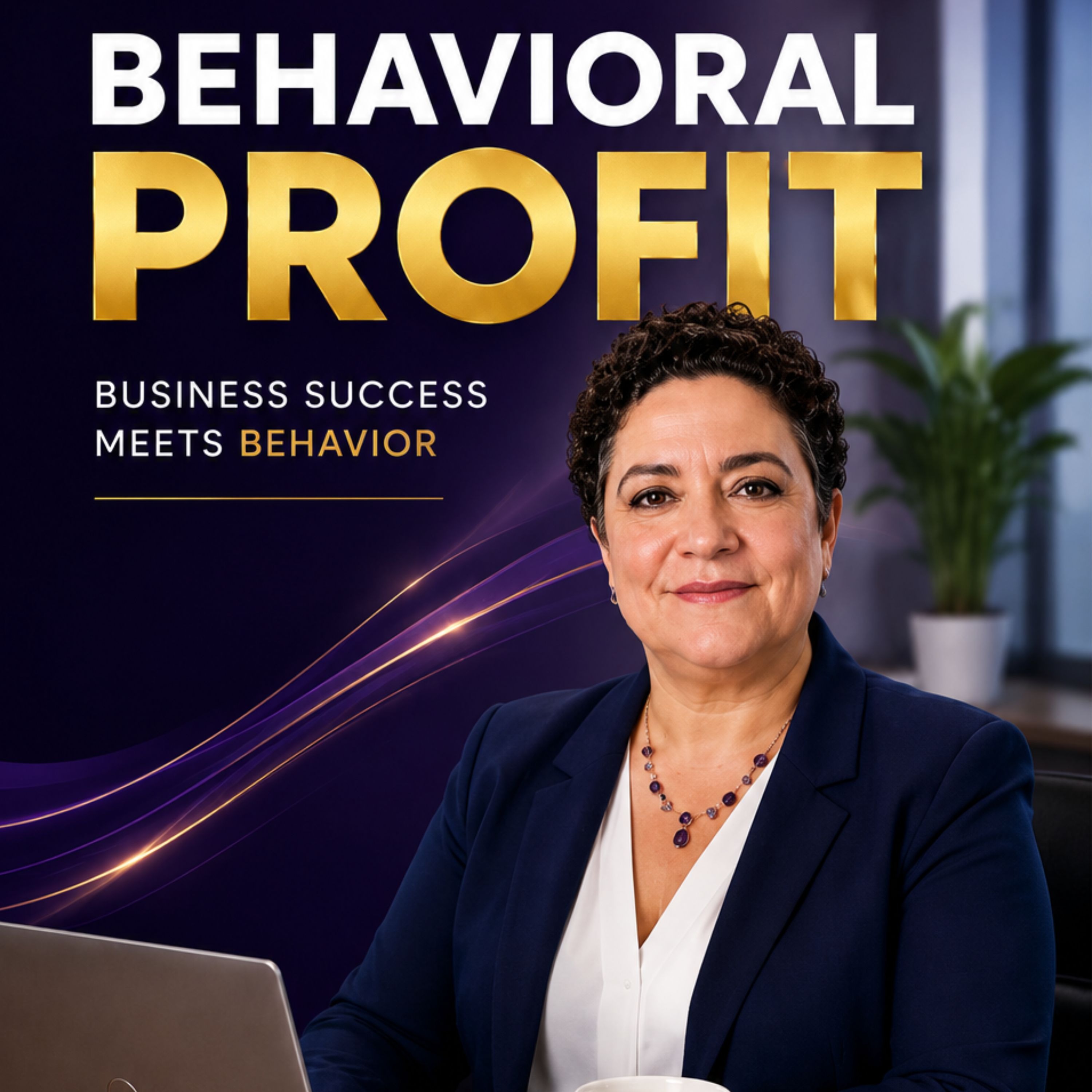
In this episode of Behavioral Profit, Debbie Longo sits down with Gavin McMahon, founder of Fassforward, to discuss a pivotal leadership lesson that changed the trajectory of his career.
While leading a major digital transformation initiative, Gavin found himself in conflict with a senior executive over priorities, communication, and organizational change. Although technically correct, he learned a powerful lesson about influence, leadership, trust, and the importance of understanding different perspectives.
Together, Debbie and Gavin explore:
• Why being right isn't always enough • The role of communication in leadership success • Navigating organizational politics and power dynamics • Trust, credibility, and influence in the workplace • Why people are the foundation of every successful business • How challenging experiences can shape future leadership
This conversation offers valuable insights for business owners, executives, managers, and professionals navigating change and leading teams.
Guest Information:
Gavin McMahon Founder & CEO, Fassforward Consulting Group
Website: https://www.fassforward.com/
Email: gavin@fassforward.com
Connect with Debbie Longo:
Website: DebbieLongo.com Podcast: Behavioral Profit
Email: debbie@lifeinbloomny.net
Linkedin: https://www.linkedin.com/in/debbie-longo-life-in-bloom-ny/
Welcome to The Behavioral Profit. I'm Debbie
Longo, executive behavioral coach. This podcast
explores the connection between behavior, leadership,
mindset, communication, and business performance.
Every result in business starts with human behavior.
The way people think, lead, respond, communicate,
and make decisions directly impacts culture,
productivity, growth, and profit. Through real
conversations with business owners, executives,
entrepreneurs, and professionals, we explore
the behavioral patterns that move business forward
and the ones that hold them back. Thank you for
being here. Welcome to the Behavioral Profit.
And we have a very special guest today, Gavin
McMahon. Good afternoon, Gavin. Welcome to the
show. Hi, Gavin. Nice to be here. Good. And thank
you for being here. I'm going to ask you today
to give an example of a situation or scenario
that you personally experienced in a business
environment where you had an issue or you went
through a major change. What your process was
and what the end result was. And the end result
should always be be positive. I do the show for
a few different reasons. And one main reason
is because everybody has issues in business.
No business is ever perfect. Believe it or not,
a lot of changes that happen in people's businesses
repeat. There's a pretty good chance that somebody
out there is going to have almost the same exact
situation as you. We want to be able to ask the
listener if they could identify with any part
of this show of your story or your example. It
doesn't have to be what that situation is. It
could be something that you're talking about,
a part of the process. That's really the main
goal of this. If you could do that for me, I
would appreciate it. Thank you. Sure. The story
goes back 26 years. I was working for a company
called Gartner. It's a technology advisory firm.
So they work with big companies, all sorts of
sizes, and they're basically giving people advice
about what technologies to buy. I was running
what was called Gartner .com. So Gartner gave
all its advisory services through paper and CD
-ROM, and it was just moving to the internet.
That's why this story starts 26 years ago. I
was basically responsible for both the strategy
and the execution of how we would do this. A
new CMO came into Gartner. I won't name his name,
we'll just call him Bob. Bob and I had a lot
of different conversations because I essentially
ran the website and also ran how we would deliver
it. The project I was running today would be
called Digital Transformation. And it was as
hot then as AI is now. There was a lot of moving
parts in the team that I ran. And the way I was
thinking about doing this digital transformation
is we've got to take out all the old stuff, all
the old plumbing, and we've got to rewire everything
and put all the new plumbing in. And the website
was the way it looked was the last thing I cared
about. And it was the first thing Bob cared about.
So to cut this story a little shorter, we had
a series of conversations. They went like this,
Bob saying, we've got a dusty brand and we've
got to figure all this stuff out. And me saying,
that's just putting lipstick on a pig. We've
got to change all this stuff. around. So I'll
get to your stuff later. Now what I didn't think
about, and this is where I didn't, Debbie, have
a process to deal with the kind of power dynamics
in the organization. The fact that Bob was a
lot more senior than I was, I just happened to
be in a kind of hot place doing something which
I thought was pretty interesting. And I was also
relatively new to leadership, to the U .S. I'm
an engineer originally, so I was just generally
blunt about things. And so the mistake I made
was basically telling him that his idea was a
terrible idea and we should do it my way. And
because what I controlled, I could do it. We
fast forward six months later, Gartner went through
a reduction in force and I was first on the list
because I didn't have a tool or a way of having
these conversations. So that's the beginning
of the story. It's not the end. I appreciate
that. When you felt that you wanted to control
the situation and he didn't agree, what was your
thought process? Why did you think? that your
way was the best way. Did that come from past
experience? Everything to me is like a mutual
agreement. If somebody doesn't agree, then what
do we do in a situation like that? The first
thing that we had to do was build the house before
we put paint on it. I had no problem telling
people. If I was right, I get in retrospect and
I'd probably spent 25 years since then founded
fast forward and our firm all about helping people
lead and helping organizations stride through
change. This is my origin story, at least for
what I do today. I realized that what you say
is exactly right. If you need people to work
together, they first of all have to come together
and see things at least roughly on the same page.
And me just saying I'm right, you're wrong is
not a really good way of starting it, but I think
it's a really easy thing. to do if you are the
technical expert on something, because you have
to build the house before you paint the house.
So why don't you just wait and then we'll build
the house and then you can paint it. That was
my argument, but that kind of thing doesn't land
well. There's also different roles in companies.
It's important to respect each other. Everybody's
different. We might not think it's going to work
out, but then it does. I always want to go into
this person presented this. I don't know what
the outcome is going to be. And when I do that,
I go into it with a blank slate. That's really
going to help me because whatever the outcome
is, I'm not disappointed. And then that sometimes
affects the employees. It affects morale. It
lowers my self -esteem. So what was the rest
of the process? Continue the story if you can.
It's all a big system. You're completely right.
It's all connected and it's all connected through
people. Back then I used to think about I used
to put people in two categories, idiot and okay.
And okay was the good box and idiot was not a
good box. Not really a great way to deal with
people, but if I had to justify it or maybe alibi
it, it's more the right word. It was really an
engineering mindset. And I generally think business
works because of people. And I genuinely think
that pretty much everyone comes to work trying
to do the right thing and a good thing. Everything
that goes on is information asymmetry. Some people
have it. different way of looking at the world.
Some people have different sets of information
and you're all coming together with different
pieces of information. If you do what you said,
give people the benefit of the doubt, respect
where they're coming from. It's a lot easier
to rub along, but it's also difficult to do that
under the pressure of whenever it is that your
boss tells you have to get done, especially if
you know how to do that and know it's right.
That's where the rub comes along. This is why
I talk about storytelling a lot. Basically people
live in their own stories. We're all a of our
own story. And when somebody else comes along
and that threatens that story, we can get very
reactive about how we are. And I think it's much
easier if you can understand, A, that everyone's
trying to do the right thing, mostly. By and
large, there's always some exceptions to that
rule. B, everyone's the hero of their own story.
So they're always trying to do the right thing,
but their world revolves around them. And C,
you just got to figure out how do you begin to
connect with people. And I do think the way is
through stories. The person I am now now versus
the person I am then would have had a very different
conversation about. how to navigate this and
how to get through it. But I didn't because I
wasn't that experienced. I just thought about
being technically right and letting somebody
know that he was very technically wrong. That's
fair. That's your story, your process. I'm hoping
there is a listener or somebody that has a similar
situation. It depends on how you view it and
how the business owner or executive is going
to react to these types of situations. Is there
an ending to it? The ending is what I do now.
It's almost like karma for that situation for
the last 25 years. I helped found a firm. We
help lead through change and we help them tell
better stories to drive change in the organization.
That kind of understanding of where people are
coming from. People are just trying to do the
right thing and they're making decisions that
somehow roll up against each other. That's essentially
what we do. There isn't really an ending. It's
more like a fade to black at some point. rather
a definitive end, but it's more about what I
do now, how I think about the world. That would
be the end. You're just describing a simple situation
where you had something happen and the result
is what you do now. I think that what I got from
you and from your ending is any business owner
or executive. We always want to be trusting and
as kind as we can be and as open -minded as we
can be to our peers. owner, executive, who do
I affect? Everybody else, my employees, even
the janitor. And by getting through things in
a positive way and learning lessons, then hopefully
we're not going to repeat them. Cause if we do,
then we have to go through the whole thing again.
When we learn these lessons, when we tell these
stories, that's going to help whoever's listening.
And they see that I had this situation happen
and this worked out good for this person. This
is the result. So therefore it could work out
good for me. Now that's. going to save the company
money. It might even save the actual company
from going bankrupt. What happened to people,
other people don't have to repeat that. They
could learn their lesson just from hearing somebody
talk about what happened to them. Some people
have to learn trial and error, but not everybody's
like that. I mostly agree with you. You talk
about trusting and being kind. I do think being
kind. I agree with you on that trust. I'm not
sure about, and I'll tell you why. I think we
tend to use the word trust as this. big blanket
statement. You either trust somebody or you don't.
So it's unequivocal. If you think about trust
is really a faith in some future outcome or event.
If you go back 25 years, you would trust me to
run this digital transformation project. Your
faith in the future event is the successful outcome
of this digital transformation project. If you
buy new lawnmower from somebody who's a local
person down the road, you trust that you're going
to get a reasonable deal and the lawnmower will
work. So it's a faith in a future event. When
people say trust, they are looking for a blanket
trust and a blanket gets out of jail free card.
And I don't think that's necessarily deserved.
In work and in life, you can only control yourself
and what you do, how you react. You have to earn,
I think, credibility, no matter what level you
are. Then you have a right to demand trust in
that specific thing that you have credibility
in. We're all different people and we all have
different personalities and behaviors. And one
of the biggest things I could do for myself is
learn how to deal with that and learn how to
care and love the other person as much as I possibly
can. I want to constantly be feeding positive
energy. I don't want to be feeding any negative
energy because that's going to give me a negative
outcome. Is there anything you would like to
say in closing? Negative energy comes from the
story you tell yourself about who that other
person is and what they're doing. You can equally
tell yourself a positive story. It just depends
what you choose to do. Everyone's choosing all
the time. I can only control what I control.
And a lot of business owners don't understand
that because they want to control their employees.
They want to control their peers. And we are
not robots. We can't control other people. We
can't make somebody do something. You can pay
them and expect them to do something. This was
a great conversation. And I hope. that it benefits
a listener. Thank you for listening to Behavioral
Profit. Remember business problems are often
behavioral problems first. The way people think,
communicate, lead, and respond under pressure
directly impacts performance, culture, and profit.
If something from today's conversation connected
with you, take a moment to reflect on how behavior
is influencing your business leadership and decision
making. Thank you for being here. I'll see you
on the next episode of Behavioral Profit. Thank
you, Gavin, for being on the show. I appreciate
it. Thanks, Debbie.