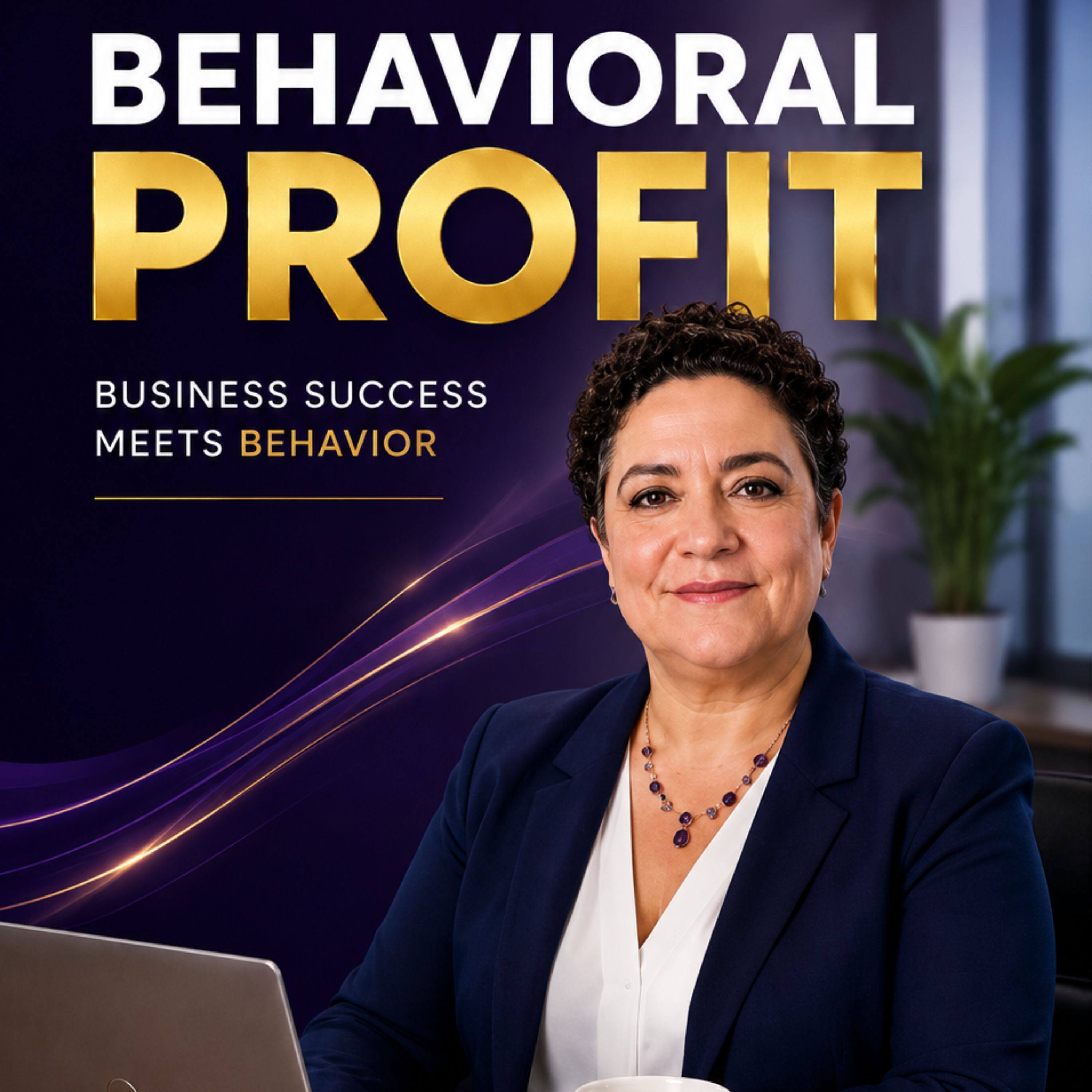
In this episode of Behavioral Profit, Debbie Longo speaks with Sreedhar Kaluva founder and CEO of My Work Belt, about closing the technology gap for small businesses. Sreedhar shares how affordable IT solutions can remove chaos, improve efficiency, and give business owners back both profitability and time. He explains how his leadership philosophy, rooted in the Bhagavad Gita, drives a people-first approach that empowers teams and builds sustainability. Together, they explore the AAA formula—accept, acknowledge, appreciate—and how behavior-driven leadership transforms small businesses.
Contact Debbie Longo
Executive Behavioral Coach
lifeinbloomny.net
Shreedhar Kaluva
Founder & CEO My Workbelt
myworkbelt.com
Welcome to The Behavioral Profit, the show where
business meets behavior. I'm your host, Debbie
Longo, executive behavioral coach. And each week
we dive into the mindset shifts, leadership strategies
and cultural behaviors that drive higher performance
and greater profits. Whether you're leading a
team or building a business, this is your space
to learn how human behavior fuels business success.
Today's guest Sri is a founder and CEO of my
work belt comes in more than 25 years of experience
delivering from enterprise scale software solutions.
for Fortune 500 companies in small businesses
applying information technology on their business.
Sri founded unique solutions of advanced technologies
and later my work belt to equip small businesses.
He is helping small business apply the same information
technology firepower that large companies use
to achieve profitability and sustainability guided
by principles from the Gita, he leads with a
behavior -driven approach that fuses people -centric
culture with practical and reliable IT solutions.
Let's open with the origin story. Thank you very
much, Debbie. That's a great introduction. Certainly,
as you mentioned, your audience can hear my voice
or they can see me. I am born and raised in India,
and being a Hindu -dominated society over there,
and I am from Hindu religion as well. But that's
nothing to do with the business. Certainly, the
guiding principles that I follow are the spiritual
principles that are given to me by my ancestors
in developing the business. So that's rooted
in my culture and rooted in my heart. And I follow
the same. Thank you very much. That was very
good. So there's a few questions here that are
divided into topics. When you left enterprise
consulting, what specific gap did you see in
the small business market that convinced you
to launch my work belt? And how did that insight
shape every subsequent strategy choice you've
made? It is whether we believe it or not, it
is very true that large corporations have deeper
pockets and they can invest time, money, energy
into developing information technology and any
other technology tools for that matter. But why
do they do that? And one fundamental principle
I learned that is to remove the chaos in their
business. And what does it do? It simply improves
the efficiency. And once the efficiency, it removes
the rupture, it removes the friction within the
organization. Now, once the efficiency is improved,
the business will automatically thrive and will
go in a higher profitability mode. Now, why do
you want to do that? Once you are in a higher
profitability mode, you have the ability to make
decisions without having constraints, and you
have the ability to adapt more and advance the
technology to further move on your market expansion
or profitability and thus sustainability. Now,
when I came into the small business environment,
I found the gap clear gap of information technology
or technology usage between large corporations
and the small businesses. And I wanted to fill
that gap. And thus, the small businesses can
compete with the large corporations with the
same firepower that they have. Now, one thing
that I also noticed that small businesses, they
always think using technology needs a deeper
pocket. But that's a thing of the past. lot of
technology tools are available at a very, very
affordable and economical position. Now just
they have to be open minded on using these technologies.
And that is where I bring value to the table
for the small businesses. So for me, there's
a lot of things that you said that I resonate
with and I agree with, and I can really identify
with the information technology. referring to
businesses, all different types of businesses.
There's a lot of issues because I work with businesses
and I'm very familiar with this in all different
types of ways. So there's a lot of businesses
that I am familiar with that don't have the time.
Yes, they don't want to take the time out. They
think that it's too expensive. They don't know
where to go. They don't know who to trust. Correct.
I think people are just going to take their money
or they don't want to be bothered. Or they say,
why should I go through this? I'm just going
to use the conventional way of advertising and
marketing like I've always done. But here's the
thing, though. Hindsight is twenty twenty. So
what they don't know that they don't know, they
don't know. So maybe. What if they do this? What
if they ask their neighbor or their friend that's
in the same industry as them and see what they're
doing? Because most likely there's a very good
chance that they might be using information technology
and all these things that you're offering that
they're not using. And then they could say, wow,
how's your bottom line? How's your profits doing?
How's your sales doing? And most likely they'll
say very well. So this is the whole thing. And
I work with a lot of marketing people that have
to do with the field that you're in and stuff.
And they advertise a lot. And that's really I
mean a lot. That's really how they get their
business, because people are not familiar. See,
it's not just simply the bottom line. We also
have to recognize the small businesses. are unique.
They are different from large corporations. Now,
large corporations, there is business managers
and operations managers, whoever they are, they
behave in a way the labor market. They will have
their paid vacation. They will be taking a break
and going, doing what they needed to do to attend
their family needs. Whereas small business owners,
they don't have that luxury. Everybody thinks
small business owner, they can do whatever they
want, but that's not the case. But my observation
is small business owners, they work twice harder
than any employee. They sacrifice their life.
They don't go on vacations as employees go. They
are very, very frugal and they operate on very
tight schedules. The reason why they do it is
because they are worried. If they make a small
mistake in running their business, it's not only
their life on the line, but whatever the 5, 10,
15, 20 families depending on them is also in
trouble. So that is in the back of mind of a
small business owner continuously, not once,
twice. It's continuously. And in some cases,
for the small businesses, there are employees
who are working 15, 20, 30 years. It's devastating
for a small business owner to make a mistake
and create a chaos in their employee's life.
So they don't. Not only profitability, when the
technology is applied properly on the business,
and when you remove the friction within the organization
and create a seamless operation, it also gives
the time back into the hands of a small business
owner. They can catch a breath, they can spend
time with their family, or they can even go for
a vacation. That is even more valuable than just
simply profitability. There are three things
that we are looking at. One, profitability. And
two, sustainability, the organization can continue
on. And three, the business owners and employees
are all empowered together. That is where the
technology helps a lot. And this is what having
a challenge for a lot of small businesses to
recognize. Yes, that was very good. Thank you.
The next question is your leadership philosophy
draws heavily on Gita. In concrete terms, which
verse or principle guides your day -to -day decisions,
and how does that spiritual lens translate into
measurable business strategy inside a tech services
firm? That's a wonderful question. I don't have
a problem to claim that I am a spiritual practitioner.
I do practice spirituality. I believe in God.
And Bhagavad Gita is not necessarily kind of
a spiritual book, but it is given by Lord Krishna,
who all Hindus worship dearly. gave the Bhagavad
Gita as a way of living. This is the way you
should live your life. This is the way you should
do your business. This is the way you need to
eat, how you take care of your family, how you
take care of yourself, what you need to eat,
what you should not be eating. All these guided
principles are given for a human being to lead
their life. Now, one verse particularly that
I am very, very passionate about it and it instilled
in my mind, I'm not going to go through the worst,
but I will give you the meaning of it. So what
he says is, you do what you have to do without
being a greedy on the outcome. Leave the outcome
to me and the universe, it will give you what
the outcome you desire and you deserve. So if
I am helping somebody, I have to keep the help.
on the focus opposed to how much profit am I
making out of them. So when I do that, my sincere
effort will come through to give this a sincere
results for my customers or for our subscribers
in my work belt. And that naturally gives us
positive energy back. So that is what we use.
Not only me, all my team, everybody follows the
same principle. Yes, that's very good. And that's
the main way that I coach and I communicate with
my clients and stuff that the bottom line is
whatever I do or say or they do or how they respond
is really dictated by the universe. Correct.
It's not really dictated by what we really say,
although sometimes we might want to think that
we do that as far as I know in the United States
is what I'm familiar with. But what you're talking
about is a higher level. And this is very good
that with the interesting that it would where
bringing it into technology. We're talking about
this because this is taking us to a completely
different level and a completely different understanding
on this, because I think a lot of people think
technology is you turn on a computer and you
figure it out or you hire somebody right to do
it. But you don't know what you're doing and
you don't know really what's happening. But somebody
told you to do it. We're talking about something
here on a higher level, which is a very, very
interesting topic. See, technology is no different
than anything else in the in the world. If you
really think about it, technology is created
by the human being and technology is used by
the human being. Now, a lot of people think that
technology is replacing the human being. But
not really. Unless the technology complements
the human being, technology doesn't have a value.
That is a fundamental principle. It has to complement
the human being. It has to make the life easy
for the human being. It has to make the comfort
for the human being. Otherwise, technology doesn't
have any value or meaning. At the end of the
day, we have to recognize that the human being
is in control of it. Next question. Describe
a typical Monday at my work belt. What behaviors
do you personally model that signal behavior
driven leadership to the team? And how do you
confirm rather than assume that those behaviors
echo through every department? We all at my work
belt follow simple principles. What you do is
the best. Put your best effort in doing what
you're doing. So typical Mondays, we generally
huddle up and we talk about what do we have?
in the week ahead of us? What do we need to achieve
the goal? And what did we learn from the last
week's experience? We might have received a call
from a customer that they needed help with. Or
we might have gotten a feedback from a subscriber
that, hey, there is a feature that you are missing
and we needed it. Or sometimes our subscribers,
being small businesses, they need a handholding.
And in some cases, some of our subscribers, they
hired a new employee and the new employee need
a training because our promise to our subscribers
is the personal training unlimited. So if somebody
hired a new employee, we train them. Business
owners don't have to worry about that. That's
one other thing we remove off of the plate. That's
how we are bringing value to the small businesses.
So we go through all these things. We divide
who is best at doing what. What are the different
tasks on our hands? Sometimes we have to do the
research and development. What can we do to improve
our own technology that makes life easier for
our subscribers? So we will go through all those
things. And that's good. Thank you for that,
because you are focusing on the people, the subscribers,
your clients, rather than you focusing on how
can you get your money? How can you make the
most profit? How can you charge more? or what
are you going to benefit from rather than what
the client is going to benefit? Because I can
tell you, as a coach, just from my experience,
the companies who make the most money focus more
on what on their clients. They don't focus on
on how much money they can make. And they're
not interested in whether the client is going
to be happy or not or what value they're giving.
A lot of business owners don't realize that they
just take they have a little thing, service or
whatever that they're selling. They make a lot
of money. They just want to increase the price
and increasing rather than. And then eventually
there's no value in that. And that doesn't work.
And then there's a good chance that they might
go down or they're going to lose profit. Exactly.
They get into trouble. See, at the end of the
day, as a founder and CEO of my work belt. I
have two people that I need to be really, really
careful, besides my family. One is my customer
subscribers, who are small business owners. And
two is the employees who are supporting these
small businesses. Now, in case of large companies,
when there is an employee customer support technician,
and they will have the ability to get away not
supporting. their customers. There is opportunity
for them to get away from it. But in our case,
our customers are small business owners and small
businesses. We don't have that luxury. We cannot
because when we don't do what we are supposed
to do, that reflects in the business, which reflects
directly on the employees of that business. So
this is something I teach to all my team members,
all my employees. They carry the torch. And they
carry that forward with me. Next question is
founders often claim they value emotional intelligence,
but still default on blunt directives under pressure.
Which frameworks or routines do you use to keep
EQ front and center during product sprints and
client crises? And how have you adapted those
tools for a lean organization? Oh, we are certainly
a lean organization. There is no way. we could
offer what we are offering for that price if
we don't have a conscious of lean organization.
No doubt about that. But one principle I certainly
preach to all my team members, all my employees,
when there is a chaos, that is when you actually
have to pause. When there is a chaos and conflict
erupts in any situation, that is where you need
to pause. It requires a great deal of courage
to pause for a minute. take a deep breath before
you make any decision because it requires that
courage, nobody do that. So it is a practice.
So we continuously practice on how to take a
pause, how to take a breath and ask the right
questions before you make a decision in a chaotic
circumstances, in a conflict. As I go back to
my original statement, the small businesses they
require handholding. And sometimes the small
businesses, they are themselves in chaos. Our
job is to lift them up and move them away from
the chaos. That's our job. So these are the simple
principles that we follow in order to help our
subscribers. And giving these tools, giving this
coaching to employees and allowing them to practice
is what makes us a winning team. and helping
us to be lean operation. Yeah, that was good.
And the key word that you said was coaching,
because you're not in it just to make a product
and benefit how you can benefit for it. I know
a lot of marketing people, like I had said, and
people in this field. And that's really what
their drive is, is just to make money, make money
and make more money. And their clients are basically
like They see them, they do a few things for
them, and that's it. And then they just move
on. But they don't keep those clients. So they
have to keep advertising to keep getting more
clients. And in a way, because every business
advertises. But what is the sole reason that
you're doing it? Why is the reason? Is it just
to keep turning over clients, right, and just
trying to make more money? Or do you have a process?
Do you have a framework? What does that look
like? Is it behavior driven? All of these different
things is what I help businesses do. This is
the reason why I coach businesses because it
takes a little bit of thinking. Business owners,
not a robot and also small business owners. They
I know a lot of them. They just make a paycheck.
They literally do not make any money at all.
The only money they make is they give themselves
up. Do you believe it? Because it used to be
this was a long time ago that small businesses
made a lot of money, but they don't anymore only
because of the cost of everything. Their bills
and bills are just so much. They can only charge
a certain amount. I mean, this pizza place that
I know and everybody buys pizza. And pizza, it's
a fairly decent price, even for a slice or a
pie or whatever. But these business owners, I
know a few pizza places, the business business
owners, and they spend money. They advertise.
They have to buy all the ingredients and stuff
for the pizza. And they just make a paycheck.
That's very unfortunate, Debbie. That is why
my mission is like that. I want to help small
businesses streamline their operation, make it
as efficient as possible so they can make money.
Most importantly, they can take a break and catch
a breath and spend some time with the family.
See, there is a huge challenge in our society.
A lot of people, they are running after money,
business, career growth, all these things. But
the foundation for your happy life that you are
leading is the family. And you don't have time
to work with the family or work with building
the family together. You may not be seeing the
challenge today, but 10 years, 20 years, 15 years
down the road, you're in a chaos, internal chaos.
That is very important for small businesses,
business owners to take a break and let's spend
family together, build the values. and build
our next generation. See, it is fully responsible
for small businesses to build the next generation,
not just simply themselves. At least that's what
I believe in it. Yes, that was very good. Thank
you. The next question is resource constrained
owners sometimes see advanced IT as a nice to
have. Walk us through how you perspired a skeptical
founder to invest before they feel ready and
cite an example. where the first step delivered
a faster return than a traditional hire or marketing
spends. This business case that I'm going to
share with you is extremely valuable. See, one
of our customers, one of our subscribers, we
call them, they were using old software and a
lot of work they were doing in their business
is all manually written. And it's a small business,
a dozen employees together. Now they were all
going through a lot of challenges because their
manual operation and legacy system that was not
suitable for the current business needs and the
software that was they are using it way old.
So they end up going and doing the work on Excel
files and the business owner doesn't want to
invest in the technology until nearly 50 % of
the employees barge in the door literally and
asking him hard questions. And once they started
asking questions, hard questions, then he started
realizing, why is this chaos happening in my
office? And then he recognized it. Okay, this
is old technology, which is giving them wrong
data and turning them into stressful situations.
So they investigated, they inquired with five
different software packages. They were all very
expensive. We are talking about the Microsoft
and all other softwares that they have looked
into for running their business. And then finally,
they stumbled upon, literally they stumbled upon
my work belt because we don't have a huge marketing
budget either. They stumbled on my work belt
and they said, this is a no -brainer for us because
you are only one third of the cheapest option
in the market. And my owner doesn't have any
problem. So I was talking to Jerry, who is the
business manager, and he said it is so easy for
us to make a decision and the software is self
-taught. We don't need a training, although you're
offering the training, because it is so user
friendly. So business owners have to be open
-minded on continuously look after what options
are available in the market. And they definitely
had a budget constraint that stopped them from
being able to use the technology. Now, once we
relieve that budget constraint from their challenge,
it's a flip of a switch. they were able to use
it. And within one month, they reap the rewards
of it. I know a lot of business owners that have
a clientele, a certain type of customer, and
they focus on that. And that's their bread and
butter. And the technology that they have suits
for that, specifically for that. And they're
able to make that money. But the question is
this, and I have a hundred examples of this,
what happens when that clientele, that certain
client or customer goes away? Now they're left
with nothing. Why? Because they didn't have the
technology. They didn't have any updated software
to go beyond that certain clientele that they
had that made all of their money. And this has
been going on for a very long time. I haven't
been in this business for like 25 years. And
I've done life coaching and helping small businesses,
all these different things, individual families.
And this has been going on for a very because
in the past, there was no like technology is
going very fast now. It wasn't really like this.
I mean, it was, but not to this extent. So in
the past, it used to be like the small business
would rely on literally one or two clients. Maybe
they were like an executive in like a company
or something. And they would get all their business
from that. And then when that was done, the Maybe
the executive said, we don't need you anymore
for whatever reason. Then the company goes out
of business, but they don't, that doesn't have
to happen now. It used to happen a lot, but it
doesn't have to happen now because we have the
technology. We have companies like you that are
focusing on how can we, and like me, right? That
are focusing on how can we increase the sales?
But like you said, what is the future of the
company to make the future to make a future for
the company. They think we don't even know if
there's going to be a future. How do we even
know, right? If there's going to be a tomorrow.
To me, that's not running a business. No, that's
just the very kindergarten way of running a business.
If you are a business owner and you are relying
on one or two customers to run your business,
I mean, for that matter, if you have a customer
that is contributing more than 30 percent of
your business, you have to pick up and start
running, bringing more business. Because you
want to make that one customer below 20%, if
not 25 % max. But if there is one customer giving
you more than 30 % of the business, it is a responsibility
of the business owner to look for an option to
bring that down. Not that you want to get rid
of the rest of the customers, that's not a good
option. But you wanted to bring in more customers
or you wanted to work around how do you make
your business sustainable. That's a simple trigger.
The next question is, once the tech is live,
how do you tie its performance to hard outcomes,
productivity, revenue lift, employee retention,
so the leadership team can't dismiss the project
as just another IT experiment? That is one of
the reasons, a key feature we have, one of the
key features we have in my work belt is budget
versus actuals. Report. So any project that you
are doing as a business owner, you will be able
to budget that project. What is my labor cost?
What is my material cost? What is my equipment
cost? What is the miscellaneous cost? How much
am I paying for my subcontractors, whatnot? All
those budget items you create and plan for that
project. As the project continues on, you continuously
update what is being consumed to deliver that
project, to deliver that commitment. At any given
point of time, you run a budget versus actuals
report that will tell you what kind of a profitability
are you on the project. Now, that gives us two
things. One, it will enable us to see what are
the kinds of projects that are giving us profits
and what are the kinds of projects that are giving
us opportunity to improve the business process.
They may not be giving profit right now, but
then that is raising a question. Why are they
not giving us profit? Because we thought they
are all giving us profit. In some cases, you
will identify the projects that are lost. And
that gives you a greater strength in making a
decision to say no to some of the projects that
are giving you loss. So there are a wide variety
of cases that you can see in the business. And
like I said, within a month, you will see a no
-brainer why we have not done this before. It
is my work belt or it is any other software technology
or any other technology for that matter. You
should have these kind of parameters that you
can look for and justify the implementation of
it. To me, this is a lot of kind of brings in
a lot of what we have just been talking about.
But to me, a coach is good also for this type
of thing like you and I are. And also, I don't
know if a small company can really afford this,
but a lot of companies have a tech team where
they have in -house And they do all the work
advertising, whatever it is that the company
needs in order to survive. And they had a whole
marketing team. They had like a basement and
it was like filled with people. So the idea for
me is if you're a small business, try to take
the leap and try not to be too scared and too
frugal. Just to say. My company is doing good
now. I don't have to do this now. Try to take
a little gamble, dip into it a little bit and
see it can really do for you. So just a little
bit of trusting. I want to share with you something.
It is not they are doing gambling. I wanted to
make sure everybody is understand. You have been
investing in your business all through the life
of your business. Using technology is equally
important as you invest in buying a machinery,
buying an equipment in your business. Only because
software technologies that you cannot touch and
feel, that doesn't mean they don't bring value
in running your business. IT is extremely important
for any business, for any size. Take the case,
you're a coach, Debbie. You are coaching your
clients, and if they don't give you the data
for the questions that you're asking them, how
can you coach them? You cannot coach them. In
order for them to give you a data, it is the
owner's choice whether they spend one hour in
a snap, bring the data, or they spend two days
and to work through all Excel files and depend
on their own assistant to consolidate the data
and give it to you. That is their choice. So
what if there is a technology? you are investing
in get the time that you will be spending otherwise.
So look at the application of technology as an
investment standpoint, not as a gambling. That's
very true. Thank you for that. Next question
is listeners love real world turnaround stories.
Recount the moment you helped an employee who
had lost almost everything rebuilt his life.
What precise actions did you take and what ripple
effects, positive or negative, did you track
in morale and output? What a wonderful question.
Actually, this brings tears to my eyes. I really,
really went through this challenge with one of
my employees. This has been a long time, not
today, but at least 10 years ago. Mark was, I'm
not giving the last name here for our privacy
purposes. He lost everything. His wife left him
and he lost his job and he lost his children
and ultimately he lost his house. He became a
homeless and he went into depression. Nobody
could reach him. He did not want to talk to anybody.
He did not want to reach anybody and my ex -colleague
he was. Then I end up calling him. Literally,
I have to search for him and bring him back to
my business and This is what I did. I did not
give him simply money to go buy food. When I
brought him into my office, I personally went
and bought a bunch of groceries. I gave it to
him and I told him that you are working now.
No matter what, you are doing something productive.
You are a productive person. I know you very
well. It doesn't matter. And then slowly, I gave
him money. for having him do something productive,
not necessarily we don't have any count of how
many hours or what is exactly you're doing or
not. But why I did that, it's not because I want
to simply give him the money. I want to build
his confidence, self -esteem. Now, within a year,
he ended up finding a job that is far better
than what I could offer him because of his seniority,
because of his intellect. And then off you go.
It is... The moment that I have to make a decision,
am I just simply give him a hundred dollars or
a thousand dollars and off you go, do whatever
you want it to do? Or do I want to bring him
in and help him to gain his self -confidence
and be able to get on back on his feet? I made
a choice of doing, helping him to gain the self
-confidence and self -esteem. That's a very touching.
story that really definitely resonates with me
and probably a lot of other business owners.
And it has a lot to do with what we were just
talking about. So two more questions. Your AAA
formula of accept, acknowledge, appreciate, sounds
deceptively simple. Give us a case where applying
it moved the hard metric and detail the numbers
so our data minded listeners can judge its real
impact. This is the formula that can be applied
anywhere in life. It's not just simply in business.
But of course, it gives you a lot more value
when you do in the business. Take the case you
have an employee. When you have employees, new
employees come on board. They come from different
cultures. They come from their own family background.
They come from their own childhood experiences.
They have their own preconceived notions when
they are walking in the door. we cannot expect
them to adapt our culture in a snap or we cannot
expect them to blend with us immediately. No
matter whether they are 10 years or 15 years
old or they are 50 years old, it doesn't matter.
So, the first step we need to do is we need to
accept them as they are. And when they say something,
when they do something, you acknowledge it. Hey,
I see that you're doing a good job. Guess what?
Their comfort Goes through the roof because they
are timid they're intimidated by the new environment
Although they may put a big face of brave face,
but subconsciously they do have that so once
you accept them the way they are and that relieves
a stress for them and then the acknowledgement
once you acknowledge what they're doing and that
gives them another door to open and be comfortable
with it. So this AAA formula has a great deal
of value and you can apply the same thing in
your own home, in your own personal life. Let's
say you are in a college environment. You are
a group of 10 friends. You are five friends for
that matter. You are enjoying the life and a
new friend comes in. Accept that new friend as
that person could be coming from a different
country altogether. So that's why I always encourage
people to use this AAA formula. It's good that
you have a formula because it just shows structure.
And I think that's a good thing that most likely
will attract business owners or potential clients.
It does sound very similar. It's all about how
you explain it. It's all about the presentation
because something can be similar, easy or complicated
or simple. But if. they don't understand it,
then most likely nothing's going to happen. No,
as a coach for business owners or for life for
the people, I'm sure you will understand the
value of these kind of simple formulas more than
anybody else. And I'm sure you have a bunch of
formulas that you are teaching to your clientele
already. Definitely. So the last question is,
finally, if the audience acts on only one idea
from today's conversation. to blend right size
IT with stronger leadership behavior, what single
move should they take this week? And why will
that action create outsized returns compared
with every other option on their list? There
are so many tasks that you will be performing
in the business. Now step back for a minute and
think which of these tasks that repeatedly doing.
What is this task that I'm repeatedly doing?
An example, I'm repeatedly picking up this part
and putting it on another way, or I'm repeatedly
entering this data into this form. Oh, inquiry
forms. People are coming on the window and they're
writing on the piece of paper, and I am entering
that data into the computers repeatedly every
day. task that is repeatedly happening in your
organization, in your life within that business
process. That is a wonderful business case to
adapt technology and make automated. And once
you do that, then you will be more appreciating
the technology. You will see an instant reward
of it and that you can pave the path for adapting
better technology for complementing to your business
and improving the efficiency. So if I have an
idea or I am curious about something or I want
to spend money on something, what am I going
to get out of that? What is the value that I'm
going to get out of that? Well, to me, that depends
on what I'm thinking and how I think, because
I could say I could spend. 10 ,000 and say to
myself, well, I'm probably not going to get that
much out of this and what's going to happen.
I'm not going to get that much out of it. So
it doesn't only depend on how much money am I
spending, right? It's 10 ,000 on advertising
just because it's more money. Am I going to get
more out of that? That's not necessarily true.
And again, this is all stuff that I teach. that
I explain when I coach, because a lot of people
don't a lot of business owners and stuff. They
don't really understand what the core of this
concept is and what it really means. So this
is the thing. So that's why it's good that we
combine this leadership behavior right with the
right sized I .T. because to me, this is what
right sized is. And this is the whole thing that
we've been talking about. This is a very good
thing, not only to take away, but for them to
really understand what this is really about and
to open their minds. There's something beyond
what they're thinking. There's something beyond
what my vision is, what my idea is. of my business,
of what IT is, right? And how I can expand my
business from the technology world. Thank you
very much, Debbie. That wraps up our deep dive
with Sri, founder and CEO of My Work Belt. If
today's conversation showed anything, it's that
world -class technology and people -first leadership
are not luxuries for giants. They are the growth
engines small businesses can't afford to ignore.
You heard how a single right -sized tool can
outpace another hire, why handwritten notes still
drive retention in a digital world, and how the
AAA formula of accept, acknowledge, appreciate
moves hard numbers when applied with intent.
The real question is whether you'll treat these
ideas as inspiration or execution. Pick one takeaway,
maybe the first tech upgrade you've been postponing.
or that thank you note for you keep meaning to
write and act on it before the week is out. Sri,
thank you for sharing both your strategy and
the human touch behind your success. Listeners,
if you found value in this episode, subscribe
to your favorite platform, leave a quick review,
and share the show with someone who's ready to
lead smarter. All links to Sri's resources. are
in the show's notes at behavioralprofit .com.
I'm Debbie Longo. This is Behavioral Profit,
where better behavior meets better business.
Until next time, lead boldly, leverage technology
wisely, and keep turning behavior into profit.
Thank you, Sri, for being on the show. Thank
you very much for allowing me to be on the show
and share my thoughts with your audience. Greatly
appreciate it, and I'm honored.