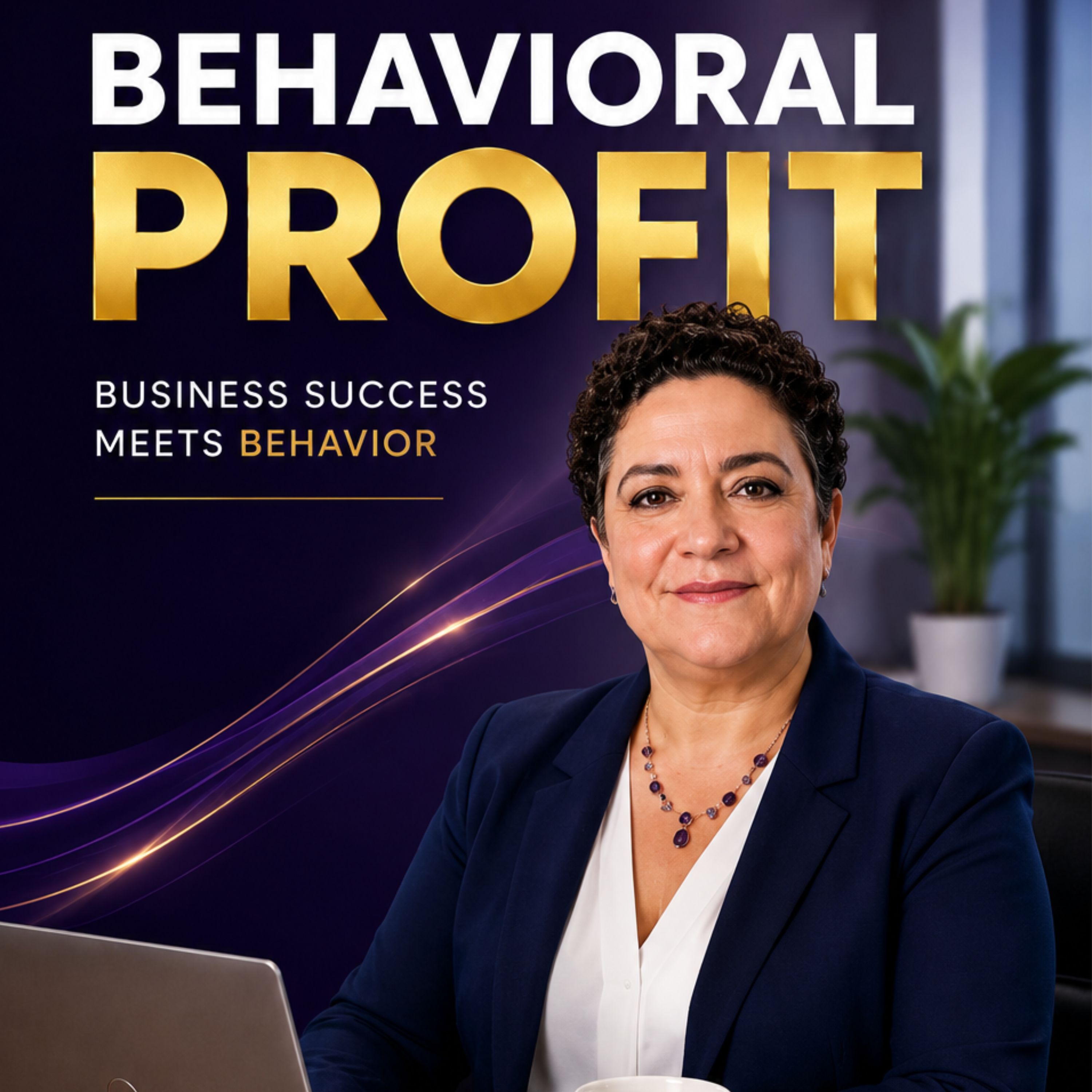
Brand strategist Katie FitzGerald joins Behavioral Profit to unpack why the fastest-growing companies often start by looking inward instead of chasing every algorithm shift. She explains her “identity-first” approach—using tools like Myers-Briggs and VARK—to craft marketing that mirrors who you are, sustains sales confidence, and outlasts cookie-cutter trends. We explore how personality-driven strategy prevents burnout, why clarity beats raw visibility, and where most executives’ sabotage growth by masking their real strengths. If you suspect one-size-fits-all templates are stalling your revenue, this conversation shows a more profitable path and offers practical first steps you can apply today.
Connect with Debbie Longo
website
https://www.linkedin.com/in/debbie-longo-life-in-bloom-ny/
Connect with Katie FitaGerald
LinkedIn https://www.linkedin.com/in/katiefitzgeraldkfitzconsulting/
website
Welcome to the behavioral profit, the show where
business meets behavior. I'm your host, Debbie
Longo, executive behavioral coach. And each week
we dive into the mindset shifts, leadership strategies,
and cultural behaviors that drive higher performance
and greater profits. Whether you're leading a
team or building a business, this is your space
to learn how human behavior fuels business success.
Katie Fitzgerald is the founder of K F I T Z
consulting a brand strategist who helps emotionally
intelligent professionals build identity first
business grounded in who they. Katie's work blends
personality, typology, emotional clarity, and
strategic culture to help therapists, coaches,
and creative steps into brands that feel honest
and stainable. She's here to talk about what
happens when marketing becomes an extension of
your inner truth, not a performance. Good afternoon,
Katie. Welcome to the show. Hello. Thank you
for having me. So I have a few questions here.
The first question is, what does it mean to build
an identity? first brand and why is that different
from traditional marketing? An identity first
brand essentially starts with who you are, not
just meeting the algorithm, not meeting trends,
and it doesn't just work off of market demand.
Essentially, what I aim to do with all of my
clients is build them a brand that feels authentic.
I don't want my clients to feel like they're
performing or role playing because at the end
of the day, if I set up all this marketing for
you, you and this brand, it really needs to reflect
who you are to give you that sales confidence.
If I get you those leads through marketing and
your sales confidence is off, it doesn't feel
like you're performing this idea of what's trending
right now. It's going to cause your sales confidence
to decrease. Like you really start to dysregulate
in a very, and that's where the nerves come in
and we have those sales issues. So I find that
if you just take a brand, make it authentic to
the It really changes the game for that solo
professional or small business owner. On this
podcast and all of my others, we're focusing
on executives and business owners, all different
industries on either different types of behavior.
How can we improve that industry? What we're
talking about here is the identity first brand.
So if somebody is interested in marketing or
wants to pursue a career in marketing, then this
podcast might give them some tips about the things
that they want to accomplish and exactly how
to develop their business or how to make it better.
When I develop my marketing, I want to make sure
potential client or customer is owing to be receptive.
People like instant gratification. It's good
to explain what the difference is between that
and working at a slower pace. Then what do I
get from those two things? What happens right
away when I work with the person and what's the
difference between the way that you do your business,
getting results right away and a little bit slower.
You can either go to a marketing consultant.
There's many of us out there. and get a cookie
cutter template. That's just essentially following
an algorithm, placing you into what seems to
work and you look like everybody else. It takes
a little time working with me developing a personally
typed brand. So what I do is Myers -Briggs testing,
which is your personality type. There's 16 of
them. Then I look at VARC, the way that you process
information, how you take things in. And essentially
I'm working with you one -on -one to build build
a brand that could last forever. Those cookie
cutter brands change all the time. And that's
when brands start to feel performative. When
you feel like you are not showing up as the person
that you truly are, but you're matching the trends
that are popular on LinkedIn at the time and
not truly being a thought leader like you can
be. The next question is how do personality frameworks
like Myers -Briggs shape your clients? Briggs
essentially is just pulling apart who you really
are. The reason I'm doing this is because everyone
has a different tempo. If you're an introvert,
you're not going to be wanting to do a video
every day or maybe running a whole podcast. The
marketing strategist, I take that into account.
I don't give you a plan that just works for anybody.
It's based off of who you are just to ensure
the success rate that it will happen. I look
at the different elements since there are 16
different personality types. Everyone's a little
different and I truly base the whole entire strategy
off of who you are to make sure that you perform
usually at 70 or higher success rate. So you're
saying that your success rate based on this Myers
-Briggs format is very effective. The biggest
thing that I've noticed is really the sales confidence.
A lot of people, it doesn't matter if you are
that solo professional that's aiming for the
top or you're already at the top, sales confidence
can always be influenced and affected, pressurized.
If you feel that your brand and what you stand
behind, what's online and what you're showing
up as is aligned, it's going to make a huge difference.
And that really comes down to biology, just nervous
system regulation. There's a difference in trying
to perform in front of others. If you want to
get into psychology, it's a sense of masking.
And I'm noticing that a lot of... Business folks
from executives to solo professionals all over
the place seem to be masking themselves and they
lose sight as to why they're really here and
what they're great at. Thank you for that. Next
question. You've helped clients move financial
crisis to clarity. What's the first shift that
makes that possible? Stop trying to play the
visibility game. It is not a formula. You can
post three times. You could post five times a
week, say authenticity and consistency. But what
does that mean? view, what gives you the drive
and the lack of emotional burnout. The biggest
issue that a lot of us run into is we don't come
and do our marketing videos. We don't show up
and do these things. But if you create a sustainable
system and schedule, it is completely accomplishable
and it's much easier to work on, which is why
I also infuse the personality type and take a
look at that when I'm deciding on schedules for
people, because even that you don't feel performative.
It doesn't like a sluggish task that you have
to do, be excited and talk about things that
excite you. That's how you develop your niche.
That's how you are recognized within your field
as a thought leader because you're passionate
versus just doing the trending hashtag or the
topic of the week. Yes, thank you. We just had
a podcast from somebody, an entire podcast on
burnout. She was talking about people who burn
out. What's their personality like? They're perfectionists.
They always think that they can do everything
right and they really try, but it never works
out like that because nobody's a perfectionist.
Make goals something that I don't think is achievable
or attainable. That clarity is important. Make
it an attainable goal, a reality. The last question
is what advice would you give to someone trying
to grow their business without abandoning themselves
in the process? Start from what you just said,
which is clarity. Look at where you feel like
you're faking things, you're making up these
words that everyone seems to be using in your
industry, and stop right there. Speak as yourself,
be your authentic self, and that's how you're
going to develop yourself into a thought leader,
someone that stands out from the crowd because
you're not just copying everyone else. You are
great at what you do, you know what you're doing,
and that's all you need to shine. That's essentially
it. If you overlook these and things you'll find
that stand out much brighter. If you take the
time to really look at yourself and identify
what you're already great at and highlight those
qualities, you know what you're doing, you know
what you're great at and you know what you're
selling, then you essentially will stand out
brighter than anyone else in your industry. These
industries topics that I do podcast on is to
ultimately increase sales and profits. As a coach,
I want to help the owner or example just to do
that. As far as abandoning themselves, which
is something we just talked about, I don't want
to not enjoy what I'm doing. And I want to think
and act social in any company that you are a
business owner in, like developing a team and
things that are motivational. If I abandon myself,
I'm not really with... other people, that's just
my own issue. And being social is definitely
going to make a great company and have great
employees that don't want to quit. They want
to stay there. And then essentially you will
have a great company because if I am a business
owner that goes through their employees, the
business owner says the employees quit because
the employee did this, but The business owner,
you should look at themselves because if they
have a lot of employees quitting, then what is
the issue? I'm saying employees, plural, more
than one. It's not only quitting. Maybe they're
not doing their job duties. What is the issue?
So what we're saying are all different ways of
helping companies and business owners and executives.
And they will have a great company and they will
be over the top. And then all the other companies
and their industry. How did you do this? Everything
is working perfect. You're making money. And
that's really what a business owner is looking
for. It's something I'm going to achieve when
I help them. And that's what's important. What
they want to do and what really should be happening
to help their company and be successful. Really
two different things. Do they want to look at
themselves and see what things they need to improve
in business? I love that you brought this up
because essentially people ask me, where did
you get the personality typing from? And some
of the best Forbes identified companies use personality
typing to create dynamic teams. It's understanding
who you're working with, being a leader. And
even when you work with me on a consulting front,
I require that my clients use designed affirmations
on the back of their computer or their phone
because everyone has something they can work
on. There's always an element. the self, the
personality, what we're doing every day for work
for many hours a day, we can always improve.
And that's essential to me. Making sure that
not only am I building you a brand, but I'm building
out the beautiful person that's in front of me,
my client, and really helping you achieve to
that very level. And it depends on the type of
person. Everyone's different. Everyone's affirmations
are different, but they're always business centered.
And they're really essential to getting to where
you want. Achieving those goals for real not
just making like you said earlier these goals
that are unattainable what is the point of that
really looking to make a difference and that's
why i like saying that i like to develop thought
leaders i really appreciate you being on the
show is there anything that you would like to
say in closing my last advice to anybody that
finds themselves struggling with marketing is
to pause look for that clarity don't chase visibility
just be your authentic self and highlight what
you already know How can they get in touch with
you? The best way to get in touch with me is
on LinkedIn, Katie Fitzgerald, or you can email
me at KFITZ Consulting. My information also will
be there. Thank you for being on the show. I
really appreciate it.