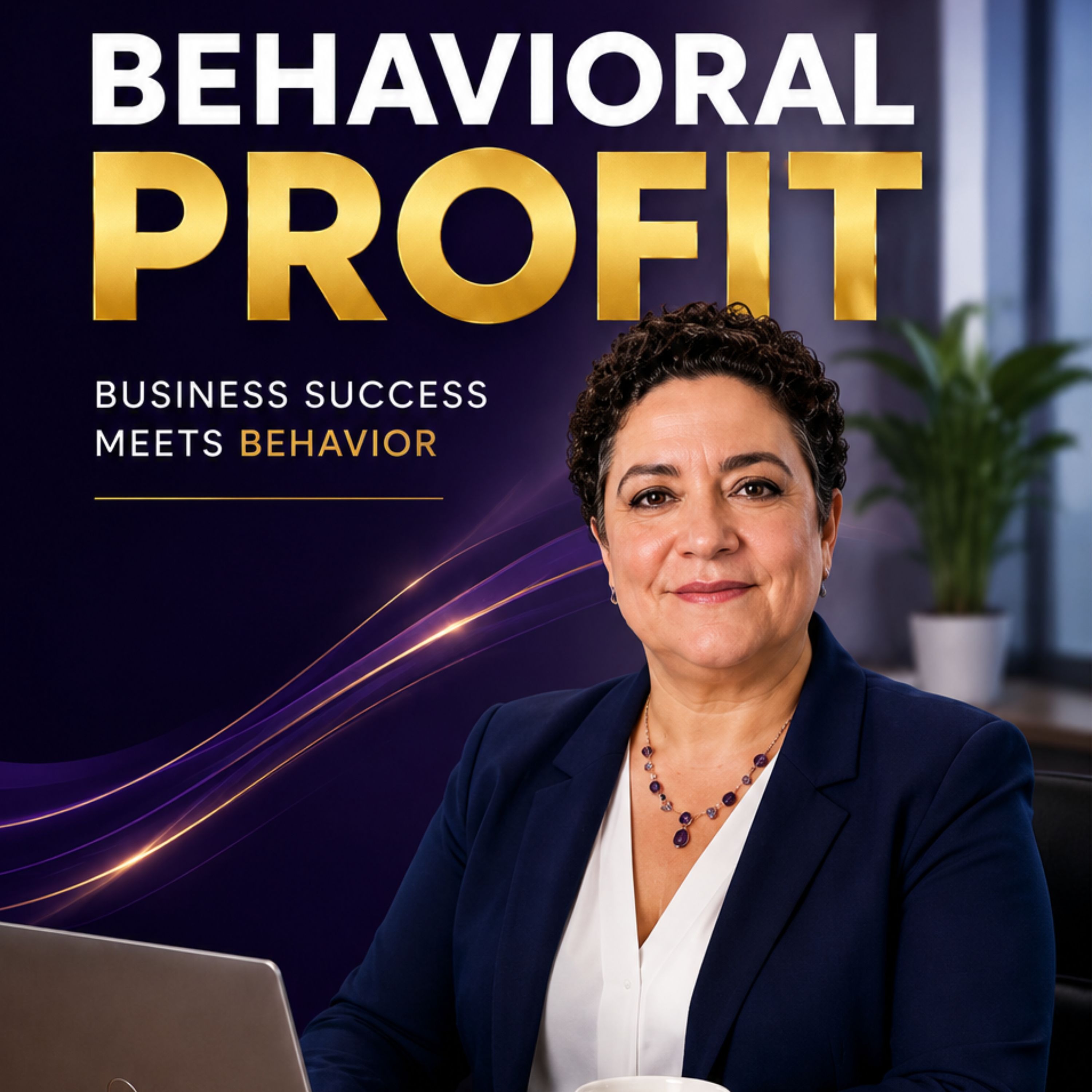
In this episode of The Behavioral Profit, Executive Behavioral Coach Debbie Longo interviews Dr. Tatiana Teppoeva, a former Boeing and Microsoft leader with 17 years of experience, who now runs One Nonverbal Ecosystem™ and helps professionals master executive presence and high-trust influence using her Executive Presence™ and BuyerMatch™ systems.
They explore:
You’ll walk away with a deeper understanding of how silent signals impact revenue, leadership, and trust — and how to make them work for you, not against you.
Contact Debbie Longo
Contact Dr. Titiana Teppoeva
linkedin.com/in/tatianateppoeva
Get the free guide:
5 High-Stakes Signals to Master for Powerful Executive Presence (https://tatianateppoeva.com/decode)
Welcome to The Behavioral Prophet, the podcast
where ... we decide the human side of business
growth. I'm your host, Debbie Longo, executive
behavioral coach. And each week we dive into
the mindset shift, leadership strategies, and
cultural behaviors that drive higher performance
and greater profits. Whether you're leading a
team or building a business, this is to learn
how human behavior fuels business success. Today's
guest Dr. Titiana Teppoeva is a certified nonverbal communication
expert, personality profiler, and the founder
of Non... verbal ecosystem with a PhD in economics,
a master's in data science from Harvard and two
decades of leadership experience at Boeing and
Microsoft. Dr. Tatiana Teppoeva brings a rare blend of behavioral
science and business strategy. She now helps
B2B leaders, sales teams and founders elevate
executive presence, close high value deals faster
and lead with emotional authority using advanced
profiling body language. coding and AI informed
insights. Get ready to think how you show up
because Tatiana's work goes beyond words. Good
afternoon, Tatiana. Welcome. Thank you. There's
a few questions and they're divided into topics.
The nonverbal ecosystem. Why silent signals dictate
50 to 93 percent of your impact? What is the
nonverbal ecosystem and how does it shift communication?
So there are multiple studies that tell us that
nonverbal represents a huge percentage. And there
are debates, how much it is, and people sometimes
argue with each other about the numbers. I recently
posted a YouTube video about that. Most known
study is from 1967 from Albert Marie, when he
found that our emotional communication is up
to 93 % of non -verbal, and only 7 % to words.
Another study by Ray Birdweasel says that words
account only for 30 -35%. There is another study
about nonverbal being around 80 -85%. I demonstrated
nonverbal can play a huge role. But for simplicity
and to avoid arguments, I like to use 50 -50.
So about a half of our presence is what we say
and about a half of how we do it. So one nonverbal
ecosystem consists of nonverbal peace. And I
include the personality profiling so we can tailor
our communication. We understand ourselves and
we understand someone who we communicate with
well so we can have personalized experience,
which makes it better for both sides. Nonverbal
peace consists of nine different categories.
It's body language, it's eye contact, gestures,
it's how we dress, and other things. So this
is what I'm covering in my nonverbal ecosystem.
The next question is, which invisible signal
sabotages leaders most often? Three main things,
and all of them related to mismatches. So one
I would highlight, it's a mismatch between what
we say and how we show it. For example, if I
say, hello, everyone. I'm so confident, and I'm
happy to share with you today. Do you feel a
mismatch? We feel some subtle cues and differences,
so it can go different ways. But when it's mismatched,
when we try to send one message but express it
differently, this is the first mismatch between
the message and how we show up. This second one
is when we address personality the way we would
like to be addressed. For example, if we have
a driven person, goal -oriented, who does everything
fast. And this person is communicating to someone
who is anxious, slow, takes his or her time to
analyze things, to have a plan B and plan C.
And this person will start like, let's decide
now, move on. then the distance will become wider
and wider between them because they have different
ideas about lives. So it's very important to
see who is in front of us and tailor our messaging
to the person. Knowing profiling is great, but
even if you don't know, you can observe the person
and see how they behave. And maybe you can adjust
here and there perception, whatever you've gathered
from observing them. And it's important everywhere
where we communicate with each other. third mismatch
when our action and intention don't match what
we actually do. So for example, I would say,
Debbie, how are you? How was your day and how
was your vacation? And I'm doing something else.
And you feel like is Tatiana interested in what
she's asking or she's just doing like check marks.
In sales teams, they have a skit, they don't
engage and then they get surprised like why this
client walked away and why they didn't sign up.
And they don't realize that the way they showed
their disinterest and this potential buyer, they
didn't feel connected. There's a statistic. When
I meet somebody for the first time, that is about
five percent of their personality. And we think
that's how they really are. And that's judging
the person. Maybe they want to. hire an employee.
That employee has to make a really good impression.
In that interview, they have coaches for this
so they can really present themselves properly
because one wrong move is going to ruin the whole
thing. And that business owner will say, I can't
hire this person. The nonverbal ecosystem that
you were talking about. And if I want to create
a relationship, with my employees and expand
my business and make goals so I could increase
sales and profits. I want to do all these things
not by judging and by saying, this is the way
that the person is. Nonverbal is important in
a lot of situations because I had to be nonverbal
in a professional way. And this starts with the
business owner or the executive. Then not only
are the employees going to follow, but they're
going to see that business owner completely different
because that's more valuable than the things
that they say. Because you ever hear of actions
speak louder than words? Not only actions, but
also our nonverbal. Because as we talked with
you, someone can be saying one thing, but showing
completely different thing with their nonverbal,
and you read it. And I wanted to add to your
statistics that usually we have up to five seconds
make overall impression. And after that, it changes
a little bit, but not too much, even though we
don't know person very well. We saw him or her
first time. And then we saw that this process
is actually very shallow. comprehension of them
in the first five seconds. So it's very important.
And I want to add to your very valuable point
about connection. So we are not talking about
faking or creating some kind of power pose to
impress someone, artificial. This is to connect.
And if the manager would like to understand their
employees better, so it works for both sides.
Manager has more influence and feels that they
can rely on the employees, some particular personality
types will not tell you much about their personal
life or concerns they have. But if you ask them
some questions, and even if they don't answer
openly, but you watch their body language, what
they are doing at the moment, if they cover their
mouth, face, that will have some cues that they
are not completely confident in what this manager
is saying, you can ask other questions. You can
create some discussions, maybe some meetings
about something. So be more observed and try
from different sides. And when you find this
key. to your employee, the whole thing changes.
And we know that the majority of employees leave
companies, not because of the companies, but
because of the managers. So if we address this
element, then we would have fewer people leaving
because of this mismatch. The second topic is
personality profiling in sales and leadership,
customizing influence strategies for faster,
deeper trust. How do you quickly profile a prospect
in a high stakes meeting? There are some cues
that we can look at, and some people are more
expressive than others. And it's also a cue,
because we have personality types that like to
show up, that they're here and they're there.
And others just aren't there, but I'm on the
back. If you need me, you can rely on me. So
there are different styles on how people show
up. And this would be the first cue. The second
one, we can look at the facial expression, and
even wrinkles that we have can suggest to someone.
who understands how to read them, what personality
type it is in front of us. Another thing is gestures.
Are they wide and open or narrow and close to
the body? There is a lot of adaptation signals.
We all have them, but we express them differently.
This will show anxiety about particular situation
or topic that we are talking about. And another
thing, even to look how we appear. Are we in
worn -out t -shirt Or are we in a dress with
big flowers and a lot of accessories and a lot
of makeup? It's also signs of personalities.
And of course, I just would like to just caution
that don't judge by one thing. So we need to
see a comprehensive picture of the person because
sometimes I can walk with a stylist and be dressed
not because I like it. or because of my personality,
but how they taught me to look for the occasion.
So if we take just one element in isolation,
we also may be judging based on how this element
looks at the moment, but not the total picture.
So if we look at all the elements together, and
even better, if we have some information prior
to the event to read what they wrote or how they
showed up online or at work, if we have this
information, that it will add to the story, we
can make some assumptions. And try, for example,
if you communicate at the meeting, try approach
for strategists or try approach for anxious person
and see how they respond. And if our approach
with them, they understand us and they respond
and react well, then we probably got it. If not,
then we can pivot based on their reaction. So
this would be the main things that I would look
at. And again, if you are not a profiler or non
-verbal communication expert, just trust your
instinct. Watch for those signs and cues and
try experiment. And with more and more practice,
you will get better and better at. Even if I
am a reputable employee or manager or somebody
that's higher up in the company I still want
to pay attention and I want to be like I am at
the job. I don't want to act differently. We're
really firm when I'm at the job and delegating
job duties to the employees, but then I walk
into the meeting I act like a new employee. I
want to be able to play the part because to me,
that's really what it is. An executive plays
his part. He does his role. The employees do
their role. What I got out of what you're saying
is they need to play that same part in everything
they do at that job. I was thinking of something
that you said in the beginning. I don't wear
it up. When I do these podcasts because I want
people to see how I really am if I wear makeup
During the podcast people are gonna think that
I wear makeup all the time. Then I sit on a couch
So I make it look like a casual Conversation
so not where I'm a business person. I'm sitting
at a desk I'm sitting in an executive chair to
me. Those are things that might possibly turn
somebody off. That's like a statistic. Two billion
people. Listen to podcasts, I make clips only
because my podcasts are pretty long most of the
time. What I got out of what you're saying is
I want to play that role. I want to make sure
that I'm giving the impression that I should
be giving. Because if I don't do that, then not
only is it going to create confusion, I could
get fired if I... I can add a couple of comments.
So as far as makeup, for example, it really depends
on taking a mini MBA course for style. because
I have clients who ask for this. Not wearing
makeup to the events is a bad taste. So you see,
perception is very different than here. Did she
even wash her face in another setting? I would
say that being authentic most of the time, as
much as we can, but be appropriate at the same
time is very important. And the second comment
I wanted to make, so you gave example from what
you've seen. I've seen a lot at companies that
especially females at the meetings, they say
something and people don't notice. And then guys
say something and everyone catches their idea.
And how about another one? Person doesn't do
that much outside of the meetings, but during
the meetings, especially with leadership, this
person is the first one to speak up on the topic,
cover achievements. that the team or another
person did without mentioning them sometimes
and things like that so how to deal with those
challenging situations to show up yourself when
you are not the person who is a performer who
is look at me i'm here and here is my results
it's a deep walk it's very hard and i know from
myself because i don't like to speak up at every
this is the skill that we need to develop And
those people who feel that they need this walk,
it may be a little bit harder for them, but it
will be very beneficial for them at them. And
sometimes we don't realize like what specific
area we need to improve on because we can improve
a walk and improve everything. But if we talk
about 80 -20 rule. or those 20 % of improvement
that we can make in our nonverbal that would
affect 80 % of perceptions that people get in
from us. So I wanted to point out this challenging
problem at work as well. Thank you. So the next
question is, executive presence and emotional
authority, practical routines that upgrade how
leaders enter the room. What is the first behavioral
blind spot you look for in C -suite client? So
going back, especially to females, I had very
many at Microsoft before I started coaching and
doing nonverbal sessions and video assessments.
And what I see is that often females, but also
males undermine the authority. So they don't
present themselves as well as they could. And
it can be done by different forms. For example,
one of those adapters, if we constantly do something
or you are very confident, you are talking about,
but then you finally, you move in some ways.
And again, I'm trying to exaggerate a little
bit because I have only that much space to show
here. Some examples, but still subconscious cues
that we will be reading from this person to undermine
a little bit more of the authority. If you look
at some famous speakers, they begin with coaches
and sometimes not a year or more. And CEOs of
big companies, we think how good they are. They
are completely different people. So it's a skill
that you can acquire to project yourself very
well. Those misalignments, mismatches that I
mentioned earlier, the ones that I'm looking
for, and also the ways that we don't undermine
our authority ourselves. I really appreciate
your insight and the way that you explain it,
because it's very easy to understand. I am the
type of person and whether I enter a room or
wherever I go, I have a very leadership behavior
and I show that immediately. Like here, I'm sitting
on a couch, I'm talking calmly, but if you see
me in person, I'm not this way. I like the phrase,
some people are natural born leaders. The way
that I act and the impression that I make, whether
it's a first impression or whether I start talking,
people can tell. immediately that I'm a leader
and that I can take control and run a business.
Many people have told me that and that's why
they wanted me to start my own business, which
I was doing, but I was in management my whole
life. I manage retail stores and I had no problems
at all because of the way that I act and the
way that I behave, how I enter the room, just
like we were talking about. But let me ask you.
So you probably strategist and I have other assumptions,
but I also don't want to judge from very short
period of time. What would you say? Do you have
a challenge of not showing too push or not showing
overbearing, over leading and being on the softer
side? Maybe for you, because you're on the couch
and without makeup and trying to present yourself
in more casual way. Those are your kind of things
around to soften your cheap side of you. So your
personality type is the leadership. Go get it.
But you have challenges maybe to adjust it on
another end of it. Other people who are very
good on the soft side, they have challenges with
leadership. I think that if I'm talking to one
person, it's not as bad. But if I'm in a room
with a group of people or even just a few people,
I... project that leadership and that very strong
first impression. I do that automatically. I
don't even think about it. And I like that. So
I want to do more of that. I don't want to be
calm. It's great when whatever we would like
to have, we have, right? This is a personality
type that you've been born with. So we have a
personality type that we are born with and then
the ones that we acquire through our life. For
example, if I'm shy person, but I need to stand
up at the meetings. I need to show up. It's hard
work for me because I need to change myself.
If you are a leader position in a big company
and then you come home and you need to be so
and not being like, I will tell you where everything
is right with your kids, spouses, relatives.
Then there could be another challenge with it.
We need to adjust to the occasion and situation
where we are. Some of us very successful at this
and some learning and trying. But again, The
skill is learning so we can train it and get
better and better, at least if we want. If we
don't, if everything is good, then there's nothing
to add. That's very true. Thank you. So next
topic, gendered leadership patterns, when gender
dynamics matter and when they don't. Do women
leaders need a different playbook or just different
emphasis? Do you tailor coaching for women in
leadership? I do. And I tell it actually to each
person based on the goals that they pursue, challenges
that they observe. Or maybe they have feedback
from other people like you shared with me. So
the same is all individuals. But if you talk
on female leadership specifically, then definitely.
And I mentioned earlier that I noticed and I
heard from that they underestimate themselves
and skills. So I interviewed over 100 people
at Microsoft for data science positions. I interviewed
males, females, project managers, data scientists,
engineers, software developers. In 80 % of the
time, females undercut themselves. They think
they need to have 120 % of what is required in
job description to even qualify. Male candidates,
they have 60 % and they think that... that's
good enough, that requirements are too high,
like it's not realistic. And when you talk with
them, I tell them, you are so good, you need
to go and ask for more difficult projects. When
I work with non -verbal, I look for the things
that our people already possess because everyone
has good things already in them and how they
can leverage them to their advantage. I open
their eyes and say, look at this, how it's great.
When we do video assessment, I show them how
how great it is, feel even better in their own
eyes. They look at themselves differently. I
try to look at 80 -20 and adjust those 20 % of
what will give 80 % of the impact of the perception.
If they want to continue working more, then we
can do more, but at least 20%. And for females,
it's mostly about confidence and how they show
up. When for males, it can be adapters being
too pushed, being too forward, being too much
into there, whereas they can push people away.
It's not completely 50 -50 or black and white.
It's a mix of main trends that I'm seeing. So
did you ever hear the expression, it's a man's
world? Yes, and it's changing depending on what
time we live in and what culture. It all affects
us. Fortunately, unfortunately, there's not much
we can do. And by the way, for your audience,
I prepared free guide. can see main things that
they can watch for. Just quickly, I think a woman
is just as qualified for any job that a man does,
if not more qualified. But it might be different
in Russia. In the United States, to me, women
have always been in the minority. And that's
why we say it's a man's world. But when a woman
really becomes a big leader, then they see that
a woman could do it. But a lot of times women
have to be twice as good. They have to be twice
as smart. they have to perform better. Just in
my view, the way America is, and I've coached
people like this, I know from my own experience.
Totally agree. It's the same if not worse in
Russia. You need to be twice as good to prove
your point. That's why these impressions that
we make, perceptions that we create is very important.
Because if you don't do it well, it's how much?
Hardly, we need to walk. It's four times. So
it's very important. Very good. Thank you. So
next topic, AI informed human intuition, where
AI enhances real time behavioral decisions. Where
does AI amplify not replace your work? So with
growing AI industries, there are tools that are
going into conversational AI, personalization,
LHR preparation, how we hire people, or how we
even read interview when they try to identify
patterns based on the video for the interview.
AI is still not there. It cannot read in context
very well yet. It cannot read all the cues. It
misinterprets things. But as a baseline, if I
work, for example, with big quantities of phone
calls or something like that. Established baseline,
they help. But there are many issues, tools.
Recently I analyzed, I think about 15 email tools
for personalization. And I thought it will take
me so long to analyze each of them and try and
pay whatever the monthly fees. I was surprised
when like half of them just didn't work. There
are either buttons didn't work or something was
wrong on the website itself. then another portion
of them just gave promises, eight times better
personalization, something like that. But what
they did actually is just get personalization
with hello. And there is a name put in the brackets
and some other information in the brackets, and
this is where it ended. So not honestly much
personalization. Another portion of tools was
about scraping online space and inserting some
information from there. But it can be creepy
because if we email our prospect like, oh, I
saw you attended this event with your son. I
think it was cool. And then this Prospect thinks,
what? How do you know this information? Are you
following me? Are you watching me? I don't want
you to know this information about me and my
son. So it can be creepy. If we use AI to communicate
this way and then we talk with this person, do
we really remember what AI talked about? The
person on that end would remember because it
details about their life. We can ask AI to summarize
it for us, but the problem that the person on
another end will not be talking in summaries.
They can ask us, how about that event that I
went with my son that you mentioned? Did you
go? And you're like, what event? AI didn't give
me this information in the summary. What event?
I don't know. And if we talk this way with our
prospects, and they after a few times realize
who was writing me those emails, it's not about
personalization. It's about breaking trust. Right
now, many companies already have AI field, and
all AI -generated emails, personalized emails
get filtered. But there are a few tools that
can be useful that I can use. Some of them we
need to be very careful from security perspective.
So, for example, one of companies with great
idea, but we don't know, like, what if something
happens? They claim that they already have 2
billion emails. And to use their services, you
need to give them access to all emails. They
can grow with learning experience and have a
bigger database of everything and to be able
to help us. Just imagine if there is a breach,
and recently there was 16 billion password breach
in big companies. So if even big companies can
be a problem like that, what can we talk about
our emails? And I ask ChildGPT, just give me
20 scenarios how this information can be misused.
So if we get this information, we also call emails
that we have, maybe amounts that we are discussing,
services that we are discussing, maybe customers,
clients sharing information outside, even the
topic of the agreement, we expose potentially
a lot of information. So we need to be very careful
who we give access to and be very mindful who
we are signing up for. But there are some good
tools and they're improving. So hopefully it
would be. move them but I'm concerned about security.
There's a lot of things going on with AI and
I'm sure we could talk for a very long time about
it and the things that you mentioned were very
basic but I don't use AI and there's really no
reason for me to use it in my business. AI cannot
replace our behavior. It can't replace our personality,
the way that we talk. And to me, that's one of
the reasons why the podcast is so valuable, because
we had this whole conversation. And as far as
I know, we didn't use AI. It's a fine line. But
if somebody just spends their whole career writing
emails or doesn't talk or doesn't converse with
anybody, they just sit in a cubicle, then maybe
it's good for them. A lot of times it can be
a hindrance and it depends on the industry that
you're in, but it's very controversial. So the
last topic and the last question is action toolkit
for listeners, first steps to read a room, diffuse
tension and close high value deals. What is one
exercise a listener can try this week to boost
executive presence? I will give two. if it's
okay. One is to record me interview or whatever
this person has and watch it without sound then
with sound. and think about what impression am
I making on my audience, and how I like it, or
maybe there are some pieces that I don't. If
you can't see anything, you can ask someone you
trust, maybe some relative or some coworker,
friend, and ask their impression. Also, do it
without sound and with sound. So they only can
observe nonverbal and then they can observe both.
So this would be very valuable. We don't look
at ourselves that much. It would be super beneficial.
And another exercise would be great that if you
have some goal, I would like to be this confident
person. And I know that I have some internal
limiting beliefs or some roadblocks. Imagine
that you don't have any of those. You're perfect.
You're North Star. And record yourself. It doesn't
have to be in real life somewhere at the meeting
if you don't feel confident doing it. You can
just do it with yourself. Just go in this state
of mind. Feel that you are that person and record.
yourself giving speech or doing some actions
and compare this to your previous recordings
from the meetings or whatever. In most cases,
you will see the difference that how you showed
up here as the person who you wanted to be would
be much closer to your North Star. if not completely
there, then the one that you are in reality.
And it would be the sign, finding this difference
and working on that. And the beauty of nonverbal
is that it works both ways. So inside, transformation
shows up on our external, on nonverbal, how we
portray ourselves. But it also works the opposite
way. So if we start being more open, showing
more power, doing things that don't do, but we
should more, then internally, also changes. So
it works both ways. So addressing it from both
perspectives would be the best. And of course,
some people more inclined to internal work and
others inclined to external work more. But the
balance of both, I think it's the best. Yes,
that makes a lot of sense. Really good suggestions
and insight. If I were just to take one thing
away, One thing out of the last question that
you said, and the key thing for me is toolkit,
because I want to point the finger. It's you.
You're the problem. It's your fault. And I don't
really want to look at myself because that takes
too much time and that's too much of a problem.
And I can't be bothered with that. help people
with their behavior, whether it's looking at
themselves, maybe they have an issue or something
they want to work on, something like that. And
so everything that you said was very important
to me because I have people on this podcast in
all different industries and I'm trying to get
a very broad range. That's why the podcast is
so general. Most podcasts, they focus on one
thing. Here's the script. Here's the questions,
but I don't do that because I want to be able
to send a message and maybe try to contact the
person that's in the industry of what we're talking
about. In every podcast, I want to do that. And
that's one of the reasons why I do it. So I want
to be prepared and I want to have a plan. I want
to have a toolkit for whatever it is. If I just
wing it. and say, this is gonna happen, I don't
really know, I'm just speculating, or it doesn't
matter to me, then... I might wind up in a worse
situation than I am now. I don't want to take
that chance. I want to make sure that I take
the action and use the toolkit and make a plan
and have a coach help me. The way that I coach,
it doesn't matter what field you're in. I do
something completely different than what most
coaches do. And this is another reason why I
have the podcast. Working with experts not only
gives you professional opinion, it shortcuts
your path. to success so much. I myself got into
nonverbal, not because it was a dream from earlier
age, but I was good at getting interviews, getting
jobs and selling things. And so something worked
very well, but I felt in some nuances it was
missing, but I couldn't identify myself what
exactly it was. And this led me to go into nonverbal,
into profiling, learning more and now style and
all of those things. And I learned from expert
so much that I wouldn't have read from the videos
that I would record because I'm not this expert.
So it's super important to seek help and you
will shortcut it so much. And I see it from the
people who come to me that they try it with and
something else and they're still there. But at
least recording themselves and know they are
not where they are and maybe tweaking a little.
It's first step in realizing that there is some
room for improvement. And because we talked with
you, the behavior, nonverbal. It's a huge part
of perceptions that we create on people and how
we show up in this world in different circumstances.
I totally agree it's super important to work
with experts who can help and accelerate your
progress so much. That was important. If you
want to start applying this today, Tatiana created
a free guide called Five High -Stake Signals
to Master for Executive Presence. It's based
on real coaching. and available at, I'll put
the link in the description. It's a great primer
to what I teach in more depth. Last question.
How can listeners bring this kind of coaching
into their teams? Thank you for being on the
show. I have the links here and I'll put everything
in the description and it will be clear if you
want to get in touch with Tatiana. pleasure to
be here and discuss such an important topic.
And thank you for all the listeners. I hope that
your impression will be great. Thank you.