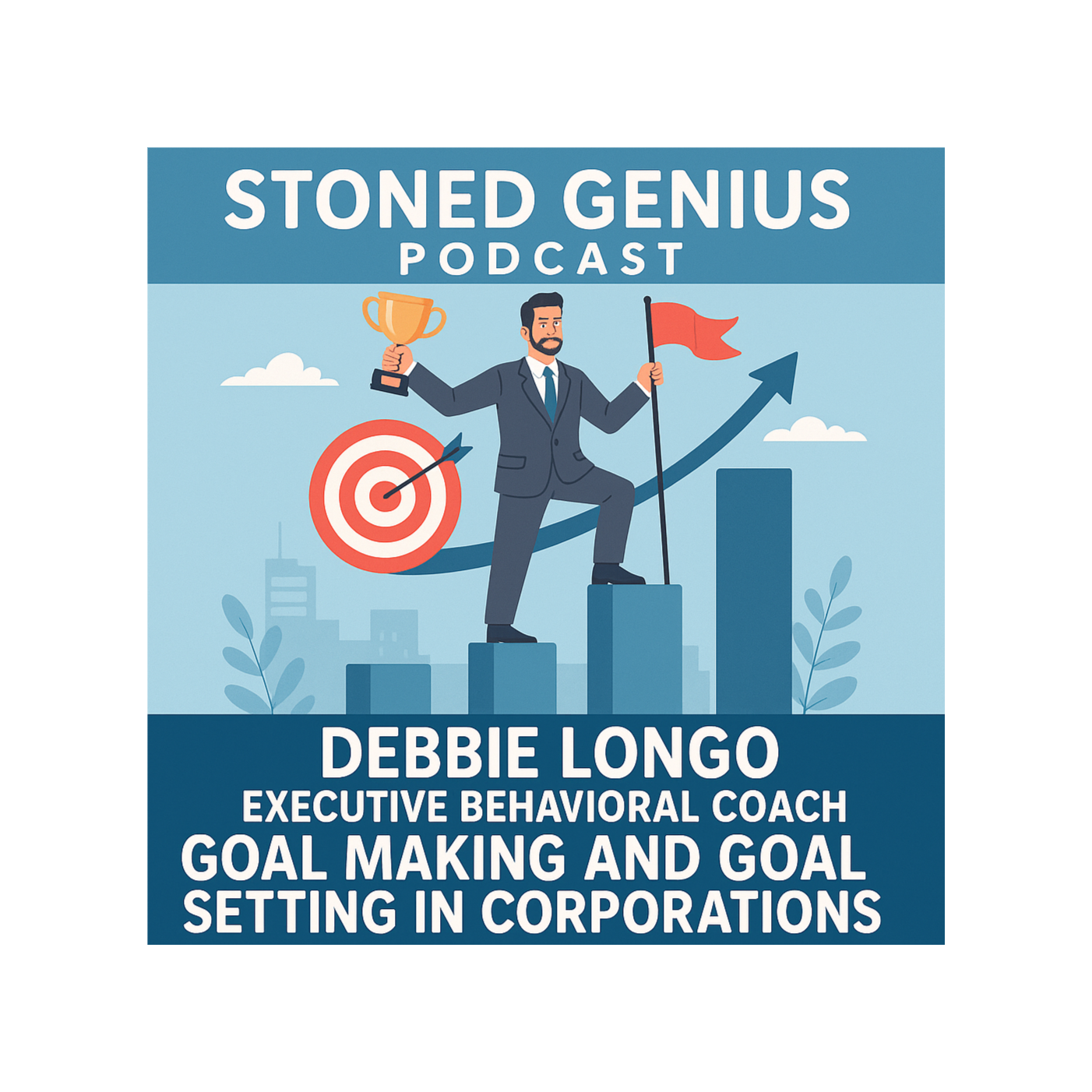
Guest: Debbie Longo, Executive Behavioral Coach
In this power-packed episode of the Stoned Genius Podcast, host Cliff sits down with Debbie Longo—an Executive Behavioral Coach with over 24 years of experience transforming workplace behavior and boosting organizational performance. Together, they explore how intentional goal setting can revolutionize leadership, improve team morale, and increase profits in today’s corporate world.
Topics Covered:
What You'll Learn:
Connect with Debbie Longo: LinkedIn: https://www.linkedin.com/in/debbie-longo-life-in-bloom-ny/ Behavioral Profit Podcast: https://podcasts.apple.com/us/podcast/behavioral-profit/id1814656212 YouTube Channel: https://www.youtube.com/@debbielongoEBC
About the Show: The Stoned Genius Podcast goes beyond the buzz to unpack serious strategies from unique minds. Each episode dives deep into thought-provoking topics with guests who are disrupting the status quo and shaping the future.
Like what you hear? Don’t forget to subscribe, leave a review, and share this episode with fellow leaders and entrepreneurs who are ready to level up.
🎧 Available on Apple Podcasts, Spotify, YouTube, and everywhere you get your podcasts.
Everyone, welcome to another episode of the Stone
Genius podcast. Today, we have a very special
guest. We have Debbie Longo. She's joining us.
She is the founder of Life in Bloom NY, like
New York, lifeinbloomny .net. She is an executive
behavior coach and we're going to find out more
about that. Welcome to the podcast. Debbie, how
are you today? Thank you very much for having
me. I appreciate it and I'm very good. I'm going
to stop right here because I said life and bloom
and why, like New York. But is that a New York
accent that I'm hearing too? Long Island. Long
Island. I love it. So let's hear a little bit
more about you, Debbie. Can you explain? I introduced
you as an executive behavioral coach. Can you
tell us a little bit about that and maybe some
other things that you might do? Life and bloom
and why started off. my company as a life coach
company i've been in this business for twenty
five years approximately. The end why is for
new york. But i don't live in new york anymore
so a brief introduction or explanation would
be i do all types of coaching and after covid.
There was a lot of issues with companies going
bankrupt, going out of business. And I knew that
I could do something to help these companies
because the way I teach it is it doesn't matter
what goes on in life, in my surroundings, in
my environment. Outside forces don't have anything
to do with me and succeeding in business. Succeeding
in my life being successful and when i can do
that then whatever can happen it doesn't matter
and i don't wanna point to something happened
to me there was covid and i don't wanna say that
that is the reason why my business failed and
why i went out of business so as an executive
behavior coach what do you think is the most
difficult thing to maybe modify as an example.
And I've used this on this podcast before. When
I was a trainer with Sprint, I did new hire training.
During the first two weeks, they would go through
all sorts of stuff. So the first week we would
get people that say, they'd raise their hand,
I'd call them, I don't understand this shit.
And I'd be like, What stuff don't you understand?
I wouldn't reference that they said the word
shit. I didn't call them out. I go, what stuff?
Although I did stress that word. What stuff?
Pause, dramatic pause. What stuff don't you understand?
At the end of the, by the end of the first week,
those people were self -correcting. They were
saying, I don't understand this shit. I mean,
this stuff. And I was just like, what stuff don't
you understand? And by the end of the second
week, they were saying stuff. And so I personally
always felt just for me personally, that it was
always best to demonstrate the desired behavior.
So there wasn't any question. I didn't ever see
anyone else doing this. What do you, as an executive
coach who's dealing with behavior all the time,
what do you find is the most difficult thing
to change within the human behavior? The thing
that I teach the most out of anything is to get
rid of negativity. Because when I'm negative,
That affects my whole entire life. And this is
one of the reasons why I started life coaching
to begin with was because I was around so many
people that were negative and I became negative
and then my life just became destruction basically.
But I can help business owners and companies
succeed in business and they can raise their
profits and get promotions. Do good in the stock
market, get bonuses and this entails a lot of
different aspects. So I did some podcasts about
respect and now I want to do this one about the
goal making and goal setting because these are
all positive things that we could do in our company
because something will happen. This world is
not perfect. Just because I'm good and I'm doing
good and I'm successful in life, it's not going
to be perfect. It's not going to happen. So therefore
I need to find ways where I can be successful
with through anything. It doesn't matter what
it is because I want to take all those outside
forces and I want to take everything in my surroundings,
my family, coworkers, whatever it is. I don't
want to. know them. I want to erase them, put
them aside, however I'm going to do it. And I'm
only focusing on me and my behavior, my thoughts,
my actions. Because that's a pretty big change
for a lot of people. So how do you get someone
to make that dramatic change in their own? If
someone tells you, oh, this is your goal, if
you do this, like I have a problem with that.
Like my goals rarely align with others and that
doesn't always bode well. So how do you get someone
to buy into the fact that your goals that you
want them to attain or maybe have set for them,
how do you get them to understand that should
be their same goals as well? First thing is that
this type of thing has to be 100 % organic. So
nine times out of 10, I don't do that much advertising
or promoting i do these podcasts i do talks i
do lectures. And i can talk to people that way
and i can get the word out so people have an
understanding about what coaching is now when
i develop their program they say oh yeah i like
what you said i want to hear more about. Now
i'm gonna develop a whole program for them. And
it's going to be outlined. Everything is going
to be in great detail. I don't charge for any
of this. If they say, OK, I want to do this.
Then I say, let's take the first step. You have
the outline. Now let's take the first step. So
this is like baby steps. So they are basically
what's happening is they're basically going to
erase everything, clear their minds, and they're
going to listen. To what i'm saying and hopefully
take action on the things that i'm doing and
then there's going all the way down their mind
and then they're building it up again they're
getting rid of the negativity by completely erasing
it and now when they go up it's gonna be gradual
levels gradual steps of becoming positive so
it's extremely slow process now could be that
somebody is doesn't really need that maybe there.
just negative in some areas. That's not the case.
So when you had mentioned earlier about goal
setting and goal making in corporations, is that
more difficult? Because I believe that you work
with companies of all sizes. How does the mom
and pop less than 10 people in their shoe store?
How is making Goals and setting goals different
at a company that size or one of a much more
substantive size. The only difference is the
amount. Let's just use money as an example. If
they want to increase their sales. by fifty percent
next year then they would make all different
types of goals for their employees and their
managers to increase that amount of money so
the only difference between the small company
and the big company. Would be the amount of money
that they want to increase because with the big
company it could be like three million dollars
and with a small company it could be a million
so that's a big difference but the. pattern,
the way that we do it is going to be probably
exactly the same for the most part. I was just
wondering whether there is a more difficult getting
to buy in. Are you just saying, hey, executives,
I'm teaching you or your team, whoever's part
of that team, I'm teaching you all and you all
disseminate it. So whether you're teaching an
ownership group that has a company size of seven,
but it's still one or two. an owner or two partners,
you could have two partners in a large company.
So is it more difficult to get buy in or is the
level that you're working with? Oh, these are
one of the compound questions I warned you about.
Is it more difficult to get the buy in of the
people because of the size of their company?
Not really. It is no, because it depends on whether
they want to make the goals succeed. and how
they're going to do that and how they motivate
their employees. And that's really the bottom
line, because I want to focus on how are we doing
this? What is going on in everybody's mind when
we are communicating to them what these goals
are and how exactly we're going to achieve it.
And this is going to be an exact step by step
thing. This is not a thing that's estimated.
How long does it take generally to implement
a plan like this to help turn a culture turnaround?
Because I know how hard it can be to have negativity
within the workplace around you. But I also know
that it's much more difficult getting rid of
someone now than it was when I started working
in the early eighties. I heard some weird stuff
and it like would never fly. A company would
Hopefully not say some of those things now, but
I'm just wondering, is it more difficult to get
rid of that negativity now that once it's already,
I've always been the type of person that thinks
every bad decision a company makes goes back
to hiring because I used to see the wrong person.
I went on after sprint to a, a staffing agency
and did nearly 2000 interviews. And I found that
if you hired the right. person, then that made
such a difference because it was really hard
to get someone to buy in that just was there
for a paycheck. So how do you get someone that
is there for a paycheck? How would you address
that? Or if someone came to you and go, I have
someone, how do I address this to them? The hiring
process is very, very important, but remember
outside forces don't matter. So it doesn't matter
who it is, what it is. What's going on? What's
the situation? If I am a boss or I'm an executive,
I want to be able to know 100 % exactly what
to do and what to say in every situation. The
hiring process is a lot different now because
everybody's focusing on everybody else. And now
there's lawsuits, discrimination. And now A lot
of bosses or business owners are very, very cautious,
maybe almost fearful that they are afraid that
if they say something or if they do something,
they're most likely going to get sued. And that
is not a good way to think. But outside forces
don't matter. So if I say to myself, I know this.
for a fact that there are lawsuits but in my
situation this will not happen to me. I will
be able to know and understand exactly when an
employee is going to do something wrong or I
need to enforce their job duties or whatever
it is. And that will be a calm and professional
manner and they will understand it and nothing
will come of that. Okay. There will be no lawsuits
and there will be no problems. And this is the
point that I want to get to. And that does not
happen overnight where I can know that we call
it creating a knowing, which basically means
that I know it 100%. There's no doubt in my mind.
When I go. to the kitchen and I turn on the light
and do I think that that light is not going to
turn on if I turn on that light I know 100 %
that that light is going to turn on there is
no doubt in my mind and I use this example a
lot because everybody turns lights on but to
relate that to the business world is a lot more
complicated because I wanna Be able to take out
all of that. That is going to be all that negativity
outside for us, all these different things. That
is going to be the death of me and my company.
And that's just a matter of time. But it's up
to me to change my thinking and my behavior.
Only me as a boss, as an executive, whatever.
And then other people are going to follow me
and I'm going to lead by example, but this is
why this is so important. And what you're saying
is very, very important because these are realistic
issues that people do have today. They do think
these things business owners. When a company
is setting a goal, does it matter the industry
that they're in or regardless of industry? is
goal setting important? It doesn't matter about
the industry. If I need to make the goal and
I need to make the way that I'm going to make
it, if I'm writing it down or I'm enforcing,
that's going to be different between companies.
But my behavior and the way that I think that
this goal is going to come out and the end result
of it and the way it's going to be enforced,
that's all my behavior. That doesn't have anything
to do with the company, the size. Do you see
ownership that regardless of how you tell them,
you reinforce it to them? Do you find companies
that they're going to fail? I'll give an example.
When I was director of operations for a company,
the owner of the company wanted a new employee
handbook developed. So I took a lot of time,
made a 70, I think it was 70 some odd page handbook.
But he, his partner, and then some of the salespeople
he liked, they don't want to follow all the rules
in the new handbook, but they thought it was
very important for everyone else to follow those
rules. So you would have a discrepancy like that
with an owner, but they would also do that to
their salespeople when setting goals, which I
didn't really mind. I didn't mind seeing those
things change, but When you're trying to get
an ownership group to adhere to something, do
you find that difficult or by the time that they've
arrived to you, have they already gotten past
the, oh, we're just kicking the tire. We really
want to do this, but maybe not. That depends
on the person, the company, but here's the thing.
I teach this, so I want to lead by example. So
I want to make sure that I know 100 % that that
company will will succeed and what I am teaching
them and what I'm explaining to them will work.
But here's the thing. This is something that's
permanent and they are going to now take this
information because I don't want to see them
again. I love everybody and I want to talk to
people on the phone and I have no problems with
that. But. The way that i teach it is i give
them this information i teach it to them explain
it to them they practice it and then they say
okay debbie we're done and now they gonna go
and take that information and implement it. Into
their work force and that's something that's
gonna be permanent and that's an everyday thing
providing that they keep doing that now is somebody
depends on. where the person that what level
there at when they come to me but some people
don't know anything and some people might say
i just need help with a few things but nine times
at a ten if they say that that's fine and i will
go by that. But a lot of times sometime during
the process they usually have to learn a lot
of. techniques and different things that they've
been doing all over again, only because of if
they do it with any negativity at all or any
doubt, then they'll fail at it. So I want to
make sure that I am the person that's really
leading by example. And it is important and confidence
goes a long way. Sometimes people would ask me,
they're like, how did you do that? Or how did
you get in there or whatever? It's like, because
I look like I belong. I was exuding confidence,
not being a shill. So when someone has their
plan, they've introduced it, their goals, you
would just mention that they may have to retrain
or rethink how they've operated previously. Do
you or is there a need for you to do like tune
up maintenance, like to make sure they don't
slide like Let me check you at three months.
Oh, you're doing all right. I'll check on you
in a year or something like that. Or are you
just expecting them to reach out if they need
your assistance again? I have different packages
and plans and things that we tailor to the case,
the individual, the company, whatever the situation
is. And if they want to. Come back to me in three
months. Now that would probably be something
that I would recommend or not at the end of their
training. We'll make it like a mutual agreement.
I would say, maybe this might be a good idea.
What do you think? And then they would say, yay
or nay. Then we could come back in three months.
If we could try some things, if you're not sure
about. You mentioned to me that you might not
be too sure about this, this and this, but if
we could try some of these things and you could
maybe try them on your own to implement them
with your employees, and then you could talk
to me maybe in a month or two, and then we'll
revisit these situations, these issues that you're
having. And then if they are not working at that
time, then. We could maybe do some more work
but that's gotta be a mutual agreement and that
really depends on the situation because i wanna
tailor it exactly to that company to that business
owner there are no two clients that are exactly
the same it's like a fingerprint. Every time
i do this i start from zero and i'm creating
something it's like creating a business. Every
time you get a new client, you're creating a
completely different business. That's exactly
what it is. So how much knowledge do you need
to know of the customer's field to fill that?
If it's almost like creating a new business,
then you're going to have to be adept at how
their workflow may go or whatever they're into
and whatever you're addressing. How do you address
that? So we have a conversation. And then i give
them a survey to fill out and i give them some
questions then. I might give them another set
of questions that are more detailed and i need
to have enough information in order for me to
make this plan because i don't charge them. The
consultations and i could do like a workshop
and. Lecture and i don't charge for these things
and then i make the plan and then i give it to
them that's all free. I need to have a lot of
detail in order for me to make this plan. So
they're really going to understand it because
they have to want to do it. This has to be a
going to 100 % say, I really like this. This
is a great idea. If they're not sure, then it's
not going to work. Is there a field or maybe
even a business section like sales or production
or accounting? Is there something that you've
either worked with, whether purposely or unpurposely?
Is there like a group? Or maybe even find yourself
most comfortable with it. Do you see yourself
kind of doing the same types of groups or could
even be referrals so they may be in the same
industry? What do you see on that front? It's
interesting that you asked that question because
believe it or not, people that are spiritual
like chiropractors, doctors, nurses, health care
workers. They understand about behavior. They
understand about living on a different level
than a business owner that's only going to care
about making money about themselves and not take
into consideration anything that their employees
are doing, whether their employees are happy
or satisfied. or the way they're treating their
employees. So the health care people are easier
to work with, but that's not saying that anybody
else is not easy to work with. I'm just saying
this just from my own personal experience. So
do you prefer or is there an industry like, oh,
I'd really like to help that industry sometime?
Or is there a preferred industry you have right
now? Or is it those healthier? Because just because
they may be the easiest may not mean that they're
the most. Sometimes it's the most difficult customers
that you're like, oh, I'm glad we finally completed
a deal. I don't ever want to do that again. But
you kind of get some sort of reward or something
out of it, I guess. If somebody has prior experience,
let's say they went to school for psychology
or something. I don't teach it on a psychology
level, but. If they have different types of experience
with the mind, then they're going to be more
teachable nine times out of 10. But personally,
I like a challenge. So if somebody doesn't really
want it and is really trying and they're constantly
banging their head against the wall, then that's
fine with me. But I can't say that there is one
industry. that's better than the other or one
that I like to work with than the other. I want
to know that individual person, that business
owner, that boss, that executive. What is he
willing to do? What lengths is he willing to
go to to change his behavior, help his employees,
maybe change the employees behavior? And then
that will inadvertently increase sales and profits
because they don't know what to do. They don't
know that there's a problem. Even if they know
there's a problem, they might know, but they
don't know how to fix it. And then if it's a
point where they're not sure if it's a problem
yet, then they can fix it. It's easy to fix,
but then they don't know it. So then they go
on and on with all of these issues that are happening
in the workplace with the employees the employees
trying to control. What the boss is doing what
the policies are the boss is not enforcing the
policies and the boss is saying every single
day can you stay an hour later and the employee
doesn't want to. But they think they're gonna
get fired so they say yes and then the boss doesn't
pay them an hour a day five hours a week and
then the employee gets really upset employee
gets a resentment. The boss gets a resentment
the boss says you have to go i can't work like
this anymore and now because the employee didn't
stick up for themselves and they didn't say.
I cannot work. That's it. I cannot work. This
is past my hours. Then the boss will respect
them more. But because they didn't do that, that
starts a whole thing. But we want to focus on
who is the person that's going to lead by example.
The employee is not going to lead by example.
It's got to be the boss, the executive, the business
owner first. That is. the most important thing.
And if we can succeed at that, then the company
will have great employees. The employees will
be fantastic. They will wake up in the morning
and they can't wait to go to work because they
know that they're working in a positive environment.
But it starts with the business owner. That's
the one who has to be positive first. People
don't realize employees are really paying attention.
to what their boss is doing, what their surroundings,
what the other employees are doing. A lot of
times, bosses just think, oh, they're doing their
own work, but they don't realize they're really
paying attention with what's going on all around
them. And that is the reason why these types
of things, goal setting, goal making, is creating
a positive thing. And that's getting rid of negativity.
But also it's motivating the employee and the
employee wants to work. They want to do good
things for the company. They want the sales to
be higher. And what's a good way to do that?
Commission. That's a good way. But a lot of people
don't like to work on commission because you
don't get a salary. If it's a certain amount
every month, every week or every month, you're
not going to get that. That's just the way that
a commission job works. So a lot of people don't
like that, but they can reward with small amounts
of money, but they don't necessarily have to
do that. There are tons of ways to do this, but
we want to make sure that the business owner
is motivated enough in order to teach his employees
and his whole entire staff, even his peers. Maybe
his board members a positive way of thinking
and a positive way of running the company. And
if I can succeed at that one more business owner,
that's not going to fail. And then they're not
going to care about the outside forces. And the
thing that I don't like about commission sales
jobs is that often whoever's in charge doesn't
actually know what motivates. their employees.
Because of that, they're shooting themselves
in the foot. I remember at the last commission
job I had, so I was different than other people.
Most people would be, if they sold something,
they would be like, like if they made, I don't
know, 60 bucks on something. And I used to be
a Nikon rep. So say they, someone else sold something
and they made 60 bucks on it. That'd be like,
oh, that was like working two extra hours. And
in my head, I'm like, that means I can leave
two hours early. Because to me, it was always
about, I had a number set. But the thing was,
my goals, because I would get pushback. And this
is where I would be in ownership. Don't always
see eye to eye. Where the pushback would be,
I would always tell them, give me a number. If
you give me a number that I can leave at noon
every day, give me that number. Let's just see
how often I hit it. And if I hit it a great deal
of times, then they would be upset thinking that
number was too low. The number that they gave
me. So I always had trouble with goal setting
and goal expectations because often my, I'm going
to blame ownership here. They were not doing
a good job of selling to me, getting me to do
the buy -in. We used to talk about it. heads,
hands, and heart, being able to have everything
in your head into it, your heart into it, your
hands into it. And it's very difficult to get
someone to do that. So when you're talking goal
making, are you talking goal achieving? Are you
talking, is there a difference between goal setting
and goal making, like making a target and setting
a target? So I don't know if those two are different
or if you meant making was that you meant achieving.
The first thing is. You're right when you say
that the boss a lot of times doesn't know how
to make the goals or how to motivate the employees.
Because I was in sales for a long time and that
was true. And that's why commission jobs are
self motivating. Because if I'm not motivating
myself, then I'm not going to make money. But
it turns out that you make more money at a regular
job than that. Then a commission job than a regular
job. It was funny because they just didn't know
the words because here's the deal. They wanted
me to like work a full day. And let's say I had
a goal $6 ,500 in a day for a whole day. If they
would have come to me and said, when you hit
$13 ,000, you can leave. They would be surprised
at how often I was doing that at like noon or
one o 'clock. And so I'm basically doing a half
a day. The problem that I would find with ownership,
then they would get mad. Even though they would
get mad that I was leaving early, not that I
was doubling everyone else's goal. Like if everyone
else stayed all day and had a $6 ,500 goal, and
if I hit $13 ,000, I could leave whenever, and
they would get mad that I left at noon, make
that to everyone then. But a lot of people didn't
want to work that hard. I always talked about
you don't have to treat everyone equally, but
you do need to treat them fairly. Because I remember
when 25 years ago, I was a manager at Best Buy.
And we had all these young guys that worked for
us. And then we had a couple of older gentlemen.
And I say older now, but they're probably like
what my age is now, like mid fifties. This is
when TVs were still gigantic, huge pieces of
furniture, big boxes and stuff. And so the TVs
were kept out on the floor and then you would
have to into the night, if someone bought them,
you'd have to use what we'd call the big Joe,
the big lift to get up and get the TVs and bring
them down. So at the end of the night, the young
guys would always ask me, they'd be like, why
don't you ever make Ned take down the, do the
TVs? And I'm like, I am fine with that, but we
will be here till 10 30. And they're like, okay.
They didn't want to be here until I said that
they thought the difference was that I didn't
treat them equally. Why are we always having
to take down the heavy stuff and he gets to clean
and do the light work? That wasn't the difference.
The difference was, do you want to leave at 930
or do you want to leave at 1030 when that's done?
Actually, I think his name was Jed, now that
I think about it. Sorry, Jed. So anyway, that
was one of the things that I always, let's treat
everyone fairly, but we don't need to necessarily
do them equally. often when you have created
a plan, someone's come to you and they're like,
oh, let's do this. And then you come up with
a plan and they're like, oh, I'm not so sure
about this. Do you get pushback or do they ever
want to like temper it down a little, like dip
their toe into the pool, so to say. Let's answer
the question about the difference between goal
making and goal setting. That was a long time
ago. Good memory. I want to know how to make
the goal specifically. Is it a daily goal is
it a weekly goal i have certain amount of money
that i need increased in sales and i need to
know how i am going to make these goals to reach
this one the end goal is whatever amount is the
increase in sales i'm just using that as an example
the goals making is just that. But I either make
the goal or I don't. And if I don't make the
goal, then the next week or the next month, the
goal has to be higher because I need to make
that end goal, which is the end of the year or
however I'm making the goal, whatever the situation
is. And I think that I approached it a little
different. And I actually wrote down his first
and name, first and last name here, but I'm only
going to use a first name. When I was a trainer
with Sprint, I was doing a store visit into the
month and We're just going to use for simplicity
sake. Let's say that people in a sprint store,
this is early 2000s, had to average a phone a
day. Let's say they had to do 30 phones a month.
So my position and district manager positions
were considered same level. So I was able to
have this conversation with him and he blew up
at me for this. There was someone on the floor
that he was talking to about, it was near the
end of the month and he was talking about monthly
goals. And let me put where I... come from first.
I'm a big believer that you can't hit any goal
until you hit your daily goal. Doesn't matter.
And that's what leads into this. It doesn't matter.
I will never say your goal today is your daily
goal. I don't give a shit. Your goal is your
daily goal. So what Jeff did was he told this
person, he goes, oh, I see you've only sold like
five phones this month. It is like the 28th of
the month. He's like, man, you're going to have
to sell 25 phones over the next two days. And
he was not kidding. and saying it in a way that
if you want to talk about negativity, if you
want to see someone hit with a negativity stick,
I actually said something to the employee before
I said something to Jeff, because I said, no,
I go, your goal is whatever your goal is. How
many are you supposed to have today? And they're
like, one, I go get one. And they're like, and
I go, and if you get two, good job. You can't
get to 25 before you get to 23 or 21 or two or
one. And that's how I always saw that is sometimes
managers got so focused on that goal that they
would literally, I'm sure security cameras were
still a thing back then, but I would have said,
if you would have just seen this person, this
employee's face going, I'm worried about getting
one today the way my month has gone. And now
you're literally trying to tell me I need 25.
Thanks. I appreciate that. So I guess My question,
short question long, how do you monitor once
it's implemented by the company that you're working
with? Is there any post monitoring that you do
yourself? Like you said, I believe earlier surveys
maybe are things like that. Is there a thing
that you do after it's implemented to see if
it's actually working or do you just kind of
take the the company's word for it that it is
working or not working? The goal has to be realistic.
So in the example that you gave, if you are not
comfortable, if the employee is not comfortable,
they don't think they can make the goal, then
that's it. The goal should not go any farther
than that. And the company is going to tell me
everything. I'm going to show and teach them.
They're going to say to me, this is working.
This is not working. And I'm going to believe.
whatever the company is saying, because if they
say something is working and they're not and
it's not, then they're going to be the ones that
are shooting themselves in the foot, not me.
But I want to always make sure so I ask probing
questions and sometimes I repeat the questions.
One day I'll say a question and then two days
later I'll say the same question or maybe I'll
say it in different ways. And that will get the
person to think the client. And once the client
is able to really think things through and really
understand things, then I'll be asking less questions
because they're now going to be the one that's
going to be doing the talking. And now they're
going to be saying to me, now this is my issue.
Now I think I know how to solve it. Is that what
you like to hear they're coming to you saying,
I can now solve it at this point? So that was
one of the things that I used to do in management.
I did not care if you had a question. I wanted
you to come with questions because if you don't
ask the question, generally going to be done
wrong. But there are always three ways I'd answer
the question. It would either be, man, that is
a great suggestion. Go ahead and implement that,
get it started. Or it would be, I really like
that. You put a lot of thought into that. Here's
why this would work or why it wouldn't work.
This is the components that would, we can pull
out of it and work or wouldn't work. Or I would
say, Hey, I really appreciate you thinking about
that, but I think for efficiency wise, I've done
this in the past and this just may work better
this way. And so letting them know that because
it's always about encouraging them and having
them critically think to come to me. Because
that was always the best. I remember once I was
a manager with Best Buy back in the 90s. And
when I was gone, they had hired someone for one
of my departments who looked like he was like,
I don't know, 10 years old. He looked young.
And so when I get back, I even remember his name
and I stay in touch with one of these guys. I
met Kyle for the first time when we're staying
there talking in the audio department. And I
asked Kyle, I go, Hey, Kyle, how old are you?
And you only had to be 16 at the time, I don't
know if it's still the case, at the time to work
at Best Buy. He could have been 16, which is
still young, but he looked young. He goes, I'm
going to be 18 next month. And without missing
a beat, and this is the guy he's staying in touch
with, Chris House, he goes, he didn't ask you
how old you're going to be next month. He asked
you how old you are. But it was like, man, he
listens to me. Because I know that I've said
that it just was so impressive because we keep
circling back around to demonstrating the desired
behavior to elicit a response from them. It's
really cool when you as someone who is generally
doing the training, seeing someone that's really
absorbed that because once again, we've talked
about they have to buy into whatever you have,
whatever, whether like you said, whether it's
raising sales 50 % or it's the industry, the
staffing industry that I was in was a lot of
industry work and construction cleanup and disaster
cleanup. And so we were always worried about
injuries. So even being able to implement something
that you can see a tangible, hey, the number
of injuries drop down. That has to be a big thing.
Are there still techniques that you're coming
up with as you implement this? Like you say,
like you have a current client, they bring something
up and you're like, oh, I've never thought about
that before. Not in front of them, of course.
And then you kind of have to develop a new plan.
So are you developing new plans or is it an ever
building criteria or curriculum? I guess I should
use that you use, or is it just kind of the same?
And June will be just like me. We're talking
about each individual client. So I have the plan.
And then every day every time i talk to them
most likely the plan is gonna change so then
we have a conversation and then i was gonna talk
to them about this tomorrow but now because of
this conversation now i have to make a whole
different. Plan to for the conversation tomorrow
and that's only because i don't know what is
gonna happen how they're gonna react and they're
gonna response to. What we said yesterday or
last week. So it's a thing that is just constantly
changing. And also if I work with somebody, I
have a client and then she brings up cause every
situation is unique and she brings up something
or something happens there. And then I could
use that not the same situation, but that idea
of what happened. I told this client this and
she implemented it this way and this was the
result now i could use that on another client
with the client situation with the new client
situation and they're not gonna know that not
that matters. Because that's just for my information
but that's gonna now help so i use the ideas
and the things that i do in client a to help
client b that happens all time. I'm going to
ask this and I don't know if it affects you or
not, but it's becoming a more and more common
question. Do you use AI in any way to help lay
out a plan, help if you get stumped or maybe
you're not quite as familiar with a particular
industry that you've not worked with before?
Have you used or are you beginning to or plan
to use AI at all in your plan building? I'm going
to tell you a little secret about myself. I don't
use AI only because my marketing guys use it
for promoting. Well, they say they do. So, but
my plan, the things that they're going to implement,
what I'm going to say, the way that we're going
to have the conversation that all comes from
my mind that just comes to me. And that is a
gift that I have had ever since I was born, basically
was a young child. So I'm quiet and I sit in
a quiet place and I think about what happens.
And then I just take a piece of paper. I don't
use the computer. I take a piece of paper and
I write down everything that comes into my brain.
And then it comes right out onto the paper. And
then I put it in like a word doc or something.
And that could be the conversation that could
be making goals. And that is going to be from
pretty much everything that we're going to say.
And that is just a gift that I have. That's just
a special gift that I've had my whole life. Let's
see. Anything else you have for us before we
go today on goal setting and goal making in corporations?
I think that. Every business owner can be successful
and it's going to depend on the boss, the executive.
That is what it's going to depend on. Everybody,
all their employees, everybody around them is
waiting for them to be successful. So then if
they're successful, then they're going to in
turn help everybody else. They gonna help their
employees they gonna help their business so maybe
those employees let's say for example are not
capable of being successful of looking at themselves
of realizing what their problems and their issues
are and they want to change it so they're saying
to themselves maybe one day my boss will be successful
and be positive and he will help me do that and
then. When that happens if that happens but if
they do something about it it will nine times
out of ten happen then what's gonna happen they
gonna influence the employee and then the employee
might go home. And then they might influence
their daughter with the same situation only with
not work something that the daughter is doing
school but that's really what it starts with
so whoever the person is. Here we're talking
about the bosses and executive coaching and different
things, but whoever the client is, whoever the
person is, then if they are the ones that want
help, then that's the most important thing. And
this will 100 % increase sales and profits. I
can tell you from 25 years experience in this.
Okay this is not a theory there are statistics
to back this up this is all factual information
this is not something that was just. Somebody
woke up yesterday and just dream this up so that's
really what we want to focus on and i'm doing
the all these podcasts with all these different
topics because i wanna explain to people and
get the word out so people can even just not
necessarily understand. But they're familiar
with that they can change and they can do things
differently. And this is what happens if they
do. I've had a love hate relationship with upper
manager most of my life because I feel like a
lot of their decision making process is suspect.
It's you just see stuff and you're like, how?
And that's why I'm glad that there are people
out there like you. that are helping businesses
of all different sizes and individuals even.
Because as you say, I think about you helping
a business, but you're really helping the individuals
there. And like you just mentioned, they'll take
the skills that they learned from you and they'll
go home and maybe help their child with their
homework or setting a goal for buying their first
car or whatever that may be. That's kind of the
neat thing, too, is being able to see your work
not just in that type of setting, but also see
it in the domestic, for lack of a better term,
setting with a family, because that's important.
A lot of times when people work, they see their
peers, their employees, the people that they
work with, they see them more than they see their
family. So they'll go to work for eight hours
they'll come home and then the child has to be
in bed in an hour and then they go to sleep a
few hours later for five hours later. And then
they wake up and then they have to do that all
over again and they're doing that five days a
week so realistically they're only seeing their
family two days a week. What do i think is more
important is it changing the family first. Or
is it changing the work environment first, because
it's going to be difficult for me to do everything
all at the same time. So if I'm seeing, and it's
not that one thing is more important than the
other, but realistically, if I'm seeing somebody
more often, then I have a better chance of when
I change that behavior to implement it to other
people. to do the person that I'm seeing more
often first rather than the person that I'm seeing
less often. And plus the people at my job, there's
more situations that are going to come up, more
problems because I'm seeing them more often.
So there's a lot of different things here. Yeah,
there are. And maybe you'll come back again at
some point. I would like to get into this more
about this and then because. It is fascinating.
We'll talk about it more off air, too, because
I have some things to say as well about how we're
just finishing up. So, Debbie, thank you so much
for being on the podcast. Thank you. I really
appreciate it. You're so welcome, everyone. This
was Debbie Longo. She is the founder of Life
in Bloom NY dot net. She is an executive behavior
coach. You can reach out to her. I will have
all of her contact information. You can go to
Instagram. at The Stone Genius, or you can go
to this show that you're listening to or watching
to right now and find that information. Debbie,
again, thank you so much for being on the podcast.
Thank you very much. You're welcome. Everyone,
you guys have been listening to The Stone Genius
podcast. We'll talk to you soon.