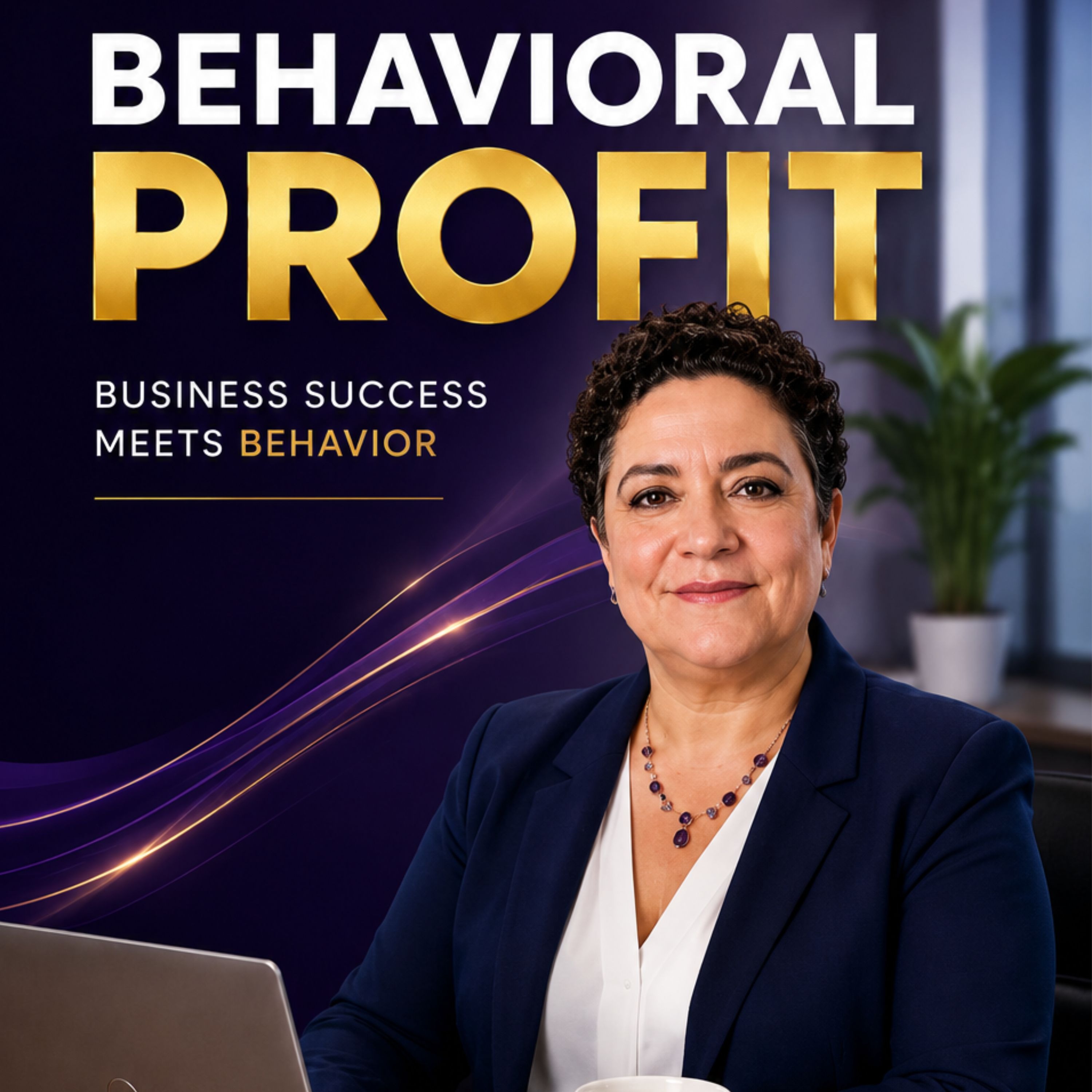
In this episode of Behavioral Profit, Executive Behavioral Coach Debbie Longo sits down with leadership expert Ron Reich, who brings more than 30 years of experience developing leaders from the frontline to the C-suite. Together they unpack the real behavioral patterns that hold leaders back: fear of letting go, trying to have all the answers, and shutting down independent thinking. Ron shares why “everything is a choice,” how language like “I have to” quietly increases stress, and why psychological safety and relationship-driven leadership are non-negotiable if you want a healthy culture.
Debbie brings a mindset lens to the conversation, challenging listeners to look honestly at whether they’re truly willing to grow or just hoping things get better while repeating the same behaviors. They explore how internal shifts, personal responsibility, and being in control of your mind—not the other way around—translate into better decisions, stronger teams, and real performance improvement. If you’re a supervisor, manager, or executive who says you want change but resists it in practice, this conversation will push you to choose your direction on purpose.
Contact Debbie Longo
Executive Behavioral Coach
Contact Ron Reich
Welcome to the Behavioral Profit, the podcast
where we break down the real behaviors behind
performance leadership and workplace growth.
I'm your host, Debbie Longo. Today I'm joined
by someone with more than three decades of experience
developing leaders at every level, Ron Reich.
Ron has spent 32 years in training, consulting,
and organizational development, working with
major companies across industries from healthcare
to high tech. He's also a dedicated student of
leadership, having read more than 400 books on
the topic, and he brings a practical people first
philosophy to the work he does every day. He
believes leadership is about relationships, service,
and the commitment to stay a work in progress.
I'm excited to dig into the behavioral patterns
behind great leadership and the shifts that truly
impact culture and performance. Ron, thank you
for being here. Thank you, Debbie. It's good
to be here. Thank you very much. I appreciate
you being on the show. So we're going to make
this interview a structural kind of slash conversation
type interview. And I have a few topics here
that we can work around. You explained a little
bit. We were talking before about leadership
patterns. You mentioned that you spent over three
decades developing leaders. So what is the behavior
you see most consistently holding leaders back
and what usually triggers the shift? I think
one of the things that holds leaders back and
that holds organizations back, it's been my direct
experience, it's been my observation, that a
lot of leaders are afraid to let go and they're
afraid to let people be themselves to empower
the people that are actually working for them
and just let them do their thing. It's a constraint
on everybody. Yeah, I definitely agree with that
because to me that has a lot to do with the mindset
Which is a lot of a lot of things I teach right
in the way that I teach it But to have a constraint
as you put it. That's just kind of like freezing
my mind Almost like my mind is in like a stroke
level. Well, I mean I think a lot of times too
Tying into that, Debbie, it's along the lines
as well of so many leaders think, I have to have
all the answers. And if I don't have all the
answers, maybe I'll ask you a question here or
there. An old HR director at a company where
I worked one time made a comment to me and said,
there's such little independent thought here.
It's crazy because the leaders were do this,
do this, do this. And now I'm going to tell you
to do this. I still remember at a plan of action
meeting down in Florida somewhere, the VP of
our group is in front of a couple thousand people,
whatever it was. And he made the comment. We
work very long hours back at the home office
trying to figure things out for you. And I was
like, and that's one of the biggest problems
that exists here because you don't let people
think we will think for you. Just do what we
tell you. But I always want to be the one to
make the decision myself because I always think
that I know the right thing and what to do and.
that that's gonna be the right way to do things
instead of me thinking about should i be taking
direction does this person have more knowledge
than me is am i gonna be able to learn from this
person and that's just the matter of being open
minded and willing to do different things, willing
to change, willing to open your mind. And when
I do that, I excel. And if I don't do that, then
I'm stopping. It's like I'm literally, like if
I stop, like I'm not walking, my brain does that,
my brain stops. And when I do that, then not
growing, that stops me from growing. And that
is not a good thing because then I'm stagnant
and you can't be. That's impossible anyway. It
needs to be a two -way street, meaning that the
leaders need to be open to what their colleagues
have to say, what their colleagues are suggesting.
And clearly, the colleagues need to be open to
what the leaders have to say. And I mean, that
to me, that's called collaboration. That's working
together. And that's when you're going to get
your best results. Yep. So this podcast that
I do, this is what it's all about. what we've
just been talking about how can leaders and even
people who want to be leaders excel and how can
they open their minds and how can they really
make the decision. or they'll have the willingness
or whatever, just to change just that little
bit of it. That will make a big difference. But
like I said, if I stop or I close my mind, then
nobody's going to help me. You know what I mean?
My whole life, nobody ever helped me. I made
the decision to change and stuff. Nobody's going
to help because first of all, they probably don't
know how to help. And so often people are just
waiting for direction. Tell me what to do. Tell
me what to do. I'll sit here and I'll pretend
I'm busy. And when you tell me what to do, then
I'll do it instead of this is what I'm working
on. This is what I intend to do or whatever it
might be. And like I said, because if I'm in
that position where I'm just waiting, I'm not
growing. I'm not developing. And I mean, I'm
certainly not going to stay around long. Believe
it or not, this is a huge problem. Huge and I'm
glad we talk about this because people quit and
people get fired and people Businesses even go
bankrupt because of this one one thing here that
we're talking about just not refusing to grow
This is a huge problem. It's funny because I
worked with an organization recently We were
talking about implementing some new things looking
at different ways of doing things And some of
the participants totally bought into it, which
was fun. Some of them though, you could, you
could see in their eyes where it's just like,
you want us to do what? And I mean, this is going
to create more work. And I was like, well, yeah,
except it's the, it's, it's a better way to do
things. And ultimately it's going to make the
company grow. It's going to help the company
be more profitable, which will help everybody.
Just everything that goes along with that. Interesting,
very interesting stuff. I was looking here at
your something you mentioned about relationship
driven leadership, your philosophy centers on
building sustainable relationships, what behaviors
destroy trust, the fastest inside organizations
and what behaviors rebuild it. This is a good
topic. There are so many different ways to go
with that relative to destroying relationships,
not listening, not just what we were talking
about, not being open to ideas. I think one of
the big things too, Debbie, is creating that
psychologically safe environment. If I don't
feel safe bringing things up, I'm going to keep
it to myself. I'll speak for myself. I don't
like getting my head torn off. If I bring it
up, no, you can't do that. That's stupid. whatever
it might be, is like, good, you figure it out.
And I mean, to rebuild trust, I think a lot of
it is, and I would just say, I'll go in the opposite
direction of what I just said. Not listening,
listen, listen to understand and be open, be
flexible with your thinking and be open to trying
new things. Yeah, I definitely agree with that.
But for me, this is just my experience. It really
all depends upon my mindset and also do I want
to make goals for myself? Am I happy where I
am in my life if I'm stuck at my job or I don't
make enough money to put gas in my car to go
to work or to buy food? Do I want to stay in
that type of? Job, do I want to live that type
of life? So it's really and kind of like an internal
more personal choice because some people like
that. They just want to stay there and that's
fine for them. That's not me. But there are people
that don't want to stay there. They don't know
how to change and they don't know what to do
and they don't know how to get another job. or
ask my boss for a raise or a promotion or something
like that, or communicate with my boss. Even
an executive can communicate with their board
members to communicate in a certain way that's
positive and loving where they can say what's
wrong and what the issue is and if they need
to change something or whatever. If I don't say
anything and I just want to stay in that way,
in that form, then not only nothing's going to
happen, but you could be hurting the company
that you're working for. The company could be
going backwards. Sure. Absolutely. There's no
doubt about that. I loved what you were talking
about earlier relative to everything is a choice,
everything. get down down to do i choose to say
this to my boss or not do i choose to continue
to work here. And these are all choices everything
and i mean that that comes out of a big big believer
in steven cubbies work from the seven habits
and that's one of the extra i'm certified to
do that class and that's one of the exercises
we do where people realize. Everything is a choice.
I don't have to do anything. Nothing. And I love
that. I was like, you have to change. No, I don't.
Except there are consequences if I don't. And
that's the other side of that. What outfit do
I wear today? Everything. I make that choice.
What outfit do I wear? So I go from what's the
route that I want to go to work? I could go this
highway or this road. Everything I do from the
minute I wake up until the minute I go to sleep,
I'm making choices. But am I looking those choices?
We're talking about business and stuff here,
but this pertains to everything. Because if I
change my behavior in the business, it transfers
to my home, vice versa. So do i want to look
at those choices or do i want to keep just doing
this the same thing over and over and expecting
that things are going to get better or not or
i don't care. And these are all choices that
i make so this is why for me and this is one
of the reasons why i do this to is that big in
the behavior change or any type of change really
is an internal changes like an internal shift
basically so it's like a shift in my mind. And
that affects every single thing i do cuz the
mind controls the body listen i hate to talk
about diseases but. There's evidence you can
look it up online that stress is one of the things
that causes cancer and heart attacks. Well, and
heart disease. So this is all stuff that we have
proof of today. I'll share an example with you
when you use the word stress, because it was
just a really fun experience. I'm in Philadelphia
a number of years ago doing a session. and we're
at a hotel and I got to talking with one of the
hotel employees a little bit. We were on a break
or whatever it may have been. And she just said
to me, she was, oh yeah. She said, I have to
leave here today at 430. I have to go pick up
my son. I have to get him to soccer practice.
And then I have to get him something to eat.
And I stopped her and I was like, could you stop
just for a second? Would you mind? Please, if
you will. Would you just modify your phrasing
instead of saying I have to either say I'm going
to or I choose to. She looked at me and slowly
she did it. She goes, I'm going to leave here
at four 30. I choose to get my son and to take
him to soccer. I'm going to make him something
to eat. She went on for a little while. And I
was like, what's different? And Debbie, I swear
she just looked, she goes, my stress, my stress
is so much different. I choose to do these things
because I'm a single parent and I love him so
much. And I was like, that's right. Cause everything's
a choice. Son, stay home and watch video games.
I don't have time. You can't do this. Son, you
know, make yourself a sandwich. I don't have
time to make you dinner. Everything is a choice.
Everything. Yeah. So she just felt that she put
it in her head that she had to do it and she
didn't have a choice and she gave her and that's
a choice that she made to tell herself that she
didn't have a choice. That's a choice. I don't
have a choice because she's because we do have
choices. You see what I'm saying? Whether we
think we don't or not, that is how the human
brain works. It gives us the ability to think
for ourselves we're not robots and somebody programmed
into me. It's monday you're gonna wake up at
eight o 'clock and this is what you're gonna
wear today that's what we do with robots okay
that's not the way humans work so she programmed
that into her mind. that she had to do it that
she made that choice to say that she had to do
that so was you know what i mean so is like she
didn't have a choice which was it which i think
is interesting but i've seen these i work with
people like this these are extremely common things
extremely common i mean where creatures of habit
to me like i work with so many people it's really
difficult for me to find people who are really
not really really different in some way shape
or form everybody's pretty much the same. That's
really just my experience because things just
repeat in tons of different ways. So coaching
across levels. This was something I thought was
interesting. You've coached leaders from frontline
supervisors to executives. What behavioral difference
distinguishes someone who grows from someone
who doesn't? I think it truly, Debbie, it's a
mindset. I mean, I really, really do. And you
make me think of front line supervisor with a
client of mine. They're a heavy duty towing company.
And I was out in the field with him. We were
spending the day together because he also works
the trucks and that kind of stuff. And we had
gone through a training session with he and some
of his colleagues, maybe two or three months
earlier. And he kept bringing up unsolicited
to me, things we had covered in class, because
that ties into emotional intelligence. Well,
this is what we talked about with feedback, Ron,
and I was like, wow, you're really using what
we did. And again, how much fun is that to realize
is like, wow, you do want to make a difference,
you're using what we've learned. And I mean,
I'm recommending him, I have recommended him
as an emerging leader within the organization.
And so I think a lot of that is a mindset, and
it needs to be as well, Debbie, what we were
talking about earlier, a growth mindset. Because
I pray, I really do, I never stop learning. I
mean, I'd like to be learning until I take my
last breath. Yeah, so I agree with that. So this
is basically the common theme of this podcast.
is changing in the behavior and thinking, what
am I going to do? Which way am I going to go?
Am I going to go forward or backwards, you know,
or stay the same? Science tells me I'm sitting
in this chair. It doesn't look like I'm moving,
but science tells me that I'm moving. Why is
that? Because the earth is spinning and the earth
never stops spinning. OK, so all of the things
in your room, OK, like my everything in my room,
like my light and my computer, all of this is
all moving. We just can't actually see it moving.
So nothing really scientifically, which is really
what it really what's happening is that we're
all moving. So the thing with that is either.
I'm never stagnant. So if I am, my experience
is that I'm going to eventually go backwards.
So if I refuse to go forward, because I'm never
stagnant, if I refuse to go forward, I might
stay where I am for a little bit, but then eventually
I'm going to go backwards. So that's what it's
going to tell me to do. That's the automatic
way that I'm going to go, only because I'm not
telling myself or giving myself any type of signal
or anything like that that I want to change.
And I want to do something good for myself. Joe
Paterno, the former football coach at Penn State,
he said one time, if you're not getting better,
you're getting worse. And that makes sense to
me. I mean, I had to think about it for a little
while. Then I realized it's like, sure. And his
point was to that your competition is getting
better. And so if you're not, you're falling
behind and falling behind it. No, we're not going
to change whatever it might be. And it's like,
you're not going to be around law. Well, he's
a coach. So he wants motivates people. He wants
to do good. He's looking for people to move forward.
But if I'm working with somebody and they don't
well, first of all, if they don't want to change
or anything that's really not really that easy
for me to work with them I probably wouldn't
but the point is that that's the very very first
step is to be willing if they want that right
then I can go forward and help them if they turn
around and go backwards I can still help them
why because they took that first step of being
willing that the key thing did you ever hear
of the first step is the giant step that expression
No, yeah, the first step is the giant step. It's
all okay That's the key thing because it's the
truth because what is gonna make me pick up the
phone and call a coach or Call go on a job interview
Or look for another job online or speak to my
supervisor or something What's gonna make me
do that first step? It's gonna be me creating
the willingness That's what it's going to be.
It's not going to be anybody else. Like choices,
same thing. Like we make the choice. So these
are all very interesting things and they tie
in very, very well together. Absolutely. Something
also the future of leadership based on your decades
of study and experience. What behavioral skill
do you believe will define the next generation
of effective leaders? I believe it's communicating
effectively. And one of the reasons i say that
i think the best leaders to come will be the
ones who can talk to other people who can listen
well who can get their ideas across to people
because so often it drives me crazy now. Even
just in my personal life when i walk the dog
or or just i'm out where ever. everybody is on
their phone everybody and i need walking the
dog in the morning i'll go buy people who are
also out for a walk they had their dogs out whatever
it might be. I try to do it with everyone i pass
good morning and debbie i'll tell you right now
probably only about thirty percent of the people
respond. Because they're so busy on the phone
or what is it oh no no i can't talk to anybody
my goodness was like man it's gonna it's gonna
be the people who can build and sustain those
relationships that will succeed what makes me
stay on the phone what makes me stay off the
phone. What allows me to make these choices are
make these decisions to live this type of life
that i wanna live well you know what is a funny
little thing called peer pressure and if i have
a neighborhood okay or a community and everybody's
on their phone okay which to me this is how this
really started everybody's on their phone. A
lot of times we wanna follow people, not everybody,
some people are leaders and stuff, but most times,
if you see like 10 people doing something, right,
a lot of times you're just gonna do it. So this
is kind of like a trend, like a fashion trend,
this is how these things start, where you have
maybe like an influential figure, like a actress
or something like that, starts a trend, but it
doesn't have to be that, it could be anybody.
One person, two people, three people. That's
how it starts so if i see somebody doing doing
something and then i want to do it so can i train.
My mind not to do that can i train my mind to
know the difference between just because somebody
else is doing it i don't know if that's good
for me or not i don't know if that's gonna benefit
me or not but can i train my mind to think. Beyond
that and say to myself this person's on their
phone these ten people run their phone Do I want
to do this is this gonna benefit me or not? Or
do I automatically pick up the phone and go on
to the phone now? I'm gonna say one other thing
one thing I teach is this is a good one. I Teach
the person to be in control of their minds instead
of their mind controlling them So when I'm done
teaching somebody or coaching or helping or whatever
you want to call it They know how to train their
mind They are in control of their mind because
when my mind is in control of me I can do just
like I said Somebody's on the phone. I just pick
up the phone to me That might be a good thing
if you're in the field, you know, but like you
said everybody's walking How is that gonna benefit
us? That's just my experience Yeah no i agree
i agree and it goes back to again everything's
a choice i don't have to do that it's not always
easy it's not always the popular choice it's
still my choice very good i like it i think we've
come to the close is there anything that you
would like to say in closing how can they get
in touch with you and if i miss something from
the beginning. I think we've covered everything.
I mean, anybody, I would welcome the chance to
talk with anybody. The easiest way to do it is
probably via LinkedIn, just Ron Reich, R -E -I
-C -H. You can just Google my name. It'll come
up via LinkedIn. And yeah, I welcome the chance
to chat with anybody. Same thing via Instagram.
Yeah, this is behavioral prophet. Thank you for
being on the show. My name is Debbie Longo executive
behavioral coach. Thank you for being on the
show I really appreciate it my pleasure