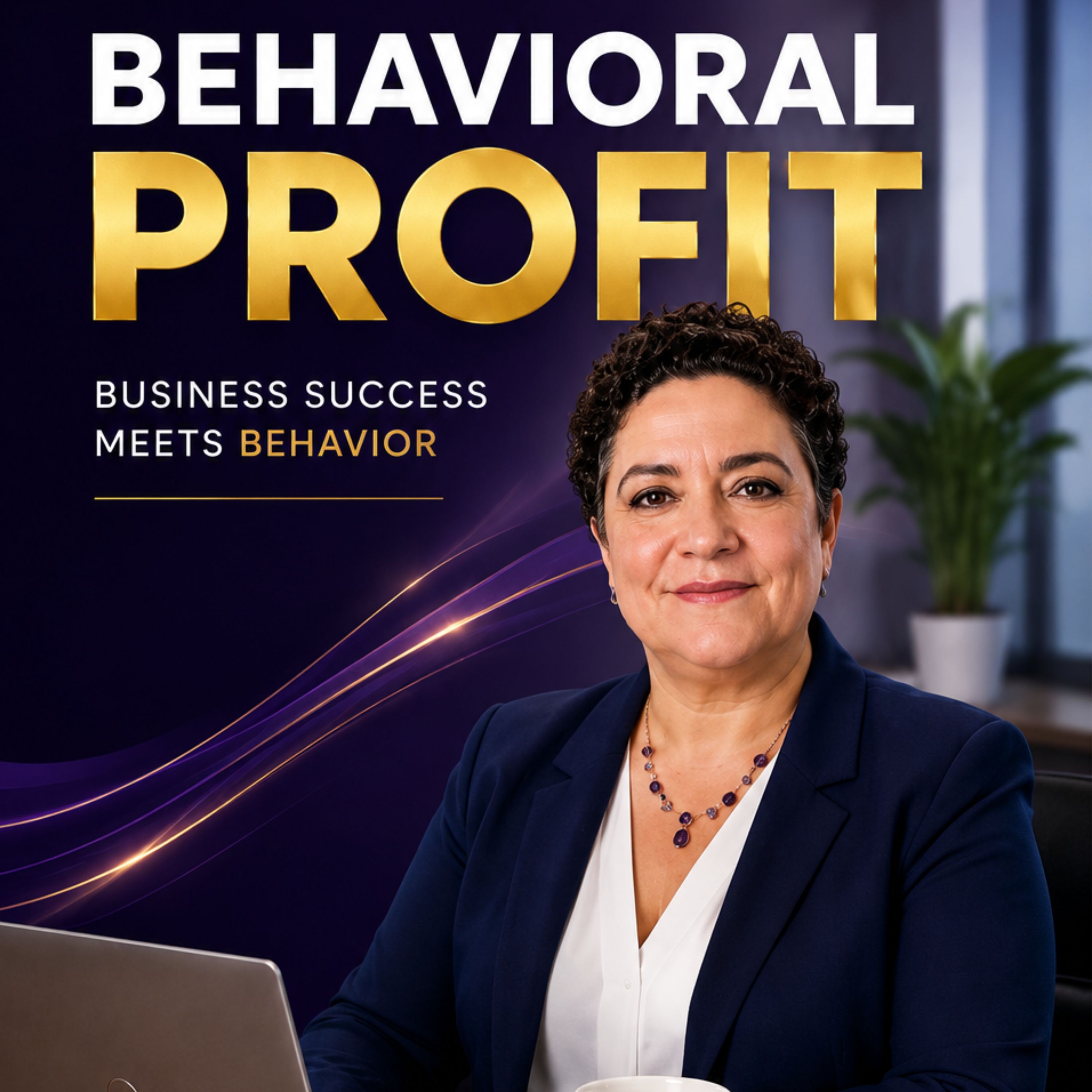
In this episode of Behavioral Profit, Debbie Longo speaks with Steve Morris, mechanical engineer turned leadership strategist, about the inner work that drives real business results. Steve shares how his journey from designing multimillion-dollar yachts and managing U.S. Navy projects to becoming an EOS Implementer and Positive Intelligence coach reshaped his understanding of leadership. Together, they explore why systems matter more than goals, how “who you’re being” shapes culture and profit, and why true work-life balance is dynamic, not static. From the Stockdale Paradox to lessons from sailing, this conversation shows how behavior, mindset, and resilience turn uncertainty into opportunity.
Contact Steve Morris
EOS Emplementer
https://www.eosworldwide.com/stephen-morris
https://www.linkedin.com/in/stephenamorris/
Contact Debbie Longo
Executive Behavioral Coach
Hi, welcome to the Behavioral Profit, the podcast
where leadership behavior meets bottom line results.
I'm your host, Debbie Longo, executive behavioral
coach. Each week we unpack the mindsets, habits
and cultural shifts that turn teams into high
performing profit driving powerhouses so you
can lead with purpose and win with people. Joining
me today is Steve Morris, a mechanical engineer
turned leadership strategist with an MBA. and
34 years guiding high performance teams on sea
and land. After designing multi -million dollar
racing yachts and project managing new ships
for the U .S. Navy, Steve became a certified
EOS implementer and positive intelligent coach.
He now helps entrepreneurs and executive teams
shift who they're being. so their actions, cultures,
and results follow effortlessly. Get ready to
explore behaving -driven leadership from the
inside out. Good afternoon, Steve. Welcome to
the show. Thank you very much for having me,
Debbie. It was a great introduction. Today, we're
going to talk about, Steve, you pivoted from
engineering multi -million dollar yachts and
Navy ships to coaching leadership teams. What
specific mindset shift did that move demand of
you and how do you help clients engineer a similar
shift instead of just tweaking tactics? I'm going
back to the beginning of my career and that sort
of that engineering, the project management,
very sort of goal directed. work and I think
what I've really learned in the Transition and
coming into coaching is kind of seeing that and
it comes back to a quote from James clear actually
from atomic habits Which is you never rise to
the level of your goals you fall to the level
of your systems And I think that that's one of
the real mindset shifts that I have seen and
experienced is this. We can set these goals out
there, but unless we're really putting systems
in place, those goals remain a dream. And I can
particularly look sort of look back over my career
and kind of see some of those times when a goal
was not met just because we really didn't have
a system in place to be able to get there. Yes,
I agree with that. Thank you very much. So my
whole entire coaching, everything I do when I
make a plan for my clients, every aspect of my
coaching, helping them in every way, shape and
form is all about developing systems and also
humans are a creature of habit. So if I develop
systems, It's very easy for them if they do the
same thing over and over. It's very easy for
them to get it without just doing things randomly,
right, and having no system. So that was very,
very good that you pointed that out. The next
question is many entrepreneurs chase the latest
framework, yet you argue that who they're being
drives everything. How do you measure being in
a world obsessed with quarterly metrics? What
evidence convinces skeptical CEOs that inner
work isn't soft? Ultimately, my experience is
that they're not disconnected. And so, yes, how
do we measure being? What are those external
measures that might sort of show up on a company
scorecard or KPIs, for example? And so one of
the things that I think, you know, as you're
asking me this question, what comes up for me
is remembering a team and that were very challenged
and sort of beset by certain incident that had
happened environmentally in their business and
who they were being coming into the conversation
was we're going to cut staff, we're going to
reduce salaries. They were in the downward spiral,
and it's about how they were seeing the world.
And so the shift I worked on with them, they
had a couple of new ideas in their pipeline that
they just hadn't explored. And so getting out
of that downward spiral into the art of possibility,
creating possibility, how might we go after these
new business areas that were on the issues list.
And ultimately the team got out of that downward
spiral and was able to continue their business
forward very successfully. So there's a very
externally measurable result. Like the business
is still in business and they're making profit.
And that resulted from a shift in who they were
being. Everybody always has an internal stance,
by which I mean like how they see the world,
how they see each other, how they see themselves.
You have that anyway. People get up out of bed
in the morning and their mind just starts going
down that race track of how they see the world,
each other and themselves. And so one path can
be a path that's taking the business off track,
I would say. Another path. that you can choose
to take with who you're being and those things
is can be a more positive generative path. You're
going to take one path or the other. So I think
to me, the answer to the question is like all
of the external results of the business come
from the internal stance of who the leadership
team being. To me, it's kind of like really in
a work. rather than focusing on the metrics.
That is all outside forces, things that have
to do with a corporation and developing a corporation
and making profit. So those things are needed,
but how does it start? Does it start with figures
and numbers or does it start with having a positive
attitude, getting systems? And when I change
my behavior first and I change my attitude and
I go into that, whether I'm developing a business
from scratch or I am making the business better,
if it went through bankruptcy or whatever. immediately
going into a positive attitude. And when that
happens, what's going to happen? Am I going to
get negative or positive results? I'm going to
get more positive results. And that's exactly
what I want. And one of the reasons why I do
these podcasts is it focuses on behavior, most
of them, and that's why it's called behavioral
profit. And I do all these different industries
and I don't specifically focus on a certain type
of industry or a certain way of thinking because
there's all different industries out there. And
there's one way pretty much to solve a lot of
people's problems. It doesn't really have anything
to do with the industry and all these outside
forces and all these things. But if you're in
this industry or this type of work, then you
want to be able to relate to it. So that's kind
of like the grab. And that's the attraction.
And then we go into all these other things. So
that was good. So you're an EOS implementer.
When founding team insists their issues are purely
operational, how do you reveal the hidden behavioral
patterns sabotaging traction without sounding
like a therapist in disguise? Well, I guess just
the way I work with the teams is We work on what
we call the 90 -day world. And when I come in
and I help clients implement EOS in their business,
we in the whole business set up on this 90 -day
cadence, which means they spend 90 days with
their head down, running like heck in the business.
And then we'll come and we'll have a quarterly
meeting. And in that meeting, we look back over
those 90 days and learn the lessons. Then we'll
check back in with the vision for the business.
And we'll set new priorities, assuming everybody's
on the same page with the vision, it's still
a good vision, set new priorities for the next
90 days and we dive into the business. So where
this sort of gets revealed, the connection between
like setting goals and setting these priorities
is we write this stuff down at each one of those
quarterly meetings when they're called ROCs.
ROCs are 90 day business priorities. And we write
down what the priority is, like maybe it's new
marketing strategy. Well, we'll just maybe the
rocks is called marketing strategy. And then
we write down like, what does done look like?
So 90 days later, we're going to come back. How
do we know that this project is successful or
being completed? I'll help my clients write down
what done looks like. So having got all of that
defined and they're all in agreement that this
is what we're going to do, they launch off and
put their heads down, run like heck for the next
90 days. My point in all of this is when we get
to the end, the end of the quarter, when we're
looking at, did you get the rock done or not
done? And this is where maybe they might say,
well, it's not done because of X, Y, Z, all of
these excuses. And as you're sort of pointing
out, like as I'm a coach, I'm looking, is this
really an external operational issue or is it
really about the internal who they're being?
So having defined what the project was going
to be. We get to the end. It didn't get completed.
Now I really do have the ability to help that
team see, right, by asking questions like what
went on and to try to really drill down and get
to the root cause. So the idea that while maybe
there was some external operational reason why
we didn't get the marketing strategy, we got
too busy. Could you tell me more about that?
Why did you guys get too busy? You know, what
was getting in the way of you guys meeting together
to come up with the strategy? Why were you unable
to? What was happening? We can just sort of keep
on going down deeper and deeper and deeper until
we really get to hopefully being able to shine
a light on truly what was going on. And I think
the art of coaching is not like if I just tell
them. Then they can go into defensive mode and
they don't believe me or they do the self justification.
No one learns So I've really got to just ask
questions and then till they get to the answer
because that's always the thing is the answers
in the room That's that's one of the givens.
I don't have the answer They've got the answer.
So we just need to keep on digging down until
they get to one that an answer that is real,
not just a made up surface answer, but down at
the root cause of what's going on. You said the
secret to pretty much all of my work is that
I ask question after question after question.
And everything from the evaluation, when I work
with a client, all the way down to sessions that
we have, it's constantly questions. because the
person needs to be able to know and understand
exactly what we're doing because I'm not going
to be doing the work. They are. So if they don't
want to do something or they don't see that it's
a problem, then I'm not going to force anybody.
We just move on. So the other thing, too, I was
thinking of is when we have a system or strategy,
we develop it. And that doesn't change. because
it's not human, especially if we're punching
information into a computer. A computer is not
human. It doesn't just say, I don't like this
idea anymore. I don't like this system anymore.
I'm going to change it. It's changed by humans.
So if I develop something, it's always gonna
be that way until I change it. But whether I
change it or not and how I change it, nine times
out of 10 is based on and dictated by my behavior
at that time and what's gonna happen and what's
happening in my world. and my negative or my
positive. So it's not only the system because
people will say, well, this doesn't work and
the system doesn't work. The computer is not
working right. And they always want to point
the finger. So they're constantly pointing the
finger on something else, somebody else instead
of looking at themselves. So it's easy to blame
it on somebody else. And it's easy to take the
focus off of me. and put the focus on another
thing or another issue or another problem. And
that way we will think that it's the other thing,
but it's not. And I know that is, but that depends
on. whether they want to change, whether they
see it or whether they really want to do something
about it. Because I could be pointing the finger
my whole life and be negative my whole life and
I'll never be successful. And if even if I am,
it'll just be a short period of time because
it'll be just just a matter of time before I
go down the tubes and then my business will go
down the tubes with it. So that was good. Yeah,
that was good. Thank you. The next question is,
positive intelligence places sabotagers and Sage
at the center of performance. Give us a moment
when your own sabotager nearly torpedoed a project.
What did you do and how does that story land
with hard -nosed executives who dismiss mindset
talk? In the work that I do with individual coaching,
one of the frameworks I use is positive intelligence.
So this is based on how we think, what's going
on inside our minds. And it starts off with that
judging voice. And everybody's got it, because
we're just human. Some people call it the noisy
roommate in your head. We just live in judgment
of others and circumstances our whole lives.
That doesn't always serve us very usefully. And
in particular, there are other types of judgmental
negative thinking or non -useful thinking that
get in the way of us really being able to do
things more productively. And so one of the ones
for me, one of these saboteurs is being a controller
and sort of really always being a project manager
and engineer that was just kind of like, stand
back, I'm an engineer. I'm like, I know what
I'm doing. It's sort of like being away. my life
went and things and so what that results in or
has resulted in in the past is sometimes I've
been there because that control and mindset is
like I'm the only one who knows how to do this
and I'm the only one who knows how to do this
and so no one else can get this done. So what
does that mean? It means I'm at the office in
the weekends. It means that I'm working late
nights. while other people have gone home to
enjoy their families and to enjoy their lives.
And you asked me for a particular example. I
don't know. I've got many from my past until
I managed to turn the corner about how I'm thinking.
But I can remember a big proposal we had, we
were working on in our business. It was worth
tens of millions of dollars. And just my need
to have it be right meant that I was in there
all weekend. working. I was the proposal manager
and I couldn't delegate and get people writing
the bits of the proposal that they were experts
in because I was just holding on too tight and
I needed it all done now and I didn't have the
proper plan and it ultimately resulted in the
I had a moment where I just like I just couldn't
get there from here and that was a bit of a breakdown
moment and so what's the I had to go see my boss
and just sort of reframe things and then get
a new plan in place. But I mean, ultimately,
my need for control almost sank the entire proposal
effort and meant that we wouldn't have got the
proposal in. Thankfully, we did in the end and
we did win a piece of the work that we wanted.
So it all turned out OK, but it was not a pretty
sight. It was not a pretty experience, a good
experience for me. And so really what I think
is that these mindsets can come up in little
ways that people kind of don't really realize
and see. And then when we get these big failures
happening in the business, if a proposal doesn't
get submitted or we don't win the proposal or
a major customer ends up getting ticked off and
decides that they're going to take their business
elsewhere. I mean, all of these things come as
a result of mindset, right, from the perspective
of the people working in the business. So there's
a cost. there's a very real cost. It can be an
externally measurable cost of we lose business,
customers go away, or it can be a harder to track
cost like turnover. People leaving jobs because
they're burned out or because they don't like
working with somebody else or they've got a toxic
boss, that costs companies a lot of money. I
mean, it costs the statistics sometimes it's
like a 150 % of somebody's salary is the cost
to replace somebody. So the cost of having non
-useful thinking and sort of the inefficiencies
and the impediments that it makes to truly forming
a high -performing team can be measured in the
hundreds of thousands, if not millions of dollars
in some businesses. It sounds like you gave an
example of what we just spoke about in the last
three questions because What I develop can work,
and I know it will work because it's worked in
the past. But how am I going to implement it?
What's my attitude? What's my behavior? And unfortunately,
every day, that's a different thing. When I wake
up, I could potentially be a completely different
person than the day before. And the other thing,
too, is I have friends that are in this field
in the scientific field, engineering. They actually
do not this exact work, but something very, very
similar on the same kind of mindset. And they
focus on the facts because in science, in engineering,
all these different industries, everything is
based on facts. But this type of work is not.
It's based on changing your behavior. All of
these things that we were just speaking about
right in these last few questions and that's
something completely different. They had a change
their whole entire everything their life their
behavior the way that they were thinking everything
in depth before they were able to do this work
and help people because that's ultimately what
they did just like you and I do. I don't have
this experience, but I was thinking about that
just came to my mind when you were discussing
this. So so it's good. So designing racing yachts
means balancing speed, safety and cost under
intense time pressure. Translate one principle
from that arena into a leadership lesson that
most boardroom overlook. The most interesting
principle for me that I. from my my sailing days
that I bring into my work with my clients now
is balance. This, you know, the subject of work
life balance is always a constant theme in businesses.
And so people are always sort of I think when
people sort of talk about this work life balance,
I get the sense that people sort of have this
idea like I'm going to just figure this thing
out and then I'm going to be good. and it's going
to be in balance. My work and my life are going
to be in balance. A sailboat is the ultimate
machine to me. It's about balance. It's the wind
coming into the sails, the waves, the healing
of the boat, the writing moment that comes from
the keel. Everything's in balance, but it's not
a static balance. It's a dynamic balance. And
when the wind blows a little bit more, as a gust
comes in, the boat heals a little bit more, the
forces of the, the writing moment forces in the
boat increase and the boat speed increases, which
means that the drag increases. All of these forces
are in balance, but they're dynamically imbalanced.
And I think that that's a better model. And if
I start talking about that in your life, the
idea that work -life balance is actually dynamic.
And that might mean that one week, yeah, we are
at the office 60 hours, and maybe we do miss
a couple of family things. But then, okay, like
if it's dynamic, then let's see what system can
we put in place to kind of bring that back through
center, and then go back to, well, maybe we're
going to balance a little bit more on the family
the next week, right? get a day off or something
like that or a lot of hard charging entrepreneurs
I work with sometimes find that the work just
overtakes everything and now I haven't been on
on date night with my spouse in two months and
so it's like okay well let's just realize that
work -life balance is not static it's dynamic
so let's bring that balance back through center
and let's go and focus on some part of your life
that got the short end of the stick for the last
two weeks. So just really seeing that things
move. And I think that's also a very useful mindset
as well, just to know that things do move. So
when I'm working hard one week, it's not going
to be forever. It's just now I'm going to get
this project taken care of. And then next week
I will focus on family or my health or exercise
or whatever it is. That phrase, this too shall
pass, right, is sort of part of that. Things
are dynamic, things move, things shift. Yes,
that was very good. That was another very good
one too. And that was exactly what we've been
talking about, just reiterating. Okay, so the
final question is, imagine the next economic
downturn hits tomorrow. What inner capacity separates
companies that adapt from those that panic? And
how should listeners start cultivating it today?
What comes to mind is there is an amazing story
that's told in the book Good to Great that Jim
Collins wrote, and it's about Captain James Stockdale,
who was a naval aviator during the Vietnam War.
I think in 1965, if he was shot down over Hanoi,
in Vietnam and he's parachuting down into Hanoi
and Captain Stockdale was a student of Stoicism
and he was apparently as he's recollecting as
he was parachuting down to the city, the hostile
city below, he was saying I'm entering the world
of Epictetus. Epictetus was a slave in Rome whose
master broke his leg capriciously just because
he could, because he had that power over Epictetus.
And so telling you all of this has a long background
because these are all external circumstances,
right? And so Captain Stockdale ends up in prison
in Hanoi for seven years. And one of the things
that came out of that lesson was something called
the Stockdale Paradox. And the Stockdale paradox,
because he came to sort of see why some people
survived being prisoners of war and some didn't.
And what he really learned is that the thing
that got him and the other people who did survive
through this incredible experience was that they
never, ever, ever gave up hope that they were
going to prevail. It's the people who gave up
hope that didn't make it. He could see that there
was some people that have been in prison, and
this is how he's relating the story. And they
would think, well, we're going to be out by Christmas,
where they've got that idea from, who knows,
but we're going to be out by Christmas. And then
Christmas would come and go, and they wouldn't
be out. We're going to be out by Easter. And
then Easter would come and go. And they would
give up. Some people would give up hope. And
then they perished. So they never, ever, ever
give up hope that you're going to prevail. got
through. Now the second, the paradox, the Stockdale
paradox is that you cannot ignore the brutal
reality of the circumstances that you currently
in. He was in prison and Hanoi, all of the things
that were going on there. So never, never, never
give up hope that you're going to prevail and
you cannot ignore the brutal reality of the circumstances
that you're in. And I think that that mindset
can help business owners In these deep economic
downturns, there's a lot of uncertainty and other
things going on. Just never lose hope, but you
can't ignore the brutal reality. If revenue's
gone down 75%, well, the brutal reality of that
is we're going to have to readjust. We're going
to have to trim staff. We're going to have to
reduce inventory. We're going to have to close
the second warehouse, whatever. You've got to
address the brutal reality of the circumstances.
You can't just be a fantastical hope that, oh,
we'll just ignore it and everything will turn
out. No, you will prevail, but you've got to
address the current circumstances. And I think
that if people can hold that mental framework,
it helps them get through these downturns. Yeah,
you can become anything, anything you want, no
matter where you are, even if it's jail, doesn't
matter where. It's all about the attitude and
behavior. Steve, thanks for steering us past
the surface tactics and into the deeper waters
of who we're being. You showed that when leaders
recalibrate their inner compass, whether through
positive intelligence, EOS, or the hard -won
lessons of a racing yacht, their culture and
numbers fall in line. Listeners, if today's conversation
made you a bit uneasy, that's the signal to act.
Grow never feels tidy at first. If you found
value here, share the episode with a colleague
who's still chasing quick fixes. Describe on
your favorite platform so you'll never miss an
insight that turns behavior into profit. I'm
Debbie Longo. This is Behavioral Profit, where
we challenge the way you lead so your team can
win with purpose. Until next week, keep testing
your assumptions, keep refining your habits,
and keep turning leadership into your strongest
asset. Steve, thank you for being on the show.
Thanks for having me Debbie.