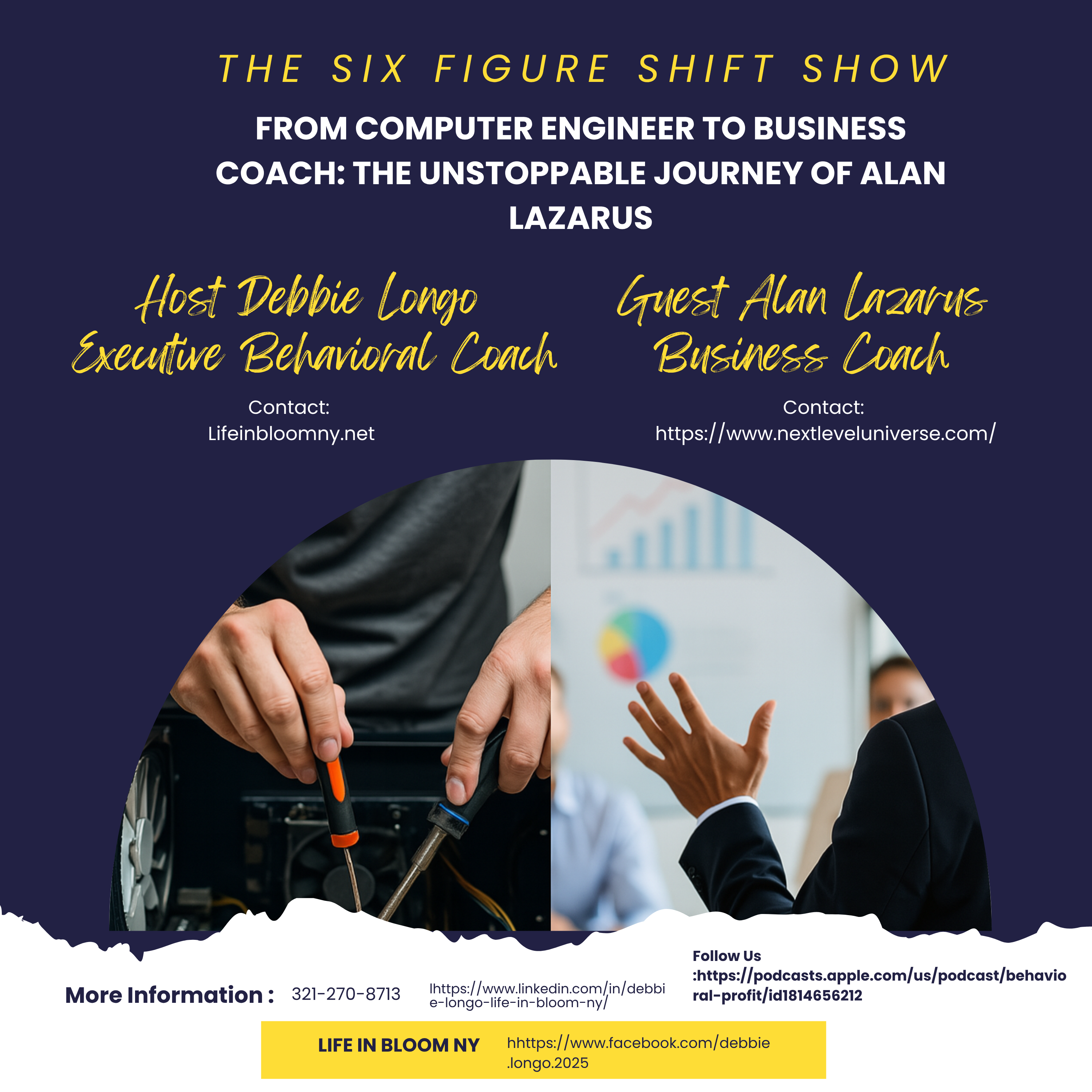
Ready for a dose of high-level inspiration and tactical know-how? In this episode of The Six-Figure Shift Show, host Debbie Longo, Executive Behavioral Coach, welcomes Alan Lazarus—co-founder of the global top-100 podcast Next Level University (2,000+ episodes and counting).
Alan unpacks his remarkable transition from computer engineer to business coach, revealing the mindset shifts and daily habits that fueled both his personal evolution and the explosive growth of Next Level University. You’ll learn:
Whether you’re an early-stage founder or an established exec, this conversation is packed with actionable insights to help you scale smarter, earn more, and build a business that actually feels good to run. Tune in, take notes, and get ready to make your own Six-Figure Shift!
Welcome to the Six Figure Shift Show, where real
business owners share their journeys to scaling
smarter, earning more, and shifting into their
next level of success. I'm your host, Debbie
Longo, executive behavioral coach. And on this
show, we explore what really takes to make the
shift through mindset, strategy, and behavior.
Tune in for real stories, real shifts, and real
results. I have a very special guest tonight.
Alan is a computer engineer turned business coach
who co -founded Next Level University, a global
top 100 podcast, boasting 2 ,000 episodes, 1
million plus listeners around 175 companies and
$1 million in revenue. Armed with an MBA and
a data -driven mindset, Alan helps leaders translate
core beliefs and values. into daily habits that
scale culture, performance, and profit. His mantra,
humility and honesty are the best tools to succeed
at any level. From habit -tracking dashboards
to value -based decision frameworks, he shows
executives how to build teams that own the mission
and how to communicate when belief systems clash.
Get ready to learn how identity metrics and radical
transparency coverage to create teams that don't
just hit targets, they refine them. Good evening,
Alan. Welcome to the show. I have a few questions
here. The first question is you mentioned about
your next level university. What is your system
behind the 2000 episodes of podcast? How did
you? get to that and what was the drive that
brought you to all those episodes? There's a
story behind that and 10 years ago, I got in
a car accident and my birth father passed away
in a car. I was two in 1991. When I was 26, I
got in a car accident that fortunately didn't
take my life, but it did get me to contemplate
what I was doing. And that's when I found my
calling. I created a company called Alan Lazarus
LLC, what you'll never learn in school but desperately
need to know. And I wanted to bring personal
development to the school systems. And then I
started a podcast in that company called Conversations
Change Lives. And that was basically how to be
a fly on the wall for great conversations with
great people. I noticed that kids were picking
majors and picking careers based on very little
data. I wanted to interview people. and ask them
what their life was really like versus what they
thought, because I was a computer engineer. And
the reason I chose that is you're good at math.
Engineers are good at math. Engineers make a
lot of money. You should be an engineer. That
wasn't enough data to make a lifelong decision.
Then I met Kevin Palmieri. He was my first guest
on the show. He was a foreman for a weatherization
company at the time. And he had a podcast called
the Paper Conscious Podcast. Change the way you
think, change the way you act, change the way
you live. I was his first guest. Then eventually
we teamed up and had the worst titled podcast
of all time. It was the conversations change
lives meets hyper conscious podcast We did that
for about 20 weeks in a row one episode a week
Eventually, we rebranded to just hyper conscious
We went all in on hyper conscious podcast and
then probably 400 or 500 episodes in we Transitioned
to what's now known as next level University
and it's a place where you learn how to level
up your health wealth life and love how to be
healthier, wealthier, and more in love. One percent
improvement in your pocket from anywhere on the
planet, completely free. That's a mantra. And
so how did we do 2 ,100 episodes? It's actually
2114 as of earlier today. We started with one
a week, and then it was two a week, and then
it was three a week, and then I think we jumped
from three to five, and then from five to seven.
All these different themes. But we created a
production company. So Next Level University
is the name of the company, the name of the podcast,
and the name of the brand. We have something
called Next Level Podcast Solutions, where Kevin
and myself, our company, 18 person team now,
we currently work with 108 podcasters and business
owners, paying clients. And so it's really scaled
quite a lot, which is awesome. And we work with
podcasters all over the world. We have a group
coaching program called the Next Level Podcast
Accelerator. How did we do it? We eventually
got to a place where we did one a day, 1 % improvement
in your pocket anywhere on the planet, completely
free, next level university. And that is what
we built the brand on. We built the brand on
consistency, reliability, sustainability. We
will be there to be the male role model we never
had, because both Kevin and I grew up without
fathers. He was raised by his mom and his mima,
and I was raised by my mom and my older sister.
And so we wanted to be the male role models we
never had. Interesting. That's very good. Thank
you. Also about the revenue streams. How did
you get there? Kev was a podcast coach. So I
did a bunch of different types of coaching. I
did fitness coaching. So I was a fitness model,
fitness competitor, and a fitness coach. And
I have these trophies behind me. I did fitness
competitions. And I figured, okay, where do I
have results? Where do other people want results?
Fitness. So I did fitness coaching for a while.
I did some mindset coaching. Eventually I did
peak performance coaching. Did a little bit of
life coaching then I was a business consultant
and then I was a business coach And I've been
doing business coaching now for the last probably
four years But ultimately it was always okay.
We have these listeners all over the world What
do they want that I have and how can I help them
achieve their goals for a fee? And so Kevin and
I started coaching it started out with totally
free. We just found listeners. We said who wants
coaching? He was a mindset coach. I was a fitness
coach and we just started out for free. And then
eventually it was, we can't do this for free
anymore. And they were like, let me pay you.
And it started out with 50 bucks a week and then
it was 75. And then it went up from there. And
now I have 20 clients. One of them is four times
a week and I sell 12 week packages and we have
a group coaching program and all that kind of
stuff. So the revenue streams are right now back
in 20, from 2020, 2021, 2022 and 2023, that four
year span, we had an average of 119 % year over
year growth. I'm a computer engineer, everything's
numbers and metrics for me. So we grew like crazy.
And then it was 18 % and then 11%. So we used
to have a 24 person team, 24 departments and
a charity. I came to Kat and I said, brother,
we overextended. So when fish are jumping in
the boat like that, you end up buying stuff,
you hire more team. We got cocky, we didn't mean
to. And So I had to sit Kevin down and say brother
we're gonna go out of business Unless we refocus
and so we took a 24 department Company down to
I said, what are the departments? We would go
out of business without we only came up with
eight Of the 24 only came up with eight that
were directly profitable. So we doubled down
on those eight now We're back to I think 16 and
we have an 18 person team. So what are the revenue
streams now? One -on -one coaching is big We
have group coaching program. We've done 18 groups.
We're about to launch our 19th group. We also
have next level podcast solutions. We produce
over 60 podcasts, including three of my own.
We also have something called next level social
media. We do social media for nine clients currently,
and then we have one thing called next level
guest solutions. We get people onto other podcasts.
We also have a next level dreamliner. And again,
I don't want this to turn into some sales pitch,
but it's a journal that I use every day. Reverse
engineer your goals and dreams one quarter of
it at a time. Achieve your dreams 90 days at
a time. Use the journal every day too. We also
have a book club that's indirectly profitable
because they end up being my clients. We have
a fitness group, all kinds of stuff. The main
revenue streams though are podcast production
and one -on -one coaching. We also have something
called Next Level Live. We've done a live event
every year for eight years, and that's pretty
profitable. Now it's fully virtual. It used to
be in person and it was not profitable. But those
are the basic revenue streams. We also had an
app called Optimal, habit tracking app. We put
most of the departments in coast mode so that
we could refocus and double down on things that
are directly profitable and indirectly profitable.
Those things are going to come later on. But
everything revolves around this one simple idea
of level up yourself, level up your podcast,
level up your business. Listeners want to learn
from us to reach their true potential. That's
personal development and success. Longers want
to build their own podcasts and their own podcast
communities. Business owners have to generate
revenue. Otherwise, they're going to go out of
business. I'm a business coach. He's a podcast
coach. We have someone named Amy. She's personal
development coach. We built a very large company
in terms of business model and then tried to
grow into it. Which in hindsight, I think we
spread ourselves to them. I am actually doing
it that way now because I had a spiritual teacher
mentor for 19 years and she passed away in 2021.
And she had a few businesses and she would constantly
be giving stuff out for free. One -on -one sessions.
They could have been friends. of clients or somebody
that she met like in church or whatever. So that's
what I do too. My mission is to help people.
It's not to chase after greed and power because
it just comes. The more I give away, the more
it comes. If I'm focusing on just money and how
much can I get from everybody and I give limited
amounts, that will wind up to be destructive.
You know, I always say money can never be number
one, but it also shouldn't be number 10 It passion
is what are you obsessed with? So I'll just use
fitness as an example. So I'm obsessed with fitness
Purpose is I help others get in shape passion
to purpose into profit is third So how do you
make that profitable? But profit can't be tenth,
but it also can't be first if the only goal is
profit like I'm here right now Number one. I'm
here to serve Number two, I'm here to practice
my craft and become a better podcaster. Number
three, if someone ends up reaching out and this
is profitable, great. But if not, that's okay.
And it needs to be a priority, but it can't be
the number one priority. So I'm curious about
digital products because we're talking about
companies advancing and going from zero to being
a large company, six figures, or having that
as a goal. What if I have too little product
or too much product? Will that affect me and
my company? Because I just want to have the right
amount. But what does that mean? What does that
look like? It all comes down to supply and demand.
And people think that if you create the supply,
the demand will come. That is absolutely not
true. So I break it down into five simple steps.
I have a podcast called Business Growth University,
and it's got only eight episodes as of right
now. In the very first episode, I talk about
what I call the business star, and the next five
episodes go deeper into each. The business star,
it's branding, marketing, sales, client delivery,
and community. And ultimately the supply and
demand thing. We have online courses. We give
them away for free. And that creates leads. It's
called lead gin. And then you reach out to those
people. Now, you know that those are listeners
and then you offer them other things. But the
ultimate key here, I like to change the word
sell to help or to invite. So I have something
called a next level sales system that I run.
Every single day for 42 days in a row, actually,
I'm big on streaks and numbers. Anyone will understand
that based on this conversation. And I call it
five by five next level sales system. five posts,
five unique posts, five likes, five comments,
five DMs and five invites. And I do that every
single day. And to me, social media marketing
and social media branding and personal branding
and sales is really critical. Client delivery
is also critical too. Client delivery, what I
use as an example is when you buy a bag of chips
and it's only a third full, if you constantly
disappoint everybody, they're not going to keep
buying the bags of chips. So you have to be able
to over deliver on your promises. And I think
that in today's digital world, there's a lot
of people that are really good at branding, marketing
and sales, but they can't deliver and they can't
meet the bold promises that they make, particularly
with digital products. And then there's other
people that are really good at client delivery.
You're either good at branding, marketing and
sales, but not good at client delivery. or you're
really good at client delivery, but not good
at branding, marketing and sales. And the truth
is you need to be good at all those five. Branding
is who you are and what you are. It's your reputation
in the marketplace. I always say Tesla should
not sell energy drinks and Red Bull should not
sell cars. Marketing is the message that you
have. It's the messenger who you are and it's
the channels in which you reach your target demographic.
And it's your target demographic. Sales is helping
real people in the real world with meaningful
conversations. It's building meaningful relationships.
And so do it yourself in the real world. Make
sure you know who your target demographic is.
Make sure you know what problem you're solving.
So for us, for example, next level university,
if you are a listener, you really don't have
to go anywhere else for your personal development.
We're going to help you level up your life, love,
health and wealth every day from in your pocket
completely free. We don't have any advertisement
except for our own stuff. And basically we take
away the problem of having to curate content
on YouTube and you can just trust that we're
going to be there for you in your pocket, motivating,
inspiring, and educating you every single day.
Client delivery is okay. My program is 12 weeks.
It's called the Next Level Business Accelerator.
It's 1500 bucks, which it comes to $125 per session.
We're going to do metrics and habits and goals
and priorities and all this kind of stuff. And
I'm going to make sure that it's the Mario car
booster. Client delivery is can I actually deliver
on that? And the truth is, in the beginning,
I couldn't deliver with certain people because
they wouldn't execute. And so now I'm much more
picky. I actually have a filter of people I don't
work with. To go back to your original question
though, digital products are the future. Online
is the future. There's 8 billion people on this
planet, 5 .65 billion on the internet. And that
number is increasing. You can scale companies
way faster. than you could in the past, but there's
also way more competition. And it can be very
hard to create a compelling product or service
on the internet that actually gains traction
because it's really good and worth the price.
The last piece is community, and these are the
companies that really crush it. If you can build
a community where people identify as a next leveler,
or they identify as someone who believes what
you believe and lives life like you live it,
Like our fitness group, for example, those are
all really warm leads with real people, but you
can't spam them. You have to add value first.
And that's why the next level sales system is
set up the way that it does. It's five posts,
five likes, five comments, five DMs, five invites
in that order. Because the invites are an ask.
But the first 20 things you do on their posts,
likes, comments, and DMs, those are all adding
value. So it's add value invite. I was on with
a client earlier and I said, do you want to come
to book club this weekend? That counts as an
invite. She said, no, not interested, but thank
you. Her name's Moe. No worries. But at least
I shot my shot. Why? Because she's going to be
a part of the community. She said, Alan, I'm
too overwhelmed. I appreciate it. Not interested.
All good. No stress. And I get my check for my
five invites for the day. I think that very few
of us are mastering all five of those things.
Last thing I'll say. about this. Success is not
doing 10 ,000 things. Success is doing those
five things 10 ,000 times and improving on them
every single time. And as an engineer, it's so
obvious to me that if you are consistently improving
in those five areas in your company, you will
be successful. And then it's just a matter of
creating more and more demand and then limiting
the supply and then raising the price. but doing
it in a way that's integrous. Because here's
the thing, when you iterate, I've done 10 ,766
coaching sessions, trainings, and podcasts. If
I'm not better than the standard coach at this
stage, then I can't raise the price. To me, the
value for the client or customer has to be at
least five times what you charge in their consciousness,
not in yours. So I always tell people the average
amount that people earn on average, 788 % more
over their lifetime for people with a coach.
I said, if you can make 788 % more working with
me, and it says especially for business coaches,
why wouldn't you invest in me? Which is really
an investment in yourself. However, if you don't
have work ethic and you don't want to execute
and you can't handle hard truths, there's nothing
I can do for you. Yeah, that makes a lot of sense.
I have a small company. I want to have a plan.
and I need to know how I'm going to get to whatever
my goal is, if it's making six figures or whatever,
then I'm going to execute that plan. A specific
goal, timeline, how many employees I'm going
to have, just a very specific thing. And I think
that what you explained is very good for a small
company or an entrepreneur to really get motivated
to say, Alan and Debbie, they're really successful.
And I could do that too, just by taking a few
suggestions and maybe get a coach because I need
help in this world. So I need people to help
me in order for me to succeed. That takes a lot
of humility. Success to me, the biggest thing
that I can share that I've... learned over coaching
so many people from all over the world all different
cultures all different backgrounds all different
sexes all different types of people and I do
relationship talks coaching as well we coach
couples we've been doing that for five years
and the self -belief plus the humility rarely
walk hand in hand and they're the two most important
character traits for success you have to believe
in yourself enough to execute but be humble enough
to know you need help simultaneously Kevin and
I, he had low self -belief, but high humility.
I had high self -belief, but low humility. And
so you have to be certain enough that you're
going to succeed, but also scared enough that
you're going to go out of business to actually
stay humble. We got cocky when we were winning
119 % year over year. We're more than doubling
our business every year. Of course we got cocky.
We didn't mean to. We just did. And now we got
our biggest client we've ever had three months
ago. It's almost six figures, just one client.
I said to Kevin, congratulations, this is awesome.
Biggest payday we've ever had. But dude, don't
get cocky. We celebrated for three minutes and
then I was like, back to work. Let's go. Because
the moment you get cocky in business, you're
going to go out of business. But you have to
have a little bit of that confidence in you.
You can't be too timid. You have to have tenacity
and self belief, but you also have to have humility.
It's hard to keep those hand in hand. If I have
a partner. that has more of a quality and I have
less of that quality, it's better to have the
opposite than a lot of the same quality. With
you and your partner, one can motivate each other
and that will help you get your quality bigger
and vice versa. I always say similar core goals
and core aspirations and core values, complementary
skill sets. And that's the key. It's the yin
and the yang. Make sure your yin is yanging.
But you have to have common goals and values.
Goals in conflict are a thing. If Kevin and I,
my business partner, if we're both driving from
Boston to LA, we both grew up in the same small
town. If we're driving from Boston to LA and
I want to go the southern road and he wants to
go the northern route, we can't take the same
car. And that's a goal in conflict. If I like
heavy metal and he doesn't, we can't take the
same car. If I'm going to Vegas and he's going
to LA, we have to leave separate cars once we
get to Vegas. So it's a metaphor of that's why
a lot of intimate relationships fail and a lot
of business partnerships fail is because they
have goals that diverge and or core values in
conflict. So Kevin and I have very similar core
values and very similar goals, but we have complimentary
skill sets. And that's been really helpful. He's
more short -term thinker. Make sure we stay in
business. I'm more long -term visionary. And
we both have both, but we've really, we call
it drive to five. I'm usually overconfident.
He's usually underconfident. And so we balance
each other out pretty nicely and we drive to
five. So 10 means you're basically overly optimistic.
Zero means you think nothing is ever going to
work and you got to be at five. You got to be
both confident and humble simultaneously. And
I think he and I help each other. I asked him
the other day, am I over? He said a little bit
over a little bit more optimistic than I probably
should be. I need to, I need to get a little
humility in advance. because you either stay
humble or you get humbled. We check each other
and respect each other. And it's important. And
every now and then I got to say, come on, man,
like, you can do it. So I'll give you an example.
We're shooting for half a million this year.
He doesn't think we can do it. And I'm certain
it's possible. I said, we can't miss a trick,
but I got to go for it. Worst case scenario,
I end up at 480. I'm still glad I went for it.
But here's the thing. He is more motivated by
small short -term goals. I am more motivated
by shoot for the moon land amongst the stars
and that's the truth of you have to understand
what motivates you and usually The people who
have really high self -belief and self -efficacy.
They need to aim really high and get their butt
kicked I always say aim high you'll get humble
pie aim low and you won't grow And so for him,
I need to get him to aim a little higher. For
me, he needs to get me to be a little more practical.
It's good we're having this conversation because
if somebody's on and they want to be in a partnership
with somebody, the statistic is very low that
a partnership makes it. Nine times out of 10,
a partnership fails. That's why a lot of companies
are not in partnerships, they have big boards.
And that way multiple people usually is not good.
But in that sense it is because everybody has
a stake involved. They have a benefit. So they're
trying to keep the company. But to have one partner,
the statistic is very low. That partnership,
the business might work, but the partnership
will actually make it because of these things
that you're saying. You're absolutely right.
Back in 2012, my first company was called Campus
Libre and we had four team members. And we applied
for something called Y Combinator. Do you know
Y Combinator? Y Combinator is an incubator program
in the U S and essentially there's a group of
mentors that have no time, but they have a lot
of money and wisdom. And then there's young entrepreneurs
who have a lot of time, but they don't have money
and wisdom. And it's an exchange and I eventually
want to create my own incubator. And in some
ways I already have one with the 20 clients that
I have. But I don't have equity in their companies
yet. Why Combinator actually won't invest in
your company unless you have a certain number
of team members. Because two is scary, but one
is also scary. Unless you have four people that
all have sort of skin in the game, an investor
might not even invest. in your company. And I'm
going the non -investor road. So we bootstrapped
our company. I told Kevin I didn't want investors.
I got offered large investments early on and
I said, no, because I said I don't want anyone's
hands in our cookie jar. I didn't come this far
to be told what we can and can't do with our
own company, that kind of thing. That's definitely
made it harder by a significant margin. If you
do want a business partner, you have to be really
self -aware and you have to be really aware of
who that other person really is. And remember,
it's who they are when no one's watching. People
say words lie, actions lie when they're around
you. You need to know who is this person and
what are they when no one's watching. That is
the really important question to ask. Yeah. How
can someone get in touch? I have absolutely people
and absolutely not people. I don't think everything's
for everyone. I don't think everyone's for everyone.
My absolutely people are people who have high
work ethic, high humility. and who have a sincere
interest in reaching their true potential in
life and business. That is my absolutely people.
If that's you, please reach out. You can Google
my name. Next Level University is the podcast.
NextLevelUniverse .com is the website. And if
you are someone who wants huge rewards for minimal
effort, you and I are not going to get along.
I believe in striving, not arriving. I believe
success is earned every single day and the rent
is due every day. So at the end of the day, I'm
not here to help people who don't have high work
ethic and that's nothing personal. I just know
that I'm not a good fit for you. So thank you
so much for having me. Thank you.