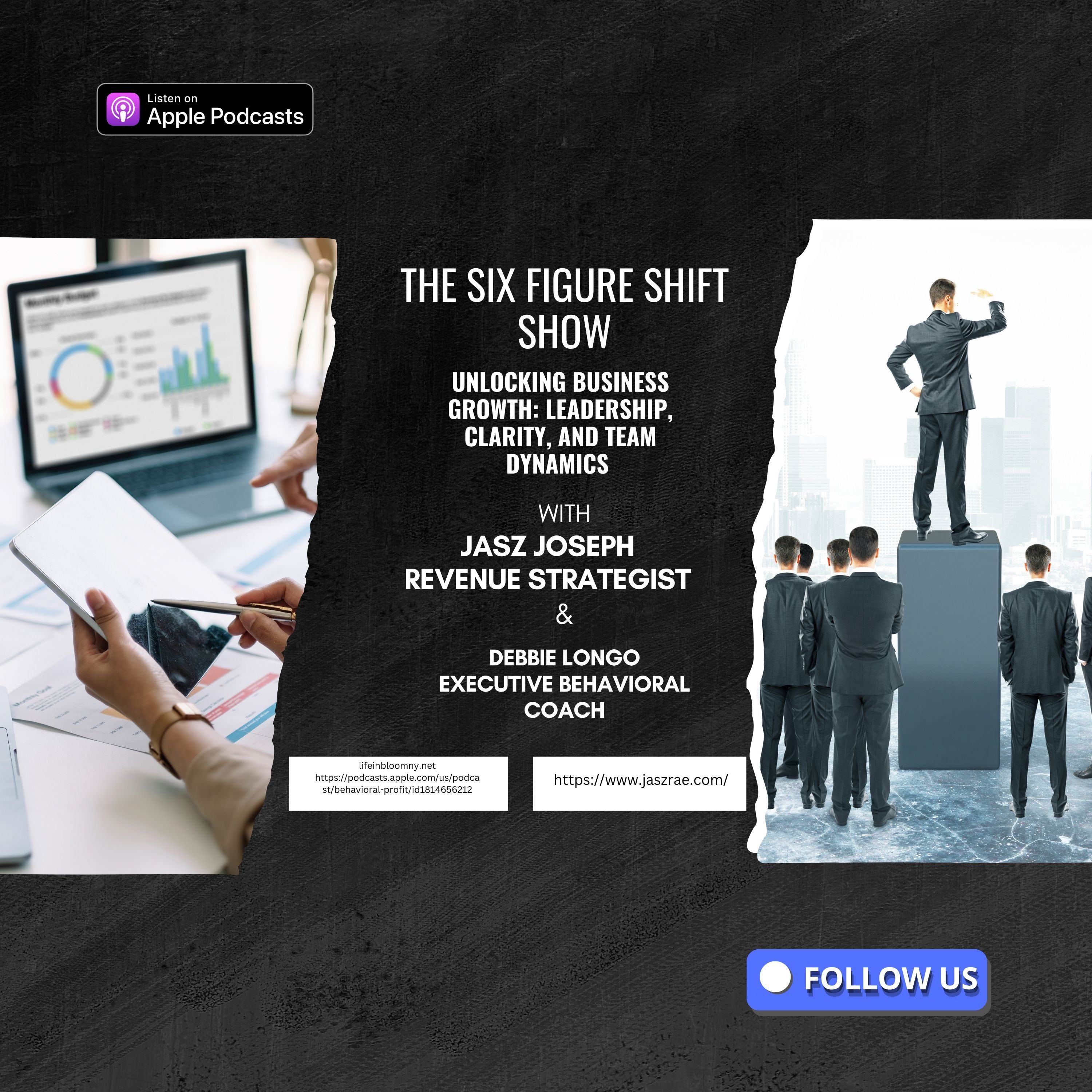
How does fuzzy decision-making quietly drain revenue? In this Behavioral Profit episode, host Debbie Longo, Executive Behavioral Coach, sits down with Jasz Joseph—revenue strategist and founder of a HubSpot consultancy—to connect the dots between leadership behavior and bottom-line performance.
Jasz unpacks:
Whether you’re a CRO chasing ambitious targets or a founder scaling a scrappy team, you’ll walk away with actionable frameworks to turn people-power into profit. Press play and start converting clarity into cash.
Chapters: 00:00 Intro • 00:25 Meet Jasz • 00:57 Clarity & Team Behavior • 02:27 Aligning Goals • 05:30 Habits → Revenue • 08:53 Sales vs. Marketing • 14:25 Shared Accountability • 19:59 Tool Overload • 24:47 Wrap-Up & Next Steps
Welcome to the Behavioral Profit, the podcast
where leadership behavior meets bottom line results.
I'm your host, Debbie Longo, executive behavioral
coach. Each week, we unpack the mindsets, habits,
and cultural shifts that... turn teams into high
performing profit driving powerhouses. So you
could lead with purpose and win with people.
I have a very special guest today, Jazz Joseph.
She is a revenue strategist and founder of a
HubSpot consultancy that helps B2B companies
turn complex systems and misaligned teams into
clear revenue driving operations. With over a
decade of experience in digital marketing and
sales, Jazz brings a non -fluff lens to growth.
helping leaders simplify their tech stacks, align
cross -functional teams, and build strategies
that drive results. Today she joins us to talk
about the behaviors behind business growth, what
gets into the way of clarity, and how leaders
can build cultures that move with purpose. The
first question is, how does a lack of clarity
show up in team behavior or revenue performance?
It's a great question. So it can show up in a
variety of different ways. As you'll often see,
duplicated were. missed handoffs, or an overreliance
on tools like Slack or email for clarity. So
whenever you start to see teams becoming reactive
instead of strategic and operating from a place
of stress, that's usually when I come in. So
from a revenue standpoint, if leads are falling
through the cracks, deals are stalling out, or
your messaging is inconsistent, marketing activities
usually fail to support those sales. goals. And
it's rarely a talent problem. It's usually a
clarity problem. So when leadership can be really
clear with their team about how do we treat our
leads? What is the amount of time that needs
to happen from a conversion to the first time
we reach out? What is the messaging that we use
during the sales process? When those roles and
priorities are really clear, that's when we start
to see performance increase. You're focusing
a lot on goals. and how people perform. When
I do coaching, that's very similar because that
not only increases positivity, that will eventually
increase sales and profits, which is really the
goal here because we want to be able to help
companies to grow. And whenever leadership is
able to really clearly articulate those goals,
that trickles down. And that's when you can feel
confident that your marketing team is going to
do... their job, your sales team is going to
do their job, they're going to be aligned in
working toward that one goal that leadership
has outlined for them. People are not working
in silos. And I have a podcast, Goal Making.
Not only will it help a company grow with sales
and profits, but they take that attitude and
behavior that they learn from coaching and carry
it home. They carry it to their social life.
If it's work from home or in person, how much
time does that employees spend with their peers.
If they're working a 40 hour work week, they
spend 40 hours. Then let's say they have a child,
they come home from work or they finish work.
The child goes to bed an hour or two later. They
have quality time two days a week. Let's say
they work Monday through Friday, and then they
have Saturday and Sunday off. They're spending
more time with their work peers and their bosses
as opposed to their family. Who's going to influence
more? the people you're spending more time with
or the people you spend less time with. You spend
so much of your time in the workplace. So when
you can feel like you're contributing to a greater
goal and you have a good relationship and things
are clear, like the amount of stress in your
life just decreases tremendously across the board.
There's a lot of people that I know. that say
they can be open more with people that they work
with rather than their own family. That is so
much to do with that company culture, which to
your point, it starts at the top and it just
trickles out. Any way that we could increase
performance and revenue, it's all gonna help
the company. The next question is, how can executive
teams connect team dynamics and internal habits
directly to revenue? I think this question...
really boils down to a very simple answer. Teams
that meet regularly, use shared dashboards, have
very aligned definitions of success, are more
likely to close deals. So most executives are
tracking pipeline numbers, but they're not tracking
how their internal behavior of those conversions.
And when I talk about internal behavior, I'm
talking about things in delays that lead follow
up, poor CRM habits, unclear campaign goals.
So if your team is not following up with leads
in a timely manner, if they're not Cleaning up
the data in the CRM and tracking what they're
doing and ensuring that all of that data is correct,
the email addresses, the phone numbers, the lead
statuses, etc. Then you're not going to be able
to have the big picture discussions that we're
talking about, where you can meet and you can
clearly identify what is our team doing, what's
working, what's not working, where do we need
to prioritize our time and our energy moving
forward in order to hit these goals. When leadership
is able to... that alignment and clarity, it
trickles down. So whenever we have shared priorities,
it reduces that internal friction and it increases
momentum. Teams that have really solid internal
rhythms, and when I say internal rhythms, I'm
talking about things like regular team meetings,
feedback loops, good review processes. So you're
not sitting wondering, am I doing a good job?
Or I feel like I'm doing a good job, but this
person is saying I'm not. Having that total clarity,
from a feedback and review process standpoint
is going to help teams identify opportunities
fast and act on them in a more competent manner.
Oh, I feel about my team and how I want to create
less greed and less ego in order to care about
my and my workers, even my coworkers. And that
will increase positivity, productivity, and therefore
not only increase There's a lot more here that
we're talking about. Internal habits, just like
you were explaining, when I help companies, I
show them how to grow. And this is a process.
It's about learning a whole different way of
doing business, conversing with people, hiring,
enforcing job duties. That person is changing
to being a very positive leader. The next question
is, what are the most common behavioral breakdowns
between sales and marketing? teams. I think one
of them is speaking different languages. So marketing
is often talking in terms of campaigns and branding,
and sales is often talking in terms of deals
and dollars. And if we are not able to accurately
blend those two, then there's going to be frustration,
there's going to be animosity, the teams are
not going to be able to work together. My best
performing organizations that I work with have
very aligned sales and marketing teams. What
does that truly mean? It means that marketing
is speaking sales as language, not really the
other way around, but marketing is tying all
of their initiatives to deals and dollars. At
the end of the day, that should be our primary
driver of success is revenue. Are we closing
deals? Are we generating revenue for the company?
Marketing needs to be thinking in that way as
well. Oftentimes what this looks like is in terms
of qualified leads. So, I see qualified lead
means something different to marketing than it
does to sales. Maybe we have a webinar or an
ebook. There are people that are finding it on
social media, they're downloading the ebook,
they're watching the webinar. Well, marketing
is spotting themselves on the back saying, we
just generated all of these qualified leads.
Sales go sell to them. And sales are getting
these and they're like, these people don't even
know who we are. They attended one event. Like,
these are not sales ready. leads. And so when
there's not a shared definition of what is a
qualified lead, what makes a lead ready to go
from marketing over handed off to sales, again,
that's when, like, the breakdown, the animosity
starts to occur. So it's really important that
these teams work in tandem and they're not siloed.
We shouldn't be having marketing having a meeting
talking about what they're doing and sales not
be included in that meeting when they can work
together and understand each other's role. That's
when real momentum starts to hit and marketing
starts to understand these are the specific thing
that sales needs from these contacts in order
to accurately be able to sell to them. And then
sales starts to appreciate, okay, marketing is
bringing me these really amazing leads that I
can even sell to. And that's when we start to
be able to work together and really see that
flywheel move at a faster pace. the supervisor
or the executive think that they are going to
get leads and they have no leads and then they
say have quality leads because the ultimate goal
is to do the action. But on the behavior side,
what if They say that they are going to succeed
and they are getting clients from these leads.
Or they would say, I have clients, even though
they don't. Let's say they have a whole bunch
of leads and they're not even good, but they're
going to say, I have clients from these leads,
even though they don't. And this is the type
of stuff I do when I do coaching because the
mind controls what's going on in my environment.
So this is one way to take negativity out of
the equation. They could say these might work,
they might not. That's not saying it's a hundred
percent positive. that these are quality leads.
And when I say that, it's happening now, even
though it's not. Nothing's happening. That is
saying that I want this to happen. If I say I
have a job and I don't have a job, I go to the
interview, I go through the whole process right
before I go on the interview, I say, I don't
think I'm going to get this job. What kind of
message is that sending? This is just another
way of thinking about it because I want to always
think... that my company is going to advance.
My company is going to be the company that's
going to succeed, that's going to do well, that's
going to reach the stock market, all these different
things. And if I think, I don't know if I'm going
to get clients or not, doesn't it help me advance
my company? I think you hit the nail on the head
in terms of confidence and feeling competent
and confident as you're going to market, whether
you're in a marketing role and you're trying
to get leaves or you're in a... sales role and
you're trying to close those leads. If you don't
feel confident in your process and if you don't
have the right tools in place, then it's not
going to work. There's a lot of foundational
work that needs to happen on the front end before
we can even start talking about this handoff.
The next question is, how can leaders build shared
accountability without creating more tension?
I think one of the main ways that I see this
done accurately is through your tools. As you
mentioned, I run a HubSpot consultancy. For me,
that means HubSpot, but that could be any CRM
or tools that your team is using. And having
shared dashboards or scorecards so everybody
can see that progress in real time keeps everything
objective and not personal. As leaders, we never
want to come to the table and say, you're not
doing good enough. If we have shared dashboards
and scorecards that everybody on the team had
visibility into, Then we can come to the table
and have a strategic conversation without pointing
fingers to be able to say, marketing, you're
not driving enough leads because we set this
goal and this is where we're at. Or sales, you're
not closing enough revenue because we wanted
to hit this number of revenue and we're only
at this number of revenue. When there's that
ambiguity, that's when I see a lot of tension.
So if we just say salespeople go south, they
will, but what do you need them to do? Who are
they selling to? What is the messaging? How much
do they need to sell? Same thing on the marketing
side. If we just say marketing, go get us leads.
Are they getting the right kinds of leads? Are
they warm enough for sales to sell to? To me,
clarity and visibility is the biggest way to
avoid tension. If everybody understands exactly
what the goal is and is on the same page with
it, then you're going to be able to move forward
in a really productive way. Feedback has to be
a part of the culture. can't only be a reaction
to mistakes. It has to be a part of the regular
rhythm. Leaders on a regular basis, whether that's
in weekly meetings, quarterly meetings, whatever
makes sense for your team, feedback should be
normal, both positive and negative. That should
be a normal part of your process. It shouldn't
be a situation where feedback is only coming
at you from a negative lens when you've done
something quote unquote wrong. And then on the
flip side, when should be celebrated. Whenever
teams are able to share that credit, they share
responsibility as well. So whenever you do hit
those revenue markers, you generate the lead,
sales closes the deals, celebrate that from a
whole team standpoint and give everybody the
credit and make them feel like they're really
a part of this bigger thing. And that really
helps contribute to, again, that ongoing growth
and motivating them to keep going. I was in sales
for a long time. We used to have hang. Say positive
things about the employee in front of a group.
in front of the other employees and say negative
things, like if you need to tell the employee
what they did wrong or you need to enforce job
duties, that should be said one -on -one. And
then we used to make a big deal out of it. We
used to say, oh yeah, this person did this. Isn't
that great? And all of these things create positivity.
And not only does it increase sales and profits,
it reduces tension. And that is... how to run
a business where it's really going to succeed
in a hundred different ways. And one of the reasons
why I have this podcast is just to show the executive
and business owner that. And if that's attractive
to them, if they decide that they want help,
either with you or with me, then they will seek
the person out. I don't want to charge for it.
I want to give this information to educate people,
to let them know that all these different topics
and subjects here that we're talking about that
are all intertwined in all these questions that
we just talked about, that's gonna create a company
that's really gonna succeed and do well and be
in existence for a very long time. And that's
the legacy that the person is gonna leave. Not
only they're gonna leave like a good 401k or
a pension to their family, but this is what they're
gonna stand for. But sometimes, It could be where
the executive or business owner needs to put
food on the table for their family. They need
money for gas. Their company is not doing good
because of all these things that we just talked
about in these four questions. And they don't
eat because their kids have to eat. The company's
not going to last too long. And we're trying
to avoid that. So we're talking about all these
different behaviors and all these different ways
that a company can do better than what it's doing
now. So the last question is, how does tool and
system overload affect team behavior and leadership
decision making? Too many tools create confusion
about where to find information, who owns what,
how to execute quickly. And something that I
see a lot of businesses come into that can be
problematic is searching for that magic tool
that they think is going to fix all of their
issues. And you and I both know that a tool is
not going to fix anything if you don't have the
right strategy and salvation in place. And oftentimes
they come into these organizations and they just
have so many tools. We have a tool for this,
a tool for that. None of them are being used
appropriately. None of them are optimized. There
is way too much lack of training happening. Nobody
really owns them or understands what to do with
them. And the teams are just overwhelmed. They're
overwhelmed with data, notifications, and oftentimes
that just turned into, I can't trust these tools
because they don't know how to use them, I can't
trust that the data inside them is correct, and
so I'm just going to not use the tools, I'm gonna
go rogue. And so the fix is not more tech, it's
better usage. Most teams do not need more tools.
They need better governance around the tools
that they have. They need better documentation.
If one person owns that tool and they leave the
company, what happens? Do you have the documentation
so you can onboard somebody new to that tool?
If we want our sales team or our marketing team
to be using a specific tool, then we need to
arm them with the training so that they can use
that tool appropriately and in the way that we
want them to be using it. I think I think it
all just boils down to put the tools away at
first, and let's talk big picture. Let's talk
strategy. Let's talk foundational business building.
And once we're crystal clear on where we're trying
to go, what we're trying to achieve, what those
goals are, maybe we onboard to one or two tools
to help us get there while keeping that North
Star metric in mind. It's a physical world. And
I want to have things that are going to solve
the problem. I have this microphone. but gonna
do any good for me if I don't put it in front
of me even though I need the microphone. But
even though I have the tool, that doesn't mean
anything really if I don't know how to use it.
Your point is use one or two or don't use any
and start off with nothing. If I'm given 20 tools
before I start the job, then I'm gonna depend
on those tools. It's like a child with toys.
Because if a child has a lot of toys, the mother
gets them everything they want, then the child
is gonna rely on those toys. It's the same thing
with the employee and a boss. Are they gonna
be dependent on those tools? Focus on the physical
part of the world. That's just the reality. You
can't change that. But I don't focus on that.
I focus on the mental and the mind changes everything.
I'm able to use tools or do anything that I need
to do physical, as long as... my mind is trained
to think that way. But if it's not... Then what's
going to happen? Am I going to know what to do?
Am I going to know how to use those tools? Or
even if my boss gives me job duties or asked
me to do something, a program on the computer
or something with advertising or marketing, I
need to learn that. I have a question about computers.
Are computers really used the whole entire time
that people are training or are they teaching
them how to function? even just a little bit
without the computer. I think in tandem with
what you're sharing, now we're seeing this rise
of AI, artificial intelligence, and a lot of
people are leaning on that in the same way that
they lean on their tools. And so, again, it's
do you have the foundation in place? Are you
using ChatGBT to do everything for you? Or do
you have a solid foundation and a strategy that
then you're feeding into AI to help you work?
faster in a more efficient manner. So I think
computers, it's the exact same thing. Do you
have that foundation in place? Do you have that
human element? And then are you utilizing the
computer to get you faster to that goal? Or are
you using it as a crutch? because you wouldn't
be able to get there without it. I can use AI.
What is that doing for the future? Is there anything
that you would like to say in closing? Thank
you for having me. I think we talked a lot about
different ways to help your sales and marketing
teams achieve those goals and using tech, how
leadership can get involved from a more strategic,
higher level way. to help their teams get to
those goals in a faster manner. So thank you
for having me. You can visit my website, which
is Ray, J -A -S -V -R -A -E .com, or you can
connect with me on LinkedIn. I'm very active
on LinkedIn. So Ray Joseph, tell me that you
heard from me on the podcast. And yeah, I would
love to meet you.