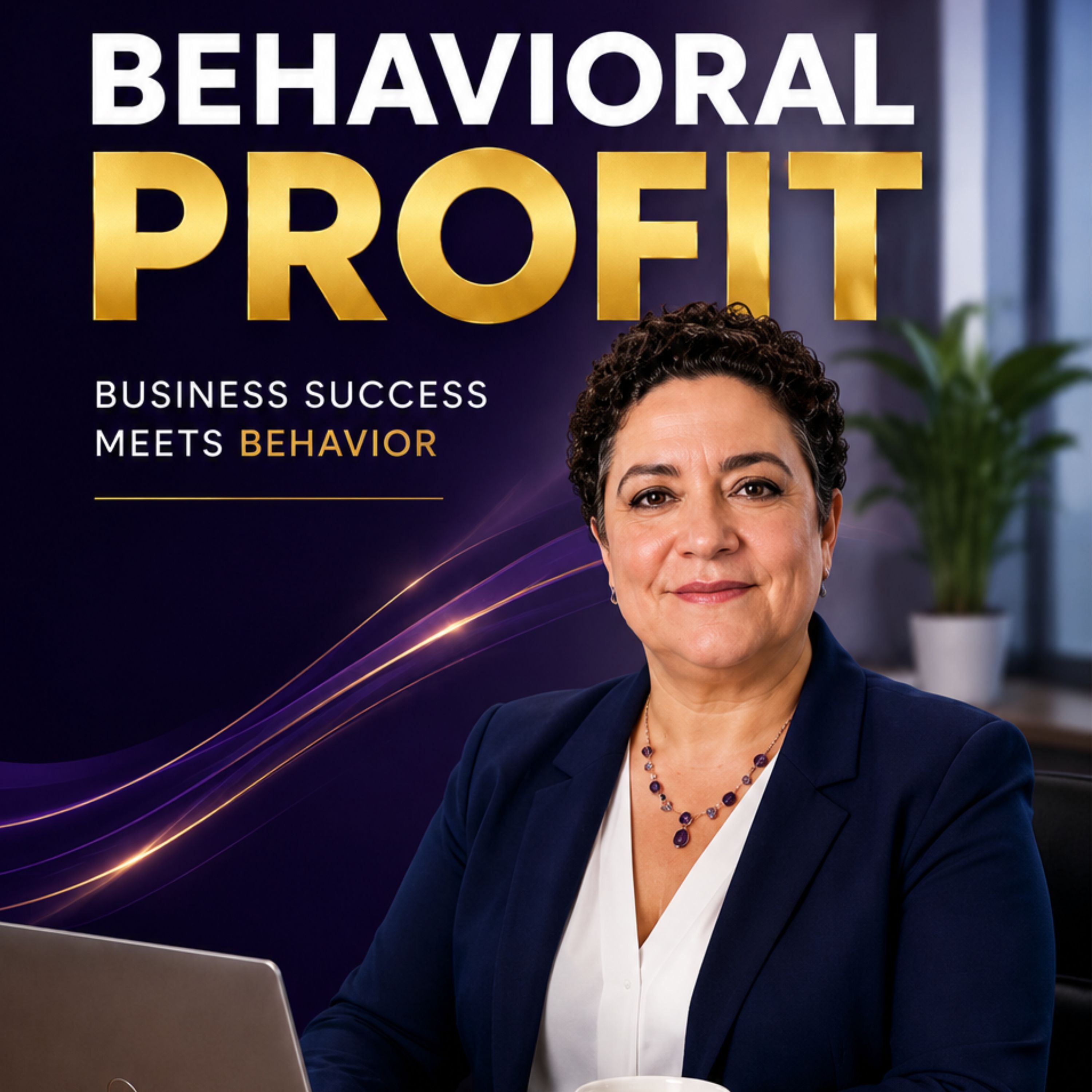
In this episode of The Behavioral Profit Show, Debbie Longo is joined by executive leader Victoria Pelletier to discuss how leadership behavior, resilience, and intentional decision-making drive performance in modern organizations.
Victoria explains how aligning technology with human behavior creates sustainable results and why culture, accountability, and mindset matter more than systems alone. The conversation highlights resilience, reinvention, and the behavioral patterns leaders must develop to navigate complexity and lead with impact.
This episode offers practical insight for leaders focused on performance, culture, and long-term behavioral profit.
Connect with Debbie Longo Website: https://lifeinbloomny.net Email: info@lifeinbloomny.net LinkedIn: https://www.linkedin.com/in/debbie-longo-life-in-bloom-ny/
Connect with Victoria Pelletier Website: https://www.victoria-pelletier.com Email: victoria@victoria-pelletier.com LinkedIn: https://www.linkedin.com/in/victoriapelletier/
Welcome to the Behavioral Profit, the show where
we explore the behaviors, patterns and decision
-making habits. that shape performance culture
and long -term profit. This show is designed
to help leaders understand how behavior directs
outcomes and how simple, intentional shifts can
transform how people work, lead, and grow. We
accomplish this by bringing on executives, innovators,
and experts who share the strategies behind their
success, the challenges that shape them, and
the lessons that drive real change. Each conversation
gives you practical insight to strengthen your
leadership, elevate your teams, and create measurable
behavioral profit in your organization. Today
I'm pleased to introduce Victoria Palichier,
a highly respected executive recognized for her
leadership at the intersection of technology,
people, and performance. Though her work with
collegial, and unstoppable you, she guides organizations
in aligning innovation with human behavior to
drive results that are both strategic and sustainable.
Her journey is marked by resilience, re -innovation,
and meaningful transformation insights she has
shared globally, including through her TED Talk
on resilience. Victoria's perspective challenges
leaders to rethink how culture, performance,
and technology work together and how intentional
behavior becomes the real competitive edge. Good
afternoon, Victoria. Thank you for being on the
show. Thanks for having me. I'm happy to be here.
So let's start with a few questions and then
maybe we'll make it into a conversation however
it goes. The intro that I just... Gave you is
what the points here. Okay that I would like
to focus on Tell me what do you focus on? Mainly
what is your area of expertise specifically that's
broad. I have a few funny enough I referred myself
as a multi potential light so very diverse interest
and experience across a multitude of things,
but I started my career very very early at age
eleven funny enough i worked at a bank when i
was in university and got promoted through the
ranks very quickly. I got recruited out of banking
operations at age twenty four to be the chief
operating officer for an outsourcing company
and that began my career into the world of be
to be professional services i stayed there ever
since. doing large scale transformations more
than forty merger acquisition or divestiture
transactions from due diligence all the way through
to the integration work. I know a few industries
quite well in the professional services sector
technology in fact can roll the company work
for today is a tech company. And I said it, I
lead our people in performance business. So all
the enablers around technology, but I've also
spent a decade running corporate travel businesses
and human capital businesses. Another 10 years.
That's still kind of at the heart of what I do
today. So B2B professional services is the specialty,
but I've got some, some nuances and some other
both industries as well as some functions that
were parts from ops and in human capital that
I know quite well. Interesting. Okay. So What
challenges or transformations have defined your
professional journey? Making the shift I went
from into professional services. I had a goal
of being a lawyer. That was the plan when I was
in university, but I enjoyed the corporate world.
So as I got promoted through the ranks, I decided
to take a year off before going to law school
and never went. So that was sort of a transformation
pivot number one. And then second was when I
went into professional services, I loved the
dynamics of the business to business environment.
You're serving multiple constituents in both.
the client that pays the bill, and then ultimately
the end user or customer, whether that be their
customer or their employee. And so that just
creates challenge, which I like. But I've also
had one for me as a leader. So as you talk about
behavioral shifts, I became an executive at age
24, the only woman, the youngest by a couple
of decades, I felt I needed to show up in a way
that wasn't necessarily akin to how I am as a
human. It was what I experienced in my own journey
in terms of seeing leaders, that kind of command
and control. And I found out that I had a nickname
as the Iron Maiden, which I thought was because
I made very difficult business decisions, transformation,
restructuring. But I actually found out it's
because I showed up all business all the time,
not a lot of emotion. I thought it was a sign
of weakness. So it took me several years to recognize
that perception's reality. I needed to be intentional
around showing up differently. So now my nickname
is the turtle. I'm still extremely resilient,
tough exterior, but soft and marshmallow -y on
the inside. And I do let people see that. Right.
Very good. Thank you. So how does your consulting
intersection of tech people and performance?
which is broad, which we had explained before,
right? That you do when you kind of combine them
together, right? How does this affect or relate
to the behaviors that you see at your workplace
previously or now? Obviously, we cannot predict
the future. So whatever we can see if it's previously,
Maybe it's something that we can learn a lesson
from what i'm trying to do is one of the things
anyway is to. have these podcasts and i have.
Close to thirty now of behavioral profit and
i also have another one the six figure shift
show which is like entrepreneurs that started
with nothing and have a six figure business or
whatever and what i'm trying to do is get people
executive business owners whoever managers from
all different. ranges, broad ranges of industries,
companies, and maybe somebody who listens can
relate to the industry or the type of business
or whatever that we have the podcast on because
we're all basically tying into all these podcasts.
We're tying them all into the behavior. and the
personality and getting rid of negativity that
i talk about it's all tied into one but it's
compiled of all people from completely different
industries and like i said and companies and
positions or whatever so whatever the differences
of that podcast now i'm doing a i so i basically
take anybody because as long as because that's
why cuz i'm trying to get. the broadest range
possible so now i get a few people with a i.
So who comes to me are those are the issues that's
what i believe whoever comes to me and says i
want to be on your show and this is the business
that i'm in or this is the position that i have
that is what the issue is because if it wasn't
those people wouldn't come to me so there's a
good chance that somebody's listening is gonna
be. relating to this at all. And then that will
help them to be motivated maybe to make a change,
different things like that. How does all of this,
the consulting intersection of tech people and
performance and these different positions and
stuff that you were mentioning before that we
just spoke about in this whole entire podcast
so far, how does that relate to behavior? personality
change, getting rid of negativity, and did you
do it? Did you accomplish it? And how? That's
very lofty questions, plural. I'll say, first
of all, people do business with people, people
they like and they trust. And I'll say that all
the time when it comes to networking, when it
comes to sales. And so for me, it's about building
authentic relationships with people. And so I
learned that early in my career. In fact, when
I made the shift from a business to consumer
environment to business to business, and all
of a sudden I was leading sales teams, et cetera.
So I needed to really focus on how we showed
up as humans and built connections. So I've always
known that. Even when I showed up as the Iron
Maiden versus the turtle I am now, I recognize
that. I was probably better at do as I say, not
as I do, and showing some of those emotions.
I think we saw much more of, I'll say, a crescendo,
a noise. around the behaviors and how people
showed up post -COVID. And I don't love the social
media headlines. They're good at grabbing attention
around the great resignation or talking about
quiet quitting. But the reality is people wanted
something very different. They wanted to work
for leaders they liked and they trust, not the
kind of leaders I entered the workforce and quite
possibly maybe I was as an early executive. And
so I have left companies. purely because of the
culture and leadership. Despite having built
some great teams and having strong business performance,
it's very important to me to be focused on the
right kind of behaviors, to build the right kind
of incentive models for employees that drive
the right kind of actions, outcomes, and behaviors
we desire. And there is no trade -off, I will
say, around Client, I will say engagement and
focus on strong positive culture and business
performance. Like I think there are people think,
oh, I know it's a, it's a dirty phrase right
now in the U S but to talk about diversity, equity
and inclusion, but in saying like, that's not
a tick in the box that actually drives business
results. So stop thinking about it as an additional
cost as we hire chief diversity officers, et
cetera. So I've been very, very, very focused
on that. I had to your question around, I personally.
how bad to make that shift i told you the horrible
nickname i had i needed to show up differently
i work in a global and most of my career has
been working for large global organizations and
different cultures and respect for that my early
years in the outsourcing environment that you
think outsource technical support or back in
the day much more telemarketing that wasn't like
the desired career. That was when you're a new
immigrant to the country, you're underemployed,
you're unemployed, you do it for a period of
time. So for me, it's like, how do I make this
the best environment for the time that I have
people here, keep them as engaged and productive
as possible, and ideally for longer. And that
again, drives business results and drives our
costs down. So I recognize as a leader, as a
human who needed to show up in a very different
way. I'm focused on being, I refer to it as a
whole human leader and showing up that way. And
I've seen great results doing it and where it
hasn't worked well in the companies I worked
for, I've left companies because of that poor
leadership and the behaviors that people were
bringing to the workplace. Very good. That was
very good. Thank you. I appreciate that. Another
one of the reasons why I'm doing this podcast
is because A lot of people are afraid or make
excuses or are in denial of the fact that they
need to do exactly what you did. And that is
to leave their job if they're unhappy, if they
have better goals and dreams, if they need to
make more money, if they know that they can do
more productive work or whatever. for a higher
position whatever the situation is that they
don't feel that they need to be at that job and
they do not do anything about it and they sit
in suffering go to work every single day make
a minimal paycheck go work live from paycheck
to paycheck and they live a horrible life in
essence that's really what it equals and because
of that. their whole life is now miserable, not
only where they work, because most of my life,
believe it or not, if I were to add up all the
hours, whether I'm working from home or going
to a place, whatever, if I add up all the hours,
that's a lot of hours that I'm actually working.
So that affects my home, my family, my neighbors,
when I go to the store. So whatever attitude
I develop at home, I mean at work, then I bring
that back into my home. And this is another thing
that I do also because I do life coaching also.
So that's this is another whole section of it.
So you did this and you knew that you needed
to do it and you accomplished it. And what happened?
Your life got better. You came out on the other
side and you knew that that was going to happen.
So what would you say? Because like I said, there
are a lot of people out there that will not do
this. And maybe they're turning on this podcast
or maybe another one, maybe looking, searching
for keywords or topics or whatever, and they
want to make a change and they don't know how.
That's really the bottom line. I want to also
try to educate people and motivate them. So what
would you say to somebody who is cannot do that
or is really just doesn't know i find majority
of my social media post with two hashtags. One
is unstoppable and that's quite frankly nothing
is going to prevent me from achieving a goal
or objective i set for myself. The other hashtag
is no excuses which by the way drives my children
insane but it's more around that. You have choice.
No, we cannot prevent challenge or adversity
that might come our way all the times. There
are some who I think invited in. But in most
cases, there's things that will come. We can't
control that. We can control how we show up.
And it doesn't mean that we're not emotional.
So I'm very quick to emotion. And so I will encourage
that with people. You need to process the trauma,
the adversity, the challenge. But then you need
to be strategic and intentional about taking
steps to move forwards towards the goal or the
objective. And that comes with it. That's the
thoughts. It's the language and it's the behaviors.
So that's what I mean by like no excuses. We
have a choice in how we are going to move forward.
But what I'd also tell people is control what
you can control. Now I say that sometimes I need
to remind myself of that and take my own advice.
You can influence and try and control those things
and those you can't. then you say no. So for
me personally, in terms of how I choose to lead
my life and spend my time, if it doesn't bring
me personal or professional joy or value, I say
no, I delegate or I outsource. And then I guess
the last piece of advice I would say is... find
an accountability partner or maybe it is an executive
or career coach who are going to help you. There's
probably some blind spots you're not seeing.
And so if you're miserable in that place and
you're having a very difficult time being intentional
about the thoughts, the language, the actions,
the behaviors to move you forward, then find
someone who's going to help you develop what
that path is and hold you accountable to it.
Yes, those were some very good suggestions. Thank
you very much. I appreciate that. And I totally
agree. And these are issues to me, very, very
common. What you just explained and suggestions
that you gave that people go through and they
struggle with every single day. So I'm curious
about this. You spoke about the unstoppable you
a little bit. I'm curious about this other thing.
I can't even pronounce it, but I'm going to spell
it. K -Y -N -D -R -Y -L. What is that? I would
like you to say it for me. Kindle is a technology
company that spun out from IBM four years ago.
In fact, I was working at IBM when they announced
that they would spin it out. I ended up leaving
before the transaction closed and went to Accenture.
And then my former boss who had recruited me
into IBM joined Kindle. Now I left IBM for a
reason. I tested a lot of things before I made
a decision to join Kindle. culture and things
like that were very important to me. And there's
some great things that they've done around their
ways of working and trying to have values that
we all lead by. I love the leadership handbook
that everyone gets when they join. So around,
again, what kind of values belief system and
how are we going to work? I love what I lead
for Kinroll globally. So we are a Now full service
technology and services firm what spun out from
IBM was the infrastructure and managed services
business and since then we built a full consulting
business that might my leader he runs that globally.
I need our people and performance practice there
was a study recently you said you've had some
folks and i on your show debbie there is a research
paper by one of the major management consulting
research terms bcg. Boston Consulting Group,
and they actually said that the value of AI is
a 10, 20, 70 model. Only 10 % comes from the
AI algorithm itself. 20 % is the data and the
technology that supports it. 70 % is people and
process. And so I love, I'm a very in -demand
person within our organization leading that practice.
So everything from value realization, how do
you build the business case, the value case?
How do you govern and make sure we're delivering
for it, assuring it, calling out risks, stakeholder
management? I lead our PMO, so delivery around
that. Business process transformation, we're
not going to automate and build AI agents on
poor processes. I also lead our culture and change
management practice. You need to ensure successful
adoption and enablement of any kind of change
or transformation, not just AI. And lastly, workforce
transformation and re -skilling. Everyone's jobs
are going to change dramatically with AI. The
organizational structures change. The job architecture
changes. And we need to do sort of a mass re
-skilling. So I get to lead all of this within
the firm. And so that's supporting all of the
transformation that we do for our clients. So
as you can tell, I'm pretty excited about it.
This is one of the things that i've been talking
about a lot is that a lot of people think that
is gonna replace their job but meanwhile you're
talking about the ten twenty seventy so. It's
not really a fact but if i think that it's gonna
happen so and that was one of the reasons why
i really was really happy when. People came to
me and they wanted to do podcast about AI and
they were experts with AI and behavior. So it
worked out good because that's kind of what they
said along the lines of what you said. Cause
nobody ever said out of all the professionals
and people that I spoke to and people that use
AI, nobody's ever said that they thought that
AI was going to replace them. That's a fear that
people have and it's not again. I just want to
try to clear the ground a little bit for people
who maybe think a certain way or aren't sure
or need some clarity or just even need an education
because it's not, if the person's unhappy, then
maybe they're doing something that they could
change. And that's really the bottom line. I
just wanted to mention last thing about the Ted
talk on resilience, which is very good. I love
Ted talk. He's awesome. Can you talk a little
bit about that topic and why it's so important
to you? Why you did a TED talk on it? So must
have been very influential type thing. Yeah,
it's one. I'm not a person who needs a vision
board, but or that I need to manifest something.
But that said, I set a goal for myself. I achieve
it. But this was one for me. I said, I want to
do a Ted talk. I was hoping they'd approach me
versus me having to apply, which is exactly what
happened. The organizers of TEDx in Miami had
seen me do other talks. And the theme of the
event was resilience, which happens to be one
of the things I speak on. So I was thrilled,
privileged, quite frankly, to be the opening
speaker for that on resilience. I spoke on healthy.
resilience. And it's important to me for many
reasons. So I come from extreme childhood trauma
and a multitude of things that have happened
through my, not just my childhood, my adulthood,
both personally and professionally. And my ability
to be extremely resilient has helped me. I've
also been able to lead organizations through
significant challenge. and transformation and
the ability to be resilient helps in that setting.
But the talk was on what I refer to as healthy
resilience, and in part because I didn't always
have it. I'm always resilient, the healthy part
I didn't have. And so, and for me that means
just dealing with whatever the trauma adversity
challenge is and moving forward with never really
processing it, dealing with the emotion and that
comes with it. And so for me, I just, I had this
like suit of armor that I wore all the time to
not, again, not showing emotion for many reasons.
One, perception of weakness in the workplace,
but two, I was afraid to talk about my traumatic
childhood or other experiences. And so I don't
think in some instances I'd fully process it.
So when I talk about healthy resilience, I talk
about multi -stage process. And although I think
there's, you can build the muscle, you can get
around resilience. At the same time, I think
there's, in my case, there's also an element
in my DNA, fight or flight. I'm a fighter. And
so for me, I have this like five step process.
One, be clear on the goal or objective you're
setting for yourself. That's always the anchor.
The next is being incredibly self -aware and
self -reflective. So when I think about how I
showed up maybe in my personal relationships
because of childhood trauma, until I was aware
of why I was showing up that way and being reflective,
I didn't understand it. And then the next step
is to be strategically intentional around what
I mentioned before, the thoughts, the language,
the actions, the behavior that get you closer
towards that goal or objective. and then surrounding
yourself with a community that will support you.
And by supporting you, yes, it's loving you.
Yes, it's encouraging you. But it's also people
who will challenge you. Identify the blind spots
that you have. And in some cases, that community
can be professional help, whether it's a psychologist,
psychiatrist, whether it's an executive coach,
an accountability coach. Find yourself that community
to support you. And the last step in that is
giving yourself permission to fail. Right? Like
not being too hard on yourself if you fall down
and stumble, getting right back up and focusing
back on the goal or objective. So for me, that
five step process, that sort of continuous loop
is around is what I mean by healthy resilience.
And I had to learn it. And so I gave the talk
because I want other people to learn it. And
I talk about trauma to triumph. And I do think
that healthy resilience helped me get there.
I like it. Thank you for the I had trauma in
my childhood and I came out on the other side
and became very successful in businesses that
I've ran, managed in the past. And now I have
my own business, obviously. So I was very successful
my whole life. And that's through all of the
bottoms that I've had, like I said. childhood
abuse, depression, a lot of things. I've overcome
those things. And now, like I said, I'm successful,
but I did that by changing my mindset. And all
of these things you're explaining to me are specific
ways that you change your mindset. So in essence,
that's really to me. What the goal is here that's
really what the messages i think that we're talking
about here so somebody a listener or whoever
can hopefully relate to one thing that we talked
about because this is a lot of topics we could
do a podcast on each of these topics because
to me they're very important leadership resilience
we could easily tie these into behavior and business
easily. if not even personal and business is
a very very to me important things that probably
very common and some things i didn't realize
that became very popular like a i and behavior
when different things like that so this was very
good podcast and i think this was very important
for us to look at this and discuss these topics.
maybe somebody got something out of it, which
would be a good thing. Is there anything you
would like to say in closing? Well, if any of
your listeners want to find a way to follow me
or connect with me, I have a website, which is
victoria -peltier .com. And from there, it'll
link out to all the different places that they
might choose to follow me. So thank you for having
me. It was great. Perfect. Thank you, Victoria.
Thank you for joining me on the show and sharing
your depth of experience and clarity around leadership
resilience and performance. Your insights make
it easier for leaders to understand how behaviors
shape outcomes and how intentional action builds
stronger organizations. Your story is a powerful
reminder that growth comes from the choices we
make, no matter the circumstances. I appreciate
the value you brought to this conversation and
I know our audience will carry these lessons
back. into their own work and lives. Thank you
for joining us for another episode of Behavioral
Profit Show. Each conversation is designed to
help you see leadership through a sharper lens
and understand how behavior drives the results
you experience every day. If today's discussion
inspired you, challenged your thinking, or gave
you a new strategy to apply, take it back to
your teams and put it into action. That's where
the real behavioral profit begins and that's
how meaningful change takes root. Thank you for
being on the show, Victoria.