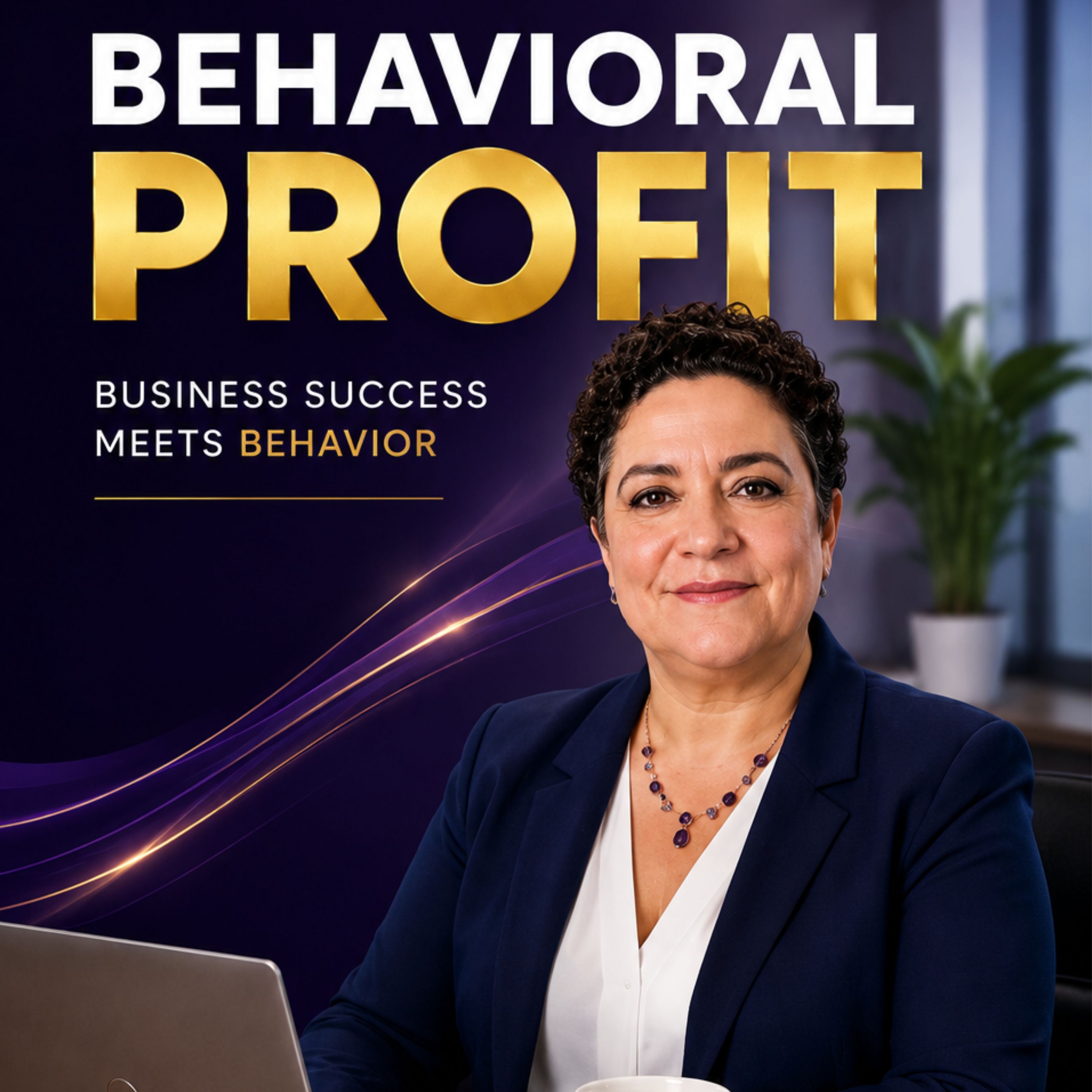
In this episode of Behavioral Profit, Debbie Longo speaks with Oksana Lukash about the behavioral patterns inside organizations that directly impact performance, retention, and long-term profitability.
With over 20 years of experience in people operations across small, mid-sized, and large organizations, Oksana breaks down the real difference between companies that struggle and those that scale successfully. The conversation focuses on how leaders treat employees, how decisions are made, and why internal behavior always translates into external results .
They discuss the gap between focusing on shareholders versus stakeholders, why employee experience drives customer experience, and how trust, psychological safety, and alignment create measurable business outcomes. Oksana also challenges common leadership habits, including over-reliance on AI in hiring, making decisions in isolation, and treating employees as replaceable rather than as long-term investments.
This episode reinforces that businesses do not fail because of strategy alone. They fail because of behavior—how leaders communicate, how teams operate, and how people are treated. When those behaviors shift, performance, retention, and profit follow.
Contact Information:
Debbie Longo Transformational Coach
Email: debbie@lifeinbloomny.net
Website: https://lifeinbloomny.net
LinkedIn: https://www.linkedin.com/in/debbie-longo-life-in-bloom-ny/
Oksana Lukash:
Website: http://www.oksanalukash.com
LinkedIn: https://www.linkedin.com/in/ksusha45/
Email: ksusha45@gmail.com
Welcome to the Behavioral Profit Show. I'm Debbie
Longo, Transformational Coach. This show is about
one thing, why businesses don't perform the way
that they should. Most leaders think they have
a strategy problem, but they don't. It's behavioral.
It's how decisions are made, how pressure is
handled, and how people actually operate inside
the business day to day. On this show, we break
down... what's really driving missing targets,
stalled growth and poor execution, and what shifts
when behavior changes. Because when behavior
changes, performance improves, and that's where
profit comes from. We have a very special guest
today, and we're gonna take a closer look at
what's really going on in her business, what's
working, what's not, and what behavior may impact
performance, and what your experience is in your
businesses that you've worked on. Good afternoon.
Welcome to the show. Thank you for being here.
Thank you, Debbie, so much for having me. I'm
going to ask you to talk a little bit about your
experiences in the businesses that you've been
in and possibly your current business that you
have, whatever you're comfortable talking with,
where you have seen a behavior change when from
one... point to another, and this will be also
part of your experience also, right, in the business.
And that change ultimately went to increase sales
and profits, or it went to make the business
more positive, where the employees were better,
everybody was nicer, different things like that.
But what the ultimate goal of this show is, okay,
is what I just explained, which was very broad
in the introduction. But the ultimate goal is
if I change my behavior, either the business
owner transfers to the employees, that will ultimately
increase sales and profits. And then the company
will go from all the way down to the very, very,
very top. And their peers in their industry that
own other companies will have no idea what happened
at all. and they will know because their business
will basically skyrocket, okay? So if you could
explain to me some of those experiences, I would
really appreciate that, thank you. Yeah, no,
happy to. So to give you a quick overview so
that the viewers understand my experience, I
spent over 20 years in the People Operations
space or... A lot of people call it still HR
and worked for small, medium, large companies,
privately owned, equity or VC backed as well
as a lot of public companies. And what I've seen
the main huge difference is how talent internally
is treated. It's also how companies look at all
of the stakeholders versus shareholders. So the
stakeholders is everyone that's involved with
the business. It's your talent, it's your employees.
It's the board executives, your customers, the
people that do invest in your organization, as
well as your customers and clients, vendors,
everybody. And again, obviously shareholders
are usually only the individuals that have financially
invested in your organization. And the big behavior
is that if you pay attention to the experience
that every single stakeholder has, that is the
difference maker because you're thinking about
the entire company, everybody that's involved
with it. The way I say it, especially if your
business is very much dependent on the customer
experience and customer service, you cannot possibly
ask. You are employees to provide a four -season
rich Carlton experience to somebody when you're
giving them, right, a Motel 6 experience themselves.
You can not ask people to do something you're
not willing to do yourself. And I think for a
very long time, a lot of companies only focused
on financial metrics, operational rigor, all
those things that are easy, in quotations, to
measure. and report, but how do you measure again,
right people? How do you measure engagement?
We've tried, but it is very tough. But the thing
is once you invest in each individual, once you
again understand what each person is amazing
in, what are their strengths? What are their,
we're going to call it superpowers and align
them to roles where they can do what they do
best the majority of the time, and you create
an environment and experience where they're striving
and most of their needs are met, all you really
then have to do is kind of get out of their way
and let them do their thing. And I've been again
in companies, one comes to mind, where we grew
from 200 to 600 in less than two years and were
acquired and were able to actually drive a higher
per share sale price because we were the best
company in what we did. And our differentiator
was customer service. It was the customer retention.
We had, I believe, 98 % of customer retention
in an industry where that's unheard of. And it
was all because we were best with what we were
doing internally for our employees. And that
just completely build over into our clients and
we also built in. why the work that they were
doing was important. So that's really good and
that's an excellent point. There's a few excellent
points actually that you made there. So the first
one is that you explained about how a few different
ways that you can help people change their behavior,
right, by being positive. And also, a lot of
people don't realize, and this is one of the
things that I teach a lot too, is that everything
is customer service. Everything is sales. So
like people say, oh, I'm selling a service. That's
not true. They're selling themselves. Like I
sell a service. I don't have a product, but I'm
selling myself. And one of the reasons how I'm
doing this is through the few podcasts I have
advertising social media. So everything is sales.
And how do I, what do I do? I have to have customers
or clients, whatever you want to call it. in
order to make a business. You do, everybody does,
so I could live, so I could pay rent and put
food on my table. How do I treat the customer?
How do I treat the client? That's customer service.
So we could think it's one thing, but you have
to really look at it and use your imagination
a little bit. because everything is customer
service. So not only that, but if I have employees,
some businesses have a little, some are small
businesses, some are medium sized businesses.
All right. And if, if I have employees, I want
to treat them like I would want them to treat
my customer. So I'm going to talk to them positive.
Now they're going to get on the phone or speak
to the client in a positive way. But if I talk
to them negative with controlling and manipulating
and everything, then that's how they're going
to relate it to the client or the customer, whoever
they're talking to. And that's ultimately the
person that's going to bring in their business.
So it really depends on how I treat my employees.
And that's exactly what you just said. Those
are the examples that you just exactly gave.
And that goes perfectly in line with what? Ultimately
increasing sales and profits, because that's
exactly what that's going to do. I can add really
quick to that, too. At the end of the day, we
are very social creatures as people and we do
business. with other people. So again, right,
there's very, I mean, there's definitely a handful
of organizations and companies that do something
that is so unique, that they kind of have the
monopoly on the market. With everything else,
there are dozens, if not hundreds of companies
that offer the same product, the same service.
So the difference truly does come to those relationships.
And it comes down to the fact that you have again
that trust, that psychological safety, that again,
all businesses are great at taking care of their
customers when everything is going fantastic.
But the true test is when things go off the rails,
when there are mistakes, when there are issues,
that you want to be able to reach out to somebody
and have that conversation. same thing as internally.
Yes, you want to treat your employees positively,
but in no way does that mean that you're right,
not going to have the tough conversations. If
somebody is not doing what they're supposed to
do, if they're not meeting the standards, it's
more how you do it. It's again, it's not beating
somebody over the head and really a rate making
them feel less. then it's being able to give
them that constructive insight with examples,
but also provide tools and support on how they
can go ahead and be able to work in that area.
So be specific. If you're going to ask somebody
to be better in something, also support them
and give them the tools. and then stay with them
to ensure, right, that that behavior is moving
in the right direction, because that's how they're
going to be able to also then handle those sticky
situations with the customers when they come
up. And that is another thing that is extremely
popular and common is that this is how, if my
business is not going well, there's a problem.
There's a serious problem. If I am decreasing
in revenue, in sales, what's going to happen?
I'm going to have, if I'm a business owner or
an executive, I'm going to have less money in
my pocket. And that's not a good thing. Let's
say I'm on the stock market. My stocks are not
going to be doing good. That's not a good thing.
So unfortunately, people, businesses and business
owners have to get to this place where they are
losing a lot of money in order to see that. Now,
I don't want that. And I know that doesn't have
to be like that. But a lot of times that's where
it gets to because the business owner is going
to constantly do what they're doing. And they're
just increasing negativity, whether, like I said,
it's control manipulation, whatever it is, right?
They're increasing negativity. And then what
happens is that that's when the business starts
to go down. And also nobody could do anything
by themselves. I can't run a business by myself.
I can't have a family by myself. If I was by
myself, I would have no family. It's impossible.
There's no way that I could do pretty much anything
by myself. So whether that company, and I could
think of like a tech company, whether those employees
have direct access to the customer or the client
or not is fine because that's going to manage
them differently. Basically, so the way they
manage the way the business owners and the executives
manage or transfer information or whatever to
the employees is going to be different depends
on the business. But It could be advertising.
It could be anything, social media. Eventually,
that information gets translates to the customer.
And believe it or not, you don't necessarily
have to speak to the client in order for it to
get translated there. But that's not a whole
nother story for another podcast. I think another
behavior that CEOs, boards, executives. business
owners, founders really need to adopt and be,
in my opinion, non -negotiable, is don't look
at your talent as easily replaceable. And what
I mean by that, again, everybody, like you pointed
out, is going to have tough times. But here's
the thing. You know that. No business, right,
just starts off and shoots into the sky and never
hits the mark. And if you do, you probably have
a lot of skeletons in the closet that you don't
know about, because again, it's those tough times
that test the business, that test the teamwork,
that test the relationships and the ability of
everyone in the organization. But as the top
leader, when you are making decisions to hire
somebody. I believe it is very important that
you have to look at every single hire as you
are making a commitment to them, that you are
going to do everything and anything to guarantee
their space and that job for as long as humanly
possible. The same way as when you're bringing
in a new person, you also need to ensure that
that does not jeopardize the jobs of other people.
If you are in a situation where, and I'm not
saying don't ever let anybody go, right? For
anybody that might jump to that, no. What I'm
saying is don't just automatically, oh, potentially
our business is gonna increase. We're just gonna
hire a bunch of people. And if it doesn't come
through, we'll just let them go. Don't do that
because you do have that obligation. And like
you said, you were not hiring just an individual.
You're hiring actually their entire family. You're
hiring everybody that that person knows and loves.
And guess what? As a leader, your employees'
family and their children know your name. It
is up to you in what context and how. but you
are being talked about at dinner tables. So you
need to take that very seriously. So again, every
investment, every addition and headcount is a
huge responsibility. And again, I think it's
very important when the tough times come, don't
automatically jump, select, cut headcount. Look
at all the other ways that you potentially can
tighten the belt. Also, I would urge regardless
of the size of your organization during the tough
times, during the times, even great times, but
you need to write potentially pivot. There's
a lot of change management. I seriously beg all
the executives to not make decisions in silos.
The bigger the company, the higher your role.
the more you are separated from what actually
happens day to day on the floor. So if you're
making decisions in a silo in a room, you're
going to screw up. Bring in as much as you can
with confidentiality, all of those things in
tow. Bring in the people that the change is going
to impact and make them be part of the solution.
They're the ones doing the job every single day
and don't doubt their capability. Just because
if you did that role five, 10, 15 years ago,
that's five, 10, 15 years ago. Let's think back
of, right, how we even lived a few years ago
and how we do now. Change is, right, instantaneous
and happens every single second. That's another
thing. You as executives of leaders, have that
obligation to your people, and you need to take
that seriously in order for them to also have
that psychological safety to be able to step
up during the challenging times. And guess what?
People will understand when you do need to let
them go and other things. If, right, again, they've
been part of that change and part of trying to
figure anything and everything out to save costs.
they will eventually understand that a lot more
versus, right, we get pulled into a room or better
yet, I forget the company that just did this
with 30 ,000 employees, but they woke up to an
email and then, right, their laptops were turned
off and that's it. And that's how they found
out that they were being let go. Let's stop doing
that. Yeah. So those are very good points. And
at the beginning of what you said was that We
have AI. So when somebody, when a business owner
wants to hire people, right, they get thousands
of applications, whether they post the job online
or social media, wherever they post it, everything
gets filtered through AI. And now that platform,
that system picks the candidates that best fit
their job role based on this, this and this,
whatever you punch in. Well, here's the thing.
That's what I was just going to say. So the thing
is that that's good because it makes it a lot
faster rather than the business owner looking
at each one, which is what we used to do before
we had AI. But the problem is that what happens
is I want to look at those resumes and I want
to make sure that I'm not missing anything because
there are things that I can that can get out
of these people right before other than what
AI gives. So the thing is that I know when I
am picking these people, right, I want to pick
them where I know that they're going to be like.
really benefit my company because here's what's
going to happen if they're not going to work
out. And people think that I can do this a lot
faster than what people think. OK, I could do
a lot of this on an interview or maybe an orientation
or something. If people are not going to work
out, right, that's going to be a lot of extra
money that I'm going to have to spend training
people. Then they feel it's not a right fit or
the business owner is not going to like it. then
they quit, then I have to train more people.
It's extremely expensive for business owners
to train people. And just like you're training,
you're filtering, you're interviewing the people,
you're determining them, just like that, that's
the same thing as me treating my employees. in
a positive way because what's going to happen
if I don't treat them right, if I don't serve
them, if I don't give them the proper training
or relay whatever it is that I need to to explain
to them that they are now going to transfer to
the client. All of that is the same thing as
me not hiring the right people. The way that
I treat them and the way that I hire them. and
the way that I choose them is the same exact
thing. So that's why I need to be positive and
explain and describe things always in a positive
way where it's going to benefit the candidate
or the employee. It's not going to benefit me.
Ultimately, it will. But I'm not doing it to
serve my needs. I'm doing it to serve my employees
needs. And that way they can get me customers
and clients, even if they're not directly working
with them. It doesn't matter. It eventually will
get to the customer. I need to have a customer
for every single company. I will not have a company.
Okay, so this is the thing. So this is what a
lot of people, they look at it at face value.
And they say, well, this doesn't pertain to me
because I'm a tech company. My employees don't
deal with customers and different things like
that. They do, they do. So this is what I'm saying.
It's like, you have to use your imagination a
little bit and tech companies do this. You know
what I mean? They all have. Yeah. Yeah. I want
to, I want to go back to the AI thing. I think
here's the thing too. We, for some reason, and
I don't know where or when this happened, we
look at a lot of things as or. So it's this or
that, and actually very few things in our lives
are an or, and most of them are an and. And what
I mean by that, even like look at vows when somebody
gets married, it's for better or for worse. Well,
if you have a choice, what would anybody take
for worse? It's for better and worse. you're
going to have good days, you're going to have
bad days, or you can have a good and a bad hour
in the same day. The reason I bring that up is,
again, AI at the end of the day is a tool. It
is a fantastic, a very powerful tool, but people
need to use it that way. Because what happens
is, and again, with my experience, a lot of recruiting
and talent acquisition functions are very, very
understaffed. because AI is a tool, you can not
100 % rely on its abilities as well because at
the end of the day, people with a lot of bias
have also built it. And if we're going to be
completely honest, job description, most of them
suck. Like there's no other way of saying it.
They're outdated. There wasn't that much time
put into them. So any job description is a company's
best. attempt to try to capture what it is that
they think they need. Our resume is a candidate's
best attempt to try to capture in two, max three
pages, all of the experience that they think
somebody's gonna find right relevant. So we have
an imperfect job description, an imperfect resume,
and then we're laying an imperfect tool on top
of it. to try to make a match. It's a recipe
for disaster. So I think again, right, we can
use AI to help us navigate and maybe sort some
of the resumes, but I think you can not take
the human out of it because still. We are the
ones with all the experience that can see transferable
skills that understand what certain companies
are doing. And I also guarantee you that there's
so much bias on the recognizable logos of large
companies or still recognizable big names of
certain colleges that get resumes through to
the next. age that don't have the experience
that they need or right that the company requires,
they get pushed through for other reasons. So
there's things that we can do where we can actually
blind, where we can blind the resumes of names
of companies, of colleges, and truly just look
at that experience. and then identify individuals
that we might want to talk to. So again, I just
want to urge people to continue using technology
and tools as tools, not as a complete total replacement
for the human experience. It's not intelligent
enough to be able to pick up all of that, and
you're going to potentially Our resume is just
that it's a piece of paper. That's what gets
you an interview The rest is up to the person.
So again, let's just spend more time in that
process Finding the people and giving them the
time and the grace to talk about what they bring
to the table Versus it just being right was what
is what is in it for the company? It needs to
be it's a relationship. So it needs to be beneficial
for the company and the candidate Yeah, it's
easier for a business owner to look at AI and
have them filter all of those candidates, but
that's not going to benefit them in the long
run. So they should take that. little time, extra
time, whatever it is, little or a lot, that they
have to not just depend on that. It's a tool
that we could use. If you don't want to use it,
it's fine. Just go old school and go back and
just go through them again. It's not the end
of the world. But if you wanna use it, you still
need to filter those candidates yourself and
look at what is gonna benefit you. But the thing
is, how am I gonna be able to, is this person
gonna work out? How am I gonna be able to communicate
with this person, with this candidate? Because
sometimes, I hate to say it, but sometimes it
has to do with the the vibe that you're getting
from the candidate when they are on the interview,
that mental connection. So they could dress really
nice and look really good, you know, but how
do you feel? Think about what is your gut telling
you after you go on that interview. And these
are all connections because we don't, like you
said, we don't want to do it fast where I need
to hire somebody. OK, I'm going to hire 10 people
today, you know, and then I just hire this, this
and this. I just pick what AI gives me. That's
not going to be a successful business. because
we need to look at things where this is gonna
work out and this, I'm developing a very, very
positive company now where everybody will get
along and all of these things that I don't think
are gonna happen, they will happen because everybody
always has doubts and that's just a human thing,
but I don't have to have that. I can interview
people and just have, not only interview, but
have the employees that I have now, right? and
work with them and say, they will get along and
everything will be perfectly fine. And there
will be no problems at all. And every business
can get there, but they're the ones that are
holding themselves back. Yeah, I disagree with
the fact that it's possible to create an environment
where everybody gets along. I think that is actually
not reality. Here's the difference. I think a
lot of people... mistake, being professional
and working together and being friends. When
you are in a work environment, nobody's asking
you to be best friends with everybody. So you
can absolutely not like somebody as an individual,
but if you're working together, it is the expectation
that you are professional and cordial with one
another, and again, find a way to work with one
another. So I think that's where, again, it's
up to the company to create the experience, the
psychological safety, the ability to have constructive
conversations. to still have respect for one
another and totally okay if we never go to lunch
together and never go to happy hour or whatever
else it is so I think that's where right the
company needs to be honest about it but we also
need to be a lot more thoughtful in the entire
recruitment process in the interview process
in how we prep for it and unfortunately again
in 20 plus years of what I've seen it's an afterthought.
The managers are running from one meeting to
another, to another, to another. They review
the resume 30 seconds before they're walking
into the room with the candidates. They start
asking all the exact same questions from the
resume that already are stated there versus really
thinking through of what does my team look like?
What are the skills that I currently have? What
are some of the gaps in the skills that I have?
What are, again, some of the right, the really
strong individuals that I have on the team and
what do they bring to the table? And again, what's
lacking? What do we need right now? What do we
need in six months? What do we need in 12 months
based on where the business is going? And again,
ask those questions. Ask questions that have
people give you real life examples of how they've
handled the situation. If you're hiring somebody
for customer service. have them go through of
how do you deal talk to me about how you've dealt
with an irate candidate and if somebody tells
you they've never dealt with one and they've
been in customer service let's say right anywhere
longer than a year that is very difficult to
believe because we can all go outside and we'll
find an irate candidate or client customer anywhere
out in the world so ask those really thoughtful
questions again go into the interview if you
are interviewing somebody prepared and respect
them the same way as you know they have prepared
for that interview. And I think that's where
we missed the point. We asked again employees
last minute to jump in and interview somebody
where they don't know what they're looking for.
They don't know, right, what to ask them. They've
never been trained on how to interview. start
actually spending more time in that process and
treating it like the important process in it.
So those are some good points. But the ultimate
thing is we don't know what's going to happen
because nobody's a psychic. But the point to
this whole thing is that and we're talking about
the structure, the way that we conduct the interview
and how we get the candidates and that's totally
fine. But the point is that I always want to
go in and this is what you're giving examples
of this. I always want to go in with as positive
as an attitude that I could possibly have. So
if I say, oh, I'm going to interview 10 people,
but I'm probably not going to hire any of them
because they're probably not going to be good.
Do you think I'm going to hire anybody? Probably
not because I just went into that with that attitude
before I even interviewed anybody before. ever
walk through the door. And like I said, you're
giving all different examples of this type of
stuff. And I wanna make sure that not only am
I transferring that behavior to the employees,
right, but that they're accepting it. And they're
saying, this is really good, what my boss is
doing. And now I wanna practice that. positive
behavior or this specific thing that they're
teaching me. And what does that do? Then that
transfers to another employee. Not every employee
is going to get along. That's not reality. What
I say might not come true. That's the reality.
But the point is that how am I going into it?
How am I transferring that behavior? And that's
going to go by what kind of behavior do I have?
Am I negative? Am I positive? Am I controlling?
Am I manipulating? I mean, there's like a hundred
examples of this that we could go on with this
podcast for like three hours. You know what I
mean? And this is all the stuff that I teach
because not only is this gonna increase sales
and profits, but it's gonna make my company a
lot more successful and it's gonna make me a
lot more happier. than I am now. And then what
do I do? I take that behavior and then I transfer
it to my home, to my family. I think this was
a very good way to close. We're almost out of
time. So is there anything that you would like
to say in closing? I think, again, I would just
encourage every company to focus internally and
focus on building an environment, processes and
ways of working. that are based on your organization,
what makes you different and why customers come
and choose to work with you. Stop chasing what
everyone else around you is doing and copying
a little bit of that because you don't want to
be a version of somebody else. If you're going
to win, if you're going to be the company in
your industry, in your space. Focus on, again,
what makes you different and unique. Embrace
that. Be able to, again, clearly define that
to your customers, to your partners, to all of
your stakeholders, to future candidates. And
they will, again, if it aligns with their values
and what they're looking for, they'll come and
choose to work with you. And it's absolutely
okay that some do not, because again, you want
to bring in people that can thrive in the environment
that you have and what makes you different. Yeah,
very, very true. And that was an excellent way
to close. Thank you for listening to the Behavioral
Profit. At the end of the day, most businesses
don't have a strategy problem. They have a behavior
problem. When you identify what's actually driving
your results and shift it, performance changes.
If you found this valuable, take a look at your
own business, what's really driving your results
right now. Thanks for listening to Behavioral
Profit. I'll see you next time. And thank you
for being on the show. I appreciate it. Of course.
Thank you, Debbie.