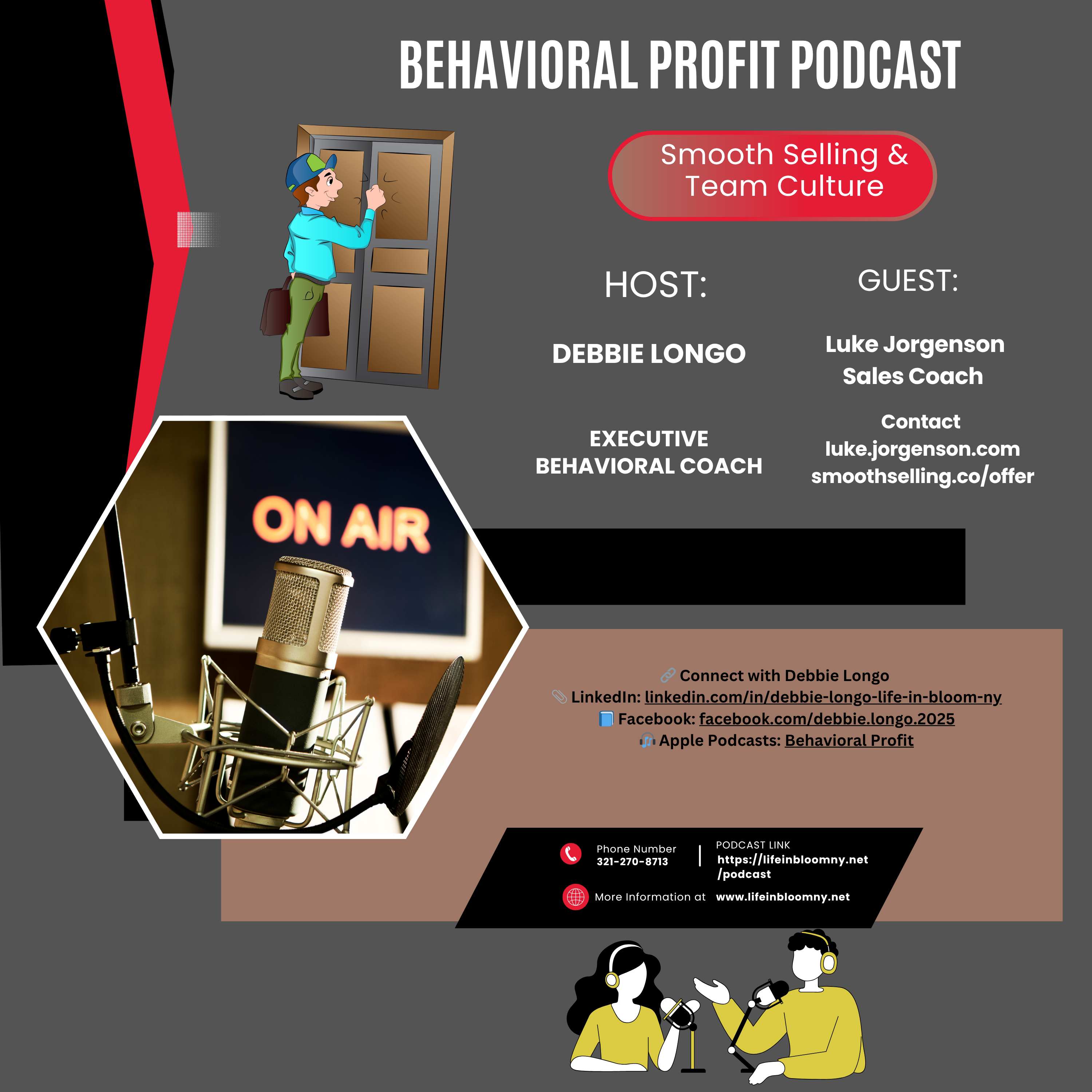
In this episode of The Behavioral Profit Podcast, host Debbie Longo welcomes sales coach Luke Jorgenson, a top 1% performer in the solar door-to-door sales industry. Luke shares how he transitioned from a high school teacher to a nationally recognized sales leader, leading ethical, high-performing teams for nearly a decade.
Now a coach for individuals and sales teams, Luke dives into what makes sales work — from mastering your pitch to building strong team culture. He explains why sales is a life skill everyone needs, not just salespeople. You'll learn the mindset behind effective selling, how to communicate value smoothly, and what leadership behaviors drive success in tough environments.
Learn more about Luke's Smooth Selling Framework: smoothselling.co/offer luke.jorgenson.com
Welcome to the Behavioral Profit Podcast. I'm
your host, Debbie Longo, Executive Behavioral
Coach. This is the show where we turn workplace
behavior into real business results. Whether
it's leadership, performance, or team dynamics,
we dig into the patterns that hold businesses
back and the shifts that drive profit forward.
Let's get into today's episode and unlock your
behavioral edge. We have a very special guest
today. Luke Jorgensen is a sales coach who spent
the last 10 years door -to -door sales industry.
He also led sales team for nine years. Luke and
his teams were known for selling the right way,
ethically, as well as having an amazing team
culture. Luke has now shifted to being a sales
coach for individuals and teams. Luke, would
you like to tell your story? Welcome to the show.
Thanks for having me, Debbie. The crazy life
of door -to -door sales. It started before that.
I was actually a high school teacher doing that
for a living, looking for a little summer income
as us teachers often do. I heard about an opportunity
to excel and I knew individuals that did that.
And I thought that might be a good way to do
it. I went for a week. I liked it, surprisingly.
And I decided to. make the jump and change careers.
So I jumped right in, head first, feet first,
all that good stuff and made a career out of
it. And so I spent 10 years selling a great product.
I sold solar to residential homes and loved the
product, loved the idea of it. We made a career
out of it and basically changed our whole life,
our whole trajectory. And I'm very blessed and
very happy to have made the jump. Thank you very
much. I appreciate it. Do you want to talk a
little bit about your talking points? I enjoy
sharing my experiences about what I learned selling
daily, meeting such a wide range of people every
day. Yes, some weird people for sure, but 99
% of people are good. I've found that being new
to the industry, I just didn't know what to expect.
You heard stories about the whole idea of rejection
and that's definitely a thing. Getting over rejection
is a huge skill that you got to learn in that
industry, but I thought it was going to be a
lot worse than it really was. I guess I just
didn't know what to expect. You didn't have success
with 99 % of the people, of course, but 99 %
of the people I felt if you treated them the
right way, they treated you the right way. And
so that was a huge, I think once I realized that,
you know, if you come across the right way, people
are going to reciprocate that back to you. Even
if they're not interested, even if they're busy,
even if they're a little bit honoring, I felt
like I had a gift to approach it the right way
aspect. I got a lot of good results. My day wasn't
filled with negativity nonstop. Although I got
rejection and knows nonstop. But to me, that
was a little bit different than getting the door
slammed on my face. For instance, I had great
teachers. Luckily, somehow, some way I met up
with a team that was really good and all these
guys were young guys. They've been in the door
door industry. Now selling different products.
Most of them were coming from selling home security
systems. And that was the main core of the team.
So all these young guys I'm going to learn from
that are right out of college. Just tell me what
to do. I think anyone in any new situation, I
think that's the right way to approach it as
far as maybe you're new in sales, maybe you're
not even in sales, but you're starting a new
position with a new company or a new opportunity.
I think the best way to do it was like, I'm here
to work really hard, but I'm just going to learn.
And as I taught my team and started coaching,
my people that would come in our doors and I
started to become a trainer and I just try to
give them that same mentality. I know you have
great experience. We hired you because who you
are and what you've done in the past. But if
you can just take two steps back for a minute
and just latch onto somebody and these people
that know what they're doing, you'll be successful.
Because I've seen a lot of people, and you've
probably seen this in the industry, the know
-it -alls, they don't get too far. Even though
they're new to an industry, they know it all,
they're not coachable, they're not teachable.
That mentality really holds them back. I think
that's very brave of you to move and change jobs,
take the leap of faith, just take a chance. And
when it's a matter of being able to live, pay
my bills because they're moving and the financial
obligations that go along with it, that's a huge
chance to take. And that's why it's very good
that it worked out for you, because one of the
reasons why I do this show is a lot of people
want to do that, but for whatever reason, maybe
they're fearful, maybe they're doubtful, maybe
they think, I don't make that money. When they
probably do, they can change their finances in
some way where they can do it. because it's just
changing the mindset. I want people to see so
they can understand that there are other ways
of doing things and there are ways of getting
out of the rut that the person's in or they're
dissatisfied with their job or they argue with
their boss. That's a very positive story. And
I do a lot of podcasts where they're very negative.
I try to help people. And I'm going to be starting
another one that's going to actually be a coaching
session. They'll turn out positive, but they're
not going to start out positive in the beginning.
It's very good that I am doing this because you
already came out on the other side. So now somebody
could see that there is hope for them also. I
think that's a good message, Debbie, if I can
just piggyback on what you said, because the
way I looked at it is I was struggling financially.
I loved what I was doing. I love being a teacher.
But when you're in debt and you have all that
debt, I was like, at what point am I going to
be able to not keep looking at my bank account
every five times a week and wonder? So the money
would come in and we, as teachers, we get paid
once a month. And it was funny because the last
week of the month was always like, Oh, I just
can't wait to the first of the month. It was
always let's not get those groceries. And you
think I was a teacher. We didn't get paid a lot.
And I even had my masters and I was doing the
extra things on the side. I taught an extra class
for instance, to get a little bit more pay, but
I think people realize if you stay where you're
at, you're just going to get the same result.
That was logical to me. So if I kept doing what
I'm going to do, I'll just keep getting the exact
same results. Now transitioning to coaching.
That's one of my big themes is look, if you want
something to change, you're going to have to
change it. And I think the best way to change
it is to get someone that's then an expert, a
coach to help you because you can go from A to
B to C to D, but that might take you four or
five years. And if you can do that in six months,
for instance, then you just cut your timeline
down significantly just by having a little bit
of help and leadership. I like that. Thank you
very much. Next topic is I love talking about
sales mentally. Why so many cannot make it in
door -to -door sales? It's extremely hard. And
who succeeds is not always who you think. I always
thought, how is he so good? Look at the face
value, judge the book by the cover. There's no
way, but the good people learn the systems and
the methods at work. I think a lot of people
look at who's your typical quote unquote salesman.
And someone might picture someone that's super
outgoing and energetic. can be good at sales,
no matter what your personality is. If you have
the right methods behind your personality, you
don't have to change who you are. It's interesting
because when we would hire people, I had a couple
of leaders with me and we'd always look at each
other. We should just bring people in here and
flip a coin. If you don't know what's in someone's
heart, you can answer the right questions in
an interview. Are they going to keep going when
it's hard? I think that's a life lesson for anybody.
especially in cells, are they going to let the
fear of rejections of how much they care about
how people think of them? And if they care a
lot about how people think of them, it's really
not great for cells, honestly. But that's a skill
you can get better at. So who's going to be teachable?
Who's going to have all those mental things that
you just can't check a box. You can't show that
on a resume. As part of my message in coaching
is also a lot of people, I'm not a salesman or
I'm not in sales. If you have anything of value
that you're trying to communicate to someone
else, you are actually in sales. You might be
personal branding. You might be trying to promote
yourself at work. You might have ideas you want
to share at work. That is a sales process. I
think a lot of people can benefit from knowing
just some very basics in sales. And that's what
we set up with my basic coaching program. It's
a simple, effective tool for salespeople, of
course, but also people that might not even have
a background and might not know where to start.
That was very good. Thank you. There are a lot
of situations that people sell in a lot of ways.
The big thing with selling is that it's usually
only commission, but You make more money on commission
than a salary job where you're getting a certain
amount every week. But people don't know that,
or they just want that salary every week because
they know that they're getting that. And the
process of doing something different and going
into a different career. is very challenging,
like we had just talked about, but it's also
very rewarding because I'm able to grow spiritually
and mentally in all of these different things
that I do every time I do something different
in my career or home, something that I don't
know, something I'm not familiar with, something
that takes me out of my comfort zone. And when
I do these things, I'm growing, but not only
that, I am evolving. I'm advancing myself. Now,
some people know what their destiny is. Somebody
who grew up to be an actress, when they were
a child, they knew that they wanted to be an
actress. Somebody who's in the Olympics, when
they were a child, they knew that they were going
to be in the Olympics. A lot of times people
know their destiny, but it's a matter of whether
or not getting there. How am I going to get there?
What is the process that I need to go through?
And that for me is what coaching does. If I want
to learn algebra, I sign up for the class. When
I go into the first class, I don't know algebra.
By the end of the course, I know it. I've taken
the quizzes. I've went to the lectures and I
took the final and I passed everything. Let's
say it's algebra one. Would I take another algebra
one class? No, because I already know algebra.
So now I want to take something I don't know.
So if I like algebra, I might say, I really like
it. And I really want to advance in this and
it's helping me grow. Now I want to take algebra
two. That's just a different scenario or an example
I'm trying to use because each time I take the
algebra class or each time I do something different.
If I'm a boss or an executive, I hire a new employee
or there's a challenging employee that have to
enforce what their job duties are because they're
not doing it. Every time something happens that
gives me a challenge. That helps me grow. So
I want to be out of my comfort zone. That's just
from my own personal experience. I'm also a life
coach. That was how I originally started. My
company is Life in Bloom and Wife in New York.
I have the experience in everything. And so those
are some good points that I wanted to say. Can
I add to that, Debbie? And if you look at all
the idea of coaching, if you look at some of
the greatest athletes in the history of the world,
take a look at Tiger Woods, for example, he had
a coach. And so some people don't want to get
a coach and they don't even know how to swing
the club yet. And so you got to take a look and
same thing, Roger Federer, all these tennis pros,
you look at any walk of life where people are
really successful, they have coaches. And it's
not just athletes, it's in business. They might
call them a mentor. They might call them a peer,
but someone that they can turn to for guidance,
for direction, for help to go to the next step.
And so I think the idea of coaching is powerful.
I just got a new coach to help my brand, help
get my new business off the ground. And so I
think the idea of coaching is just powerful.
We need them. So the next topic is sales should
be learned by anyone who has to communicate value.
Sales is not just for typical salespeople. Sales
is like a life skill in business. Do you have
something of value you need to communicate? Then
you need to learn basic sales skills. People
all the time will say, I'm not in sales. And
they are. If you're an employee, you're going
to try to sell your value to the company in some
way or form. So if you're a business owner, you're
going to try to sell your ideas and your techniques
and what you guys need to do in the direction
to your employees or your buyers or anyone on
the executive team. So I think the idea is sales
is such a diverse path. And I think sales is
one of the quickest way to improve your people
skills. We need cells. You are in cells. If you
do learn those skills, you are going to improve
your people skills. The growing social media
where technology is allowing us to stay connected,
but not really connected, but that idea of you
still need those people skills. You still need
to be able to communicate value in some way,
shape, or form. If you got a spouse or a partner,
at some point you got a position where you're
coming from to them. Sometimes even my wife should
be like, are you selling me? No, I'm not, but
I probably am. Cause there's just like a skill.
You're just trying to communicate value to someone
else. And there's a proper way to do that helps
them A see your side and B can bring them to
your side. It doesn't mean it always works, but
there's proper ways, there's proper methods.
And I would invite people to get some training
on sales, read a few books, listen to some podcasts,
join my course that we're offering a super low
price course. I think if anyone's looking for
a career opportunity, young people, I think sales
is a great thing. I just went in it for the money.
And then I realized, like you were talking about
the growth. I could not believe how my personal
growth was unreal. It was like putting me on
this super growth protein. I don't know how to
describe it. Like a gym guy that's out there
working in the gym three times a day, having
math as a result. So the sales process, because
it's great. You get immediate feedback on people's
skills. You will say something and then they
look at you and oh boy, I just derailed it. Don't
say that again or. It's just the feedback is
so immediate and then it helps you with your
personal growth. I recommend it to young people.
Get out there. The growth is huge and it's amazing,
but also it's a skill that you can use in so
many aspects of your life as a business owner,
entrepreneur, employee, like whatever it is that
you're doing. Thank you very much. That was mostly
what we talked about in the question before was
reiterating. I need to have for me to succeed
in anything. I need to have faith and courage,
even if it's another career or getting a promotion.
I need to know that's gonna work out. And if
I'm not sure when I go into it, maybe I will
become sure. Maybe that's part of the process.
But the faster I can know that, the better it's
gonna be for me. And the more positive it's gonna
work out. And that's a process. That's another
reason why I need a coach. And it's good that
coaches have coaches, because like you were saying,
you can learn more from them, especially if you
don't know anything at all, or you don't know
a lot. It's like a therapist goes to therapy.
So there's a lot of teachers take a continuing
learning course. Right. It's done pretty much
in every industry. The next topic is pitch, presentation,
teaching, closing, and follow up. The core of
cells. We could give you an example. Say you're
a business owner and you see a problem in your
team. And so when you go to communicate to them.
You want to have an idea of how to do this. You're
trying to communicate the value. You're trying
to get them on your side. So there's a certain
way to do it. It has a lot to do with dealing
with the problem, talking about the solution.
Let's say you're a business owner and you have
a problem with your employees coming late. This
is what we're seeing. Here's what we feel like
the solution to that problem is. And then you
can transition into a game plan. Sales is all
about moving someone from point A to point B.
And just a little bit. So that point A to point
B might be for your employees. We agree. There's
a little bit of a problem. And now you're trying
to get them from point B to point C. Let's get
some action. Let's get some change. There's a
lot of things you can do asking the right questions,
trying to get buy -in, trying to them to actually.
agree with the problem, them to see it's actually
a problem, questions become a huge part. But
those are your core, like you got a pitch and
presentation. The presentation pitch sometimes
depending on the situation can be the same, depending
on the cell and the cell situation. But the presentation
is also being able to teach. So we are, when
you can teach someone something else, they see
you as valuable. If I can teach someone else
something they didn't know, immediately without
them thinking, they're thinking this guy's valuable.
And then if I can keep going and keep doing that
and show them that A, I can actually provide
something of value now to you. I have something
that will help you, something that will benefit
you. Now he's offering me something of value.
And then follow up just doesn't happen enough
in cells. The next step is it's not always just
one conversation and it's done. The follow up
is a key, the follow up plan. Maybe they're not
on your right side. Maybe you got to keep the
connection going. So follow up is a big key for
cells. Thank you very much. You said a lot of
good things. You explained how you came out the
other side, how you went through the process.
I'm hoping that gives somebody clarity and helps
them in some way. The way you do it, the pitch,
the presenting. the closing, the follower. I
need to have some kind of system, some kind of
process I do if I'm doing any type of sales or
anything. Like you said, everybody's selling
something in some way or convincing somebody
of something they want to do to try to get them
to do it or whatever. So the next one is anyone
who wants to improve their people skills. should
get into sales. The repetitions of having connections
with other people, whether that's on the phone,
whether that's on a zoom, whether that's person
to person. I look at waitresses and waiters.
I think they're in the same boat. The people
skills. I got a daughter that was a waitress
for a while. I just noticed immediately her people
skills improved. And we're still in a people
to people. We have all this technology, but we're
still people to people. And so anything you can
do to improve those skills and It's just going
to take you because I see a path of the people
that are really good with people skills, especially
in our younger generations. They're going to
stand out way more than people that don't. And
so I've already seen that in one of my sons in
high school. He's pretty good with people skills,
but a lot of his friends aren't. And so I look
at him and opportunity in. work in entrepreneurship.
I see him as he's already four or five steps
ahead of some of his peers because not that he's
smarter, his people skills. So he can talk to
adults. He can communicate instead of just one
word sentence, he can communicate a little bit
longer. I think that's a key. He often talks
on the phone instead of texting. Like those types
of things, anything you can do to help your people
skills. And I'm kind of. referencing this to
young people, but I think is also with us. How
can you get around more people? When you go to
the coffee shop, how can you talk to someone?
How can you approach them on anything out of
it, other than a conversation? You're just trying
to just sharpen your people skills and anyone
that's in some type of people oriented position
can benefit from just practicing their people
skills. Yes, that was good. Thank you. So we
talked about growing spiritually, mentally. The
people skills I know are not very popular now.
They're not very common only because of the technology.
Everybody is looking at their phones. A lot of
the younger generation, they're isolating. They're
on the computer. They don't want to interact
with their peers. There are a lot of ways that
we can improve people skills. Being in sports
is one of them. They can join the football team
or the baseball team in their school. And that
helps. That's very good to build discipline and
people skills and different things. Another way
is to just get out there. and talk to people
in all different ways. You could talk to people
in your community. There's a lot of things where,
what are my classmates doing? What are the people
around me doing? What are my neighbors doing?
And a lot of times I follow them. That's how
society basically develops. What's going on in
your neighborhood? People might be on their phones
all the time. But what's going on in somebody
else's neighborhood? Maybe they can't afford
phones. They're outside playing. And a lot of
times that's a good thing because they're being
social. And that's very important. So it's not
that one thing is right and one thing is wrong.
We could find positives and negatives to both
things, just like we can with anything. The things
that we're mentioning here are different topics,
different parts of maybe somebody's behavior
or what somebody is doing in their life. Those
are things that we could touch on. If you're
listening to this podcast and you could relate
to any of these things, maybe we can help you
just to fix or just help you with that one little
thing that you want to change. It doesn't have
to be that I want to go from not being social
at all to being the most social person in the
world. It doesn't have to be such a drastic shift.
It can be just, I just want to change this one
little thing. I'm not social at all. Maybe I
want to become a little bit more social. Maybe
I want to become a little bit more social. And
then gradually I'm just giving an example. So
gradually I become more and more social, or I
might want to make a drastic change. But one
of the reasons why I have these podcasts is to
explain all of these different things to people,
to show them how you got to the other side, but
to explain to people there are all different
ways of doing things. And the best way that I
could do that is to give different examples,
conversing other professionals, people that need
help, like on a podcast and a lecture. at a workshop,
which is all different things that I do. So anyone
who wants to improve their people skills should
get into sales. I love talking about building
teams and team culture, how experiences should
be a big part of any successful team. So one
of the shocking things when I started selling,
I was lucky because I got on a team that really
valued team. A lot of organizations talk about
it, but they don't walk the walk. And it's a
super unique, I heard a guy when I first came
in, he's, we're going to do this activity. We're
actually going to play kickball. And I'm like,
what? And he's, yeah, everyone's coming. I'm
like, I have an appointment. He's, no, you got
to cancel your appointment. You got to switch
it. And I'm like, really? For kickball? Yeah.
You don't understand here. We're a real team,
a family. I guess that's what people are doing.
So that's what the teams does. I saw over time.
So I did that when I played kickball, had a great
time. And all of a sudden you become connected
to your coworkers. Now in this scenario, we'd
meet a couple of times a week, have trainings,
but then you all disperse and y 'all go sell.
And typically you're going on your own. unless
you're getting some training. So you would go
sell on your own and then we'd come back in the
meetings. And then all of a sudden these relationships
started forming. These people became my friends
and our spouses connected and we did things outside
of the office. I've been involved with teams
and sports basically my whole life, but the consistency
of that really changed the game for me because
I had support, I had people that were in my corner.
I had new friendships, people that were more
successful for me. I was rubbing shoulders with
people that thought a little bit better than
me, that had been where I want to go. All of
a sudden, all these benefits started to happen.
And I think now I see, I've looked for it and
I've adopted that same mentality in our teams
and we've had amazing people. Just to give you
an example, we had a guy that we had to get rid
of. The underperforming basically wasn't something
for a while. Didn't have any cells and people
don't sell. Obviously they don't, it's not a
good fit. He's I really suck at cells. I'm just
terrible. Cause you know, that full commission
cells, I would agree is not for everybody. How
are you making money? You got to find work. I've
known that for a lot of time, but I just, I don't
want to leave the team. And so. At that moment,
I'm like, okay, there's really power in this
idea of real culture, real connections, a real
welcoming when someone comes in, like not just
the boss welcomes them, but you have 10, 15 other
people welcoming in. And then over time, these
relationships grow. And so people really start
cheering for each other and there's more happiness,
honestly, with your team. So. I like this idea
and we're not quite ready to do this yet, but
eventually we'll start coaching teams on this
idea of culture and how to really build it and
systematically. It's like following a plan, but
a fun, enjoyable plan. People come for the money,
but they stay for the culture. And we found that
to be true because every once in a while people
would get other offers to go to this company
or that company. And most of the time people
would choose to stay instead of going somewhere
else just because of the culture. So I think
that's a powerful tool for teams. That's interesting.
And that's very good that you do that, that you
help in that way and you teach that because not
only does that build social skills and increase
their behavior and mental fitness, but it also
teaches them a lot of other things that are part
of their own personal lessons also. So there
are a lot of things that it does. It just depends
upon what I want to realize and what's important
for me that I want to focus on for me to move
forward in my life. Because to me, that's what
coaching is. I'm trying to help people to advance,
to be better than what they are now, to get out
of their comfort zone, all these different things
that we just talked about. And that's how they're
going to move forward in their life. And that's
how they're going to be successful. If you look
at these big companies and you mentioned all
of these different pros in sports, they had a
vision when they were a child and they worked
their whole entire life. These sports stars that
even made it to the Olympics or won all kinds
of awards, they worked their whole entire life
to get to where they are now. They knew that
was going to happen when they were a child. And
that goes for business too. These big companies,
their CEOs knew that they were going to own these
companies someday. So they had this vision when
they were very young. And you don't have to have
it when you're very young. You can have it at
any age. But these are just examples of anybody
is able to get farther than where they are now.
It depends on if they want to see that. It depends
on if they want to look at that. If that's what
they want to focus on. And that's important to
the person. It's important to me if I'm helping
the person, if the person wants to be helped.
I am doing that now. I'm out of my comfort zone.
I'm going way beyond my reach. I never thought
that I would do a podcast. I didn't really know
a lot about them before I started this. And now...
I am, believe it or not, a different person.
It's just strange, but I feel that way. Oh, I
believe it. And that's really helping me grow.
So there are a lot of different examples of this.
There are a lot of different scenarios, but I
would like to ask somebody if they're listening
to this podcast, that they can be... the person
that they've always dreamed to be. They can succeed
in the things that they never thought. I want
to be a sports athlete. This is the thing that's
holding me back. And there really aren't things
that are holding people back, not physical things.
The person could be holding themselves back mentally
for whatever reason, but anybody could do anything.
So it's just a matter of, does that person really
want to do it? Does that person have the willingness?
Is that person really going to go through all
of this whole process and all these things that
we just talked about? Do they really want to
go through that to get out the other side? When
you're a good agent. Do you really want to stay
where you're at? Do you want change? If you want
something to change, if you want the results
to change, you got to change. the inputs, get
out and do something slightly different. It doesn't
mean you need to be totally different because
that seems overwhelming to some people. When
you go to the coffee shop or talking to people,
it doesn't mean you start talking to everybody.
But maybe the person taking your order, ask them
one question and you're like, that wasn't so
bad. And then you sit down or you're waiting
in line and you're like, how's the day going?
And all of a sudden you realize this is not so
scary. I can do this. Maybe with your podcast,
the same thing, you're like, I got to figure
out this part. And you figured out that part
and you're like, Oh, I got that down. Now I need
to do this. You need to find the right microphone
or whatever. You just take steps, but you're
working towards something that you really want.
You want some improvement. You want some results.
And that was very good. I agree with that. Do
you want to say something in closing or do you
have anything else that you would like to say?
Oh, that's great. Thanks for having me on Debbie.
So if anyone wants to learn more, they can follow
me on Instagram. It's at coach underscore Luke
J. So at coach underscore Luke J on Instagram
is the best way to connect with me. Offer an
introductory course sells, which I think literally
we've been talking about it, but anyone in any
type of situation where they're trying to communicate
value to someone else should take it. It's super
inexpensive, but we've gotten really good feedback
from it and that's it smooth. Selling .co slash
offer. So if you go smooth selling .co slash
offer, you can get the course there and see if
you like that one. You might be able to take
some more and learn some more. Thank you very
much. So I have your offer here written out.
I am teaching a training on how to pitch and
sell smooth. I was known for making the sales
process smooth for both myself and the buyer.
Taking a lot of pressure out of the sale. and
making the sale a no -brainer. In my course,
W Method, Smooth Selling Framework, I teach this
proven sales framework that can be applied to
literally every sales situation out there. For
the same prices buying me lunch for the same
time, I'll teach you to immediately improve your
sales. Find the training and smoothselling .co
slash offer, which you had mentioned. And the
one thing that I wanted to say, In response to
a question that you said was about people being
in sales and their personality and how they can
succeed and they don't necessarily have to have
any experience, they can be teachable. And then
you said something about the repetition and I've
been in sales my whole life. And the trick that
I've learned is the constantly repeat. And even
if that person is walking out the door, I am
talking to that person and I'm selling that person
until the minute they get out of the door. If
it's inside sales, outside sales might be a little
different, but I always did inside sales. Or
even if they're walking away, I'm still talking
to them. I'm talking to them until it becomes
the minute that I cannot talk to them anymore
because they could stop. And I'm constantly repeating
the same thing over and over. There's a whole
psychology to this. You can look this up. that
people, we only hear 20 % of what somebody says.
So if somebody says two sentences, we hear, we
might hear four words out of those two sentences.
If I'm repeating, chances are the person's probably
not even gonna know. So that's why the repeating
is always good. Some people get annoyed at it,
that's okay. I think it's great. So that's just
my personality. My information is going to be
on this behavioral profit is the name of this
podcast. You'll be able to get in touch with
me. My company is life and bloom and why .net.
And I have a website email info at life and bloom
and why .net. I also put this on YouTube and
there's 15 podcast channels that we put it on.
Thank you very much for everything. I really
appreciate it. Thanks, Debbie. That was great.
Thank you for your insights. Have a great day.