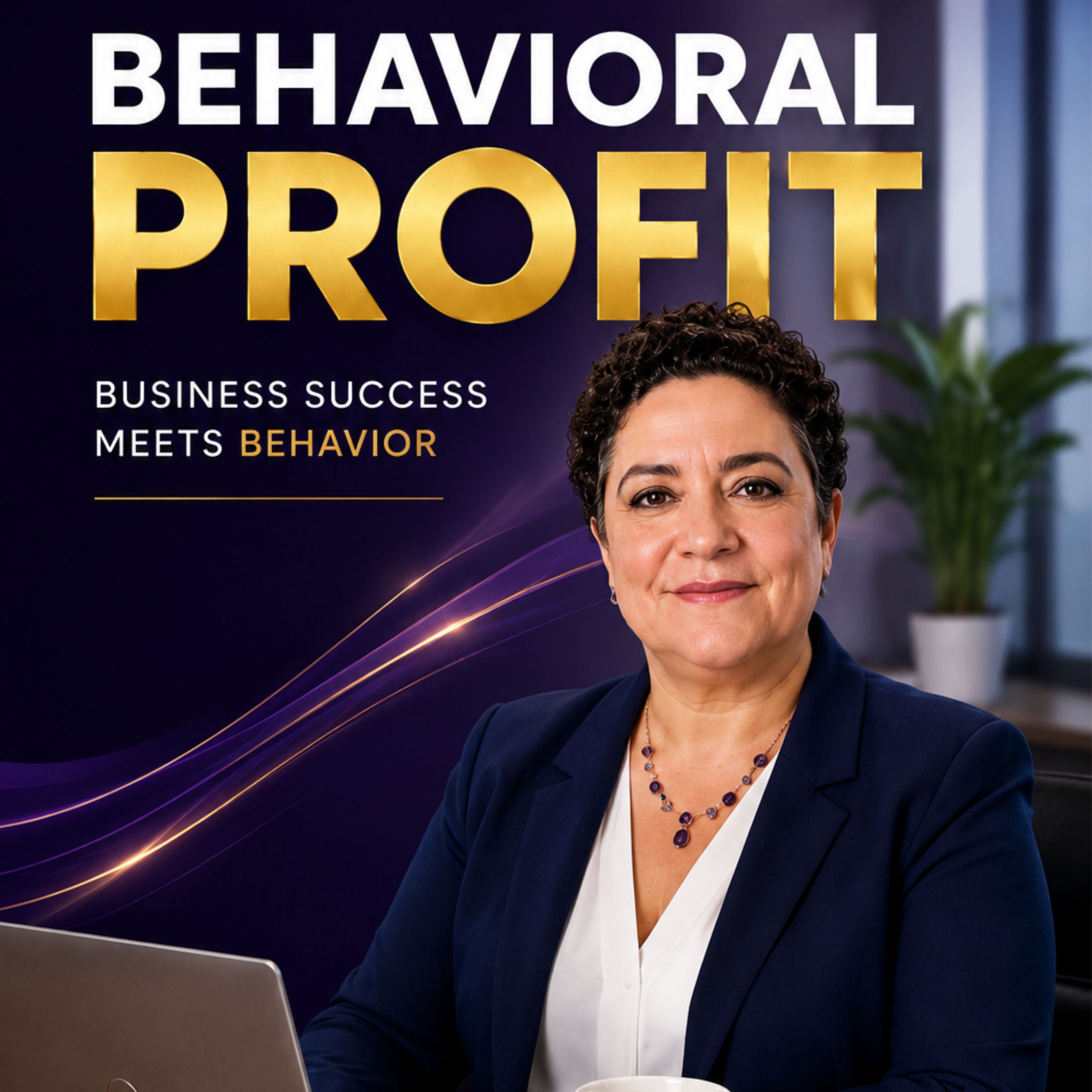
When pressure builds and leadership identity feels misaligned, most leaders react too late. In this episode of Behavioral Profit, Executive Behavioral Coach Debbie Longo talks with Meike Bettscheider, Global Leadership Coach, Transformation Strategist, and Founder of Compass-Setting.
Meike shares how she helps executives navigate high-stakes transitions before crisis turns into collapse. Drawing on her Executive MBA from Chicago Booth, her Executive Master in Change from INSEAD, and two decades of global leadership experience across Europe, the Middle East, and Africa, she reveals how behavioral science, emotional intelligence, and intuitive insight create real, lasting transformation.
You’ll hear about her signature approach that integrates 24/7 leadership coaching, epigenetic insight, and psycho-physiognomy (face reading) to uncover blind spots and unlock untapped potential.
This episode is a masterclass in balancing human depth with boardroom credibility — and how clarity, when applied with precision, creates change that sticks.
Listen now on Apple, Spotify, Amazon, and YouTube.
Contact Debbie Longo, Executive Behavioral Coach:
Contact Meike Bettscheider:
Welcome to The Behavioral Profit, the podcast
where leadership behavior meets bottom line results.
I'm your host, Debbie Longo, executive behavioral
coach. Each week, we unpack the mindsets, habits
and cultural shifts that turn teams into high
performance, profit driving powerhouses. So you
can lead your purpose and win with people. Mikey
is a global leadership, transformation strategist,
and founder of Compass Setting. She works at
the intersection of behavioral science, emotional
intelligence, and intuitive insight to guide
leaders through high stakes transitions before
crisis becomes collapse. With an executive MBA
from Chicago Booth, and executive master. in
change from instead and two decades of international
leadership experience. Mikey brings a new combination
of boardroom credibility and deep human insight.
She's held executive roles across Europe, the
Middle East and Africa and now designs bespoke
transformation retreats in Greece for startups,
foundations and organizations from the US, Canada
and UK. Let me start again. Her signature model
includes 24 seven leadership, cloaching, epigemic
insight and face reading, a powerful tool she
uses to reveal blind spots and untapped potential
as single conversation. Clients call Mikey when
the pressure is on, when identity, business and
vision feel misaligned and stay because her approach
doesn't just create clarity, it creates change
that sticks. Good afternoon, Mikey. Welcome to
the show. Thank you so much, Debbie, for having
me and for your kind introduction. So there's
a few questions here. Segment one, understanding
the leader beneath the role. You use the phrase
behaviors beneath the behavior. Can you explain
what that means and why it matters in leadership?
Absolutely. It's actually one of the most important
things I bring into my work because leaders often
look at what they're doing. overworking, micromanaging,
avoiding tough conversations, and they try to
fix the behavior. I'm sure you've seen that too
in your work. But what really shifts things is
understanding what's underneath. Often, from
my experience, there's a fear of not being enough.
That's actually a belief that rest equals weakness
and a driver for perfection that's rooted in
often childhood survival. And I've had leaders
come to me saying, I just need to delegate better.
And actually, we end up uncovering a lifelong
fear of disappointing others. And once they see
it, it's like the whole system softens. And that's
where we can do the real work. Thank you. That
was good. That's exactly what I do. Exactly what
I teach and That's the most important thing to
me is to really get down to their behavior and
what is participating in what they're doing now,
whether it's negative or positive, but if you're
positive and everything is working great, then
you basically don't need me to say it, but that's
what we're trying to do here. So that was important.
That was good. Thank you. How can face reading
uncover leadership blind spots before a conversation
even starts? That's a great question because
face reading is not about mimics or gestures.
It's really where it gets fun because the face
never lies. We store so much information in our
facial structure and features we were born with.
I've had moments in sessions where I notice an
asymmetry or tension line, just a line that points
to suppressed emotions. And when I reflect that
back, the client goes quiet and says, no one's
ever seen that before. Because face reading,
let me see where potential is hiding. because
it's focused on qualities, never judgmental,
or where emotional energy is leaking before the
client even says a word that makes it easier.
We don't have to go back to the past and whatever
happened before. And for example, I once worked
with a leader who had a very soft filtrum, that's
this area here above the mouth and the sensitive
jawline, huge emotional intelligence, but totally
shut off. And when I named that, he actually
admitted he'd been ignoring his empathy because
it got in the way of hard decisions. But that
was exactly the trait his team, in that case,
needed more of. And when we talked through it
and about it, and I showed it to him, it opened
the door to transformation and that very quickly.
Yeah, that was good, too. Can you share a powerful
moment when this revealed something crucial?
Yes, absolutely. So because of what I said earlier,
the leader really was hiding things. He was not
living his authentic self and his quality. And
a leader doesn't have to be harsh or hard or
dominant or stringent. But if we are leading
like we are, more maybe with empathy or with
the willpower we have or the courage or the structure,
then the team sees it and then this team follows
actually. And that's especially in crisis or
in crucial moments. I think it's interesting.
The face reading, there's all kinds of readings
and All different ways that we can detect maybe
somebody's personality or what they're saying
what they're thinking what they're gonna say
so there's all different ways that we could do
that with the body and there's like face reading.
And there's all different other things we could
do yes so so the point is that the deeper i found
from. My clients and also myself personally,
this is actually part of my story The deeper
that I look into myself And the deeper that I
search within myself my soul my body That will
help me to reveal Certain things and we're not
not necessarily about the past if it needs to
go into the past. That's fine But I'm talking
about now I'm talking about right this second
the deeper that I do that the more things that
I reveal and I see about myself the Better it
is for me to realize right that I have to change
and if I go and I want to change, then the results
are out of this world. Phenomenal. I absolutely
agree. And it's always the start is always to
go inward and not looking outward and really
facing ourselves, being super honest to ourselves.
And as you said. Feeling it in our body or questioning
our beliefs, our mind. It's the whole system
we have to look at. And it tells us so many things.
Yeah. And unfortunately, there's a saying that
everybody must hit bottom. So a lot of times.
Very very receptive if my business is about to
go bankrupt or if I'm failing in my relationships
all different relationships and whether it's
business or personal because this carries over
if it's business it'll carry over to my personal
life and vice versa. So do I want to wait until
that really happens do I want to wait until I
have no money at all. and my business is totally
bankrupt and I can't even put food on my table
for my family. Do I want to wait until then?
Well, that's completely up to the person. That's
up to the individual whether they want to or
not. But the bottom line is that I want to help
people to change and grow and however we do it
before it gets to that point. And then they could
really make it just in. Go to an unbelievable
level. 100 % agree. It's always, but it's a two
way street. They have to be open and willing
to be, let's say curious about some methods,
about some help, about looking at themselves.
So the tools that shift the inner compass, you
integrate tools like face reading and empathetic.
coaching and the work. How do these work together
to help someone grow through a leadership challenge?
Yeah, it's a mix. It's my personal mix. And as
you said before, everyone, we all coaches, we
have our own kind of mix and methods. It totally
depends to the individual we are talking to or
working with, because I don't believe in one
size fits all coaching. My clients are human
systems like yours. So I use tools that speak,
as we said before, to the mind, body, and beliefs.
And we all usually have a lot of wrong beliefs.
Face reading shows us physical and behavioral
traits, as I said before, qualities. Epigenetics
helps us understand especially how stress and
trauma affect gene expressions, which is very
individual, and how we can shift them through
environment change or micro change habits. And
the work Byron Katie, that's for the mind, the
stories we tell ourselves, the anxieties we build,
the beliefs we keep us or they keep us trapped.
And when a client is stuck, I actually look at
all three layers and what's visible in their
body, what's stored in their biology and what
they're telling themselves that might actually
no longer be true. This is how I mix it all together
and try to support them very quickly. Like we
were saying before, there's all different ways
to quote unquote read somebody right in a million
different ways. So if I want to do something,
it's like if I want the psychology reason about
why I'm doing something, I go to a psychologist.
If I want the medical reason, I go to a medical
doctor. It depends on what type of reason that
I want to get. But I don't know what this is.
Personally, I do. But if I am a business owner
or an executive, I don't really know what it
is. So this is one of the reasons why I have
these podcasts. Also, just to open the person's
mind and then the person might say, I don't really
know about this, but it does sound interesting.
So maybe it's something that I would like to
explore. That is so valuable. What you're doing,
because as you said, there's so many things.
There are so many things out there, but it has
to speak to every individual. And you're offering
that to all the people. That's amazing. Thank
you. Tell us more about the concept. of proselience.
How does it differ from traditional resilience?
I think everyone is talking about resilience
a lot, and this is about bouncing back. And proselience
is actually about shifting forward. It's a term
I use to describe the proactive inner growth
that happens through adversity. and not just
after it so when i work with clients it means
not just helping leaders cope but helping them
evolve so that they can face future challenges
way easier because you didn't come here to be
good at surviving you come here to live lead
and actually a line from a deeper place and when
someone learns to lead with prozilians, they
definitely stop repeating old reactions and start
leading from clarity, even in chaos. And I believe
it's really one of the biggest shifts we can
do. And I help them through, especially through
my 24 -7 coaching container. Because i believe
if we if we get aware become aware of the wrong
beliefs and we become prosilliant and we know
okay what we can do for the future. That doesn't
work overnight and i'm sure you have the same
experience with your clients so. The behavior
change takes time it's a process and this is
why i offer for my own experience actually that
crisis doesn't happen once a week. During the
coaching session, it happens on Friday night,
Saturday morning, Sunday, lunchtime, whatever.
And then they need some not sure there's somebody
there or a reminder. Hey, you can do it differently.
Yeah. And that's a really good point. And this
is why we do this. Like you said, what's an example
of a micro shift that leads to macro long term
change? Actually, there is so many. different
ones but when I go back to one leader who lost
it all and I was working with him he lost confidence
he lost the job several times and so we worked
first on the qualities through the face reading
we worked on the resources he had I could see
in the face I reminded him of that we worked
on the wrong beliefs and He really raised up
and said okay that was anyway not my career path
i was happy with so we got away from the victim
it's horrible i will never. The confidence trade
and changed into. really something new, and he's
now having his own consultancy business, which
fits way better to his qualities. He's playing
in a band because he found back or rethought
about his remembered his musicality as a resource
for stress relief. And so that that was actually
a big shift through only a couple of sessions.
Yeah, that's good, because like we said, it's
looking within yourself. And if I try that, And
then I see the result. It's like working on acting
on blind faith. And I see the result, which we
know is going to be positive, but the person
doesn't know that. Then I can see that it's really
going to work. And then I want to do more and
more of it. So to me, that's just the way I do
it with my clients and the outcomes that we get
from that. Yes. So leadership through pressure
versus presence, you've worked with high pressure
leaders who unknowingly create fear. What kinds
of behaviors tend to send these signals and how
can they be shifted? That's a great question
as well, because I see this all the time, especially
with very driven, smart, well -meaning leaders.
They don't set out to scare people. but their
urgency, tone, and also the body language signals
for sure danger. It's things like walking into
a room and diving into numbers without eye contact,
sending a 3am slack, repeating a we must win
mindset without checking actually if the team
is already burning out, and often they say But
I'm being transparent. And they are. But transparency
without emotional attunement creates panic and
not trust within the teams from my experience.
And again, that's exactly why I created that
24 -7 model so I can help them in real time and
not a week later while the team is already demotivated
and the coaching For sure, you do the same isn't
about giving them more to do. It's about helping
them actually see the ripple effect of their
presence and learning how to shift energy as
fast as they shift strategy. Yeah. So in thank
you for that. In my experience, a lot of times
fear has to do with controlling where they're
not creating fear purposely. It's just that They're
very aggressive. They try to control the workplace,
let's say the manager or the business owner or
the executive. And then what happens is people
think that they always should do good and they
never should do anything out of sync or never
mess up on anything. And that's never going to
happen because people are human and they're not
going to do everything perfectly. So then they
might think that, well, I can't do it this way.
I can't be perfect all the time. And therefore,
I need to really try to be that way, even though
they know that they can't. And then that creates
fear because they don't want to get fired or
they don't want to get written up. So that's
really what my thing is for that. And the more
that I can look into that. And also, am I abusing
fear? Am I doing too much of it? So that's another
thing. What's the cost of mistaking pressure
for productivity in today's leadership culture?
And I think that comes back to what you said
before, creating anxiety. So that creates pressure
too, not only the number and the costs from my
perspective, it's enormous. Because when pressure
is constant, creativity dies, people stop offering
ideas because they don't feel safe enough, actually,
to risk imperfection. The problem is our culture
nowadays celebrates urgency. And we've confused
speed with success. But when I bring a team or
a founder to one of my retreats in Greece, so
totally out of their place in their environment
where they run and have that productivity and
speed and what becomes obvious is the best decisions
and the biggest clarity, the real innovation.
It definitely doesn't happen under pressure.
It happens in space, in reflection, in presence,
because we don't get better by running faster,
we get better actually by returning to a place
inside us that can listen. And that's what I
help leaders to access. And I'm sure you do the
same creating that space. I think that's really
crucial to really work and create something new.
What do you think? Yeah, so I agree. I like what
you said that it decreases the morale. So the
fear and the pressure and everything is a lot
of times that's just what if I'm a business owner
executive, I create a lot of that. Then people
that's what they're going to be. That's what
the employees are going to be receptive to. And
not only is that going to create more of that.
Fear and pressure, right? Then people get demotivated,
their morale gets low. They're not going to want
to make their goals. And then it's a whole cycle
going downward. So you're going down the ladder
instead of going up the ladder. And then what
happens then is that there's no, they're not
making their goals. And the company is literally
financially going backwards. And again, do they
want to wait to get to that point to realize
what are they doing? Or if they want to say that,
they might just want to point the finger and
just say, it's because of the employees, the
employees did this and that. But the role model
is the executive or business owner. And that's
really the bottom line. And that's what the employees
are going to follow. What people don't realize
is the employees are paying attention. Oh, yeah.
They're not like like an outer space. They pay
attention while they're working. They pay attention.
They look at everything everybody is doing, especially
the business owners and the executives, because
they're the ones that are creating all of these
things or they want to become a role model or
whatever the situation. And they enforcing their
position and everything that the employee needs
to do for the company, are they enforcing that
in a positive way or in a negative way? That's
the whole thing. And these are all negative things,
right, that we're talking about because we're
trying to fix these things or help the business
owner or whatever. So this is the thing. So there's
all different ways of looking at this. So that
was good. Next section, results alignment and
new compass. What does internalizing your compass
look like in action for a leader? Thank you for
asking, Debbie. I think it's a weird maybe concept,
internalizing the compass, but it means we stop
needing external validation for every move. Whenever
I work with leaders who've built massive success,
but at some point they lose touch with actually
why they're doing it or how they're showing up.
internalizing your compass means learning how
to choose from values and not fear. It's having
a grounded yes and a powerful no. That's the
core of my work and yeah, so I think it's important
to always reconnect also to our values as a leader.
So am I aligned to that? Is my compass aligned?
And values are a very powerful tool and easy
tool to check on your own compass. Where do I
get the values from? Maybe I get them from home.
I get them from my childhood. Maybe when I am
in high school, peer pressure. Maybe if I'm dating.
And that carries over because I'm not working
then. I don't have a full -time job then. So
a lot of that is going to carry over, but I'm
not a therapist and I don't do anything at all
that's related to therapy. And I'm not about
to, like we said, look into somebody's past and
try to bring stuff up and all these different
things. But the point that I'm trying to make
is that maybe the listener can actually think
about this just for themselves because they know.
what they're feeling, what they're thinking,
what happened in their past, whatever, from stuff
they can remember I'm talking about. They know
and maybe they want to think about it and maybe
they might see, well, there's a connection here.
I didn't realize that I did this in high school
or something happened. Maybe I had a traumatic
experience. when I was younger or something.
And I didn't realize this behavior now is carrying
to my job. And I never thought about that until
I listened to this podcast. And then I started
looking up or maybe I did a little bit and I
couldn't make the connection right now. I'm started
looking up on Google. Google is the psychologist
there, the medical doctor, everything. So so
that's what I might do or look at some videos
on YouTube. And that'll help. That'll help for
a while. But really, I need a coach and I'm not
here to sell anything to anybody. I'm here to
send the message and and teach people and explain
about all these different aspects of businesses,
of industries and all different ways that coaches
can help people. That's really what I'm here
to do. And it's up to the person, the listener.
the individual to decide if they really want
to do this. And if they don't decide it, then
I can help them. I have no problems with that.
I've done it hundreds of times. Yeah, I like
that. Yeah, absolutely. So that was good. Thank
you. So how do emotionally safer teams directly
translate into better performance and profitability?
I think that comes back to the point I made earlier
if they feel safe. that creates, or it's a milieu
where innovation can grow, where they feel heard,
seen. They can also bring in their own strengths
and skills, and then they work as a team. So
I think safety, it's proven. The most successful
companies or teams have the feeling of safety
within. And one part of safety is for sure the
biggest part, emotional. Safety that's very true
because when people think of safety they think
the floor is wet. And we should put a sign up
saying wet floor otherwise somebody is gonna
fall in the situation is not gonna be good. Maybe
we should close the back door because a bug or
something might come in or whatever. So these
are the things that I think of. So there's a
difference between that and emotional safety,
which I think is really important. That's actually
something I never thought about. I never considered
that that term. So last segment, practical tools
plus the reset moment. Can you walk us through
your reset moment practice and why such a small
pause can change the course of a day or decision?
Yes, sure. And this is. something I built into
every retreat I'm doing and every coaching, especially
with clients in fast -paced, high -pressure roles
we talked about earlier. A reset moment is exactly
that, a moment. Not an hour, not a ritual, just
a conscious pause. I ask leaders to stop, breathe,
and check. What state am I in right now? Is this
pressure I'm feeling mine? Am I leading or am
I reacting? And that might sound very basic,
but that little check -in when it becomes habitual
shifts the entire tone of leadership. It's how
a client goes from sending a reactive email to
picking up the phone for a real conversation
from repeating an old pattern to choosing something
more intentional, the small moment. But that
has a big ripple effect, especially in organizations
where people are mirroring each other constantly.
It's a good thing. It's not control. It's mirroring.
It's the safe environment where you can do that.
We talked about emotionally safe environment.
So that was good. So I do something very similar.
Breathing exercise or breathing meditation where
you're just breathing and you breathe in through
your stomach, through your solar plexus. And
then you wait two seconds and then in through
your nose and then out through your mouth. So
you're going. And you do that. And that could
be a reset also, which is very similar to what
you said. And you would do that several times.
And I know from my personal experience and people
that I work with, just breathing alone will change
your life. Yeah, that's fantastic. Absolutely.
Yeah, because it brings me to another level of
consciousness. And not only that, it. right away,
immediately stops whatever that negative thought
is or whatever it is that I'm doing, you know,
that's negative, you know, like fear and control.
So that's very that's anybody can do that. I
mean, that's you don't need training for that.
But it's a matter of self -discipline. To me,
that's really what it is. I don't want to stay
in those bad habits. Yeah. Yeah. And to do it
conscious. Next question, what's one powerful
question every leader should ask themselves in
high -stake moments? That's a great question,
Debbie. From my perspective, I think the question
would be, am I acting from alignment or from
anxiety? This one cuts straight through from
my perspective because... Often we justify urgency,
pressure, control. We talked about it earlier.
But when we pause and ask this, we see it clearly.
And if the answer is anxiety, it's not a moment
to perform for sure. It's a moment to reset or
breathe, as you just explained. And then one
question has helped myself and some of my clients
avoid major missteps. toxic communication loops,
or just simply exhausting themselves unnecessarily.
Yeah, very good. And this is everything that
we just talked about. And I gave some suggestions
also. These are things that they can do, ask
themselves a question, do a little exercise.
But the bottom line is, if I really want results.
And I want superior results. I'm talking about
something that you could never ever dream that
would even be possible in your lifetime. That
person needs a coach 100 percent. And I can do
that. I don't know if that's what you do, but
that's really a lot almost all the time. This
is not a question. This is not a theory. This
is not something that. I woke up yesterday and
I'm just starting doing podcasts and just start
talking. This is what I'm saying is coming from
25 years experience doing all different coaching,
life coaching, executive coaching with all different
people and industries. I basically put that all
together and turn that into a podcast. That's
basically what I did. Because each thing each
podcast I have number one is from people from
different industries but I put my two cents in
and and and I respond to the questions and and
the comments of the podcast and I'm putting all
of that all of those comments and everything
all From comes from my experience. So I think
that's interesting. That's something that I just
realized Really valuable, you know, right. I
don't need to share that with all of us. If someone
listening feels like they're stuck in urgency
or burnout, what's the very first step you'd
recommend they take to not be stuck in anxiety,
to really realize, OK, I need help and to reach
out to you, to us, to any coach, to a mentor,
whatever, whoever they want to call it, but not
over go it for sure. Not. Yeah. Be honest to
themselves and we all should do that just to
be honest to ourselves and seek for help. That
was really good. Thank you. Is there anything
you would like to say in closing and how can
they get in touch with you? I'm more than happy
to have a quick free 30 minutes get to know call,
you know, via my website and we can set it up
or write me an email or reach me. via LinkedIn
or Instagram. I'm happy to have a real conversation
and to support your work. And thank you so much
for giving me the opportunity and for having
me tonight. Yes, thank you. Thank you. I appreciate
it. Thank you for being on the show. Thank you,
Debbie.