
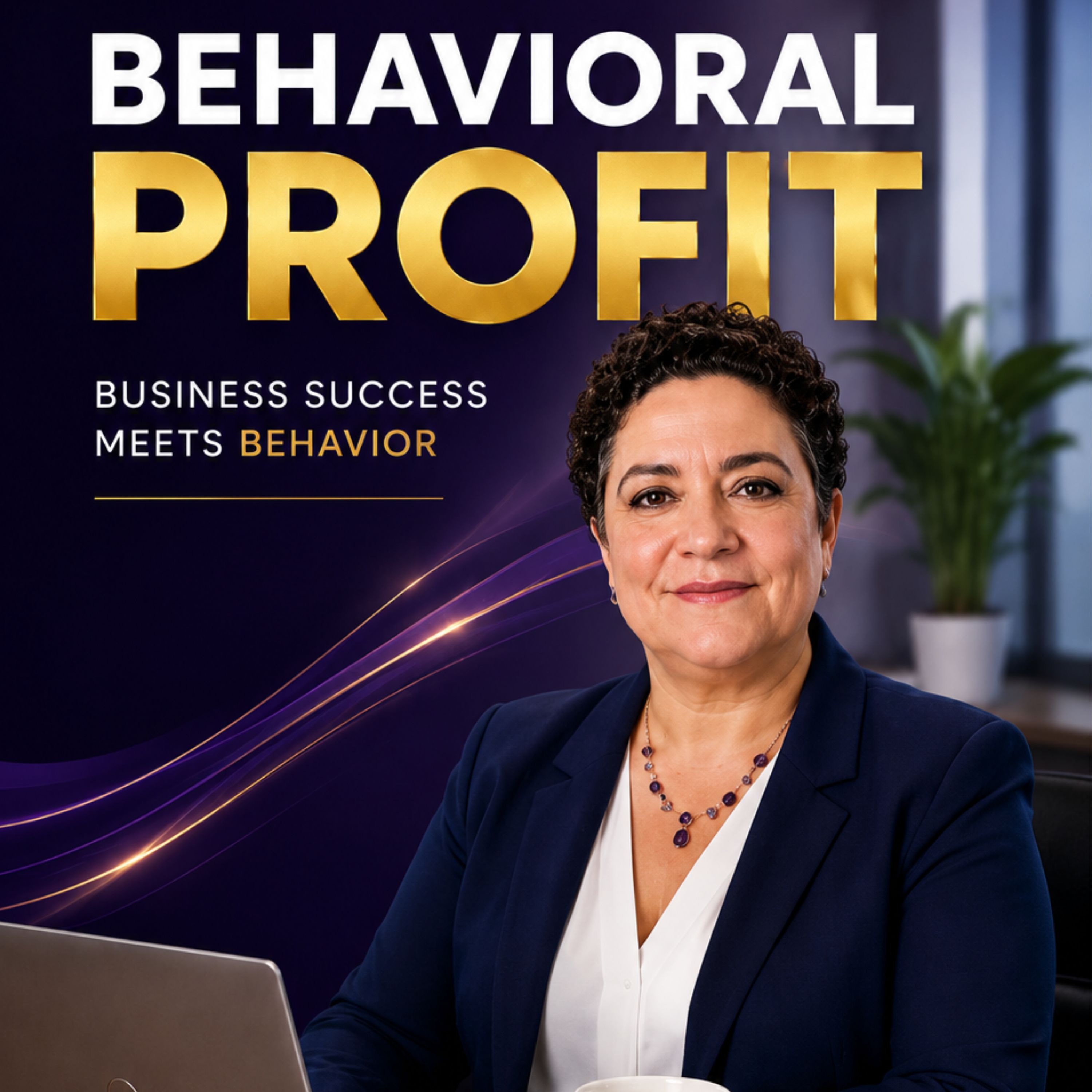
Visionary CEO and board advisor Sid Mohasseb joins host Debbie Longo to show why behavior—not tactics—drives lasting business results. Sid explains: • How emotional intelligence builds high-trust cultures • Why flexible frameworks keep teams nimble in fast-changing markets • What “actuated mindfulness” looks like in high-stakes decision-making • A real-estate negotiation that proved human connection beats cold logic
If you’re done with surface-level leadership hacks and want practical ways to spark real change, press play.
Episode chapters 00:00
Introduction to Behavioral Profit
00:23 Meet Sid Moha: A Visionary Leader
01:53 The Importance of Frameworks in Business
05:59 Mindfulness and Leadership
09:43 Behavioral Leadership: Trust, Innovation, and Change
12:59 The Entrepreneurial Mindset
22:26 Conclusion & Contact Information
Connect with us LinkedIn:
Debbie Longo: https://www.linkedin.com/in/debbie-longo-life-in-bloom-ny/
Guest link — Sid Mohasseb: https://www.linkedin.com/in/mohasseb/
Welcome to The Behavioral Profit, where business
meets behavior. I'm your host, Debbie Longo,
executive behavioral coach. And each week we
dive into the mindset, leadership strategies,
and cultural behaviors that drive higher performance
and greater profits with you leading a team and
building a business. This is not just a space
to learn how human behavior fuels business success.
We have a very special guest today, Sid Mahabid.
a visionary leader whose career spans CEO and
board level roles across multiple industries,
from leading billion dollar consulting firms
to serving as president of the largest angel
investment organization in the United States.
With experience as our partner and managing director
at firms like KPMG and Enterprise with $26 billion
in revenue, he brings decades of insight into
what only drives business transformation. But
what sets him apart is his core belief, who we
are, our emotions, our experiences, and even
our blind spots shape what we do. For him, behavior
is not a sidebar to leadership. It's the foundation.
Culturers are built by behavior, and in turn,
culture determines creativity, contribution,
and result. You'll also hear the story of a personal
real estate negotiation that reveals how emotional
intelligence and human connection can triumph
where logic alone fails. If you're ready to move
beyond titles and tactics and into the heart
of effective leadership, this episode is for
you. Good afternoon, Sid. Welcome to the show.
Pleasure to have you here. Would you like to
add anything to that intro? There's nothing more
we could say. And the less is that it's not about
me in general of what I've accomplished. I believe
it's about them and what people can accomplish.
That begins in their mind and their mindset and
how their emotions work together, how they put
the pieces of the puzzle together. So let's focus
on them and less on me. So there's a few questions
here. Why frameworks are only as useful as the
people and problems they solve? I would appreciate
that. In business, in MBA schools and in a lot
of places, we're fascinated with this idea as
a, let's follow this framework and it has certain
elements to it. And it could be a management
framework. It could be a performance framework.
It could be HR framework. And then we have these
best practices that we learn from in business
school. We teach students, but The problem with
that is life is not like a cake that means the
pieces don't fit together nicely and cleanly
and you can't say okay take piece A and screw
it in piece B and then piece C bring it to at
an angle of there and boom you have a bookcase
you have success That is an illusion we've been
driven to believe in a way because it makes life
simpler. Every kid is different. There are thousands
of books raising kids. And show me that exactly
work it doesn't. So raising a child is like raising
a business. Leadership is right. Grow a company.
We are all individuals with very unique characteristics.
There is 110 billion people that on the face
of the earth that have come and gone. There's
8 billion now. Name two that are exactly the
same. We're all different. What is practical
for me is not practical for you. So the idea
is, yes, there is learning that we can take from
these frameworks of how Jeff Bezos has done it,
but the tailoring of those things means that
it has to fit my organization because just as
I am unique, everyone in my organization is unique.
They are here for a reason, and it's not necessarily
money. It's a bundle of satisfaction. It includes
creativity that we can give them. It includes
security. It includes the benefits. It includes
the opportunity to make money. It includes their
ability to be with their family. That's why they
become a part of us as a company. Each person
has a set of satisfaction, reasons to be with
us, as a customer, to buy from us, as a partner,
to partner with us, or as an investor, to invest
in us. So here's where I say that the framework
idea has to have the flexibility. It's a learning
point. It has to put the pieces of the puzzle
of success and leadership and culture together
with the understanding of the reasonings that
satisfies the people in our ecosystem and ourselves.
So here's the argument. We write something on
a wall that we are a company that believes in
people and believes in creativity. That doesn't
create culture. What creates culture is if those
people who are joining us have a belief of being
creative, being honest, diligent, productive,
or whatever it is that we want that culture to
be. So it begins with who we attract as opposed
to pushing some sort of a framework for a culture.
Let's have a Fourth of July hamburgers in the
backyard and talk about how great we are. It
works bottoms up, not top down, regardless of
what framework we use. I hope that makes sense.
Yes, it does. Thank you very much. My experience.
has been that people and their minds, because
the mind controls everything, make it useful
for themselves and depends on your thought pattern
and what you're thinking and how you're thinking
it, and even whether you want to be useful or
not. The framework is the thought, it's the thinking,
but it can be translated to a physical thing.
The mind and your behavior and how you come to
make that framework possible or even create a
thought for that framework, any type of thought
at all. That to me is the original thing that
happens. Then I build the framework in a way
that might not always be the case because people
might think of something physical or something
solid as that and they just do it that way. They
just think of it that way and they don't realize
that their mind can alter it or think of it in
a different way. in order for them to get maybe
more of a benefit out of it, or maybe it become
more useful, different things like that. For
one thing I say, common sense is not that common.
The point that you're actually suggesting is
one of the key pillars of my belief. We have
the Anabase Academy that fuses mindfulness and
entrepreneurship, which is at the core of who
we are. Mindfulness means being aware of situations,
being aware of emotions, being aware of the reality
of life. If I want to accomplish something and
I don't have the money or the right customers
or they're not ready. Those are realities that
impacts execution. That's what I think. It matters
what it is. So mindfulness is about, I use the
term actuated mindfulness. Stimulated to connect
to results. Mindfulness. A lot of people talk
about mindfulness as going into, we're thinking
about, oh, isn't it that we're connected to this?
I realize that my fears are this. I'm not against
meditation, but meditation without detachment
to actual, you have to be attached in order.
for you to realize results, impact in real life.
This idea of I'm completely detached, sit here
on the top of a mountain or in a basement of
a room or in front of an ocean and I think about
great things and then I come out, it doesn't
work. So mindfulness is at the core of looking
at what I call our that zone, people call it
the comfort zone, where we think everything is
awareness and the need for awareness drives our
ability to listen without our biases and say,
here's the reality of people. This is how people
feel when they work for our company. This is
not an illusion and our behavior is influencing
their behavior. It's not abnormal to get results
from people within the thing because that's the
reality. But the key is to actuate mindfulness,
to take mindfulness and that awareness into impact.
Reality, actions and reactions. Our decisions
have consequences. Our progress has to do with
choice. So I always say the best friend we have
is change. but people see it as the enemy, something
that has to be managed, something that has to
be controlled. If we didn't have change, our
children would never grow up, we'll have McDonald's
for lunch every day, we'll do the same thing
every day. It is change that gives us options
towards prosperity, towards more, towards better,
gives us the opportunity to choose. It is this
ability, looking at change, looking at it within
the context of awareness of our reality, for
the sake of change, is not necessarily a good
thing. mindful of who we are, our ecosystem,
with clarity of thought that is not around false
hope. It's not being fearless. It's being aware
of the fears that are approaching us. Because
fearless is stupid. If I'm fearless and I don't
see them using me, this is some of these stuff
that you see on Instagram and Facebook and so
forth in terms of motivational nonsense. These
are stopping us from actually realizing we are
in control. We need to learn. I'm not against
learning. We need to look at the frameworks,
at books. But there are no two people who practice
leadership the same way. There are thousands
of leadership books out there. But depending
on the situation, depending on who you're speaking
to, depending on where you are, who you are,
what your business is, and all of that, your
leadership style changes. It should change. I
don't care if there are 10 ,000 books out there.
What matters is how you individually put those
pieces of puzzle together. It's good to learn,
but it's dangerous to follow lifestyle life,
thinking I'm like Elon Musk. I am like Jack.
I'm like somebody else. You are unique. Realizing
that authenticity, realizing that uniqueness,
and realizing that everybody that works with
you to your colleagues, to your employees, to
your friends, to your family members. They're
all unique too. That is at the core of how we
behave, how we practice mindfulness, how we actuate
it, activate it, to actually connect us to outcomes,
results, prosperity. Okay. So the next question
is how behavioral leadership drives trust, innovation
and change. So if you could maybe combine those
three things, talk a minute about each one and
then combine it. Innovation and change. Let's
take an organization. We have employees. Let's
just take that dimension. Forget about the customers
or partners, investors, and how we interact with
the society. Because those are the five pillars
of any organization. Let's just focus on the
employee. We have an assumption that when we
hire somebody, we give them a job description,
a salary, and we expect a certain level of productivity
from these people. Who has the decision to join
the company? Us or them? They make the final
decision. When they say, I'd like to take on
this job, they are processing it based on their
own set of reasons. The job offers two days work.
working from home. I like that. The job offers
good benefits. My wife or my husband has a health
problem. So the benefits is good. The job takes
me to California. I have a boyfriend or a girlfriend
in California. I like to be close to them. The
job pays me $100 ,000. I think I'm worth really
$200 ,000, but the rent is due. So I'm going
to quit at five o 'clock every day and I'm going
to do something else after that. We choose as
the employee, not as the employer. The employee
chooses how much productivity they create. much
capability they bring in, how much creativity
they bring in, how much innovation they bring
in, how much commitment they bring in, they choose
based on their own set of reasons. The fact that
they do that requires this notion of them being
satisfied with what you offer them. And that
is at the core of trust. They have to trust that
you are genuine, there is alignment between the
two of you. And if there is trust, then I would
believe that the direction that you're taking
me, the right direction. Otherwise I wouldn't
trust. I wouldn't go in that direction. I wouldn't.
People change when these two things exist. One,
there is severity of a problem or an opportunity.
That is, I would change if I see the company
is going broke and I have to do something or
there is such a wonderful opportunity ahead for
me and for the company, my career, my family.
satisfying my needs that I would define, then
I would like to change. Then the question is,
what is the direction of change? Usually the
leader says, here's our vision to change. The
only reason that I would follow that leader is
if I trust them. If I trust, then I would follow.
So I will change. Otherwise, why would I change?
There has to be a reason for it and there has
to be a direction of it. The direction is leadership
issue and the leadership requires trust. Trust
is a funny thing. People think that you trust
me, I trust you. But there is a three -way trust.
It's not a two -way trust. The first thing is
I have to trust myself as a leader. Genuinely
trust. Not BS -ing myself that I'm capable of
conquering the universe, seeing myself in the
White House or as the head of this or that. Trusting
my abilities and trusting I can't change, I can't
evolve, I have these issues and I can recover.
Trusting, genuine trust in me and my capabilities
and who I am. Then I have to invest trust in
others. I don't expect them to trust me. Then
I have to trust them first. And if I do those
two things, what comes back is a compounding
effect of trust. Their trust in me as a leader.
And that is an unbelievable three -way trust.
Now there's a partnership. Now there is collaboration
in a particular direction. Now a culture begins
to form, to shake. And the last question is,
why seeing others clearly beyond money, ego,
or assumptions can unlock powerful outcomes in
business and life? I believe... And this is after
40 years of doing business. I'm an immigrant.
I came to United States when I was 16 years old
by myself. I have built a number of companies.
I have worked, as you mentioned, at the beginning
in a lot of startups. I have helped a lot of
companies grow. I've learned a few things in
my journey. We talked about this idea of mindfulness
and actuating mindfulness. So that's one piece.
Each one of us have the ability to build greatness
and it is in our gene. We are designed not just
to survive, to thrive, to create better, to create
more. People think an entrepreneur is someone
who makes a lot of money, someone who's a BSer,
all of that hoopla. That's not the case. The
definition of entrepreneur, which was originally
introduced in the 1700s, is an entrepreneur is
someone who has something, who wants to exchange
it with something better. It could be your time.
It could be a product. It could be an idea. It
could be a service. You want to exchange that.
with something better of higher value. You decide
what you have and you decide what higher value
and knowing that there is risk. I may not get
everything I want. This is essentially in our
genes to want better. We're all entrepreneurs.
We can take what we have and exchange it with
something better. If we realize we have that
ability, it's the same in life and business.
You and I as an individual. in our lives want
to create better. Maybe it's making a better
dish for lunch or dinner. Maybe it's we have
a kid, we want to take him to Disneyland because
it's fun. Maybe it's a date night. Maybe it's
spending time with our children at some ball
game. We have work. We have our relationship.
We have our friend. We are an enterprise and
we're always trying to create better. The same
thing applies to a company. It's designed to
create better. The better is not always money.
The mistake is that I have I've worked with hundreds
of entrepreneurs. I've made investments in tens
of companies. And whenever the entrepreneur wanted
to focus on money, the results were suboptimal.
Because at midnight, at three o 'clock in the
morning, when everything is going wrong, when
things don't work, when we face the reality of
the difference between a plan and what happens,
money is not enough of a motivation to get you
a crime. It's just not enough. That's when you
give up. That's when you unfold. That's when
you look at other things. That's when you begin
to do things that are immoral, that are not the
right thing to do. That's when you begin to compromise,
not only yourself, but your business. So the
key is we are all an enterprise. We're all an
entrepreneur. We have the mindset, the ability
to evaluate things and create better. That's
our mindfulness, our awareness. that comes in
from how we listen, how we do things, how we
create our emotions, how we deal with our emotions,
how we see comfort zone, how we desire to imagine
and be better. And if we take all of that together,
we have a fusing of mindfulness and entrepreneurship.
If you put these two things together, mindfulness
as awareness. entrepreneurship as a desire to
be better, to create more as we define it. Martin
Luther King is an entrepreneur. Mother Teresa
was an entrepreneur. Almas is an entrepreneur.
But we decide what is better and that could be
anything. We desire someone who works a cleaning
job. gets up in the morning at six o 'clock,
a single mother, and goes to work, takes a bus
an hour away, cleans hotel rooms, and makes $10,
$12, or $22 an hour, saves that money to take
children or grandchildren to Disneyland. She
had something. She exchanges it with something
better, knowing that there is risk. The kid may
not like Disneyland. It may never happen. The
risk is that I don't have enough money to pay
the rent. We're all entrepreneurs, and that's
essentially here. The Anabases Academy is where
we focus on these elements. We focus on provoking
people. It's the most non -academic academy.
There is no test. There is no conclusion, there
is no certificate. It's not for tens of thousands
of dollars to join it if you find your next best
version by being purported, by putting the pieces
of the puzzle your way together because you're
unique. If I do that, if our neighbors do that,
if your son does that and if your friends do
that, we are going to be in a much better place,
live in a better world. People can have a better
culture, they can have better behaviors because
they understand who they are, because they understand
their communities, because they understand that
we're not alone with our own driver. You touched
on a lot of different topics and different ways
that the mindfulness and the entrepreneurship
come separately, and then they go hand in hand.
And what I teach starts off that way, but then
that helps the person to create whatever their
goal or dream is. Maybe they're an entrepreneur
and they want to establish a company, or maybe
they're a solo entrepreneur, maybe. They're from
a medium business and they want to go to a big
executive type. position. It's not only the first
step, because sometimes the first step is the
giant step. If I get through that, then I could
do all different things. That depends on really
what the person wants. You were saying before,
the person determines what job they're gonna
go to. The company doesn't, because the company
has to sell their position. They literally have
to sell the position to the candidate. because
they have to hire somebody and they want to hire
the best person. How does mindfulness connect
with how I'm performing at work and whether I
want to get a promotion or not? How am I treating?
My peers, my boss, am I trying to control and
manipulate my boss? Am I trying to make my own
rules and not want to follow the job duties the
way that I'm told? Had his mindfulness connect
with that, then what you're saying, I work much
deeper than that. So I'm just curious about that
as the last question. The idea is the journey
begins with the first step, as they say. The
giant leap is the realization that I am designed
as a human being wherever I am. If I'm in high
school, college, I have a PhD. I have sold three
companies and I'm wealthy. Doesn't matter where
I am. I am designed to create better. I have
that ability within me, genetically. That is
a recognition. that a lot of times is loss. The
purpose of the way that you look at the world.
I'll give you an example. They asked two people
who were working on a construction site. Hey,
what do you do? The first guy says, I'm digging
ditches, laying pipe, making a living. They asked
the second one. He says, I'm building a hospital
to cure the sick. They were doing exactly the
same job. The perception of what they are doing,
what the cause, what the drive, what is internal
to us, the creation of. I am doing something
better than just survival. That is critical.
That is Realizing I do have a choice, I do have
a capability. The second is, if I do have this
control, this choice, how do I guide? How do
I win? How do I prosper? And that's activating
the mindfulness part. I have the ability. Just
because I have the ability, that doesn't necessarily
mean I sleep in in the morning. It's greatness.
There's work to be done. That work is about not
only just sitting in a mountaintop and thinking
great deals and then coming down and you have
employees not paying them, doing hard things,
saying the wrong things, hard work, and not being
empathetic to them, either from an employee's
perspective or an employer's perspective, just
to actuate that awareness into reality. If you
combine those two things as a first step, not
as a last step. Now, there is a lot to do. Every
day we have thousands of decisions. Every day,
at every given point in time, I may be wealthy,
I may be poor, I may have one leg, two legs,
no legs, I may be an IQ of this, we are all different.
So the practice of doing those things gets into
a lot of detail activities, a lot of detailed
relationships, psychologies, a lot of behavioral
issues. So there is a lot more, as you say, in
the detail, but it all begins with what I would
say, provoking people to see that they are an
entrepreneur. By activating their mindfulness,
there is a better version of themselves. If they
get into that practice, there's nothing to stop
it. If folks believe or resonate with what I'm
saying, I would encourage... them to go to the
Academy. It's called AnnaBases Academy. Anna
means moving up in Latin and bae means the bae.
So it's a -n -a -b -a -s -i -s, academy .org.
And there's a place they can join our wake up
calls which is for free. We have a membership
that's one dollar for life. So you can see the
approach. that we're taking, it's a movement
in my opinion to provoke and engage people and
we're learning partner. I don't have all the
answers. Collectively, we can put the pieces
together. You may have a piece and I may have
a piece and somebody in Philippines and we have
people from Africa, from China, from all across
the US joining us on these wake up calls and
then going into other things that we do. We have
conversations with experts. We have these collections
that are small five, seven minute videos, lots
of stuff. If you believe that you can evolve
and more, the first step is to be provoked. And
that's the choice, to be provoked. It's not motivational.
I can't give you motivation. All this stuff on
social media, I'll do three things and four things,
you're going to be trillionaires and you're going
to have a great life. It's nonsense. So the last
thing that I want to say is I do all different
industries and that gives a lot of different
suggestions, opinions, outlooks about how to
perform in all different industries. If you're
listening, and anything we say attracts you,
or you're in this type of industry, or you do
this type of work, then you might want to consider
trying some of these or getting in touch with
us, because it comes, like Sid was saying, it
starts with me. It comes with the first step
of me. And do I want to try this, do something
different, make a difference in my life, become
a different person? the person that I am not
now. This is the reason why I do these podcasts.
It's for the listener. And I really want to get
that point across because I think that's very
important because I'm trying to get a wide range
of people. This podcast is not narrow. The more
exposure I get, the more people relate to it,
the more people are able to listen. So how can
they get in touch with you? They can go to the
site, adivasesacademy .org, and contact us. Also,
my name, sid at mohasib .com is my email, so
they can reach out to me that way. Thank you
for being on the show. It was great to spend
time with you. Thank you, Debbie.