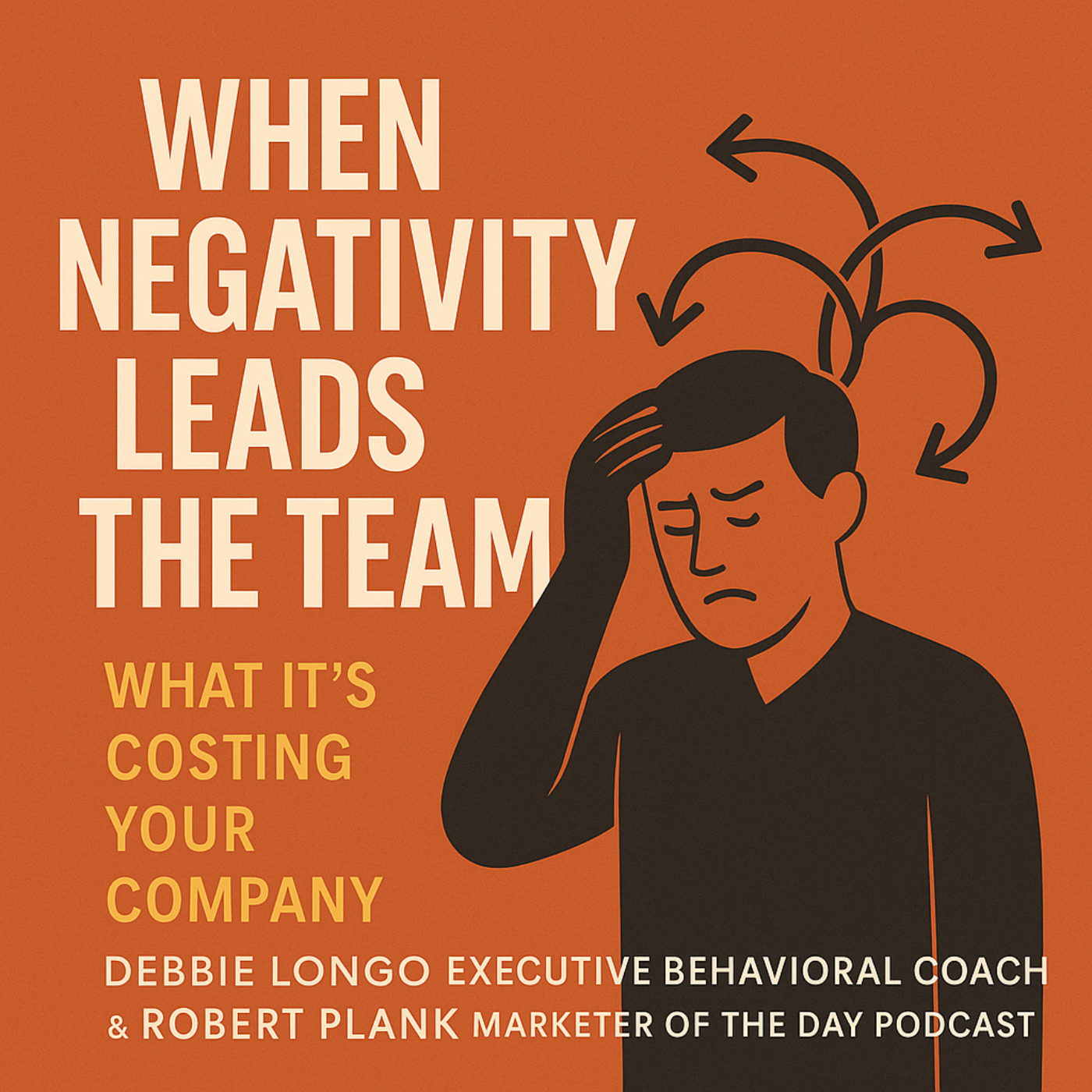
In this episode, Executive Behavioral Coach Debbie Longo joins Robert Plank, host of the Marketer of the Day podcast, to explore the silent damage caused by negativity in the workplace.
From declining morale to lost profits, negativity—if left unchecked—can quietly run a business into the ground. Debbie and Robert break down how toxic behaviors spread, what early warning signs to watch for, and how leaders can take charge before it’s too late.
Together, they discuss how a shift toward positive leadership and behavioral awareness can save not only a company’s culture, but also its bottom line.
In this episode: • How negativity infiltrates teams and kills performance • The real cost of a toxic work environment • Why leaders must address energy, not just output • Steps to create a healthier, more profitable culture • Real-world examples of behavioral turnarounds
If you’re a business owner or team leader, this conversation will help you rethink how your company works—from the inside out.
And we're here with Debbie Longo who is a corporate
skills behavior coach with over 24 years of experience
helping executives and business owners boost
their profits by transforming the way their teams
work and today in today's episode we're diving
into the toxic impact of negativity in the workplace
which includes how it spreads why it matters
and how shifting to a culture of positivity.
can truly save a business because, according
to Debbie, negativity left unchecked doesn't
just hurt morale. It can destroy performance
and even be the downfall of a company. So with
Ms. Debbie Longo's help, let's talk about how
to turn that around. Ms. Debbie, glad to be speaking
with you. Thank you very much. I appreciate it.
I appreciate you too. And so, as far as us getting
a handle on who you are and how you can help,
what do we leave out of that bio? What are you
all about? What's your current passion and focus?
I've been in this business for 24 years and I
have experience in a lot of different types of
coaching. After COVID, there were so many issues
with companies losing money. Going out of business
because they didn't know what to do and they
were losing profits and they just lost all their
money. And then they file bankruptcy and that
wasn't good enough. They had to just completely
go out of business. When I saw that I said to
myself, I know there's a lot of things that I
can do to help companies because these companies
did not have to go out of business, but The way
i teach it is it doesn't matter what's going
on in my environment it doesn't matter what's
going on in the world is the same attitude is
everything. If i can do that and i can succeed
at that whatever is going on in my own environment
outside of me. As no issue at all and regardless
of all of that my company will act. normal and
have their profits and do everything that they
would normally do whether they're outside forces
are not. And that's really the whole object to
this. I like it focusing on what you can control
and you think about the silliness that happens
when you don't adhere to that like you mentioned
the pandemic a little bit remember when that
was like a day when that sort of started and
you went to the store and everyone was buying
toilet paper not because. of a shortage of toilet
paper because of the rumor, which then led to
panic buying, which then led to the actual creation
of that shortage. And you figure that was quite
a metaphor for just kind of the chaos that ensues
when you escape those bad boundaries. When you
say, hey, we're running this company. Here's
how we should run it and we should be logical
and think this through and act with integrity
and all those things. And so I know that you're
big on the people, on the behavior. And so starting
with the problem and us understanding it, what
are some of these common signs that negativity
is taking hold in a workplace and maybe even
signs that appear before the problem is obvious?
There are a lot. And we could talk for hours
just on this one question. But to really summarize
it is all of the attitudes and behaviors in the
company. Every single person from the CEO to
the janitors are negative and they can't handle
working there and they say negative things. They
argue with the boss all the time they always
try to take control. Over the workplace their
job duties what they need to do they'll say they
can't do it they'll just say. Tons and tons of
negativity all around and there's a saying what
goes around comes around so if i act like that
in the workplace then everybody's gonna see that.
Everybody's gonna act like that so that will
literally infect the workplace and then it gets
to a point where nobody can do anything to help
because it's over the top. They have been companies
where the CEOs have fired their entire workforce.
All at one time and they literally had to start
over because the problems and all the issues
and everything was so bad that it doesn't matter
who you bring in it's not gonna help. And the
object is not to get to that point. And if positive,
then the same thing that's going to affect everybody.
So that's one big thing. The other thing is that.
So not only will people do it and then other
people influence other people, they're going
to see it. Well, you'll have little signs like
all of these things that I just said. But once
the CEO notices that that's the time. to do something
about it early on when it can be fixed the employees
really gonna do anything about it. I mean they
might they might not but they're just an employee
there is ceo and the business owner is the one
that's responsible for keeping the business afloat.
That's the bottom line so that's really who we're
focusing but. We want the ceos to be successful
for their company to be successful so they can
maximize their profits and sales. I like it and
your contagion analogy makes a lot of sense if
there's a virus or there's cancer you think that
there's the early stages or something can be
done but then when it's spread when it's everywhere
and with the workplace is filled with that negativity
and it's everywhere you look and it's you even
just being around that. How to make you join
in on it then you have to imagine that the good
people the positive people will be forced out
or leave or you bring in a few new people in
and they're outnumbered by all of the. Bad stuff
so it makes sense how sometimes the leadership
lays off the entire staff because sometimes there's
no fixing except for starting from scratch and
so this is a really important problem for us
to be focusing on but then sometimes it's tough.
To care right about how will this affect the
results the outcomes those good old profits and
so can you tell us about maybe the really bad
things that happen if this is left unchecked
this unchecked negativity how does it impact
leadership team morale and company profits. If
a CEO or a manager or an executive. Give orders.
Or. tries to enforce an employee's job duties.
And the employee says, I can't do it. And then
maybe the manager or executive gives them some
extra work and expects them to insert that work
into their normal day. And the first thing that
the employee says is, I don't have time for this
today. When they can easily do it it's a little
bit of extra work it's no big deal. So they are
constantly telling the bosses that they cannot
listen to them they cannot do what the bosses
are asking them to do and that is difficult for
company to operate like that. We need to find
ways that to help the boss or executive whoever
to. Allow to help the company to function because
the boss's job is to tell the employees basically
what to do or what their job is or to enforce
their job duties. But if the employees are so
negative where they just say they can't do it,
they can't do it. Then that's just going to bring
the company down and then also gossip coffee
clutch with the water cooler. That is also very
infectious to and then gossip is one person tells
another person. But then that person doesn't
keep it a secret then they go and they tell another
person and then there's the telephone game i
like all these things. Where one person says
something and then by the time it gets to the
tenth person is a completely different story.
If it gets to the boss. And if it's about the
boss or about the company, which there's a very
good chance it could be, then you could start
firing people. So it can get really, really serious.
And then also the way I act at home is the way
I act at work. And the way I act at work is the
way I act at home. So it goes both ways. So that's
the whole thing. And I don't want to be able
to. bring negativity into the workplace. It really
depends on the situation because there's a lot
of different situations. Of course, and I'd love
to get into some of those situations with you
in a moment, but just to properly digest what
you said, you said a lot of amazing things. It
seems like a lot of it comes down to your habits
and your simplicity in the way that you function.
It is hard to unlearn some of these things that
the water cooler gossip and. This habit is saying
no and I can't do it and I'll do just enough.
And it is tough to unlearn those bad behaviors,
especially because nobody wants to be that one
overachiever. And then everyone else is doing
the very minimum. You're thinking, why am I working
myself so hard? And everyone else is having it
really easy. And then this whole idea of then
you end up just driving yourself crazy, right?
And thinking too hard and working too hard. And
if we just say, hey, here's what I'm about. Here
are my boundaries here are the rules i abide
by i've definitely been in situations where.
I before i knew better i would kind of try to
gossip with like one person in particular and
he just wouldn't even engage would name respond
and i tried being a little more big and he wasn't
about that. He was about solutions and positivity
and getting it done and how can we be productive?
And as you and I said right before we recorded
that you'll make a book about this someday because
you've seen so many things. You've been in so
many situations. And what do you think is valid
or appropriate or timely for our conversation
here? Can you share a story or an example where
a negative workplace culture was turned around
successfully? There's one Issue also i should
say about respect. So if the manager or the executive.
Respects the employee then the employee is gonna
respect the manager and vice versa. Let's say
for example lunch is always at twelve o 'clock.
And then the manager says. Extra work this morning
and lunch is gonna be at one o 'clock now it's
not gonna be twelve o 'clock anymore. The employee
doesn't like that. The employee says, I'm not
going to accept that lunch is going to be at
12 o 'clock because I have to eat my lunch and
you know, I'm hungry and my energy level is low.
And I could get this done in the afternoon. Like
do you need it in the morning? You need it at
the end of the day. You don't need it right the
second. So the manager is just being a little
bit controlling. So now the employee is sticking
up for themselves and the employee is saying,
this is the time that we agreed. When I first
started working here, we signed the contract
or we made a verbal agreement that lunch is going
to be at 12 o 'clock. And that's when I'm going
to go. And that's it. It's not like an urgent
thing. The manager says, you can go to lunch
at 12 o 'clock. Now the manager knows that he
cannot control that employee at all ever again.
And now guess what happens now as long as the
employee gives respect back to the manager when
he asked her to do something she does it. As
long as she does that then the employee now gets
whatever she wants because now the boss respects
the employee so if she wants a day off. Or if
she's on a vacation and she wants extra time
at the end of the vacation or she has to go to
home early to pick up our kids from school or
something like that. The boss would say yes,
because now the boss respects her. And that is
a way that's just one example, but that's a way.
And that's a big thing, believe it or not. What
to do what the boss tells them even though they
know that it's wrong. They know that they're
going to get upset that they're not going to
be respected because they think that the boss
is going to fire them. What it's the other way
around. The boss is not going to fire them. If
they stick up for themselves and they say what
they feel and what they need to say, the boss
is not going to fire them. Instead, the boss
will. appreciate them and give them respect.
And people lose six figure jobs over this. They
get a resentment and the boss gets a resentment.
And then they say, oh, something happened and
you're going to have to leave. And we'll just
call it that. We won't fire you. You're just
going to have to leave. You're going to have
to walk out and that's it and never come back.
And it doesn't have to be all because they're
not knowledgeable enough to know this one simple
fact. Yes, which is that respect is a two -way
street, and it seems like they're just a need
to think these things through, right? As you're
explaining this in my head, there's like there's
two buckets. There's the positivity and the negativity
and the negativity is maybe what comes naturally
if you're not careful, right? There's the resentments.
There's. their revenge, there's the keeping score,
all these things that we've all seen it happen
in this workplace. And it is logical to say,
hey, I don't want that. I don't want to experience
that. I don't want to be a part of that. And
then what you're mentioning is that that good
bucket of it sounds like leadership and responsibility
and empathy and wanting to make things right
and being careful about other people who do have
needs and emotions. And so as far as this this
realm of leadership that we're talking about.
What role would you say leaders play in fueling
or fixing the toxic energy at work? They need
a coach. They need somebody that's going to show
them what to do, that's going to train them and
help them. Because here's the thing, if they
knew how to do it, they wouldn't have gotten
to this point. So they need some type of help
somewhere. Coaches are great and they help very
large companies all the time. Very successful
companies, Microsoft, Apple, these companies
all have coaches, all different types of things
that help the employee's behavior, morale. And
that's why this type of work is so extremely
important because people don't know what coaching
is, and they don't know what this is about and
they don't know how they can help. So like I
said, it's going to get to this point and I'm
just going to have to fire a whole bunch of people
and just get all new people. And what's going
to happen then? Well, the behavior is going to
stay the same. It's not going to be any different
because the boss's behavior didn't change. This
is just natural stuff. This is just what we do,
the way that we act. But the point is that we
can change it that's the whole thing and people
don't know. They're uneducated they don't know
that they can change it and once they learn that
then they could see that this is really helping
and then they'll always be successful because
then they carry that through their whole entire
life. Wherever they work whatever they do what
doesn't matter outside forces don't matter. they
will literally carry this behavior this attitude
through. All of their jobs their home everywhere
they go everything is gonna be a lot better some
people like a hard life some people like a life
where they're always arguing and getting upset
but some people don't want that some people want
to change and that's just completely up to the
person if they like a hard life. And they wanna
always run into problems then that's fine with
me that's up to them that's their decision not
mine. I'm interested in helping people who want
to change them their workplace. And that will
help to help the company in a million different
ways and in the end that's gonna not only increase
sales and profits but the company will be skyrocketed.
Totally into another dimension way beyond all
the other companies in the industry and nobody's
gonna know what's going on but they're gonna
know exactly what's up. Very nice talk about
this idea of some people look like a hard life
for a hard workplace and there's the same choose
your heart where you can say well i'm not going
to focus at all on the root cause i'll just treat
the symptoms and i'll just always be working
on that or i can change my behavior and change
the way i go about it like you think about how.
The average person that goes on a diet gains
back the weight and more but then this time without
the muscle mass they lost the muscle mass during
the diet and now they're even heavier you think
about the average lottery winner is. Broker them
before they won the lottery or dead from compared
to years ago because they didn't change the behavior
they got a stroke of luck but then they still
acted the same old way and i imagine that. This
is similar in the workplace and i love what you're
saying here if you change some of these things
it'll carry out to other aspects of your life
in a ripple out to your personal life your family
life in other jobs and careers you have them
it will also be these transferable skills and
so it's great you and i have swam through all
this negativity and felt a little bad about like
this and that can happen but now we're on the
upswing right now we're talking about what changes
possible so as far as those steps. What are the
first three steps that any company can take today
to start shifting from negative to a more positive,
productive culture? They can do a little audit.
They're the manager, the executive. They know
everything about their company. They know how
they operate. They know their employees. They
know everybody's personality. They know what
employees are doing and what they're not doing.
They can make an outline for themselves about
what they need to improve and what's good. So
they could make, take a piece of paper, draw
a line down the middle, positive and negative,
and write all the things that they think are
negative in their workplace. Everything they
see, just go about a normal day. And then at
the end of the day, write down everything they
see that day that's negative and write down everything
they see. That day that's positive and they can
actually do that every single day that's just
one thing. There's a lot of things they can do
they could make goals they can make weekly goals
daily goals for their employees. That will help
the employees to get motivated by the thing is
most of those things it's nice to do those things
but we want to give them a permanent solution.
where this is not something that is just gonna
help them in one situation because these same
situations are gonna keep coming up unless they
fix the problem they realize what's going on
to get rid of the negativity the negative part
of that problem or issue and change it to a positive
now they've learned the lesson but if they don't
do that then that thing. That issue that problem
whatever it is is gonna keep coming up again
and again and that is one of the things that
so toxic so it's like banging your head against
the wall. That hurts so much. That you just wanna
like take a hammer and start banging your foot
and then you'll forget about the pain in your
head. So it's it's real insanity but that's really
a fact and that's what many companies do. They're
so used to losing money and then they're stuck
and then everybody loses money. And then what
if they can't pay their bills? They have companies
going to go bankrupt. That's going to be the
first problem. They got too used to the misery.
It sounds like right. Just settling too much
and saying, oh, well, this problem. Well, it's
not too bad yet. Oh, we have a few bad apples
in the workplace. And you're saying, well. fix
the problem before becomes bigger before becomes
unmanageable so i love what you're saying here
you're saying to draw that vertical line on a
piece of paper and write down what. What do I
see that's negative? What do I see that's positive?
And then also, what are my goals? And then to
work on identifying the toxicity and that way
what problem that there is to be solved. And
in a moment here, I want to make sure that we
mention you and the services you provide because
we mentioned a lot of things here and people
do need help. Book learning and podcast learning
is a great start, but nothing beats, as you said
earlier, having a coach, having a real life person
to jump in and help out. But before we get to
all that, I want to make sure that we cover all
the bases. And as far as anything you think that
is left out of our conversation, do you think
could there be a missing hidden question about
all of this that we're discussing that I should
be asking you? I just don't know to ask you.
Really, the only thing that I could think of
that would Really be the end shocker to this.
Every executive on this earth, every boss knows
everything I just said for the past 27 minutes
and they know it 100%. But to know something
and to take action, to take it from your brain
to your hands. That's a completely different
thing. So what is stopping you from actually
taking action? And that's something that everybody
should be thinking about. We're talking about
business owners. So because we're talking about
the workplace. So think about what's stopping
you from taking action. And are you used to your
company declining? Because if you are, then you
most likely are not going to take action. I believe
that everybody every single executive owner knows.
That there are all these problems and issues
and their company is going down because of it
and they know that there is a solution. They
know that it doesn't have to be this way. For
a million reasons they don't take action. That's
a very big problem and covid is an example of
that. Right and whatever you have these economic
upheavals right kovid recession or whatever.
Happens things up right and it brings a lot of
things like that maybe should have been dealt
with long ago it weeds out the week companies
and if something has been shaken up then maybe
it's a chance to say hey now be aware of this
problem and there is still time to turn this
around and not be so used to that slow decline
if you think about. Why haven't I implemented
this, Debbie? You think, well, maybe I didn't
think it was a priority. I gave myself some excuses.
I didn't believe I could solve the problem. I
didn't have the right people on my team helping
me with this. And there's a million reasons.
A lot of them just can be dealt with. We deal
with the problems and we start making progress
on this kind of thing. And how can we make progress?
So someone said, I agree with everything Debbie
said. I know something needs to happen. For some
reason, the change hasn't occurred yet. With
Debbie's help, it can. So what are some of those
next steps? Where should someone go? How can
someone get in touch with you? My website, social
media, there's a lot of places for them to get
in touch with me. But what I offer them is free
from the time that they listen to this podcast
until the time that they have a whole entire
program detailed what we're going to do. Every
single day, what their issue is, how to solve
it. All of that is free. And then I give it to
them and then that's their decision. Whether
they want to take action or not after they have
all this information. And I'm not charging for
that because I want to educate people for them
to see what is going on. And it's not necessarily
a problem. It's just things are happening. So
they don't know so now they'll know because i'm
not only my gonna explain it i'm gonna exactly
show them in detail what is going to happen.
And what will happen so they kinda like have
to work on blind faith a little bit because they
don't know that it's gonna work but that's just
the way it is and even when you run a business
you take chances to me that's part of being successful
in the business if you're not willing to. make
advancements and take chances and spend money,
then a lot of times to me that's just part of
the business. So they will know by the time they're
ready to take action 100%. Of course, you take
calculated risks in business and you do little
micro commitments. That way it's not so overwhelming.
So micro commitment number one is listening to
this podcast and we're near the end. And that
was easy enough. I'm concerned about this idea.
workplace negativity in the toxic culture and
i've heard a lot that helped me and press me
from debbie and the next step is to go to life
in bloom and why dot net that's another micro
commitment you go there and you click a button
that says book a strategy call and you just meet
with debbie and she said no pressure no commitment
you going me you have this conversation and you
express some of these ideas and so many times
it helps to just talk to this. neutral third
party. You complain to your family about the
workplace culture. They don't care about it.
You tell employees or your boss, you're worried
you got fired. You're worried about the gossip
train starting. So you talk to someone like Debbie,
who knows this, who eats, breathe and sleeps
this stuff and loves it. And she's all about
empowering your workforce. She offers these transformative
coaching services where you can just get this
new fresh perspective and take new different
actions. And you can unlock your team's potential,
and transform skills and behaviors for workplace
success. That website you mentioned is lifeinbloomny
.net. And that is Debbie Longo we've been speaking
to. Last name L -O -N -G -O. Her phone number
is 321 -270 -8713. If you're a phone person,
your email is info at lifeinbloomny .net. ny
.net. And you mentioned social media there, Debbie.
Is there a preferred, are you like, YouTube,
Instagram, Facebook person? Where do you prefer
someone to contact you on social? All Facebook
is fine. Fair enough. And so we can find those
comments on the bottom of life in bloomny .net.
And if you were as impressed with Debbie's experience
and stories here today as I was, you need to
book that call because Debbie has many fulfilling
career examples. You can create a happy and positive
workplace by initiating a culture of trust, inclusivity,
and appreciation. You can prioritize open communication,
recognize employee contributions, and promote
a work -life balance. We've been alluding to
that and touching on that in many aspects of
our conversation today. So that is Life in Bloom
NY .net. Go there, click the button to book a
strategy call. Thank you for being here, Debbie.
educating us, helping us out, telling us what
we should stop doing, what we should start doing.
I really appreciate you being here and delivering
these insights. So thank you. Thank you very
much. I really appreciate it.