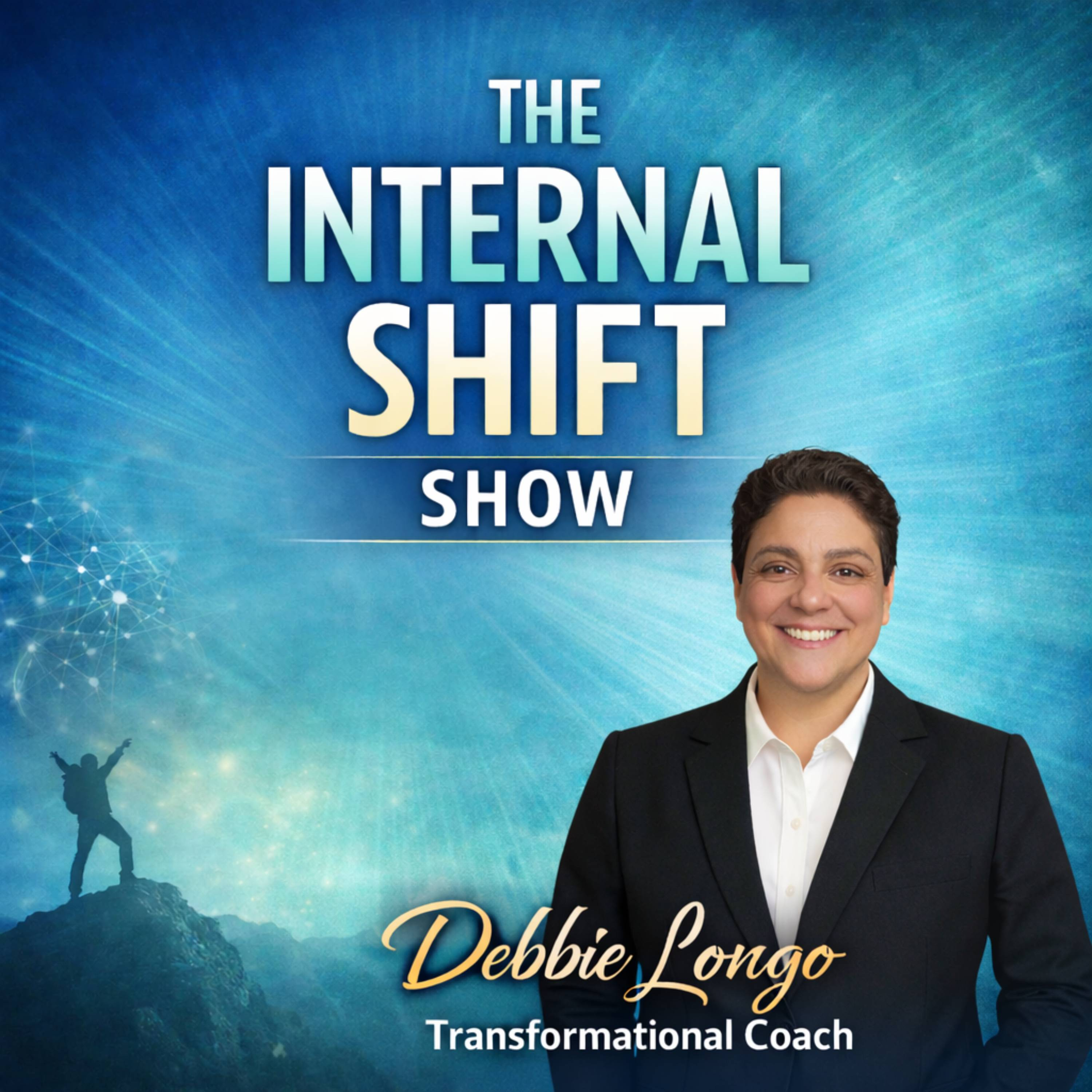
In this episode of The Internal Shift Show, Debbie Longo speaks with Nancy Dayo about chronic pain, disability, opioid addiction, identity loss, resilience, and the internal shifts that helped her rebuild her life after going from Silicon Valley CEO to bedridden chronic pain patient.
Nancy shares how her entire identity was built around achievement, endurance, pushing harder, and constantly proving herself through work and performance. After selling her business to a competitor, she attempted to reclaim her sense of strength by climbing Mount Kilimanjaro. Instead, the climb triggered a devastating spinal injury that completely changed the course of her life.
After collapsing in severe pain on the mountain, Nancy spent months searching for answers while doctors repeatedly told her nothing was wrong. By the time doctors finally discovered crushed vertebrae and severe spinal damage, she had already become heavily dependent on opioids, including OxyContin, while struggling with extreme chronic pain and physical limitations.
Throughout the conversation, Nancy openly discusses losing her independence, becoming bedridden, isolation, addiction, emotional despair, and the repeated cycle of trying to “push through” her condition only to experience even greater setbacks. She explains how years of believing resilience meant forcing herself harder eventually became destructive both physically and emotionally.
The major internal shift came when Nancy realized the medical system could not fully solve her situation and that she needed to redefine what resilience actually meant. Instead of continuing to fight against her limitations, she slowly began accepting a “new normal” and focusing on what she could still do rather than obsessing over everything she had lost.
Nancy shares how she returned to graduate school while lying down on a portable army cot because sitting remained too painful. Despite embarrassment and fear of judgment, she re-entered society in a completely different way and discovered that her disability did not erase her ability to contribute, learn, travel, advocate, and create purpose.
Today, Nancy writes and speaks about chronic pain, resilience, disability, identity, and emotional transformation. Her story reinforces the idea that life crises may completely change how people move through the world, but they do not have to eliminate purpose, possibility, or future growth.
This episode explores chronic pain, opioid addiction, emotional healing, disability, resilience, identity loss, personal transformation, mental health, self-acceptance, and redefining success after trauma. It reinforces the idea that healing does not always mean returning to a previous life — sometimes it means creating a completely new one.
Contact Debbie Longo, Executive Behavioral Coach:
Website: https://www.debbielongo.com/
Email: debbie@lifeinbloomny.net
LinkedIn: https://www.linkedin.com/in/debbie-longo-life-in-bloom-ny/
Facebook: https://www.facebook.com/debbie.longo.2025
Instagram: https://www.instagram.com/debbie.life.in.bloom.ny/?hl=en
Contact Nancy Dayo:
Email: nancysdeyo@gmail.com
Welcome to the Internal Shift Show. I'm Debbie
Longo. This show focuses on how internal decisions
shape direction, progress, and long -term outcomes.
Today's conversation uses real -world experience
to examine how subtle internal shifts influence
the way people move forward. I'm joined by a
very special guest today, Nancy Dayo. Good afternoon,
Nancy. Welcome to the show. Thank you, Debbie.
Good to be here. Thank you for being here. I'm
going to ask you today to tell your story and
point out a specific situation or scenario or
life change or something where you went through
a process and the end result is positive. Now,
I do this show for a few different reasons. And
one main reason is because everybody has their
own individual story, but there are parts to
people's stories that other people can relate
to. So maybe a listener is in a situation that
they don't know how to get out of. And or maybe
they think that the scenario or the experience
that they're in is just going to be normal. That's
just going to be how they are for the rest of
their lives. And it's my experience for a very
long time of working with people that that will
hold me back 100%. And if I don't want to be
that way and I don't want to have that life,
right, then I can make a transition and I could
go from that negative situation and go through
a process and then have the end result or turn
that into a positive, whatever that is. It doesn't
have to be the end because sometimes we could
continue. But the idea is not to sit in a negative
situation or scenario or anything, because there's
no such thing as that. So the other thing is
that we want the listener to understand, to try
to relate to something that you are saying. It
doesn't have to be the thing that you're going
through. It can be something else that you're
talking about. And I'll probably give examples
as you start speaking, as you go through your
story. So we want to ask the guests if they could
really listen to what we're talking about here
and see if they could identify with any part
of this podcast at all. So if you could do that
for me, I would appreciate it. Thank you. Great.
Thank you, Debbie. Well, here is the one sentence
headline before I share my story. I went from
being a Silicon Valley CEO to a bedridden chronic
pain patient and back out in the world again
as a graduate student, then as an advocate for
girls and women, all of it lying down horizontally,
mostly on an army cut. This story I'm going to
share is a story of how I learned to redefine
what resilience really meant. When I was a CEO,
my whole MO was push harder, work faster, work
harder and longer than everybody else. I was
probably an average person at Silicon Valley
at the time. But my business didn't succeed.
I had to sell it. to my arch rival. And that
was a huge breakdown in who I was and who I thought
I could be. You might think that was the moment,
but it wasn't. I decided to climb Mount Kilimanjaro
as more than an endurance test, but as a way
to redeem myself after that failure, to prove
that I was still strong and capable. But as I
ascended the mountain, suddenly there I was at
16 ,000 feet. I had collapsed in pain so severe,
I thought I was dying. I couldn't move my legs.
They felt disconnected from my spine. And when
I tried to shift my body, it felt like somebody
was driving a metal rod. through my back. So
I thought two things. One, I think I'm bleeding
out. And two, everything I built my life on,
pushing harder, pushing through is just not working.
You think that might be the moment, but I still
kept going. For the next six months, I saw doctors
in Africa, in the UK, and eventually in the United
States who all looked at my films and my x -rays
and told me I was fine. I mean, I still remember
the day my hometown guy, my hometown doctor in
San Francisco, California, walked into my room
and there I lay weak in a hospital bed, unable
to walk, a commode by the bedside, and he grabbed
my films and he said, I have great news, you're
fine. It just felt somehow like there was a disconnect
and I wasn't being believed. The good news is
that by the time they figured out that I had
smashed vertebrae and a disc that needed replacing,
I was already highly dependent on opioids and
specifically on Oxycontin. Many of your listeners
probably know the story of Oxycontin in the United
States, but it was a very dangerous drug that
was very addicting. So I moved forward into the
life of a chronic pain patient. My life was in
bed. For some reason, because of my injury, I
was really unable to sit more than for a few
moments at a time. I was isolated. My friends
left me one by one as they were frightened by
what they saw, by my disability, by my pain,
by my discomfort. Every time I tried to get up
and push, which is all I knew, I would crash.
I would have a huge setback. I'd be completely
dependent on my husband and bedridden for weeks,
and then I'd have to start over again. Finally,
I went to the Mayo Clinic in Rochester, Minnesota
for a drug detox and physical rehabilitation
program. The interesting thing about this, just
knowing a little bit about my personality and
who I am, is that it's a three week push and
they take all the drugs away in week one, which
makes you violently nauseous and your skin's
crawling and you can't sleep. And then they forced
back physical function. So I was somebody who
couldn't sit. I could barely walk. I had no strength,
but they pushed that back over the course of
a couple of weeks. And at the end of it, I felt
like I can see I might be able to get my life
back. I'm sitting a little bit. I'm not lying
down as much. I'm feeling a little stronger and
I'm off opioids. I got home two days later. I
was in so much pain that I was hospitalized to
get it under control. And in that moment, in
that the depth of despair, the doctors came in
and said, we really have nothing more for you.
We've intervened and we've structurally fixed
your back. But the pain that you're living with
just needs to be managed. We're sending you home.
And I thought, this is a moment. Here's the shift.
The medical system has nothing for me. I'm on
my own. My mode of pushing and shoving and forcing
my way through everything and enduring past everybody
else isn't working. And in fact, it's actually
causing my body harm and doing wonders on my
mind at the same time. So I needed to find a
new way forward. I just had to do things differently
because the life of a chronic pain patient bedridden
and opioid addicted is no life. So as I thought
about it, I realized a couple of things. The
first is maybe being horizontal is a new normal
for me. Maybe it's just the way that I need to
be in the world. And I slowly started to learn
that we're all human. We're all individual. There
are so many ways we can be in the world, whether
we're disabled or not. But I decided to re -enter
the world. My solution was to go back to school
to get a graduate degree. I was passionate about
women and girls, and I wanted to get an international
studies master's. The only way I could do it
though was lying down. So at first I kept deferring
when I got accepted, waiting to be normal, waiting
to get myself back again. I didn't really know
who I was lying down, but finally I realized
I had to start maybe before I was even ready.
And so I concluded that an army cot that was
portable that I could set up in a minute that
I could lay a air mattress down on would be the
solution for me. No matter how mortified I was
about it initially, no matter what I thought
my cohort of students might think, I was not
willing to be identified by that disability.
So I went back to school. The acceptance I received
from that community of students was just beautiful.
They said, you have a lot to contribute to the
world. You just happen to do it lying down. And
that was a big aha moment for me. and I graduated
and I thought, if I could lie down in a classroom,
maybe I can start to travel again. I had been
on Kilimanjaro. I had been around the world.
I love to experience new cultures. And so I started
to travel lying down across three seats and coach.
And that was possible. Yeah, I got a lot of looks.
I had a lot of people trying to take the aisle
seat from me. But I realized that that was just
my way of being in the world. And that led to
my work in Women and Girls Empowerment, where
I did it in a different way. And so today I write
and speak about chronic pain and identity and
redefining resilience. I've written a book about
it. But the important thing for your listeners
is what I learned is I had to really listen to
my body and accept that it couldn't do the things
it used to do. I had to focus. on what I can
uniquely do, which was lie down, but use my brain.
And I had to find a new way forward. Yeah, that
was very, very, very good. Thank you. And this
is the exact point that I tried to make is the
reason why I have this podcast. When I just said
at the beginning in the intro and most of my
guests go through this, obviously, but you indicated
it straight out that you thought that this is
the way that you were going to be. This is how
you were going to be. This is how your life was
going to be, whatever it was. that you were thinking
exactly. And that type of situation should not
be, in my experience of working with people,
that should not be acceptable. And when that
becomes unacceptable and I tell myself, this
will not be this way, okay, I have friends that
the doctor told them they had cancer and they
said, no, they don't. And they would have not,
now I'm not saying to do this if you have cancer.
If you're going to listen to the doctor, that's
fine. But there are people out there that do
that. Whatever the situation is, I can tell myself
that this is not going to be this way. This does
not have to be this way. And I will not accept
it. And when I do that... then I'm willing to
change because all's I'm asking is that the person,
the listener or the individual to create the
willingness to want to change and want to do
something about it and then they can be helped.
But if they don't want to do that and they want
to sit in their sick and suffering and they choose
to accept this as their life and that's how they're
going to be, then that's completely up to them.
That's fine with me. I'm not like that. those
are not people that I can help. And that's really
the bottom line. Maybe somebody else can help
them, you know, but the way that I do it, that's
not my thing. That's not part of my process of
helping people. So this is a very good point.
And now my question to you is when you decided
that you got the army, army cot, and you didn't
want to lay down anymore or you didn't want to
stay in that space and that mental space. And
you decided that you wanted to go back to school
and you wanted to get out of that where you thought
that you could do something else, right? Rather
than being that way. What was that process? What
did that look like? And how did you make that
decision? Did you have extra help? Did somebody
come to you? Did somebody say something to you?
What was that process like? And what happened?
And how did that exactly come about? And if you
could be, like I said, this is a podcast, so
you could talk about it to whatever length you
want to talk about it. Thank you. I think for
me, there were several factors. that were going
on in my mind. As I mentioned when I shared my
story, I was determined, but I had limitations.
And from an analytical standpoint, I had to figure
out what I could control and what I couldn't
control. And what I couldn't control was my body's
inability to sit. I just couldn't do it. The
pain was too fierce when I tried. So that was
a non -negotiable. I realized that I had control
over whether I stayed isolated in my house or
whether I decided to reenter society in a different
way. So that was something that I knew I had
control over. I had a lot of help. My husband
was incredibly supportive. And I have to say
that after 15 years of chronic pain and hell
that we went through together, a lot of guys
might have said, I love you, honey, but I didn't
sign up for this. But he stayed and he problem
solved. And he, like me, never gave up. I also
had a fantastic psychotherapist that I found
through the Mayo Clinic. And she, for years when
I was sick, kept talking to me about the new
normal. And I kept saying to her, I hate the
new normal. It's a horizontal monochromatic.
terrible life. I want my old life back." And
she said, you just got to stop fighting for that.
You have to appreciate and accept that which
you can do and move forward with it. And she
was, she was interesting. She had her own level
of severe disability and pain and had navigated
through it. So for me, she was just the ultimate
role model. She had degenerative spinal stenosis
and couldn't lift anything. larger than a pea
and carried everything around in a rolling cart
and managed to go on about her life. And so I
saw her as the mecca of what I could do if I
would accept that what my new normal meant was
I had to lie down. But everything else was negotiable.
So another thing, too, I was thinking of was
the listener can take parts of this just like
they can do with any of my podcasts, obviously.
But with this podcast, they could take parts
of this like a disability. Do you have a disability
or addicted to pain meds or laying down and not
being able to get up? So the listener can take
parts of this and see if that's them. and see
if they could identify with that. It doesn't
necessarily have to be the whole, like, your
story. If somebody has... pretty much your exact
same situation, that's fine. But to me, I don't
know how common that is, but to have somebody
addicted to pain meds or a disability or different
things, these things are extremely common, especially
an injury and addicted to pain meds. You don't
know how common that is. Okay, that's extremely
common. They're doing all kinds of things to
stop this. So this is what I'm saying. So these
story that you're saying doesn't have to be.
your situation doesn't have to match exactly
what the listener situation is. And the point
to this is, is to get the listener to understand
and to realize that whatever that part of your
story that they can identify with, which hopefully
they can, then they could see that you went through
this process and that's not going to be their
process. It's just not. because everybody has
a different process. We are not clones. We're
human beings. Everybody has the ability to think
for themselves. Nobody can make anybody do anything.
And that's the bottom line. So. Don't be afraid
of, if you're going through anything like this
or parts of it, don't be afraid of saying, I
have to do this. I know it might be scary. I'm
not sure what's going to happen, but I have to
do it because I can't take my life like this
anymore. And again, you're a perfect example
of that. And I really, really appreciate it because
the way that you shared and the honesty and the
openness and all these things and how you shared
it and how you explained it was very, very good,
was just the perfect, very thorough and the system
and everything, the pattern and the way that
you explained it was very, very good the way
you laid it out. So my question to you is, how
do you feel right now, right this second? based
on everything we just talked about, this whole
entire podcast and everything you went through
and your process and everything. How do you feel
right now, right this second? I feel empowered.
I feel like my stories of opening up to possibility
and realizing that who we are and how we understand
ourselves might completely shift with a life
crisis. but it doesn't have to be the end of
our lives. And I sit here today having a conversation
with you, Debbie, as an example of somebody who
was able to redefine who they were and reshape
a life that seemed to be over for all practical
purposes. If people are willing to open their
minds and maybe shift how they think about things,
how they move forward through the world with
their body or with their mind, it suggests to
me that there is tremendous possibility. Very
true. And I agree 100%. And that was a very,
very good way to close. And in closing, I would
like to say that anybody could get through anything
as long as they want to, as long as they create
the willingness. And there's no such thing as
a negative situation because everything can be,
any situation can be changed into a positive.
Nobody has to sit in their sick and suffering
and say this is the way that it's going to be
Because all they're doing is holding themselves
back from their wonderful beautiful glorious
future That's basically just laid out for them
and waiting for them to come So my the universe
and my path does not hold me back I hold myself
back and that's really the bottom line and I
thank you for that. So What stands out? from
this conversation is that meaningful change is
built through consistent internal decisions,
not dramatic moments. If something resonated
with you, consider where those internal decisions
are already shaping your path. This has been
the Internal Shift Show. Thank you for listening
and thank you, Nancy, for being on the show.
I really appreciate it. A pleasure. Thank you,
Debbie.