
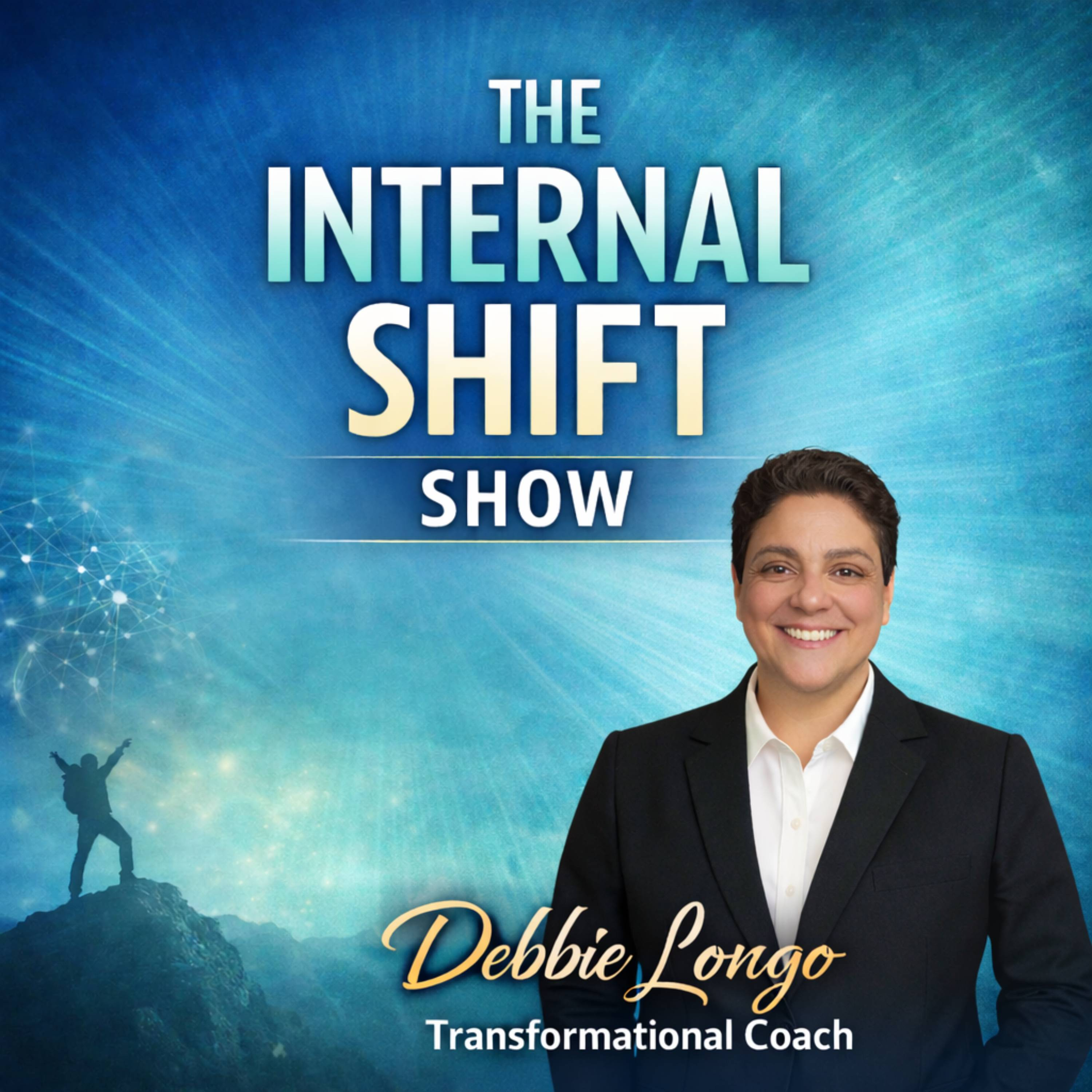
In this episode of The Internal Shift Show, Debbie Longo speaks with Gina Economopoulos about grief, emotional pain, addiction, faith, loss, self-worth, and the years of internal conflict that shaped her life journey.
Gina shares how the sudden loss of her mother to cancer at 23 years old completely changed the direction of her life and left her searching for meaning, identity, and emotional stability. Struggling with grief and emotional pain, she returned to her Catholic roots and eventually joined a convent, believing that dedicating her life to God would bring healing and peace.
Although Gina spent 12 years as a nun serving others and helping the poor, she explains that she continued experiencing deep internal conflict, emotional pain, rejection, insecurity, and feelings of not belonging. Eventually, she was asked to leave the convent, which created another major emotional turning point and left her questioning her identity, purpose, and future.
After leaving religious life, Gina attempted to rebuild her life while continuing to search for peace, love, and acceptance. She later entered a relationship with a man struggling with alcoholism and addiction, believing they were finally building a future together. After he became sober, the couple planned a new life together, but tragedy struck when he survived a devastating car accident that killed his mother. Shortly after relapsing into alcoholism, he died from the disease, and Gina found him dead just one month before their wedding.
Throughout the conversation, Gina openly discusses grief, emotional pain, enabling behaviors, people-pleasing, addiction, depression, trauma, and the overwhelming hopelessness she experienced after years of repeated loss and disappointment. She explains how alcoholism eventually became part of her own struggle and how entering recovery and working a 12-step program completely transformed her life.
Now celebrating 11 years of sobriety, Gina shares how recovery helped her finally accept herself, process emotions in a healthy way, rebuild her relationship with faith, and discover peace within herself for the first time. She explains that healing did not come from avoiding pain, but from learning how to face it honestly instead of running from it.
This episode explores grief, addiction, recovery, emotional healing, self-worth, trauma, faith, sobriety, resilience, and the importance of learning how to live through painful experiences instead of being destroyed by them. It reinforces the idea that even after years of suffering and internal conflict, healing and peace are still possible.
Contact Debbie Longo, Executive Behavioral Coach:
Website: https://www.debbielongo.com/
Email: debbie@lifeinbloomny.net
LinkedIn: https://www.linkedin.com/in/debbie-longo-life-in-bloom-ny/
Facebook: https://www.facebook.com/debbie.longo.2025
Instagram: https://www.instagram.com/debbie.life.in.bloom.ny/?hl=en
Contact Gina Economopoulos:
Email: briangina67@gmail.com
Welcome to the Internal Shift Show. I'm Debbie
Longo, Transformational Coach. This show explores
how the way we think, decide, and respond internally
influences where we end up over time. Today's
conversation draws on real experience and expertise
to look at how small internal shifts can change
direction, momentum, and outcomes. I'm joined
today by a very special guest, Gina. Good afternoon,
Gina. Welcome to the show. Thank you, Debbie.
It's nice to be here. Good, and thank you for
being here. I'm going to ask you today to tell
your story a little bit and describe a life change
or traumatic experience or some kind of situation
or scenario that you went through and what your
process was and how you got through it, how you
came out the other side, and the end result should
always be positive. Now, I do the show for a
few different reasons, and one reason is because
everybody has their own individual story, but
there are parts, the people's stories, that other
people can relate to. So maybe somebody is stuck
in a situation where they don't know how to get
out of it. Maybe it's a negative situation or
abusive or something where they know that they
don't want to be there anymore. Or maybe somebody
thinks that they're in a situation or scenario
and they think that. It's just normal. This is
just the way that my life is going to be and
I'm just going to have to deal with it. But here's
the thing. There's no such thing as a negative
situation or scenario because anything that's
negative can be turned into a positive. And when
I do that, my life gets a lot better than what
it is. So I don't want to accept just. The way
that I am now and I don't want to accept the
fact that I don't I can't move forward and this
thing is holding me back. This is why one of
the reasons anyway why I have this show is to
tell all these different stories with these different
scenarios and to explain that this is the way
that these people came out the other side. So
whatever the listeners situation is. traumatic
experience or some type of life change that they're
going through now, they can always get through
it. And that's really the message that we're
trying to send here. So if you could do that
for me, I would appreciate it. Thank you. Thanks,
Debbie. And it's so good to be here. And it's
like, wow, looking back on my journey, it's like,
where was I and how did I get through it and
where I am today? It's a very long journeys,
but I'll share with you in a brief form of where
my the internal conflict started. I grew up in
a large family. I was, I don't want to say I
was a wild child, but I just liked to have fun.
So I lived a life of having fun outside the church,
outside my family's norms, et cetera. And I went
to college and living a college life and trying
to have that American dream of finding a guy,
getting married, having kids, et cetera. But
yet then my mom, The first internal conflict,
the first trauma that happened in my life is
that my mom was diagnosed with cancer. I was
23 years old. I was there. I watched her. She
was terminally ill, and she died six months later.
And that was at the age of 23. It's like, where's
my mom? I'm the seventh child. Why me? Why does
she have to die? She's not going to be for my
wedding or anything like that. So I did a searching.
And I was searching for the meaning of life to
get added because I was too short. I was like
in such an in a down low place. Grief, we call
it. I was in complicated grief. I hated everything.
I didn't have any faith or in a God in the universe
or anything. So it was like pure hell for me
to live because there was nothing in my life.
So I did this searching and I went back to my
Catholic roots, because like I said, I was race
Catholic and I found a God, I found Jesus. So
I figured I'd become a nun. So I joined the convent.
So one would think that would help me and heal
me, which it did because it was part of my journey.
But I did not. And I thought I was going to be
the nun for a nun for the rest of my life. I
married God 12 years in the convent in New York
City. I'm a people person, hands on with the
poor. I love being a sister, but yet it wasn't
my life because I was experiencing eternal conflict
again. And here, how can a nun within a habit,
who prays all the time, have eternal conflict?
And yes, I did. I was emotionally abused by my
community. So I experienced rejection, hurt,
you name it. I had a great smile, and by the
time of my religious life, I didn't know what
to do. Talking about conflict, it's like, God,
you called me here, but I feel like the sisters
don't want me here because the way I've been
treated, what do I do? What do I do? And that
went on for years of experiences, suffering from
the community. And then finally, they asked me
to leave. They said, you don't belong here anymore.
And so... And now I'm into more conflict. It's
like, why? How can this happen? Like here, I
gave my life to God. I made final vows and I
get kicked out. And so I didn't think anything
more of my life. And people who knew me as a
nun, because I was well known, well loved, they
said, why don't you go to another community?
Because there's so many religious communities.
And I'm like, why would I want to get hurt again?
Because I was so hurt. downtrodden. So I continue
my journey. I'm out of the convent. I'm not at
peace with myself or with my life. Yes, I was.
I was in my life because, of course, I was praying
and saying, what do you want me to do? And I
was just so tired of serving people places like
doing what other people want me to do, because
that's how I was. I'm a people pleaser that I
decided to come to the Jersey Shore. I live here
on the Jersey Shore. and I got an apartment and
I got things. I did not know how to live life
because I was living in Oceania life for 12 years
in the South Bronx. So coming into the world
in the year 2008, it's like shocker. I did in
between this and before coming to the Jersey
Shore, I did go live with men and women with
disabilities. I was a house mom, which tried
to help me to trans. go from one life to another
into the world. And then finally, I did end up
here on the Jersey Shore, still trying to wander.
I'm in my 40s. God, what's your will? What do
you want? And I knew then that I was not going
to join a religious community. I was going to
do whatever. And so I went back to bartending
because I was a bartender before I was a nun.
That's the only thing I knew. So I was bartender,
nun, bartender. And so I'm like, OK, I'm Now
maybe I might meet a nice man. All along, I just
kept pushing myself forward. I don't know how
I did it, but I just kept searching, looking.
Now I'm at peace. I'm a walk from the beach.
Wow, that's like my dream is living by the beach.
It's like I'm in heaven. I'm at peace. This is
it. Now let me find a guy. Of course, Bartending,
I did find a guy. His name was Danny. He came
in. It was like, wow, I found a nice guy. So
I was like, OK, no more conflict. My life is
going to be great. Well, it comes to find out
he was an alcoholic. He was active. So that was
kind of new to me, a whole new world. It's like,
stop drinking. Oh, no, I can't. I didn't know
anything about alcoholism. I went to Alan on
where he asked me to go because now I'm in internal
conflict again to see him. He's a great man when
he doesn't drink, but when he drinks, he's, he's
a drunk. It just useless, you know, he's an alcoholic.
So anyhow, I'm just like, okay, but I, there
was something in him that made, that had me stay
with them. I said, okay, Danny, you just need
to get back, get well, stop drinking AA, go to
AA, go to this. And he did, he found sobriety.
Yay, Debbie Mike, I don't have eternal conflict
anymore because he's sober. You know what I mean?
It looks like when you see someone sober, it's
great. And we were gonna pursue our life together
out in the West. Like I said, we're both from
Jersey. So we were gonna go out to the West.
So he went ahead and driving with his mom, like
we're excited. Okay, this is it. He's sober.
Everything is great. As he was driving with his
mother, with all of his belongings. They got
into a tragic car accident. The mother died.
He burned up. He didn't die. Get that phone call
saying, I mean, this is about 13 years ago. And
I was like, what? But he's alive. So I uprooted.
It all happened in Indianapolis. So I uprooted
and went to Indianapolis to be with him because
I do love him. I see him as a good guy and he's
sober and everything. Now he's all burnt up.
And what does an alcoholic do when they're in
pain, physical, emotional, spiritual? When they're
in their eternal conflict, he picked up, he drank.
I'm like, oh my God. And now because it's a family
disease, so I'm here in my own conflict. And
I'm like, how can you do this, daddy? God saved
you. You were sober, et cetera, et cetera. And
then ultimately, a few months later, he died
from the disease. I found him dead. So my eternal
conflict then was I was done. So this is good.
So there's a few different and thank you for
that. I appreciate that. There's a few different
things going on here. So and the main theme,
obviously, right, is your personal eternal conflict,
which sounds very maybe deep for you, something
that's deep rooted that kept coming up for you.
which is a good thing to talk about only because,
and I say this a lot, we're talking about a few
different things here, the career and the relationship
and stuff. But here's the thing, all of these
things, everything that happened outside of you,
all the outside forces and all the situations
that are on the outside, not inside of me, affect
me, but... That depends on how I feel inside.
Now, I'm not, like, trying to judge you or anything
because I don't know. I don't know what the end
result of all this stuff is. I'll ask in a second.
But the point that I'm trying to make is that
even for the listener, if they're going through
this or something similar where they're having
internal conflict, no matter what is going on
in their life... What are the situations, you
know, and maybe a relationship and the things
that are happening in their life? If they feel
this type of feeling at all, right, or any negative
feeling, think about what's going on outside
of you and how do you feel from those things?
And is that causing you to feel those negative
feelings that you're feeling? Because and think
about if I don't feel that how would I respond
and react to these people? That I'm saying I
feel this way because of them, but if I don't
feel that how would I be with these people? So
this is the thing and that's why everything is
perception and that's another reason why I do
this show right is to Ex to show that to give
examples where we're showing that and all my
guests Their stories are all like this with different
situations, obviously, but they're all like this
because this is why I asked to explain the process,
which you did fine. But because that's where
the inner thoughts and the inner feelings and
the inner behaviors and everything is going to
come out. And now the listener is going to say,
wow, maybe this is me. Maybe this is my issue.
Maybe this is really what's going on with me.
So my question for you is what was your process
like when you knew that you became that you wanted
to be a nun and from when you were in your childhood
or whatever, right? You said 21 and then you
wanted to be a nun and then you became a nun.
What was that process like for you? Because that
was a young age for you. Yes, it was because
I lost my mom at the, well, it was really 23.
I lost my mom at 23 and I was a lost soul. So
my process was like, oh, first I had to figure
out where heaven was, where my mom was because
I was crying all the time. And then in that,
as my, my process was like I was going, I went,
I went like I should, I went back to my Catholic
roots. So I went from one extreme to the other
to join the sisterhood. Was it a wrong choice?
Could have been. But I was I was you know what
the bottom line Debbie's that it's exactly is
my eternal conflict is that I was looking for
that love within me. I was looking for an acceptance.
I was I was so insecure even as a kid because
I was born with a lot of a lot of problems. So
I had this black cloud over me or I thought it
was. So everything was like poor me poor me.
So here. Mom dies. I get back into the church.
I meet these young people that love God, gave
their life up to God. I'm like, oh, yeah, I'll
do that. And they love me because I have a personality
plus. It's like, yeah, I'll take you. And it's
so true. It's all my exterior, my smile. Like,
yeah, everything is fine. I never shared my deep
feelings. Like, no, I'm hurt. I mean, this was
even before the convent. No, I don't like myself.
No, I'm insecure because to me that was like
a voodoo. You can't share those feelings. You
can't. And here I'm trying to find peace wherever
I could find peace. Oh, I'll hang out with you.
I'll do this. I'll do this peer pressure, whatever
it may be. So, you know, this process for me
joining the convent, yes, it was God's will back
then, but in deep down. I was immature. My faith
was immature because I was jumping and looking
to find something that's gonna love me for me.
And the thing was is that in a long run, I was
running away from me. And of course, I did not
realize it at that moment. And I never did until
years later. I mean, my journey continued of
looking for me. And it wasn't until maybe 10
years ago I found who Gina was. And that's very
good, thank you, because you expressed a little
bit about your feeling and you incorporated what
happened to you with your feeling, what you thought
and felt and all that. So that was really good.
So the next question is, what was your process
from when you... They told you you didn't want
to go into the convent anymore all the way until
your your spouse got Into that accident. So there's
a few things that happened in between all of
that But the thing is we don't have to say what
those things are again because you just said
it but what was your process? thinking process
and feeling and during those times because you
had a lot of change going on and then you kept
mentioning about the internal conflict. What
was that like? I mean, after I got kicked out
of the convent, my yes, it took me a while to
realize that, hey, I fulfilled one vocation.
That's enough as a religious sister. and I was
okay with it. Was I still angry? I held a lot
of anger, resentment, and hurt still from it,
from the community itself, but I knew that was
not my direction. So then when I had met, and
I was like, oh, I always wanted to meet a guy.
And when I met Danny, so my process was like,
oh, I met a guy who loved me for me. I told him
I was a sister, he didn't run away. He was like,
yeah, and we fell in love. So it was like wow
this is what it means to fall in love with a
guy and to have dreams with and I always said
I would go to any place that will keep his sobriety
because what conflict was interfering that was
the alcohol was the disease and I had to learn
another process is learning about the disease
of alcoholism and addiction and I didn't really
know I thought like I could stop so here I My
behavior was I was an enabler. I was a manipulator.
I did trying to bargaining, yelling and everything,
thinking that I have every power for him to stop.
But that didn't work. And I didn't know. That's
what I'm saying. In all of these situations,
trauma, pain, sufferings in the past, when I
was in it, I did not really know what the solution,
the healthy solution was until it was just trickling.
One thing after another, one thing after another.
So when Danny died, what was my process then?
I did not want to live. I didn't have a process.
Talking about negativity and the dominoes effect,
I really thought, Debbie, and this is one thing,
it's so hard to relate to anyone. I really thought
I was in this like part of my life or this life
of mine that I wasn't gonna, that was gonna be
dark all the time, darkness. Like I surrendered
to darkness, I surrendered to suffering, I surrendered
to pain. And I never thought I'd get out of it.
And at this point, I didn't wanna get, I was
like, I'm tired because throughout my life I
was trying to get to something good, something
good. Okay, I got something good, it's gone.
I get something good, it's gone. And here, When
Danny, when I found him dead a month before our
wedding day, that's it. I'll be in the summer.
I'm so sorry. I know it's hard. I'm just so,
you know, it's such a traumatic situations here
that we're talking about. I'm so sorry about
that. But you came out the other side because
you're here. Yeah right and you're talking about
it so that's really the most important thing
but yes one thing i just like to say quickly
is that when i have feelings sometimes you can
say like negative positive feelings but sometimes
they just feelings that i have to feel. And that's
part of my process. And there's nothing wrong
with that. But if that leads me to a depression
or to do bad things, maybe like commit a crime
or something. I'm talking about like a really
bad thing or something like that. If it leads
me to something where there's really a bottom,
then that's something that I might want to say,
I could probably do better than this. I don't
want to do this anymore. And that's the thing.
So but either way, I still want to feel those
feelings, but I don't want to do anything to
access. That's what I'm trying to say. So what
is your life now? How do you feel? Second, based
on everything we just talked about the podcast,
everything, your feelings and different things.
And how do you feel right now, right? The second.
I feel wonderful right now. Everything I've been
through, I had to go, I went through to be the
person who I am today, because yes, there was
a dark time when I found Danny dead. Like a real
long story short, I ended up coming into the
rooms of AA. I'm an alcoholic and I just celebrate
this month of April, 11 years of sobriety. And
that was another, it was eternal conflict, because
about that point I'm like, I can't be an alcoholic,
you know, but. I am. And in that, I work a 12
-step program. And in that, I was able to get
my real feelings back and able to say, hey, it's
okay to feel. And with these feelings today,
I have, whether it's sadness, joy, anything,
I'm a sober woman of faith that I know what to
do with them. I have a healthy solution. I try,
practice gratitude each day. I have all these...
like talking about your feelings, yes, your feelings
came up. And I realized in the past, I pushed
down my feelings. I got stuck in my feelings.
I had a nice pity couch with my feelings. I was
like, I drank my feelings away. I sometimes drugged
them or whatever, or I ran away. I ran away.
And now working a program, being who I am today
in these last several years, I've learned to
really work on myself through my program, as
well as just a new relationship with my higher
power. And that's a whole different process to
go through. And it was a process of in the beginning,
of course, I didn't trust anyone. I was so hurt.
I didn't smile for a year, two years after, before
this whole thing happened. But when I came to
realize, wow, I'm an alcoholic. Oh, I got accepted.
and just going through all that conflict because
I was like, I can't be an alcoholic. I was a
nun. What nun is an alcoholic? You know what
I mean? What this? What this? And your mind is
so true, Debbie. I think you shared it. Your
mind could do so much. It could be a power of
good, of bright things, but also it could bring
you such negative down -hole, whatever, negative,
nilly -nilly, whatever you want to call her,
you know? But yet, no, today, to share with you
and your listeners, I finally found out who Gina
is. I'm comfortable in my own skin. I'm able
to live life today. I could show up to life.
And I also realize life goes on with me or without
me. So there is grief that still comes in life.
There's still tragedy or things that happen,
but I know how to use them, the tools, or I know
what to do to... to embrace it or to live with
it or whatever it needs to give that peace. Because
today I live in peace. The bottom line is most
of the time. I mean, most of the time there is
a happy, joyous and free within me that I realize
that that's one thing that I was searching for
my whole life. Yeah, that's good. And that is
a very, very good way to close. And in closing,
I would like to say that All these things that
you heard in this podcast now started with a
negative and it ended with a positive and we
feel good and we feel happy and we're making
the best out of our lives. You know the best
we can and the most important thing is what do
i want to do with my life and my happy. With
my life now and is there something that i need
to go through and to come out the other side
because there is no such thing as a negative
situation because anything. Can be turned into
a positive even if it's just one negative feeling
doesn't matter what it is Anything can be turned
into a positive and my life will 1000 % get better
from that and that's really the bottom line as
we close this conversation is a reminder that
progress really comes from one big decision but
from the internal choices we repeat if Something
from today's discussion connected with you take
a moment to notice how those internal choices
showed up in your own life this has been the
Internal Shift Show. Thank you for listening
and thank you Gina for being on the show. I really
appreciate it. Thank you.