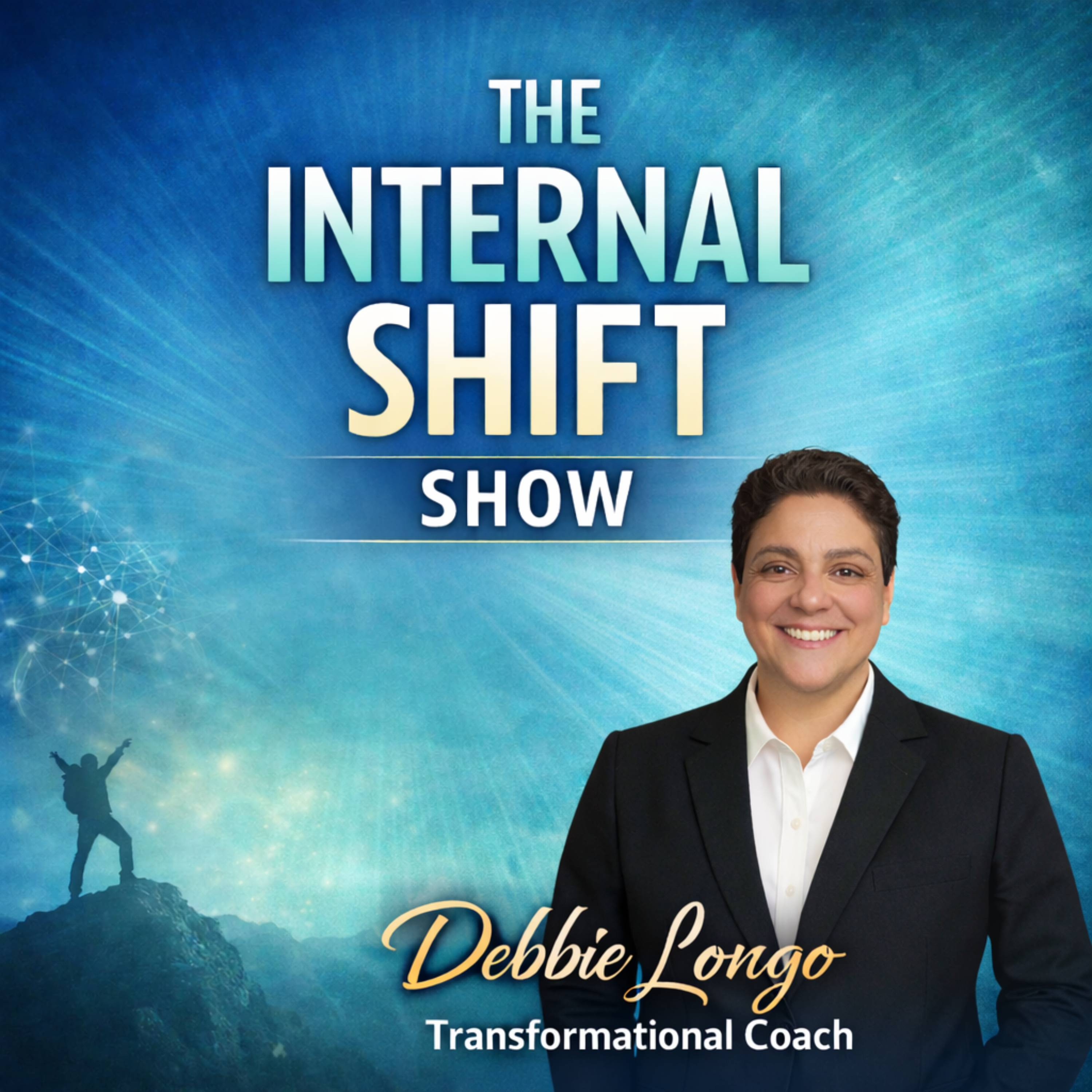
In this episode of The Internal Shift Show, Debbie Longo speaks with Brenda Bridges about divorce, emotional trauma, victim mentality, personal responsibility, and the internal choices that helped her rebuild her life after the end of a 26-year marriage.
Brenda shares the moment her husband unexpectedly told her their marriage was over and how the divorce process became one of the most traumatic and emotionally difficult experiences of her life. She explains how easy it was to become consumed by negativity, anger, blame, and emotional overwhelm during the process.
Instead of staying stuck in that mindset permanently, Brenda eventually realized she needed to shift her perspective and stop identifying as a victim. One of the biggest turning points came when she attended a gathering of divorced women and saw how many people were still emotionally trapped in the pain and resentment of their past years later. That experience became the catalyst that pushed her to consciously choose a different direction for her life.
Throughout the conversation, Brenda explains how focusing on small daily decisions, future goals, and personal responsibility helped her slowly rebuild confidence and emotional stability. She discusses the importance of awareness, mindfulness, support systems, and learning to make choices based on empowerment rather than fear or emotional reaction.
Brenda also shares how her own experience eventually led her into divorce coaching, mediation, and helping others navigate major life transitions with more clarity, confidence, and hope. She explains her “three P’s” framework: purpose, process, and people, and how having a future-focused mindset can completely change the direction of someone’s life.
This episode explores divorce recovery, emotional healing, mindset shifts, trauma, resilience, personal growth, victim mentality, mindfulness, decision-making, and the power of small internal changes over time. It reinforces the idea that while people cannot rewrite the past, they can absolutely change the direction of their future through the choices they make every day.
Contact Debbie Longo, Executive Behavioral Coach:
Website: https://www.debbielongo.com/
Email: debbie@lifeinbloomny.net
LinkedIn: https://www.linkedin.com/in/debbie-longo-life-in-bloom-ny/
Facebook: https://www.facebook.com/debbie.longo.2025
Instagram: https://www.instagram.com/debbie.life.in.bloom.ny/?hl=en
Contact Brenda Bridges:
Phone: 423-602-8246
Email: brenda@bridgingllc.com
Welcome to the internal shift show. I'm Debbie
Longo, transformational coach. This show explores
how the way we think, decide and respond internally
influences where we end up over time. Today's
conversation draws on real experience and expertise
to look at how small internal shifts can change
direction, momentum and outcomes. I'm joined
today by a special guest, Brenda Bridges. Good
afternoon, Brenda. Welcome to the show. Hi, Debbie,
it's really good to be here with you. Thank you
very much for being here. I appreciate that.
Today, I'm going to ask you to tell your story
and point out a life situation, a change. a traumatic
experience, something where you went to a negative,
you were in a negative and you went through a
process and then the end result should always
be positive. Now, I do the show for a few different
reasons. And one main reason is because everybody
has their own individual story. But there are
stories that people can relate to in other people's
stories. And maybe somebody is stuck. Maybe somebody
doesn't know how to get out of a certain situation.
Maybe somebody just thinks that this is the situation
they're in, the scenario they're in, and this
is just how it's going to be. And a lot of times
when we do this, this prevents us from moving
forward. Because when I get out of a negative
situation, then I'm going into a positive. And
then I want to just continue with positive experiences.
and positive thoughts. But then once I have a
negative thought or something negative happens,
whether it's physical or mental, whatever it
is, then I'm going back into that negativity.
And I don't want to do that. So that's one of
the reasons. Another reason why I have this is
for education and just to let people know that
they don't have to sit. in any negative space
that they're in at all. And I have these guests
that say all different things. Their stories
are all different, like I like I was saying.
And now there's somebody is the listener is going
to listen to one of these podcasts. And that's
going to be them, exactly them. And they're going
to know that there is a light at the end of the
tunnel. And they're going to know that they can
get through this also. So if you would do that
for me, I would appreciate it. Thank you. I will
do my best and you jump in and redirect me anywhere
it makes sense. When I think of my tumultuous
or traumatic experience, it really was based
on divorce like so many others. I was in that
space you referred to where I was kind of complacent.
Like I knew I didn't have a good marriage and
I did have a good life. So. was not in a space
where I thought I needed to make change. And
my husband did make that change. He came home
one morning and had got his big old Vente Starbucks
and leaned against the kitchen counter and pretty
much told me that our 26 year marriage was over,
that he was out, he wasn't gonna do therapy,
it didn't work and so on. And that was the tipping
point that launched me into the divorce process.
And in that, I wish I could say that was my positive
experience and I was reborn and I did it all
right, but I did not. I made a lot of mistakes.
I succumbed to what you were talking about where
you're in negative and only see negative, then
it's hard to get out of the negative. And then
when my divorce was done and it was very expensive,
it was very controversial and adversarial. And
it took a long time. When it was done, I looked
back and went, how did that happen? Why couldn't
it be better? What can I do to change this for
other people? So my evolution was really more
after what I went through and in retrospect.
And now I work in the divorce field, and I'm
a mediator, a divorce coach, and a divorce financial
analyst. So all the things that aren't the legal
part of divorce. And I am trying my best to be
the person I wish I had when I was going through
divorce so that they've got a thought partner
to think about what are the positives? What does
the future hold? How am I going to look forward
instead of back? All those things that you're
working to bring to people so that they can see,
there is a light at the end of the tunnel. There
is a flip side to everything. how when you're
going through this really can be devastating
emotional experience, like fun fact, which isn't
so fun, divorce is proven by research to be the
most traumatic, the second most, excuse me, traumatic
event people go through in their lives. I would
argue, and the first is loss of a spouse to death.
I would argue it's very similar. When you lose
a spouse to death, people tend to like swarm
in and support you. Doesn't mean it's less traumatic.
It's just that there's a support structure built
in. When you're in the divorce process, oftentimes
people aren't there to support you. They don't
know what to say to you. They don't know how
to treat you. You're losing your marriage, but
you're also losing your connections, your place
in the world, your community. So there's a whole
lot of grief built around that, that if we are
able to address more directly and support better,
and help the people going through that process
see that, as I did in retrospect, I got used
to or complacent about a lot of things in life
that beyond weren't ideal, that were bad or abusive
and whatnot. And once I started turning that
around to become more goal -oriented and look
forward and be more future -focused, life got
a lot better, for sure. But changing that outlook
gave me a better grounding to deal with all those
negative things. So it's one, like I'll tell
a story of a book and in my book I tell the story
about going to a party when it was a bunch of
women who either were divorced already or were
going through divorce. And I was asked by a friend
who was a couple months ahead of me in the divorce
process. And when I went, I thought, oh, this
is going to be great. I will have a support system.
I'm losing all of my couple friends and all the
things I just mentioned, like my life was shifting.
So I'll go and I'll meet new friends and I will
have this in common. I went to that party. It
was shocking because so many of the people were
still in their story about how awful life was,
how bad divorce was, how horrible their husbands
were and so on and so on. And it was Like, if
there's one tipping point for me, that was it.
Where I went, oh, I don't want to be this in
eight years. Where I'm still reliving the bad
things in my marriage. Like, it was a time for
me to refocus and look at the marriage as some
really good things came out of it. First of all,
of course, my children who were amazing. But
it wasn't all bad. It ended up not as I planned.
But being in that room with all of these women
who couldn't get out of that story was the impetus
for me to start saying, okay, I'm headed down
this path where I am thinking, and this bad thing
happened, and this bad thing happened, and then
he did this, and this is awful, and I am the
victim. I had to take a hold of this and figure
out how to switch my perspective. So instead
of being the victim, I can take those things
that happened that made me feel that way and
try to look for what's the positive message here?
What is the learning here? I'm a believer in
whatever the lesson is that keeps presenting
yourself to you until you learn it. So if I wasn't
trying to keep my eyes open to what those lessons
were and then learn them and use it to move forward
with life, I would probably be the person at
that party now who was 10 years post -divorce
still talking about what an awful thing happened
to me and what a horrible person he was and all
the things. Instead of saying that was a really
important chapter in my life. Now my biggest
passion is helping people going through that
same thing, not end up without hope, without
direction, without information, and instead to
be able to refocus so they're forward -looking,
and that the decisions they're making are from
a place of empowerment, not victim -ness, that
they have the information they need to make good
decisions instead of just feeling, and in divorce,
I find this a lot. They feel like, I don't know
what I'm doing. I've never done this before.
Or even if they have, it was entirely different.
It's really high stakes. I am just going to turn
over all my decisions to someone who knows better
than I. And I think, at least for my clients,
what they really need is to say, you know yourself
and your life and what's important to you better
than anybody else. But we need to get you to
a place where you're confident in those decisions,
where you have the information you need to make
them. where you see hope and forward movement
instead of just looking back like, how could
this have all happened to me? Yeah, thank you
for that. So when you were going through your
process of when he told you that he wanted a
divorce and everything, And then you all the
way fast forward. I don't know how many years
this is. And then you wrote the book. So what
did that process? What was your feelings and
your thinking? How did you go that? How did you
process that whole that whole time? That whole?
Yeah, good question. In my case, a lot of it
was retrospect, finding that I was looking at
things and going, wow, I wish I handled that
differently. and then giving thought to, okay,
if I could have a do -over, which I couldn't,
how would I handle it? What support would I have
needed in order to do it differently? And how
do we shape that? What does that look like? So
my process was more retrospective, and then that
allowed me to come up with a process to help
other people kind of put structure to it instead
of just feeling like it was this runaway train
that they were caught up in and going along with.
And really, I can summarize it. I call it, it's
three Ps. The first one is purpose. The second
one is process. And the third one is people.
And this is specific to divorce, but I guess
you could apply it to anything you're challenged
with. And what usually happens is first people
who are going through divorce, who are faced
with it, jump in and hire someone. They hire
an attorney. And then often, and I get these
calls all the time, they find out that that attorney
is not a match for them or maybe they didn't
need an attorney. Then they're in this big litigative
process that's going to cost them tens of thousands
of dollars when there really wasn't that much
they were disagreeing on in the first place.
So if we flip it again for divorce, but apply
to life, first figure out your purpose. What's
your goal? Future cast. What do you want your
life to look like? Because if you don't have
a goal, you're very unlikely to hit it. So I
think the most important thing in any process
is knowing where you want to go. Because if you
know, you're much more likely to get there, which
sounds so simplistic. But how many days do we
go through not thinking about anything but getting
through the day kind of operating on autopilot?
Yeah, so that was good. So the I was thinking
of a few things, you know, when you were speaking
about your story and stuff and. Any type of loss
that I go through, whether it's a divorce or
a death, sometimes what that does is that kind
of closes a chapter in my life. And what that
does is it enables me to go on a completely different
path. Like in your situation, you wrote a book
and all these other things that you're explaining.
That's why I'm asking about the process and stuff.
And then you might not have done this. If you
didn't get the divorce, you would have been on
a different path. So a lot of people think that,
oh, I live, I have one path and then I die. I
don't really believe that because human beings
have the ability to make decisions for themselves.
Nobody can force anybody to do anything. So if
I'm on a path and I want to change it, Maybe
I got a somebody says something to me right about
let's say being in a relationship or something
and then I say no and then. Now I'm on a different
path. And then let's say like a month later,
I say, yes, now that takes me on a different
path. So it's based on the the the choices that
we make a lot of times, right, are based on not
only what path we go on, but that that's going
to now make a different process. And when I go
through all these different processes, you could
call that it's just part of life. That's just
the way life is. But when I go through this,
for me, depends if it's negative or positive,
because I always want to stay in the positive.
So if I'm going one positive event after another,
one positive thought after another, that takes
me to the positive. And guess what happens then?
I just might be close to now fulfilling my goals
and dreams. I might be making more money. I might
be happier. I might have a nice house. I might
have a nice family. or internally, I'm just a
lot better than I was. And we're talking about
this situation. This is how we do it in this
podcast. Tell your story, talk about the situation,
which is how all of my episodes are, because
that's really what the show is about. But when
I do that, we're not explaining about the thing.
We're talking about that this process has taken
me on this path. So that's why I designed it
basically that way. And it flows because it's
a person's story. It's easy to really go to.
But to me, it's showing that there are all different
paths that we could go on, but that is my own
individual choice. What I want to do. I wake
up every day. I make choices. Do I want to drink
coffee? Do I want to drink tea? Do I want to
eat cereal? Do I want to have eggs? These are
the choices that I make. Depends on how my stomach
feels that day. So this is the thing. So now
whatever I choose is my own responsibility. So
now I will either suffer the consequences or
reap the rewards. And that's the most important
thing for me. And that's why it's no such thing
as a negative circumstance. There's no such thing
as a negative event because that can always be
made. It turned into a positive. I could put
my foot down right this second. Forget about
the past. I could say right now I'm going to
change. I'm going to be a different person right
now. I don't accept the way that I am. And now
I'm going to do something that's not going to
change the past. We can't change the past. We
can't rewrite it. We can't. It's done. But every
single choice. can shift the future. And they
don't have to be big ones. It might be what's
for breakfast. It might be what you're going
to do that day. But everything is a choice. And
if you make a choice and it turns out to be negative
in a way, or it doesn't turn out how you planned,
there's learning there. And then you can say,
OK, next time I make a different choice. But
it's a continuum. I think one thing I find with
folks, and I find it with myself too, We treat
these choices like they're life ending, overwhelming,
huge. I got to figure it all out. I am here and
I got to figure out at the end of my life, where
do I want to be? And we can't, but we can figure
out like today, what choice do I want to make?
And that's steering us in the direction. If we,
the universal we, stop making everything so overwhelming
and just look at what is my small next best step.
It makes it so much easier and so much more palatable
than like in in my professional area. Do I end
my marriage after decades and move on with a
whole new life? That's a big choice. Maybe you
make it a little bite sized pieces and maybe
it's I'm going to spend a little time thinking
about what my day would look like if it was only
me. or I'm going to look at finances or learn
about the finances if you're not the one in your
relationship who's doing them. So I have a better
understanding of what life might be like if I'm
on my own. Or if you don't get divorced and you
stay in your relationship, you might have a better
understanding and more control and then more
solace or comfort. if you have better understanding,
but they can be little steps. They all don't
have to be, I have to change the world, or I
have to burn it all down today. It can just be,
if I'm not 100 % content where I am in this minute,
what might adjust that a little bit and make
me happier? Maybe it's just taking a walk outside
in the sun, I don't know, or having the eggs
for breakfast. But I think it all points to,
and your message overall for me points to, how
are we more conscious? and mindful about what
we're doing, because that little mindset shift
is going to make us all happier. If instead of
going through the motions and being on autopilot
or doing things because we should, because someone
else told us we should, if we're thinking about
is it eggs or is it cereal or maybe it's pancakes
today, who knows? I don't know. I start with
the small decision. That's why I talk about these
little things because. That's how I'm going to
be able to recognize that if I change a small
decision or go on a different path for the day,
it sounds a little weird. I know a lot of people
probably don't think of it that way. But then
I think if I did this instead of this, where
would I be? I would be in a different place at
the end of the day. And if we don't do it differently,
we never know. That's the whole thing. So as
how do you feel today? Write this second right
now based on your story, everything we just talked
about in this whole podcast. How do you feel?
I feel this is maybe a weird word to use reinforced.
Like I find that talking about the importance
of just making a small shift instead of the full
life changing weight of the world shifts. It
reminds me that that's most important. And that's
where. it's gonna add up to the most movement
and that's where i'm most likely to be living
the life i wanna live so i feel maybe reassured
is a better word yeah very very good i really
like it yeah that was very good so that was a
good way to close so in closing i would also
like to say that anybody could get through anything
that they want It just, I have to be able to
create the willingness or even just the awareness
that this is not a good situation I'm in. This
is not a good scenario and I need to do something
or just think about the fact that I don't want
to be here. I don't want to be in this space.
I don't want to be in this way, in this form
of thinking. And then I am able to help the person.
And the person's able to help themselves, really.
I'm a transformational coach, but I'm not selling
myself. And this is not what this is. But the
point is that if the person's not aware and the
person's not willing, then the individual's not
going to be able to get help. Whether it's a
coach or a therapist or anything, it doesn't
really matter. This is the thing. So there is
hope for anybody. That's really the message that
I wanted to say. So that was good. As we close
this conversation, as a reminder, that progress
really comes from one big decision, but from
the internal choices we repeat. If something
from today's discussion connected with you, take
a moment to notice how those internal choices
showed up in your own life. This has been the
Internal Shift Show. Thank you for listening
and thank you, Brenda, for being on the show.
I appreciate it. Thank you for having me.