
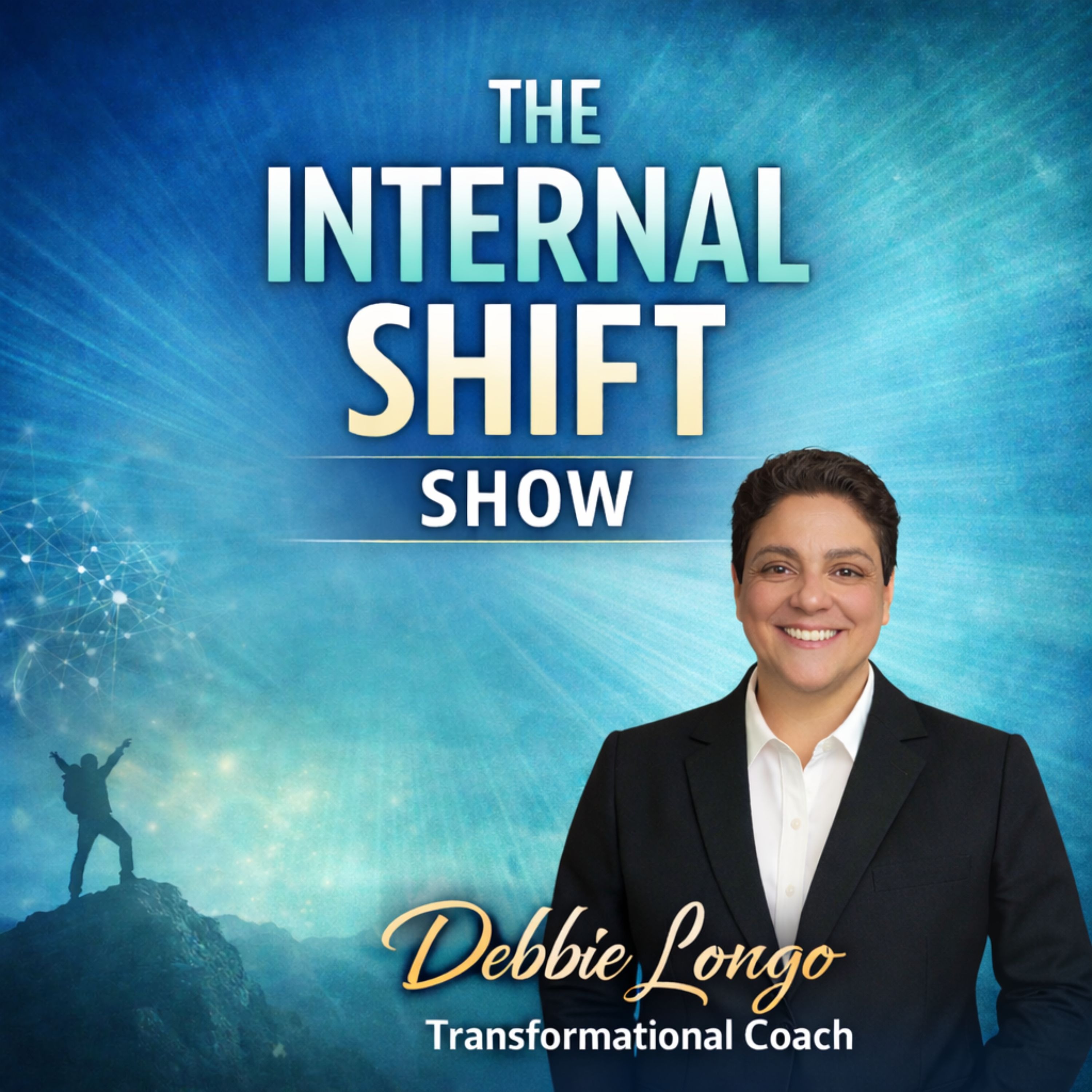
In this episode of The Internal Shift Show, Chip Scholz shares the defining moment that forced him to completely reassess his life and leadership. After years of nonstop work, heavy travel, unhealthy habits, and constant pressure, he suffered a stroke in 2012 that left him partially paralyzed and struggling cognitively. What could have ended his momentum instead became the turning point.
Chip made a deliberate decision not to identify as a victim. He rebuilt step by step, losing over 100 pounds, restoring his physical strength, reshaping his mindset, and redefining what success actually meant. This conversation explores burnout, discipline, responsibility, health, leadership pressure, and the internal choices that quietly determine long-term outcomes.
If you are pushing hard and ignoring the warning signs, this episode will challenge you to rethink what real strength looks like. The shift does not begin externally. It begins with a decision.
Contact Information:
Debbie Longo Transformational Coach
Email: info@lifeinbloomny.net
LinkedIn: https://www.linkedin.com/in/debbie-longo-life-in-bloom-ny/
Website: https://lifeinbloomny.net
Chip Scholz Executive Coach, Author, Strategist
Website: https://scholzandassociates.com/
Listener Link: http://www.scholzandassociates.com
Email: chip@scholzandassociates.com
Welcome to the Internal Shift Show. I'm Debbie
Longo. This show looks at how internal choices
we make influence the direction our lives work
and take. Today's conversation brings real experience
into that space, exploring how internal shifts
quietly change outcomes over time. We have a
very special guest today, Chip Sulz. Good afternoon,
Chip. Welcome to the show. Hey, Debbie, how are
you? Doing good. So I would like to ask you to
tell a little bit about your story and what negative
or traumatic situation happened in your past
and how you got through it. and what was the
positive end result. And the point to this is
that we want the listeners to be able to identify
with the thing, the situation, and whatever you
say, because we want to show that there is a
way out if the listener is stuck in this type
of situation, or even one that was similar, if
they could identify with some part of your story,
and now the listener can say, I can get through
this and turn it into a positive. Debbie, I've
lived a long time. And when you live a long time,
everybody would love to live a blessed life and
no rain should fall, but that isn't the way it
goes. My first marriage was failed. It was 10
months. She really liked sex. She just didn't
like it with me. And that was a problem for the
marriage. And over the course of, I think in
five years, they had the top 10. stressors in
somebody's life. And over the course of five
years, I had every stressor. Divorce, my parents
died, and it just had a change of location, change
of jobs, all that kind of stuff. So we go through
all this years after years after years. So fast
forward to 1999 or 1998, and I got laid off by
a company that I worked for for 12 years. It
would have been nice to say that we had a parting
of the ways, but it was not. So all of a sudden
I was in LA. I did not grow up in LA. My wife
did not grow up in LA. And I was in LA and my
wife asked me, well, what do you want to do?
And I said, well, I don't want to do it here.
So we decided to pick up and move to North Carolina.
27 years ago, we moved to North Carolina and
started over and just started our lives over.
She took a different path with her. occupation,
and I did the same. I hung a shingle and said,
yesterday I couldn't spell consultant, today
I R1. And it was tough. The first five years
were really tough. Then I started catching some
traction. I started doing really well. Got some
really great clients. I got some fairly big companies
that were clients of mine. And I was flying high.
In 2012, It was to the point where I was spending
200 nights a year in a hotel. I was on more flights
than most pilots are on. And I had let myself
get out of control. I looked at a video, I just
saw a video the other day of me back in 2008
and 350 pounds, full on diabetes that I wasn't
keeping very good control on, full on cholesterol,
all of that kind of stuff. I was doing really
well. I was working really hard. I wasn't sleeping
more than four hours a night. I was just, I was
running and gunning. And March 29th, 2012, I
had a stroke. It's one of those things where
God taps you on the shoulder and says, hey, I
think it's time for you to slow down. I was,
I came out of that with some aphasia. So I was
paralyzed on my right side, lasted a couple months.
It's funny when you talk about overcoming misfortune.
I mean, this is Obviously, it was self -induced.
Obviously, I brought it on myself. Honestly,
I have nobody to blame but me or maybe genetics
or whatever. But you have a choice. And the choice
is whether you give in and curl up in a ball
and die or you do something about it. Thankfully,
it was a mild stroke, although the effects of
it were not. Before the stroke, I was reading
two books a week. after the stroke, I couldn't
get through a paragraph without without stopping
and trying to figure out what it said. I only
had one woe is me moment. I only had one that
I remembered that I said, why is this happening
to me? And my mantra, which had served me pretty
well in business, now became a part of my life.
And the mantra was failure is not an option.
I mean, we're not a failure when we fail. Failure
is just a lead to another another reality, another
situation. And so I knew it was going to be tough.
I knew it was going to be not easy. I slept for
the first two weeks after I got home. I was actually
in Florida on a business trip. That's a call
that no wife would ever like to get or no spouse
would ever like to get. And she came down, collected
me, brought me back home. I slept for the first
couple of weeks. Over the course of the next
12 months, I lost 110 pounds. I could not walk
around the block when I got home. I started walking,
and before long, I was walking five or 10 miles.
In fact, everything's an app. So on the tracking
app, I walked 3 ,500 miles in the first two years
after the stroke and continued to do it to this
day 14 years later, the 14 years in March. And
so it's all mindset, isn't it? It's all mindset.
It's how you approach it. Bad things have happened.
The death of my parents. My dad was 51. My mom
was 56. When they died, I was an orphan at 30.
Bad things happen. How do you recover? And that's
really the best part about this is that recovery
is possible. In fact, recovery really is inevitable.
Everybody loves a good redemption story. I think
one of the most popular movies of all time was
the Shawshank Redemption. And it was a good redemption
story. And so I guess that's the lesson I had
out of. of all of this. I got remarried. My wife
and I have been married for 41 years. We have
three beautiful daughters and a great life. And
after the stroke, I slept eight to nine hours
a day and have continued that. I haven't let
business get in the way of taking care of myself.
I hope that's an interesting story to you. Yes,
very, very good. Thank you. I really appreciate
it so far. How did you come to this knowledge
and this conclusion that you needed to change,
make all these changes? Did you have extra help?
Did you have professionals helping you? Did you
just know what to do, self -help, different things?
What was the thought process behind? What was
your process about in detail? I'm an executive
coach by trade and by training. Have been for
27 years and In that time, I've worked with a
huge number of people. And one of the things
that I have created is I've created this framework
for how do we change. And to me, leadership is
not how you lead others. Leadership is how you
lead yourself. So this framework is a way of
leading yourself. And it's context, which is
what's happening with you. What is your life
like? What does it look like right now? Clarity,
which is understanding in no uncertain terms
what you want. Conditioning, which is getting
your mind right, changing your mind to do the
things you need to do. Choice, which is about
making sure that you understand the behaviors
that come out of the conditioning. And character,
which is about putting it all together, about
personal accountability, about doing the right
thing. And so I call it the five Cs. Well, I
developed that. I used it with clients. and I
never in a million years would know how important
it became to me. And that was the framework that
I used coming out of the stroke. So what's my
context? Well, I weighed a lot. My health sucked,
but I was alive and I was still able to do some
things. So that was my context. The clarity was
I wanted to be healthy. I never considered that
I wouldn't be back to health. I never considered
for a minute that I wasn't going to survive and
thrive. In fact, it was funny, I went to a doctor
about three months after the stroke and he looked
at me and he said, well, he said, you've got
just about what you get. And secretly I said,
screw yourself. I didn't believe him. I didn't
like that. And it's funny, I kept him as a doctor
for about 10 years and that just stuck in my
craw the whole time I was with him. I recovered
and I used that framework, the clarity, the conditioning,
which is how do I change my mind? One of the
things that happens when you lose a lot of weight
is all of a sudden you have to go from thinking
like a heavy person to thinking like a thin person.
And that's a bit of a difference about the way
you eat, about the way that you exercise and
do the things you knew. Choice was was planning
things out. I have this thing called a waypoint
document that helps people plan the actions out.
And then it's about living it. It's about being
true to yourself and living it. The other thing
is about a year after I had the stroke, my wife
bought me a lathe, wood lathe, and I just took
to it. And there was something about the lathe
and with a 30 pound spinning piece. In fact,
most of this up behind me is things that I've
made. But there's something about that piece
of wood that wants to take your head off that
you have to pay attention and the body movements
and the way you move your hands and how you deal
with cuts and all of that kind of stuff. There
was something about it that really Change something
in me now. I will talk about one other thing
They don't tell you that when you have a stroke
your your emotions get all screwed up. I mean
really badly and I had this horrible anxiety
just just gut -wrenching Twisting some anxiety
and I would just get myself twist around the
axle when somebody said something or somebody
did something or whatever and and talking about
seeing a professional, I actually saw a therapist
for a couple of years to get some strategies
to be able to handle the anxiety. Makes sense.
Thank you very much for that. I appreciate it.
So there are a few things here, all these different
things that you were describing about your life
path and how you got past it and everything.
So. I'm curious to know, well, there's a few
things. The first thing is that one thing that
I teach is that not only do I want to find, literally
find, the negative things that happen in my life,
because sometimes I sit in something and I don't
know that it's hurting me or bothering me. or
making me sad, sometimes I'm in an abusive relationship
or whatever. And these things that you're describing
to me, I'm not trying to tell your story or anything,
but to me, are not positive. And that's the reason
for this show, because we're talking about where
you were and how far you came and what was the
end result. So not only am I asking the listener
to be able to relate to that, if possible, But
what can we get out of this story out of any
point in this story? If the listener doesn't
have anxiety or the listener doesn't have something,
what the thing is, there is something in this
point, any time in this story that somebody can
relate to. And why is that? Because we repeat
a lot of. different points and experiences in
our lives. Now, one of the reasons why we do
that is I believe because that if somebody goes
through something, let's just use me for an example.
If I go through something and I don't learn the
lesson, let's say I get into a car accident and
I know that I have to quit my job and I knew
10 years before. I got into the car accident.
I had to quit my job, but I didn't want to. Well,
the car accident now forced me to quit my job
because I can't work at the job anymore because
I'm physically not capable. So there's always
and you explain this, I think. So there's a lot
of times is something that forces me to change.
But the question is for me, am I able to see
that? And am I going to go back into the situation
again? And that's where I'm saying just little
signs here and there. Am I able to learn the
lesson from when that lesson presents itself
rather than me saying, oh, it's not a big deal.
It's never going to happen again or whatever
denial or excuse that I want to make. because
then what's gonna happen again is that the lesson
is gonna repeat. And this is not a theory. You
can look it up. This will keep repeating until
I learn the lesson and it will stop. This is
a fact. This is scientifically proven. You could
look it up anywhere. This is not something I'm
making up. But these are some of the things I
teach. And like I said, you have your own...
way that you went through things and you're explaining
about the help you got. Right. And that you just
knew to do these things, which is a lot of guests
that I have. This was what it was. This they
just knew to do it. So this is my question. Am
I or the listener or you can answer? It doesn't
matter. Am I in tune with myself to know that
something presents itself, which nine times out
of 10, it's negative. because we're talking about
learning a lesson or something. I'm just giving
one example. There's tons of examples of this,
okay? Just giving one idea, one thing. Am I in
tune with myself to know that if something presents
itself to me, just so I could learn a lesson,
and am I going to accept that? Am I willing?
Am I able to create the willingness to accept
that fact that I need to learn that lesson and
move on, and that's how I'm gonna move forward?
Because if I... don't, I'm going to get stuck
and nobody stands still. And then I'm going to
wind up going backwards in my life. And what's
going to happen then? I'm going to sit in negativity,
in depression, exactly what you said about your
story. And that's why I have all of this show
and all these guests on the show with different
stories and different things that happened to
them. Because this, to me, was kind of what you
said in a way. It was similar to what you said.
because, I'm just gonna use me as an example,
I wanna know even if I don't know or I don't
wanna change, let's say I don't want to, let's
say I don't just make an excuse or whatever,
then am I even willing, just a little bit, a
teeny bit willing, just to say, let me see what
this is about, something happened in my life,
let me see what this means, what is this telling
me? Let me ask somebody. Let me ask a friend.
Let me ask somebody. Listen to my voice or whatever.
I don't want to, wouldn't say that, but because
they're negative. So listen to somebody or get
help and let me sit there and I'll evaluate that.
And then I'll say, okay, this person said this
or I'm thinking about this and I thought about
it and I don't know. Maybe I want to do this
with this person suggests that maybe I don't.
and now making the decision. And when I make
that decision, now I go on a different path.
So there's a path if I make a decision to change,
and there's a path if I don't make a decision
to change. And guess what? You just told that
in your story. That exact thing. Exactly, exactly,
exactly. You just told that in your story. Have
you ever heard of an author called Poe Bronson?
No. Poe Bronson wrote a book several years ago.
What should I do with my life? And then he wrote
a companion piece a few years later, it was in
Fast Company, and he had a number of points he
made. But the one thing that rings really true
to me is he said, we are... rarely the author
of our own change. Isn't that interesting? We
are rarely the author of our own change. Yeah,
because we don't know what's going to happen.
Well, see, and so I look back and when I got
laid off in 98, I didn't know what was going
to happen. And I could take it positively or
I could take it negatively when I had the stroke.
I mean, it caused me to change and all that kind
of stuff. So I think that's really interesting.
The second thing is Dr. Dean Nadel, several years
ago, did a study. And he did a study of heart
patients and he found that 90 percent of heart
patients were either back on the table or dead
in three years because they didn't make any meaningful
changes in their life. Isn't that sad? That is
that is ridiculously sad. I mean, and that's
their that's their choice. That's their decision.
That's nobody else's decision, but theirs. My
thought is that people should seek professional
health, that if it's if it's somebody like you
or somebody like me, I'm your behavioral change
coach. The things we do in our profession is
we help surface things for people to do something
with. They still have to do something with it.
I mean, I don't live in anybody's skin, but they
still have to do something with it. And whether
they do something with it or don't, it's up to
them. But again, 90 % of heart patients are dead
or on the table in three years because they haven't.
They haven't stopped eating corned beef sandwiches.
And just how ridiculous is that? Yeah. I know
people that have emphysema and they smoked right
until the day they were dead. I also know people
that have emphysema and asthma that stop smoking
that learn their lesson. So this is really an
individual decision. This is an individual choice
and this is up to the person. I'm here. I'll
help anybody. I don't care who you are. Okay,
I don't care about your past. You're gonna tell
me obviously if you want to because that's gonna
help me Right coach you but I don't really it
doesn't matter to me who you are the fact is
is that you come to me willingly and you want
to change and you want to tell me this this and
this and That will help you in your future. That
will help you give you give yourself a better
life So you want a better life after you have
a heart attack? Or do you want to have the same
life and have another heart attack and then your
life will be worse? Because you're more sick
and then you don't stop and then you have another
one and then your life gets worse and worse Do
you want to sit around watching beat the clock?
That's what you're asking is if your big time
is watching sitting around and watching hollywood
square And I don't know what shows are on I don't
watch that much tv, but my mother -in -law Well,
she watched jeopardy and then she watched the
other one and she did that religiously every
night And of course she was going hard of hearing
so she had it turned up as high as it can but
if i'm recovering Do I see my future as one positive
or do I see my future as a negative? I've got
a friend of mine that had a stroke and they found
him face down in a park a lot and somebody called
911 and he had some severe deficits. And I think
that's seven, eight, maybe 10 years ago, and
he's doing wonderfully now. He had that mindset
that it wasn't going to stop him. And so he rides
a recumbent bike. He splits his time between
Michigan and Arizona, but he rides a recumbent
bike. He and his wife have offloaded a lot of
responsibilities and he's doing fabulously, but
that is a choice. You can either stew in your
own juices or turn off the stove and walk away.
Yes, that was very good. Thank you. So the last
question is. How do you feel today based on everything
that we've said and the result? Obviously that
you have explained how you came out the other
side and the positive result. How do you feel
today from all of that? Well, Debbie, I feel
great. I couldn't do what I do on a daily basis
without without feeling good. I talk to people
all over the world and I've got I've got clients
and. Malaysia, clients in the Philippines, clients
all over. And I couldn't do what I do unless
I'm positive. Because listen, life throws a lot
of crap sandwiches your way. It's what do you
decide to do? You decide to eat or you decide
to wrap it up and put it in the trash. That's
basic mindset, but you can get that basic mindset.
You can grow that basic mindset. And that's the
really important part. is that look, just because
something bad happens to you, your life isn't
over. Life will go on. The one, and I know this,
but the one really amazing thing about human
beings is our ability to forget. And in fact,
with those people that have didactic memories,
they're not able to forget and their life is
kind of miserable because they're not able to
forget. But when they talk about PTSD, PTSD is
caused by the inability to forget. a traumatic
incident. But God, we forget a lot of stuff and
isn't that a blessing? There was a guy who was
one of the editors, I think he was Fast Company
or one of those, and he hung a camera around
his neck and he had a recording device and he
downloaded every picture from his past and from
everything in a file. And for two years, He recorded
everything. The one takeaway that I remember
from the article that he wrote is he said, I
wasn't able to forget anything and isn't that
a shame. You can forget. You can forget all the
bad stuff. Anyway, interesting. OK, so that was
a very good closing. So anyway, as we wrap up
this conversation, highlights how small internal
shifts can create meaningful change. If something
from today stayed with you, take a moment to
reflect on how it connects to your own directions
and decisions. This has been the internal shift
show. Thank you for listening and thank you for
being on the show. I really appreciate it. Thank
you, Debbie. I appreciate it too.