
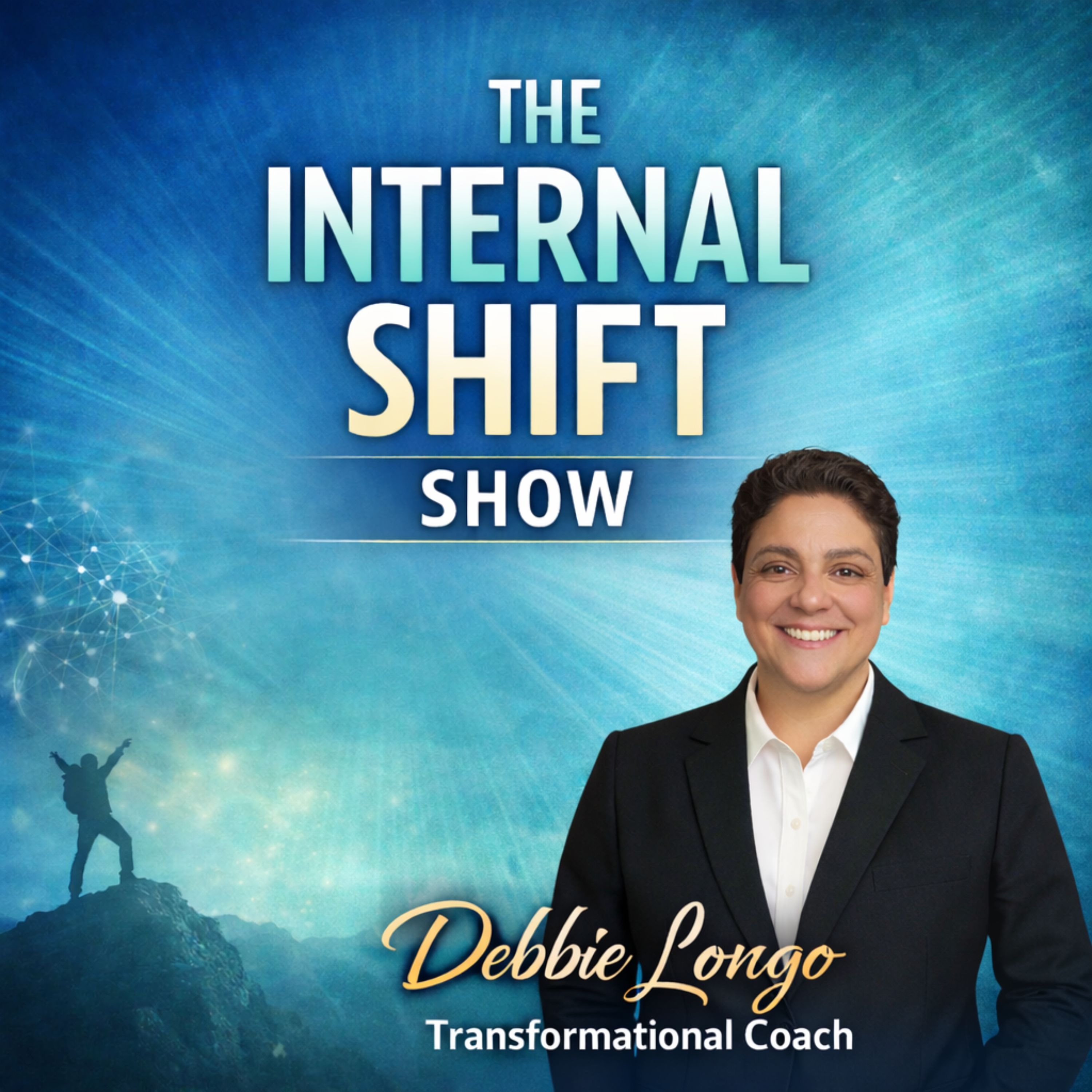
In this episode of The Internal Shift Show, Debbie Longo speaks with Debbie Weiss about a lifetime of caregiving, burnout, and the moment that forced her to finally shift how she was thinking about her life.
From becoming her father’s caregiver at 17, to raising a child with special needs, supporting a husband with mental health challenges, and later facing his terminal illness, Debbie spent decades putting everyone else first. Over time, that pattern led to exhaustion, resentment, and a sense that her life was no longer her own .
The turning point came at age 50 when she realized she had no vision for her own future. Instead of trying to change everything at once, she made one small internal shift—focusing on consistent action instead of outcomes. That shift began with her health, then extended into her finances, career, and eventually led her to write and publish her own book during one of the most difficult periods of her life.
This conversation explores burnout, identity, caregiving, grief, financial stress, and the power of changing how you think about your situation. It reinforces that no matter how long you’ve lived a certain way, you still have the ability to change direction, rebuild, and create something new.
Contact Information:
Debbie Longo Transformational Coach:
Email: debbie@lifeinbloomny.net
Website: https://lifeinbloomny.net
LinkedIn: https://www.linkedin.com/in/debbie-longo-life-in-bloom-ny/
Debbie Weiss:
Email: debbie@debbieRweiss.com
Welcome to the Internal Shift Show. I'm Debbie
Longo, Transformational Coach. This show explores
how the way we think, decide, and respond internally
influences where we end up over time. Today's
conversation draws on real experience and expertise
to look at how small internal shifts can change
direction, momentum, and outcomes. We have a
very special guest today, Debbie Weiss. Good
afternoon, Debbie. Welcome to the show. Thanks
so much for having me, Debbie. Nice to meet a
fellow, Debbie. Thank you for being here. I am
going to ask you today to tell your story and
focus on a life -changing event, something that
happened in your life that was a negative, or
where you went through a process and now you
came out the other side. And the end result should
always be positive, right? Now, I do this show
for a few different reasons, and one main reason
is that everybody has their own individual story.
But somebody could pick out something from your
story, right, that they could identify with,
whether it's a feeling or the thing that happened
or something in the part of the process. And
now that listener can say, I see now that Debbie
had this problem or whatever you're going to
talk about, life situation. She went through
the process and the listener is going to say,
now I can see that. I can get through this. I'm
not alone. There is a way out for me. Whereas
before, because a lot of people think that they're
in a situation, whatever it is, there's a million
different scenarios. On my show, a lot of people
are to the extreme, which is fine, because I
personally like that. But there are so many different
scenarios where somebody sits in the negative
and they don't understand how to get through
that process to get out of that. because really
there's no such thing as a negative situation
or a traumatic experience or something like that,
but I form that in my mind. The thing that happens
is real, but it depends on how I interpret that
thing, how I perceive that event or that situation
to be. And that's how I determine. Am I going
to be like, not be able to function? That's how
I determine. Or is it just going to be a little
thing and then I'm going to go through a process,
whatever, I'm going to find help, whatever, and
then get over the hump. So if you could do that
for me, I'd appreciate it. Thank you. I think
I have one pivotal moment, but if I didn't have
that pivotal moment, it wouldn't have let me
get through a much bigger pivotal moment down
the line. So... I guess there might be more than
one discussed here, but I think that my main
story starts when I was 17, and my father had
a massive stroke, just turned 46. Luckily, he
survived, but he became permanently disabled,
and my parents soon divorced, and I became my
father's primary caregiver for the next 30 years.
And I don't think that we expect to become our
parents' caregivers at 17 or 20 years old. We
expect it at the ages that maybe we are in midlife,
but certainly not at that stage. And when my
oldest son was two, he was diagnosed on the autism
spectrum, and that opened up a whole different
type of caregiving. different than my dad. And
later on in life, and this is kind of what happens
afterwards as a little bit of a teaser, I became
my husband's primary caregiver as well. And so
when I turned 50, I was at a place where I was
exhausted, burnt out, resentful. Like, why me?
Why did this all happen to me? I watched my friends,
especially in their 20s and 30s, live this carefree
life. And mine was never carefree, even though
my father never lived with me. It was my responsibility
to find a place for him to live, to worry about
his finances, and in my 20s to learn the difference
between Medicare and Medicaid and institutional
Medicaid and Social Security, disability, like
things you don't know when you're 20 years old.
And I was very, initially I was... I guess I
want to say proud that I was able to step into
that role of such an early age of taking care
of my dad. But as the years went on, I did become
resentful. And I spent so much time thinking,
why me? Like, I'm a good person. What did I ever
do to deserve this? It felt like every second
I was just worried and giving to everyone else.
I also have my own small insurance agency and
I was kind of, it's a second career. I was kind
of getting that up and running at the same time
that I was worried about my father. I moved from
state to state. I had to find a place for him
to go. And every minute I was giving out. to
everyone else pouring out of me, whether it was
my employees, my customers, my father, my kids,
my husband, everyone. I was volunteering. I was
such a people pleaser. Anybody who asked me to
do something for an organization, I was like,
well, I have to do it. I can't let them down,
which was ridiculous because I didn't have any
energy, time, or anything to spare. At 50, I
found myself thinking, well, this is just my
lot in life. I mean, it is what it is. Everybody's
lives look different. I don't know why this is
mine. On the outside looking in, if you didn't
know all the backstory and the stress that I
was constantly under, I lived in a nice house
in a beautiful neighborhood. Like I said, my
husband, my kids, the dog, like. the whole, quote
unquote, supposed American dream, but I was not
feeling like I was living the American dream.
And when I turned 50, for me, there was something
about that number that kind of really made me
pause and think, wow, the first 50 years flew
by. I watched my parent, my father, who had just
passed away a year before, die with a ton of
regret. I see my mom, who constantly is talking
about what -a -could -a -should -a kind of things.
I don't want to be that person who gets to the
end of their lives looking back saying, oh my
gosh, what happened? How did this, you know,
how did it go so fast? And my life didn't turn
out the way that I had planned. The only problem
was I didn't have a plan. It wasn't like I had
some people say, oh, I'm an artist and I never
got to pursue that or a musician or anything.
I didn't have any of those unfulfilled dreams.
So I didn't even know what it was supposed to
look like, but I just knew that if I had died
at that moment, I would absolutely have a lot
of regrets. And my friends were kind enough to
insist on taking me away to celebrate my 50th
birthday for the weekend. And while we're gone,
one of my friends said, let's go around the table
and talk about our hopes and dreams. And when
it got to me, I thought, I don't have any hopes
and dreams for myself. I have them for my kids,
but not for me. Like, isn't my time up? We're
50. What kind of hopes and dreams? Like that
ship has sailed kind of thing. And they made
me realize that no, they had hopes and dreams,
but I didn't. And so I came back from that trip
knowing that nothing was going to change. No
fairy godmother was coming down waving her magic
wand and saying, OK, Deb, here's your dream life.
If something was going to change, I had to make
it change. But I didn't know how or what. And
so I decided that you, you look at your life
and there's all different ways. And I'm sure
as a coach, you have a certain way to do it,
whether it's a wheel or categories of our lives
that we can kind of slot career and finance and
personal relationships and all the things. And
for me, The thing that stuck out the most, if
I was thinking of all my categories, was my health.
Because the other part of my story, besides being
a family caregiver for decades, is that I'm someone
who's struggled with my weight since the second
that I was born. And it has always defined me.
And at that moment in time, I was more than 100
pounds overweight. When you're younger, you think
to yourself, I can't wear these clothes or I
don't feel good about myself. But as you get
older, it now turns into just as much of a health
concern as a vanity issue. And so I thought,
I want to be here for my kids and possibly my
future grandchildren. So I better do something.
But I think I was maybe eight, probably even
younger when I first went on a diet. And here
I was over 100 pounds overweight, so we know
how successful that turned out to be. Same story
as the rest of us. Lose, then gain it back, plus
some more, then another year later, try again.
I don't have to tell anyone that story. And I
thought, OK, if I try again for the umpteenth
time, something has to be different. Because
as Albert Einstein said, something like the definition
of insanity is doing the same thing over and
over and expecting a different result. So for
me, Weight Watchers had always been the most
successful and the easiest to kind of fit into
my life. So I said, all right, here we go back
to Weight Watchers again. But this time, instead
of having a goal like I'd always had in the past
of, okay, I have to lose 25 pounds in three months
or by my birthday or by the summer or whatever
it is. Nope. Forget all of that. I am making
an initial goal of I am going to go to a meeting
every week. That's it. I don't care what I eat.
I don't care how much I weigh. If I drink the
water, exercise, all the things. Nope, my only
goal is show up. And I did that. And each week
that I went, I was proud of myself because I
did what I said I was going to do. And I would
say I did that for two or three months. I probably
gained five pounds, but I was okay with it because
I achieved my goal. And so once I felt good in
that, it was like, all right, let me add a little
something else. And maybe I paid attention to
how much I ate 50 percent of the time and so
on and so forth. I built from there. But in that
time frame, I also started to change. Other ways
that I was thinking about the diet my whole life,
I felt like a victim. Why me? Why did I always
have to be the heavy one, the one who can't fit
into the clothes, the one, you know, boys aren't
looking at because of my body? I'm sick and tired
of hearing, oh, she has such a pretty face, but
they don't say it's such a pity that her body
looks like that. Forget all of that. I'm going
to leave that behind, and I'm going to say to
myself, Other people have to deal with this as
well. You're just not seeing it. You're assuming
that when you go out on Saturday night and you
look around and you see other, I've got to say
women because obviously that's the equivalent,
you're seeing other women and they're drinking
the drinks or eating the dessert. You're assuming
maybe they eat like that all the time. Maybe
that's the only time during that week they eat
like that. Sure. Some people are luckier than
others. And I get that with the metabolism. I'm
not saying that that's not the case, but I think
in my mind, the switch was that maybe everything
wasn't as appearing was what I thought it was.
Number one, number two, this can't be a diet
because diets, you go on and you go off. We know
what happens when we go off. This is a lifestyle.
And back then, the term wasn't as popular as
it is today. As a matter of fact, my kids would
say, can you have that on your diet? And I would
always say, it's not a diet, boys. It's a lifestyle.
And they would make fun of me. So every time
I say the word lifestyle, it makes me laugh.
But that is it. It doesn't mean that I'm never
going to eat pizza and ice cream and bagels,
my three favorite food groups, again. I'm going
to eat them. And that's it. It just has to be
a conscious decision. And so in about three and
a half years, I lost 90 pounds. I would say that
in the past, if it had taken me that long, I
would have said, forget it. This is a waste of
time. But when I switch that mindset to say,
does it really matter how long it takes? Like
in the grand scheme of things, if this is something
that I'm never going off of, it doesn't matter.
It doesn't matter how long it takes. It doesn't
matter that it's not a straight linear progression.
It's a staircase, two steps forward, three steps
back. Like that's the way it is. But if I don't
stay on track, then it's just going to be that
landslide back like it always was in the past.
And so At this point, and I think this was probably
about 10 years ago, I have not yet hit the 100
pounds, but I have pretty much, up and down maybe
10 pounds or so, but not more than that, maintained
the 90 pound weight loss. That opened my eyes
to how I could change my life. just by changing
my mindset and the way that I was thinking about
something. Because Weight Watchers didn't change.
Yeah, they make little tweaks every couple years
to their program, but that had nothing to do
with it. It was all the way that I was approaching
it. And so when I was done there, I said, okay,
now where can I take this mindset shift idea
and apply it to other areas of my life? So at
that point, the next highest thing on my priority
list was my money situation. My first career
was a CPA. I was a CPA for 10 years. And like
I said, now I'm an insurance agent and have been
for over 30 years. And I know about money. I
pretty much, I don't want to say I know everything,
but I'm very well -versed. In my marriage, I
was always the one taking care of money. When
my son was diagnosed on the autism spectrum,
he's 25 now. So back then it was a very different
situation than it is now. And I started paying
probably about $6 ,000 a month for therapy that
was not covered by insurance. Nothing back then
was covered by insurance. I got ourselves into
some pretty heavy debt situation and had never
gotten out from under it. And my husband suffered
from both depression and anxiety, and my oldest
son does as well. And any time that I would kind
of try and alert my husband to, well, I think
we got to spend a little less money. it would
throw him into an anxious state and sometimes
he could barely speak to me for days. And I hated
that. And so instead, I just kept my mouth shut
and I buried my head in the sand and just kept
thinking to myself, somehow it'll work itself
out. It'll just go away. But each time that I
had to pay my bills, it just got worse and worse.
My heart would be palpitating. It was horrible,
and I didn't share this secret with anyone else,
even my closest friends that pretty much knew
everything because I was so embarrassed, particularly
because of my background, that I was getting
myself into trouble. It eventually led to trouble
not paying my taxes because I am self -employed,
and so it's up to me to pay my income taxes quarterly.
And I wound up not being able to do that. And
so that turned into a mess of a situation. And
I thought, oh my gosh, I've got to do something.
I've got to do something because burying my head,
it's not working for me. And I decided I'm going
to apply the same technique. So I said, all right,
either you can make more money or you can spend
less. So I started selling little things. I went
around my house. Okay, what can I sell on Facebook
marketplace? And again, this is when it wasn't
as popular as it is now. And if I sold something
for $3, which just like only going to the meeting
was literally not going to do anything to my
tax bill and my debt, I got so excited because
I was doing something. And I would take that
$3 and I would put it in an envelope and I'd
add up all my $3. And at the end of the month,
if I had enough money to pay for my family's
haircuts, that felt like a win. Anything felt
like a win because I was actually doing something.
And then it got kind of exciting. Like I'm opening
up all the cabinets, running through my house.
What can I sell? What can I sell? My God, this
is so great. And so then I thought from there,
okay, well, If I want to, because at the point
at that time, I knew what I really needed to
do was sell my house. But every time that again,
I approached my husband with that, it was very
difficult. My son who was diagnosed on the spectrum.
He had then also added all these other mental
health diagnoses as well. So between the two
of them, I couldn't handle it. So I started to
try and plant the idea that maybe we're going
to have to sell the house kind of thing. I just
figured more exposure was better. So I started
planting some seeds there. And then I said, well,
How else can I make more money? Of course, like
I said, I'm self -employed. I could try and make
more money in my business. But the thing was,
I tried that briefly, but I realized that it
didn't excite me and it felt burdensome. I saw
the way that selling my handbag excited me. different
than selling more insurance. So I said, I need
to, I need to find something else. And at the
time I was taking these health supplements from
a, like a mail order company who did network
marketing. And I thought, I, I really love these
supplements and I believe in them. So I'm going
to sell them as a side hustle. And I was getting
training and at the time I had taken a couple
of mindset courses and had learned about them
from a woman who had a podcast that I had been
listening to. And she talked about being part
of this mastermind. And I had no idea what she
was talking about. I didn't know what a mastermind
was. I had just no concept. But her mastermind
coach was launching a mastermind for people earning
zero to five hundred thousand. And I thought,
perfect, I earn zero. I fall into that category,
earn zero in my network marketing thing. So I'm
like, I'll sign up for the mastermind and they'll
teach me how to sell this stuff. I sign up for
this mastermind. I go on my first zoom call.
There's 150 people at this point. I'm probably
in my mid fifties and I look out into the sea
of 150 people. And as they start to introduce
themselves, everyone is a coach of some sort
that I never heard of. I'm a money coach. I'm
a divorce coach. I'm a relationship coach. I'm
a dating coach. I'm like, what the heck is this?
Who are these people? What makes them certified
to be these type of coaches? It was like walking
into a world I had never ever had any exposure
to at all. And it started the juices going in
my head thinking, well, now I understood that
they were qualified to help other people because
of their lived experience, which totally made
sense to me. I mean, who do you want to learn
from? Somebody who studied a book or someone
who has practical knowledge? So that made sense.
And so in turn, why couldn't I be a caregiver
coach? Because that was what my life was. And
it was very, very exciting. And I just found
it so interesting. I couldn't learn enough. I
couldn't read enough or study enough. Because
now this opened up the world of... Well, how
do you even do this? And how do you be known?
And do you need a website? And like, this was
all brandy new to me. So every part of it, the
marketing, the social media, and by the way,
some I liked and some I didn't, some of the things,
the branding, it was like, what, what? Even though
I'm an insurance agent, I'm an insurance agent
for a very big company, I don't do my own branding,
they do the branding. So this was brand new to
me. But every second was exciting. As a matter
of fact, if I could work on it 24 -7, I would
have. It never felt like work. And that's how
I knew I was on the right track. Since that time,
things evolved. So when I started coaching people,
what I found was my coaching was that I wanted
to teach family caregivers how to learn to prioritize
their own self -care. Because looking back, I
realized that's how I had gotten myself to a
place of exhaustion, burnout, overwhelm, resentment,
all the things. Because I wasn't taking care
of myself. I was below last on my list. And I
saw how things started to shift when I started
prioritizing my own self -care. And so I wanted
to share that. But when I started coaching, understandably,
the caregivers would want to tell me how hard
their caregiving life was. And I was going through
a time of intense caregiving of my own. As my
oldest son moved into his high school teenage
years, signs of mental illness got a lot greater.
a lot of emotional outbursts, a lot of physical
destruction, not, thank God, of any person, but
a lot of punching in of my walls, ripping doors
off hinges. And his issues, along with my husband's
anxiety and depression, the two of them were
at odds all the time. I saw what it was doing
to my younger son, what it was doing to myself,
what it was doing to all of us. And in that timeframe,
he wound up being involuntarily committed into
a mental hospital. And I think that that was
the last straw for my husband. And my husband,
who worked with me in my insurance agency, one
day just walked out of the insurance agency and
said, I'm never coming back to work again and
left me with a mess. He wouldn't discuss it with
me. He couldn't bring himself there. And that
was a lot to handle. He was also my husband at
the time. He had suffered from a lot of different
ailments. And so I don't know if I realized at
that time how debilitating the anxiety and depression
were. So point being, to take on somebody else's,
because I'm empathetic, to take on somebody else's
issues, it was just too much for me. I couldn't
handle it. Maybe now, when my life is not as
engrossed in caregiving, it would be different,
but I knew for my own mental health. I had to
do something different. And at that point, through
something else that I'd kind of gotten myself
out of my comfort zone, I realized that I do
have a message, which I'm sharing with you today,
is that it's never too late to change your life.
And it doesn't matter what your circumstances
are, because you can tell yourself any story
you want. It doesn't matter. always have the
power to do something about it. And that's the
message that I wanted to get out to everyone,
not just to caregivers and primarily women. But
how was I going to do it? I don't know. How the
heck was I going to get my message out there?
So everyone kept saying, you have an interesting
story. You should write a book. I said, OK, that's
lovely, but I don't know how to write a book.
I don't write. I don't like that's not a preferred
activity of mine. I don't see how that could
happen. Eventually, kind of you have to listen
when the universe puts these little hints out
there. And one day I was listening to a podcast
that I don't usually listen to. And the woman
was interviewing another woman who helped first
time stories get first time authors get their
stories out there. And I really connected listening
to her and I thought, OK, this is just too strange
that that's what this woman does. I think I at
least have to meet her. So we connected on Zoom
and she was wonderful and she made me believe.
I could do it. And she said, I'm just launching
a small group course for first time authors.
And I was so scared. I was scared because it
cost a lot of money and I was still in my money
problems. So that seemed a little counterintuitive.
I was scared because I didn't believe that I
could really do it. I was scared because I didn't
believe I had a story that people would resonate
with. And I just was scared that I would be embarrassed,
you know, that who would want to read this simple
writing of somebody who didn't know what the
heck she was doing. But I was just about to do
it and take the leap when out of the blue, my
husband was diagnosed with terminal blood cancer,
unrelated to all the other stuff that I mentioned.
And I was seeing a therapist at the time. And
I said to her, well, obviously, I'm not going
to do this now because who the heck knows what's
going to happen? I mean, the oncologist doesn't
say he has this long to live. We just knew that
it wasn't curable. He could undergo treatment
to try and extend his life. And they couldn't
say how that was going to go. So anyhow, I'm
saying this to my therapist. And she said, well,
I disagree. And I thought she was. Insane. She
said, I think this is the perfect time because
you're going to need something just for you,
separate from anything else that's going to go
on in your life, something that you can focus
on that takes you away. And I said, well, what
happens if I can't show up one week at the meeting
or there's homework and I don't do it? And she
said, who cares? And I thought, you know what,
she's right. Who cares? And so I said, OK, I'll
do it. And I joined. I really looked forward
to the weekly meetings. I connected with the
other women. It was maybe four or five of us,
which was a nice small group. And it probably
took me about six weeks or so to really believe
that it was a possibility, because I really struggled.
just trying to visualize what the whole framework
was going to be. But once I got it in my head,
it got easier. And I scheduled time almost every
day to write. Whether I got up at 5 .30 before
my husband woke up and wrote in pitch black outside.
If he was in the hospital, I brought everything
with me. I would write when he went down for
a test or he was sleeping, whatever it was. If
he was home, I would say, I'm going to go upstairs
unless there's an emergency, don't bother me
for the next hour. And I would do that. And my
therapist was a very smart woman because even
though the writing process was very difficult,
It was exciting at the same time because it was
new. And when I saw it starting to take shape
and the more, you know, I wrote, the more I really
started to believe that I could do this. And
my husband died almost six months to the day
that he was diagnosed. And when he died, I was
three chapters shy of finishing my memoir. My
husband passed away on December 30th, 2022. My
first draft was due to the editor January 15th
of 2023, so two weeks later. And of course, they
said to me, don't be silly. We'll extend the
deadline. You'll just let us know when you're
ready. And as we know, anyone who's lost a loved
one, people surround you when it happens, and
then they leave. And they just go back to their
regular lives. I remember thinking when my dad
passed away, like five days later, everyone's
back to doing their stuff. And I'm at my office
thinking, doesn't the world know what just happened
to me? With my husband, that's times a thousand,
that feeling. It's a very different feeling.
And everyone left a week later and I sat in this
room that I'm in now that had been turned into
his bedroom. And I thought, this book saved me
over the last six months. I need it now more
than ever before. And over the next week, I finished
and I handed it in on January 15th. And from
there, everything was still new. I thought, oh,
wow, I'm done. Wrong, I wasn't done. That was
just the first step. And my book didn't come
out until August 9th. And so those first six
or seven months, I had whatever was going on
with the book to help me get through the grieving
process. And I decided that I was going to throw
myself a party. On August 9th, I had about 50
people in a country club room and my brother
came from out of state. And I had my two boys
kind of be the emcee of the night. And it turned
into like a cathartic celebration that we all
needed. And looking back, if I had never gone
through that transformation, I don't think that
I would have gotten through that time because
those six months when my husband was dying, cancer
was the easy part. He slipped into depression
and the mental illness was unbelievably difficult
to bear for everyone. But I wound up being the
butt of a lot of his anger and so it was tough
and we needed We needed some light and I don't
know if I would have been able to find that and
to continue on as I have since then, now three
years ago. That was a lot. Yeah. And I thank
you for all of that because you explained the
situations and you really, I really didn't have
to ask any questions because you just told the
stories. the life -changing situations that you
went through beautifully. And you describe them
great and detail and everything that I want to
accomplish in this podcast. And I'm sorry to
hear about your husband too, by the way. I was
relating when my mother passed away. That was
what it was like. It was like, you know, my whole
family was there like three days later, like
nobody was there. It was like, oh my God, like
I went to an empty house. Like, where is everybody?
I mean, there's a lot of things here that I could
identify with you. But the bottom line is that
it seems like to me that one event triggered
another. Like you're saying you were gonna write
the book and then your husband was diagnosed
with the cancer. So when that happens, and that
happens a lot in my life too. So when things
like that happen, sometimes there's an opening,
because I believe that there's many different
paths that we can go on. People think, oh, there's
one path, beginning and end. I personally don't
believe that, because one path takes us to another
path. So if I don't live near a major highway,
I might have three different ways, three different
roads that are going to take me to that highway.
So it depends on whatever road I want to choose
to get onto that highway. Sometimes I might choose
the same road every time I go. Sometimes I might
not. So we have many different paths. So when
something's presented to me, I might want to
take that opportunity. I might, I might not,
depends on what my thinking is at the time. what
my mindset is, but then something else could
happen. And that's kind of telling me this is
not the right time to do this. It's a good thing
to do. And maybe one day you will do it, maybe
not, but now is not the right time to do it.
And now I'm presented with something else because
if I wasn't and it could be a traumatic thing
and maybe not, like I said, I'm sorry, everything
that happened to you and everything, but If something's
presented to me in place of what I wanted to
do, right, then now I am introduced to going
on a completely different path. But I don't have
to go on that path. I could say, I don't want
to do this. I want to do originally what I was
going to do, right? Even though this thing is
telling me not to do it. I could say, no, I don't,
because I have the ability to think for myself.
Every human being does, we're not robots. But
sometimes if I'm presented with different things,
if it's like your example, if it's overwhelming
or if it's too much for me to handle, then I'm
kind of like really, really pushed in another
direction. And to me, there's a million reasons
why. There's just a lot of reasons why that could
happen. And I have a lot of situations where
that's happened. And also that's just my personality
too, because sometimes I really need a push because
sometimes I might be a little stubborn when I
might say, Oh, I want to do this. Oh, maybe not
this. Oh, maybe. I want to go back to this or
whatever. There's a lot of different reasons
for that. But this was all very good. So how
do you feel in closing? How do you feel today?
How do you feel right now after everything, this
whole story, everything, this whole podcast,
everything we just talked about? I definitely
feel excited and hopeful about the future. I
took the book thing. I wrote another book like.
Let me just say that one of the things that I
discovered, and I think that it's interesting,
is I, since turning 50 and since opening up my
mind to different possibilities and changing
my mindset, I have discovered things about myself
I had no idea existed because my entire life
I told everyone, and I totally believe this,
I do not have a creative bone in my body. I would
say that time and time again. And since writing
this book, I can't stop with the ideas. Oh, I
want to make this. I'm going to do this. I'm
going to write this. And now I'm like, where
did this come from? It's it's like I opened up
a Pandora's box that I never knew was there.
And so now moving forward, it's like, oh, my
gosh, there's not enough time. I have so many
things that I want to create. And so Even though
I didn't expect I'm 62, I didn't expect a 62
to be a widow and be living my life on my own.
It is what it is. I mean, everything in life
is unexpected. That's pretty much the definition
of life. So even though it's not what I planned
and I'm not I can't go say, oh, I'm so excited
to be single. No, not really. There are things
I do like, like I can do whatever the heck I
want. I mean, so that part is nice, but I am
excited. I am truly excited for all the possibilities
that are ahead. Yeah, and that was good. And
in closing, I would like to say that that was
how I started my life coach business, too, was
that the main thing to me with coaching is that
whatever experience I went through, because I
went through that experience and I have that
knowledge, and that now gives me the ability
to teach people from my own experience strictly,
right? how they're going to get through the situation
or whatever coaching it's about. Because there's
no degree, there's no schooling. It's not like
you're studying to be a doctor. There's no curriculum,
different types of things like that, right? You're
not a psychologist or a psychiatrist. People
are. There are therapists that call themselves
coaches. I actually know one, different things
like that. So that was the way that I did it
also. Thank you very much. As we close this conversation
as a reminder that progress really comes from
one big decision. but from the internal choices
we repeat. If something from today's discussion
connected with you, take a moment to notice how
those internal choices showed up in your own
life. This has been the Internal Shift Show.
Thank you for listening and thank you for being
on the show, Debbie. I really appreciate it.
Thanks for having me.