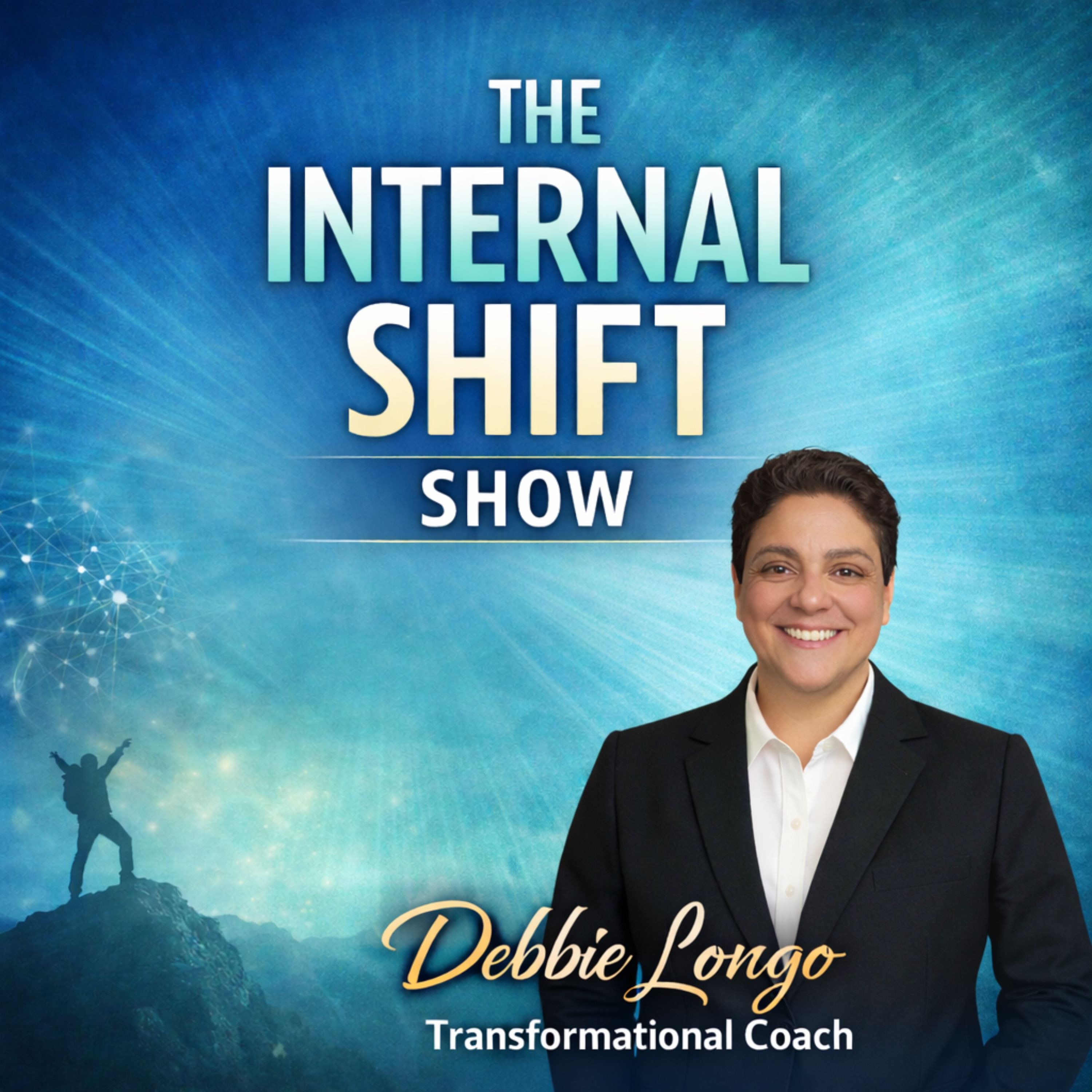
In this episode of The Internal Shift Show, Debbie Longo speaks with Jenna Udenberg about how personal adversity can shape resilience, purpose, and leadership. Jenna shares her journey growing up with juvenile arthritis, becoming a wheelchair user at a young age, and navigating a world that was not designed with accessibility in mind.
Through discrimination, medical challenges, and nearly two decades as a music educator, Jenna developed grit, adaptability, and a powerful perspective on identity and inclusion. She explains how early experiences with disability shaped the way she approached education, relationships, and opportunity.
The conversation explores how mindset, environment, and internal decision-making influence the direction of our lives. Jenna reflects on how personal struggles, including the challenges brought on during the COVID-19 era, pushed her to rethink identity, resilience, and advocacy.
This episode highlights how shifting internal narratives can transform adversity into growth. Jenna’s story demonstrates that even when circumstances are difficult, perspective and determination can open new paths forward.
Listeners will hear an honest discussion about disability, perseverance, and how sharing personal stories can help others recognize that change and recovery are possible.
Contact Debbie Longo – Transformational Coach
Email: info@lifeinbloomny.net
Website: https://lifeinbloomny.net
LinkedIn: https://www.linkedin.com/in/debbie-longo-life-in-bloom-ny/
Contact Jenna Udenberg: jenna.udenberg@gmail.com
Welcome to the Internal Shift Show. I'm Debbie
Longo, Transformational Coach. This show explores
how the way we think, decide and respond internally
influences where we end up over time. Today's
conversation draws on real experience and expertise
to look at how small internal shifts can change
direction, momentum and outcomes. We have a very
special guest today, Jenna Udenberg. Good afternoon,
Jenna. Welcome to the show. Hi, Debbie. Thanks
for having me. What I'm gonna ask for you to
do is basically tell your story and focus on
a traumatic experience or life change and then
how you went through that process and what was
the end result and the end result should always
be positive. Now, one of the reasons why I do
this is because there's somebody out there, everybody
has their own individual story. But there's somebody
out there that can identify with a certain part
of your story. And we want to explain and show
to these people, like the listener, right? Whoever,
whatever part that they can identify with that
there is a way out and they don't have to sit
in their sick and suffering because a lot of
times people don't know that they can get better.
They just want to sit in the negative. They think
that that's going to be their life for their
whole entire life. They don't know they're uneducated.
They don't want to do it. There's a million different
reasons. But a lot of times, if somebody could
see the process, if somebody's explaining it,
sometimes people can visualize it in their in
their minds, their own life. Very similar to
what you're saying. Then they can see that they
can get out of it. At least we are showing them.
At least we're kind of like giving them an education,
you know, and that's what I'm really going to
ask you to do. So if you could do that, I would
appreciate it. Thank you. Yeah, absolutely. So
a little bit about where I came from. I grew
up in rural Minnesota on beautiful Lake Superior
by age seven. I was diagnosed with juvenile arthritis
and by age eight I was in a manual wheelchair.
So it just kind of gives you a context of the
late 80s, early 90s of becoming a disabled young
person with not a lot of resources and not a
lot of the cool things that we see in life today.
Not a lot of accessibility, not a lot of access
to adaptive recreation and all just all the things
that we now know today. And I became a music
educator because I had an amazing eighth grade
band director who saw me as a person and that
inspired me to want to go into it. Not the music
of chord structure, not all the different instruments,
all the things. And so growing up, life wasn't
easy. That was the era of pick yourself up by
your bootstraps. Make lemonade out of lemons.
Lots of ableist type of connotations. And have
all those things come out of my mouth before?
Absolutely. But as I went through things of discrimination,
as I went through bullying, as I went through
spaces and places that were not made for me,
that I was not welcome in, I had to develop grit.
I had to develop my reliance on others. And so
the story that I'm going to choose to share with
your audience today is something that's more
recent, but you needed to know some of that background
information of all the things I went through.
And I started doing orthopedic surgeries at age
15. So I think to date I've had 19 surgeries.
I have six different joint replacements. I'm
still in a manual wheelchair. I'm a proud disabled
young woman, middle -aged woman. I forget about
that new label, but I had a wonderful 19 -year
career as a music educator. I have both certifications
in instrumental and vocal K -12. I've taught
anywhere from community schools that are charter
schools to parochial private Catholic schools
to ending my career in a public high school,
elementary, two different schools. Our school
district is actually the size of Rhode Island
when it comes to geography. So a lot of empty
land and forest in between, but just to give
you some context. And so again, most of my life
I was dealing with my physical disability. Everyone
saw my wheelchair first and made a lot of assumptions
and not good assumptions more often than not.
And so when the COVID -19 pandemic happened,
all of us were just a hot mess. The whole world
was a hot mess, let's just be honest. Because
we never experienced that before. And the uncertainty
was a killer. And that was the first time that
my invisible disabilities of being immunocompromised,
of being somebody that has multiple diagnoses,
not just my juvenile arthritis at that point
in my life, and all the medications and what
that did to me. And so I was getting ready to
just head back into the classroom and working
with administration to figure out how is this
going to look. I can't unmask and eat in the
faculty room. I can't unmask in my music room
where all these kids were just coughing and sneezing
and singing and all the things. And we were a
week out from me at Joining my classroom and
joining my peers and being a part of things and
I thought I'd get to either stay here in the
space I'm coming to you from today and teach
virtually or be in place and about the bubble
and that was a part of life back in that time
and Literally the school district came back though
like days before we were supposed to enter the
classroom and they said we're no longer interested
in accommodating your work from home order. And
we are prepared to make you take a disability
retirement. You need to work with the union.
We're working with our lawyers. I found my own
disability lawyer that nobody knew about and
just had to protect all the things. And so my
story today is really about identity crisis because
so much of who I was was wrapped up in Miss You
because my kids couldn't say Udenburg because
most of us can't. So my kids called me miss you.
And so so much of my life was wrapped up in that.
And I didn't realize how much. When it was unexpected,
I didn't get to have any final concerts. I didn't
get to have any final programs. I didn't get
to say goodbye to my kids. A month or two into
the battle, I had my friends, coworkers, colleagues
texting me saying, Jenna, this feels really gross,
because the kids think you died of COVID. Can
you make a video? Can you make us something?
Like these kids need to know that you're okay.
It's just that you're no longer their music teacher.
And that just rips your heart out, shoves the
knife in, twists it, all the things, right? And
yet legally I was bound up. I couldn't really
say anything. I couldn't do anything. I couldn't
do the very things that I knew was good. And
so that was super hard. And then when I was cleaning
up this space, picking up maracas and all the
little instruments that one does elementary music
with in this space, tears coming down my face,
all the things. I was given the words accessibility
educator and I was like, I don't know what that
means. I've never heard that terminology before.
I don't understand it. And so for whatever in
my head, it was like, well, if I'm done as a
music teacher, then therefore all of education
is also done. Like, at least for me, I'm such
an all -or -nothing person. It's either all black,
it's all white, I hate gray, but we're always
living in the gray because that's just human
life. And so it took months to over a year to
be like, oh no, all of these soft skills that
you learn as an educator or however you're trained,
they translate amazingly into other spaces and
places. During this time, I was a 2020 Bush fellow,
and so I was so thankful of how all the timing
just worked out. And so in being a Bush fellow,
I was developing my own leadership skills. I
was doing E Cornell coursework and trainings
and leadership certifications and starting to
figure out how can I develop a nonprofit? How
can I tell my story? I don't want to have to
have 5 ,000 coffee conversations to make one
impact in policy or to make things more accessible.
And so I wrote my memoir and. It was just interesting
to see the doors that opened that would not have
opened. Had I still been back in that classroom?
Had I still been an employee? Had I still had
the label of music teacher or miss you? And yet
I still was able to have that connection to kids.
I also coach Lego robotics and so I was allowed
to continue to. to coach virtually and have somebody
there in person and all the things. And so Miss
You is still alive, just in a different way.
And so with Accessibility Educator, it was like,
OK, well, now I need to find new people. I need
to find those that have gone before me in the
nonprofit sector. I need to find people that
are more skilled in these things and reach out
to friends who have done this before. And so,
like you said, kind of in the beginning, too,
is for me, the nutshell is representation matters.
I needed to find people that looked like me,
that acted like me, that had a passion like me.
And the scary part of going into becoming an
accessibility educator, becoming a disability
activist and active advocate is that I live this
life every day. So right now, being completely
vulnerable with you right now, like today's a
rough day. I'm in northern Minnesota. We had
a blizzard last week. Nothing compared to the
East Coast is going through now, but the ice
and snow makes all environments not accessible
for me. And so when you add in, now it's like,
oh, and I'll leave this nonprofit. Now go and
do these works to change policy, to change procedures,
to raise awareness. There has to be, for me,
there has to be that balance of self -care and
the ability of seeing all of these challenges
or opportunities as really a marathon and not
a sprint. And so... Being vulnerable and even
coming today to share these stories is how do
we go from where we find ourselves, whether it's
emotionally, hormonally, lack of sleep, lack
of good food. All the things that we don't realize
are just the everyday little things that slowly
bring us down and down and down and down. But
then the reverse of it is there are just little
simple things that can bring us back up out of
that pit or out of that cave. Like it just depends
on how long we've been there. And I also, as
somebody who has suicide ideation back in my
teens, I do have to be careful in some of those
spaces as well, because it's such a slippery
slope when you start letting one part of your
medical or your whole being take a hit. And so,
being self -reflective, and for me, because I'm
not married, I'm not connected in any of those
ways, it's very important for me to stay intentional.
of making sure that my support system is clued
in, because they can't read my mind. And that
was one of the greatest lessons that I ever learned
from a very good friend, which was really hard.
But people can't read our minds. Don't make assumptions
that they're gonna know. Don't put expectations
on them that they should know, because I don't
know. Because whatever expectations I'm putting
out into the world, then I'm saying that the
rest of the world can put on me. And that doesn't
feel good. That's a heavy lift. That's really
hard. So I'm trying to be a better communicator.
I still struggle with that. We still go to default
mode. We go to the places in which our family
of origin was a part of, unless you do some really
deep, hard work and you're really held accountable
to change that default script, that default mode.
But I love being in spaces with transformational
leaders. I love being in spaces that are safe
places for us to grow and learn. And so I try
to create those spaces for people that are in
leadership with me or that I'm alongside. And
I desire to learn more of those tips and tricks,
because like I said, today's a rough day. It's
been a rough week of access issues and just lots
of work and things that are hard. But that's
why I so look forward to our conversation today,
because I knew that you would help me even in
talking. just bring out those kernels and those
diamonds that are still in the rough. And you
still got to do the work to find the diamond,
but they're still there and they'll still glisten.
Sometimes you just got to get them wet with tears
or water or whatever. Yeah, that was good. So
to me, it sounds like you were in a pickle. You
are in a spot where you might not have seen a
way out. or might not have known that this completely
different path that from teaching, going to nonprofit
and everything else that you said, you didn't
know that this was even it was inconceivable.
You didn't know what was going to happen. So
it's basically like the unknown. And that's because
I'm not a psychic. Nobody's a psychic. And even
if I was, I still don't know everything. because
there's plenty of great plenty of great psychics
out there and they're not you know what i mean
they're not going to know but here's the first
thing is that what i like to say is i like to
live one day at a time so basically i'm focusing
on that day and whatever happens tomorrow i don't
know because that's the future so that's like
the fear of the unknown so when i start saying
This is going to happen. I'm not saying you're
saying this. I'm saying it's kind of sounds like
it. And at one point, maybe in your life. And
this is also a very common scenario. So if I
say tomorrow or next year, I'm going to be like
this. A lot of times the thinking, the mindset
is negative. And then when I do that, then I
go into fear and worry and go into all this negativity.
And the other thing is that there is no such
thing. as a traumatic experience or a sadness
or any negativity. So that is the thing. Like
you have a handicap. That's the thing. That's
a physical thing. But how do you feel about that?
And how is your mind taking in and absorbing
that that issue? What you have to go through
every day is it absorbing it in a negative or
is it absorbing it in a positive? Do I wake up
the Special Olympics? I love the Special Olympics
I think it's fantastic because I can see all
these people like I know they weren't like that
their whole life You know what I mean at some
point. They probably weren't doing great And
then they went all the way to that. And that
truly, truly, truly is an amazing thing. But
the point here is that my mind controls everything.
Now, whether I have a disease or condition or
whatever, that's up to the person to really determine
that for themselves. And. What the severity is
of it or whatever. But my mind is controlling
what I do every day and how I think and how I
react to situations. And I want to know that
whatever that thing is, it could be like we're
talking about the handicapped here. It could
be a trauma if somebody got into a car accident.
Maybe nothing happened to them. Maybe it was
just the fear of whatever situation. whatever
happened in that car accident. I mean, I could
think of a million examples of this. So whatever
that thing is, that's a physical thing. So I'm
really not in a way. This is how I like to explain
it. In a way, I'm really not connected to that
thing. I connect. I connect it myself with my
mind. OK, I make the connection and that's could
be negative or positive. But do I want to connect
with it or do I not? I could separate my mind
from it and say, I don't want to think about
this. This is a separate thing from me. The physical
and the mental is separate. Or if I want to connect
with it and embrace it and love it. And then
I want to make sure that I'm working on being
that a positive thinking that is a positive,
turning it into a positive every single day.
And you know how I do that? You want to know
the easiest way is I say the opposite. of what
I'm thinking. So I say I can't get up and walk
today. I can get up and walk today. So whatever
I'm thinking that's negative, I just say the
opposite. Very simple. And then another thing
is I want to repeat this over and over and over
again, because then I'm going to say I can't
walk today. I'm going to go right back to it.
Then I have to say I can walk today. So I keep
repeating the same thing over and over again,
the positive statement. Oh, however I want to
say it. Then what happens if I keep repeating?
Eventually, my it digs into my brain. And then
I just say it and then I just say it. And then
all of a sudden now I'm not negative anymore.
It seems like you really came. You learned the
lesson. You took the step forward. And it seems
like you really came through the other side without
knowing what was going to happen. Maybe you had
some idea or whatever, you know, but even if
we know, even if we have signs or somebody tells
us something, we're still not going to know the
outcome. So to me, it's very, very common that
a lot of people say, I don't want to do this
because I'm afraid. And then what are you afraid
of? I'm afraid of the outcome. I'm afraid of
what's going to happen. because they're automatically
projecting that and that's going to be in the
negative. Then that's the thing. So even if I
know it's impossible for me to know what the
outcome is. So I just have to just take that
leap and say this is presented to me. Somebody
said I should do this. I'm just going to try
it. I'm going to have to. I'm not going to think
about it. I'm not going to project. I'm not going
to talk myself out of it. I'm just going to try
it and whatever happens happens. And that's it.
And then I go negative. I turn into positive.
Negative turn into positive. So I'm constantly
doing this every day. I have to do this because
the whole world is negative. Everybody. Yep.
I go to the store. Two people are yelling. One
woman's yelling at the cashier right in front
of me. The woman that's standing online in front
of me is yelling at the cashier. I come home,
my kids are arguing. I go to work, the boss is
yelling at an employee. Everywhere I go, most
of the time, from beginning to end, I go outside
of my house, the neighbor's yelling at the lawnmower
because the lawnmower broke. I could go on and
on. I mean, there's tons of things that are around
us that are negative, but I don't have to be
that way. And I teach this stuff all the time.
In a hundred different ways. I mean, I'm just
just doing a few examples off the top of my head,
which I know are very common. But I mean, there's
tons of examples, all different scenarios and
stories of this different things that we're talking
about here. But I teach this stuff. So I changed
first because if I don't know it, I can't teach
it. That's the problem. If I'm not like that,
right, I can't teach that. And think about when
you were a teacher, you had to know all the lessons
and all the answers to the tests. How are you
gonna grade the tests? How are you gonna pass
somebody or fail anybody? So the teacher has
to know, and that's really what I... Consider
I always say, like, even though I use that title,
I don't have a teaching degree. You know what
I mean? I use that title as a coach, transformational
coach, which is just a very, very general term.
But there's tons of different things that I do.
But it really sounds positive what you're saying.
Because why? Because you told your story, you
went through the process and you showed us you
explained. But you also showed us in a way that
you changed all of that, which sounded like a
lot. It sounded like a lot. And you've changed
all of that. And now you're a successful, beautiful
woman. And that's really the truth. Yeah. Well,
it's funny when you're attacking to. So it's
like it's so funny when everybody is like, oh.
You must have fear of failure a lot, and I'm
like, no, I actually have fear of success. But
then as you're sharing and all that, it was like
that was like the mental game happening in my
brain was like, yeah, you're right. Guess what?
So if today is successful, then tomorrow's problems
are tomorrow's. And that's when you get to bring
more people into your team and you get to do
more and different things. But yeah, don't overthink
it. Don't overdo it. Just take the next right
step and it'll be what it'll be. Because if I
have something happen, I want to now control
that thing doesn't work out. Maybe or maybe if
it does, I don't like the outcome, whatever.
Now I want to control the situation. I want to
try to control the next situation because I want
it to be better. I want it to be some way, but
it's not going to be the way that I want it nine
times out of ten. That's the thing. And we have
the ability to think for ourselves. Every human
being has the ability. So you have a choice.
You have something presented to you. Same thing
with me or anybody. Which way am I going to go?
Am I going to take that suggestion? If somebody
says you should do this, you should move on.
You should get another career. Am I going to
take that suggestion? Am I going to take that
advice or am I not? So if I don't, that's one
path I go on and that's another separate process.
And that'll lead me to another outcome. And if
I do take it. And I say, oh, this sounds interesting.
It sounds like a good idea. Maybe I'll try it.
That leaves me. I go. Now I'm on it. Separate
doing a separate process. And that leaves me
to a separate outcome. So we have all different
paths. Everybody have all different paths that
we could take. And all of that is going to lead
us to a different ending. Now could be the ending.
It could be the beginning. It could be. The end
of the beginning and then we could start or could
be ending and then we just completely go. In
a different direction incomplete so it's there's
all different situations that you know but that's
the way i want to start is getting rid of that
negativity. and changing that and making it a
positive with every single thing I do, every
single thing. I have people call me just so they
could hear positive pages, just so they can hear
something positive about themselves. It's hysterical.
And what do I do? I say the opposite of what
they say. That's all I do. Yeah, that's all I
do. They'll say, oh, I feel like crap today.
Oh, no, you feel good. Yep. That's all I do.
They'll say, oh, I don't like the color of my
shirt because it's blue. I say, oh, blue is a
gray color. Yeah, I had a laugh several years
ago. A leader person was like, do you tell yourself
you're tired? Like, well, what woman in their
middle ages don't say that they're tired. They're
like, well, how many times do you tell yourself
that in a day? And it's like, oh, yeah, self
-fulfilling prophecy. You're right there because
then you're just always saying in the affirmative,
like, yeah, I am tired. Yeah, I shouldn't have
done this. I should have gone to bed. I shouldn't
do this. I should. And then it's like, how much
energy do you just waste in your thought process
than just being like, I'm here. Let's do this.
And I perceive that as a negative. If somebody
says, oh, are you tired? And even if I am, I
probably would say, no, I'm not. You know what
I mean? Just to change it, just to change it
to me. You might not think that's a negative
statement, but I kind of do and only because
When I'm tired, that prevents me from doing things
because I just want to go to sleep or I just
want to sit home and binge watch cable TV or
something like that. It's something it's going
to be. To me, the outcome is not going to be
productive. Maybe somebody is really tired. Maybe
they didn't sleep the night before. Maybe they
really do need sleep. I don't know. But that's
why I'm saying. I want to determine, first of
all, if it's a negative statement, I want to
take every single statement. It's hard to do
in the beginning. Every single thought, every
thought. So I have to listen. I have to analyze
every single thought, literally, because if I
say one negative thought, if I think one thing
about myself, that's not going to have a good
outcome or I know is going to be uncomfortable
for me. Then I don't want that. Then I'm negative.
One negative thing, one negative thought makes
me negative. That's the problem. You know, that's
the thing. So people want to fight for other
people and that's fine. But the problem with
that is everybody has to fight because a lot
of people like stand up for themselves, you know,
in all different ways. I'm not going to physically
fighting. You know, I'm saying stand up for themselves.
But the problem with that is everybody has to
stand up for themselves. And if one or two people
don't, then they're not. You know what I mean?
Because you have to constantly be canceling out
that negativity. So it's looking for an opening.
So wherever it can find an opening, it will go
into you and it will just just grab you. That's
the thing. You can't have an opening. And even
I would say for people when they're asking those
questions, too, you know what I mean? Like, don't
come up and be like, oh, Debbie, you're looking
really tired. Are you tired instead of just like,
hey, Debbie, it's so great to see you. How are
you feeling today? Like, it's so refreshing when
you come across the second example than when
you come across the first. It's like. Oh, yeah,
you're right. I haven't finished my caffeine
today. Oh, you're right. I haven't slept well
in four weeks. Like it just sends the other person
down this highway of not good things. And then
you'll be able to do this to other people. You'll
be able to say, oh, you look really good today
instead of, oh, you look really tired. You look
horrible. You should spend the next 15 hours
in bed sleeping. I mean, there's a difference.
So I don't say anything negative to anybody,
you know, and that's another reason why I like
this podcast where we tell our story, because
the feedback that I give nine times out of 10
is going to be positive. I might not say it at
the beginning because we're talking about what
the process, right, what the person is doing.
But I always want to talk about what's the positive
out of this story. That's the main thing. What
can happen that's going to be good for me? That's
going to be better. better than the life that
I'm living now, I'm going to be happier. And
if I want to sit in my suffering and I want to
stay there, that's perfectly fine with me. I'm
not like that. I'm not that way today. I went
through my process and I came out the other side.
I have my own story. But if somebody wants that,
that's fine. If somebody doesn't write, then
they can change. They definitely can, whether
they think so or not. That's not the issue. You
could think whatever you want. It doesn't matter.
If you can put in the footwork and you can say,
I'm willing or maybe I'm going to give it a try
or just have blind faith or I don't know if this
is going to work. That's really all that's going
to be really required. Really, when you really,
really think about it, because some people do
it on their own. And I have a lot of people on
this podcast. They tell their story and a lot
of them. Some people did it with help, but some
people went through their process and they just
knew that eventually as they were going through
their process, they just knew that they needed
to change. And then something happened and then
they did it and then something else happened.
And that's how they were able to come come to
that, get over that those things. So that's the
thing. So like I said, everybody has different
situations. But the best thing to do is I'm not
trying to sell myself because this is not about
selling. But the best thing to do is work with
somebody in a professional field. I'm a coach.
I'm not a psychologist. I'm not a psychiatrist.
I don't I'm not a doctor. I don't prescribe medication.
I don't have any degrees and I have no desire
to have any degrees at all because that's not
what I teach. And that's not the direction that
I want to go into. If somebody wants to seek
that out, that's fine with them. But there are
a lot of people in this world that have done
that and that has not worked. And that's the
whole thing. And that's why they're seeking other
people out. And that's the best way to do it
is work with, like I said, whoever you think
is a professional or whatever, whoever you want
to do it and one on one. And that will help you
to determine your outcome because it doesn't
your life doesn't have to be the way that it
is now. If if somebody is unhappy and just a
little bit. Just a little part of their life,
then they're unhappy. Yeah. And sometimes we
go through hard life lessons and it's not necessarily
all about us either. Sometimes we go through
things to get through our process, to get to
the other healed side and that positive side
to then see the next person that's coming alongside
that has similar situations or whatever. And
they're just learning and helping each other
out. So we're definitely interdependent, not
independent. Yeah. Definitely. This has been
very good. As we close, this conversation is
a reminder that progress really comes from one
big decision, but from the internal choices we
repeat. If something from today's discussion
connected with you, take a moment to notice how
those internal choices show up in your own life.
This has been the Internal Shift Show. Thank
you for listening and thank you, Jennifer, for
being on the show. I appreciate it.