
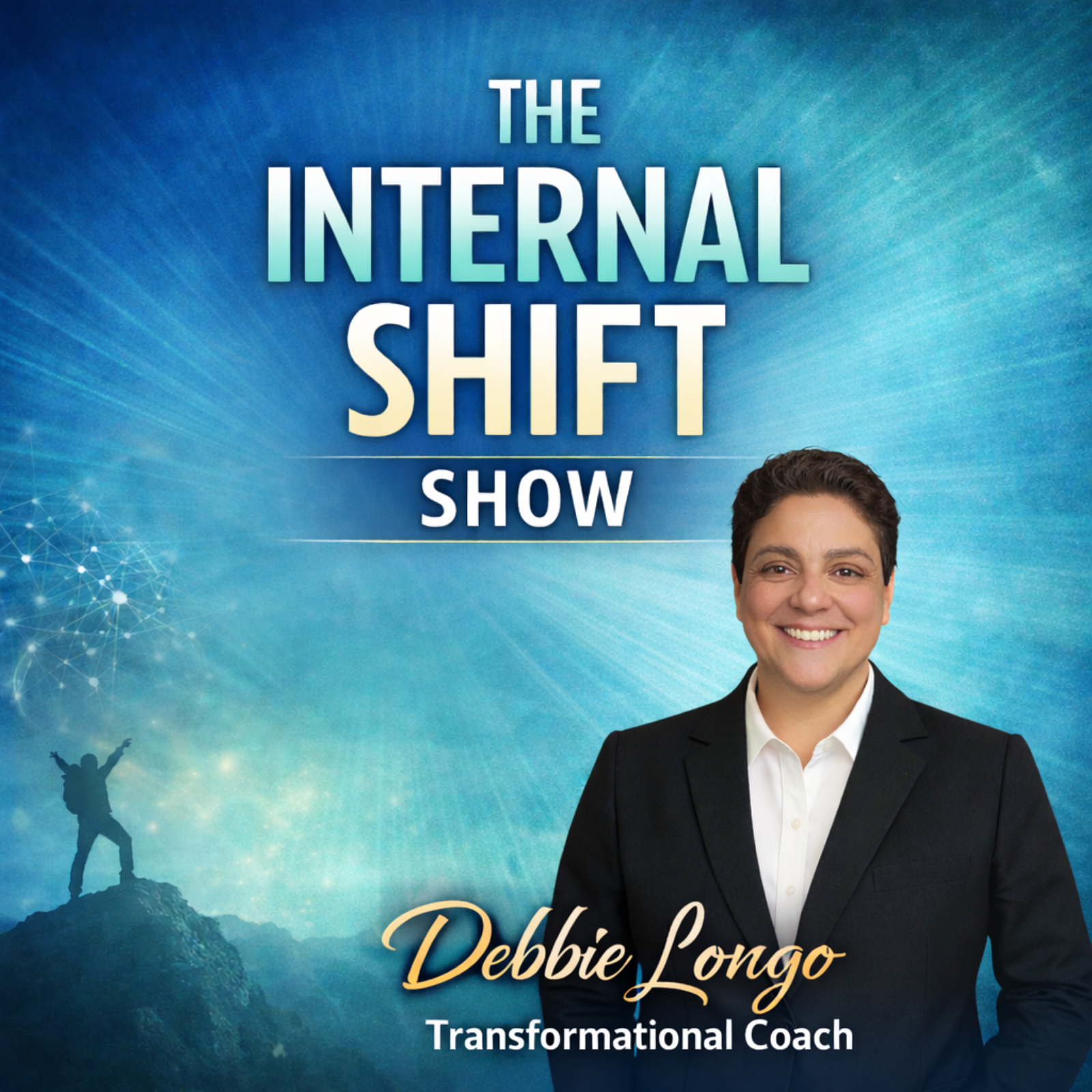
In this episode of The Internal Shift Show, Debbie Longo speaks with Kim Langenmayr about career transition, identity shifts, and navigating today’s job market with clarity. Kim, a veteran, former Peace Corps volunteer, and global education leader, shares her experience stepping away from a long-held leadership role and reflecting on what comes next.
The conversation focuses on internal shifts rather than external outcomes—how perspective changes during transition, what feels different about the current job market, and how resilience is shaped by past experiences. This episode is a reflective space for anyone moving through change and seeking clarity without pressure or oversimplification.
Welcome to the Internal Shift Show, where we
have honest conversations about the moments that
change direction, identity, and perspective.
I'm your host, Debbie Longo. Today, I'm joined
with Kim Langemar. Kim is a veteran former Peace
Corps volunteer and global education leader who
is currently navigating a career transition after
stepping away from a previous role as director
of internal education. This conversation focuses
on career pivots perspective and navigating today's
job market with clarity. Good afternoon, Kim.
Welcome to the show. Debbie, thank you for having
me. I'll start by exploring what career pivot
felt like internally when it first happened,
separate from titles or circumstances and how
that moment landed for you personally. From there,
we could talk about how working globally, serving
the Peace Corps and being a veteran has shaped
your resilience and expectation during this transition.
Starting with this most recent, which is almost
a year ago now in January, most recent separation
from the director of international education,
position. It landed pretty hard on me because
I felt, and I didn't know this until later, until
I did a lot of internal work, I felt like it
was very much tied to my identity. I come from
a generation and a socioeconomic status of people
who have, including myself, I've worked since
I was fourteen years old nearly without a break
vacations here and there but a continuous line
of works from a very young age and so to be in
a situation where even though it was not work
related that I was separated from my previous
position it still felt very much like a threat
to my safety. just to put it that way, because
I have always been fortunate enough to work in
what I'm passionate about, education, culture,
and international work. So to be separated from
my work against my will was a very difficult
thing to come to terms with. At first, it was
like, this is nice. I've haven't had a vacation
in a long time. But as time went on navigating
the current job market, it started to feel more
like a threat to my financial safety. Now that
I am close to a year into it and have started
to interview executive level positions, I have
done the internal work, the meditation, the identity
transformation where I now am operating from
a space knowing I have always been and I will
continue to be more than that. I will thrive.
Another position is going to align with me and
my passion. And when that happens, it will be
celebrated. So it's, it's been a difficult road
to navigate, but now I'm in a place where I am
steady, stable and confident in the direction
and knowing that it will be, it'll be all right.
And that took some time. That took some work.
So that's where I'm at now. That was good. Thank
you. So one of the reasons why I have this show
is for people like you to demonstrate and explain
that you were once in a place and now you're
not there anymore, whether it's negative or positive
or whatever. It's a place that you didn't want
to be in. You are uncomfortable or whatever the
feeling was. Right. And you did something to
change that. You did not sit in it. I mean, maybe
you did for a minute or so, but eventually you
literally did something or a bunch of things
to take yourself out of that. And you talked
about and those things are all good. But the
point is that. And like I said, this is one of
the reasons why I have this podcast is to show
people that they can change that they don't have
to sit. In sick and suffering or anger or crying
all the time. They don't have to sit in that
negativity. That's really the bottom line. Okay.
And that's a big thing. That's the first thing.
So this is like the outline, right? That we're
talking about here. One of the things that I
got out of what you were talking about was that
the stuff that I do, cause I do the same exact
thing that you do. I do internal work and meditation,
but I do a lot of. different things. I don't
do just like one or two things. I really have
a broad range of different practices and the
way that I do the practices. And so one of the
things that I realized is that and this is a
big part of when I teach somebody this stuff
is that this needs to be incorporated into my
schedule every minute of every day. So it's like
brushing my teeth when I wake up. Do i say oh
i have to brush my teeth now no i just wake up
and then i just brush my teeth and that's it
and that's that that's what i wanna. It to become
because all the negativity i've been sitting
in and all the trauma and everything that is
all stuff whatever your issue is that is all
stuff that i have made that a part of me. And
i've complimented my behavior to become that
behavior now right so that is now my behavior
i wasn't this way i mean really i was i wasn't
this way when i was born right so somehow someway.
As life went on or trauma, I became this way.
So this is the thing. So now I want to bring
it back to being positive and doing like you're
saying, how you turned it around and everything.
Right. And I want to make sure that I could do
that. Every day and make it a daily practice
that's that's really the key thing because i
can fall back because what happens is literally
yeah because my brain is trained so my brain
is like a hard drive like on a computer i did
might be a little bit old terms but on the high
we use chips now on the hard drive that's where
the memory is. And that memory will stay there.
And I can bring up whatever type of memory I
want from that hard drive. See, that's the thing.
So it's still there, whether you think or not,
or you don't think it's there or you don't see
it. It doesn't matter because it can still come
up. This is just how the human brain works. I
mean, you can look it up. Anybody could look
it up. You could look it up on the Internet.
It's very easy, very accessible. This this type
of information is not it's not complicated stuff.
Okay, so let's look at how your current job market
feels compared to past career moves and what
is surprised you about the process and where
you're finding friction or uncertainty. The current
market job market has what I think surprised
me most is access to the information that we
have specifically through LinkedIn and other
platforms like that. You can tell how many people
are applying, how long the job has been available.
And so what has come as a surprise to me is many
of the positions that I've applied for, the competition
is definitely out there. There are four or 500
or more applicants applying for the same positions
because the internet has opened up the job search
market to the world. So you're not just in competition
with local Folks in an area you're literally
in competition with the world because these job
markets available to everyone to see who has
internet and linkedin or idealist org or Glass
door, whatever. There's so many out there that
that you can find out job opportunities through
that the competition is nearly limitless the
disconnect between being a Gen Xer, the disconnect
between people and the... Job market and applying
for jobs is what I have found to be most a reality
check because you can't just impress somebody
with what you have to say, your firm handshake,
your eye contact, all those things that we were
taught will get our foot in the door. It's no
longer applicable because you need to make it
past the AI screening. You need to make it past
first round, second round with literally hundreds
of applicants. So that I feel was the most jarring
because I happen to have pretty good self -esteem.
I have my confidence is is in check. And so I
happen to feel and this may sound funny, but
I am the kind of person that I feel like as soon
as I submit, I felt this way. I don't anymore.
As soon as I submit my resume, I expect to hear
back. Like within 24 hours, they're going to
look at my resume and be so impressed and say,
oh man, we got to get her on the phone. And it
just doesn't work that way anymore. There's a
lot of highly qualified folks that are out there
due to the current political situation we find
ourselves in, that there are a lot of folks that
are looking for work. And it's not, it's highly
qualified folks that are out there looking for
work. And so it makes it a little bit more of
a challenge to land that position that you think
I'll put it in my perspective that I think I'm
qualified for and would be a shoe in. They'll
be happy to bring me on board. Guess what? There
are a lot of equally qualified folks out there
that are involved in the same search that I'm
in. And so that's what I found to be most surprising.
Yes, I agree. So I can talk about a million negative
things that clients and past clients and friends
and so many different people have told me about
how they can't find a job because of this, this
and this and this. I was just saying for me,
it goes back to some of those strategies that
you were alluding to earlier, where I've really
I've been a meditator for like 20 plus years.
but I've added on to that understanding your
vibration and your frequency and your thoughts,
the power of your thoughts and your emotions
and what that brings into your experience. So
it's not just about being positive, like, oh,
I can do anything. It really starts with, for
me, being grateful for what I have, being grateful
for the experiences that I've had that led me
to this point, being grateful for the position
that I most recently held because it literally
opened up so much for me that even though I was
separated without having done anything to cause
that, it really has opened up my eyes and opened
me up to a new process of thinking and understanding
that my thoughts, my words, and my actions lead
to what comes to me from the universe, from my
experience. I create my experience through my
thoughts. So if you, like you were saying earlier,
if you sit in the negativity of, oh, boohoo,
I lost my job and this is happening and that
is happening, you're going to spiral and you're
going to get consumed by... pity and negativity.
Kim, thank you for the insight you shared and
for being part of this conversation. And to our
listeners, thank you for joining us in the Internal
Shift Show. These conversations aren't about
perfection. They're about reflection, clarity,
and meeting people exactly where they are. Until
next time, give yourself the space to pause,
reflect, and choose your next step with intention.
Good night. I'm Debbie Longo, Transformational
Coach. Thank you.