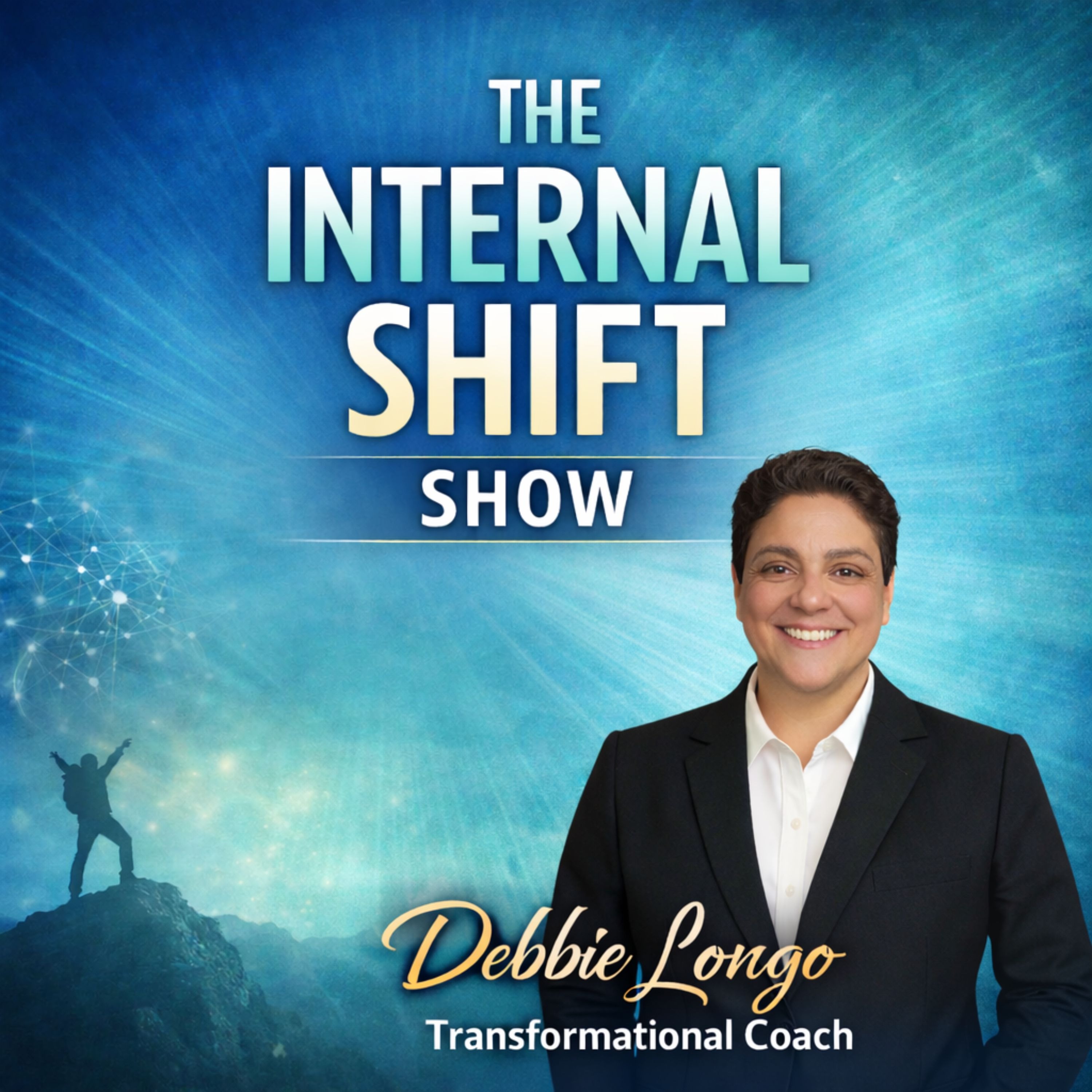
In this episode of The Internal Shift Show, Debbie Longo, Transformational Coach speaks with Mickey Fitch-Collins, PhD, about a major internal and professional transformation that redefined her career, identity, and direction.
After years of building a successful career in higher education and reaching senior leadership, Mickey found herself experiencing severe burnout, health challenges, and a growing disconnect from her work. Despite external success, internally she recognized that the path she had committed to no longer aligned with who she was or what she valued.
The turning point came when she made the decision to step away and go through a deliberate process of self-reflection, reassessing her values, strengths, and what truly energized her. That process led her to transition into the field of learning and development, where she now focuses on helping others grow, improve, and perform at a higher level.
This conversation explores burnout, identity shifts, career transitions, and the reality that growth often requires letting go of what once defined you. It reinforces that there is no single path, and that internal decisions—made consistently—shape long-term outcomes.
Contact Information:
Debbie Longo Transformational Coach Website:
LinkedIn: https://www.linkedin.com/in/debbie-longo-life-in-bloom-ny/
Mickey Fitch-Collins, PhD:
Welcome to the Internal Shift Show. I'm Debbie
Longo, transformational coach. This show explores
how the way we think, decide, and respond internally
influences where we end up over time. Today's
conversation draws on real experience and expertise
to look at how small internal shifts can change
direction, momentum, and outcomes. We have a
very special guest today, Mickey Finch -Collins.
Hi, Mickey. Welcome to the show. Good afternoon.
Thank you. Yeah, thanks for having me, Debbie.
I appreciate it. Thank you for being here. I
am going to ask you to tell your story and basically
point out a situation or some type of life change
or decision or something like that that happened
during the course of your life where you went
from basically a negative to a positive. So I
was someplace. this is my process that I went
through, pretty specific if you can, and then
this is where I am now, and the end result should
always be a positive. Now, I do this show for
a few different reasons, and one reason is because
everybody has their own individual story. but
the people can point out or can identify with
things in other people's stories that they're
going through in their life. And that thing that
they can identify with situation or whatever
it is, that is going to attract the listener
and hopefully they will be able to listen to
your process. Just so maybe they can see that
there's a light at the end of the tunnel or a
way out for them. And if just we accomplish just
that, that's a lot because nobody has to sit
in the negative. Nobody has to sit in the sick
and suffering. Nobody has to sit where they are
today. They can always change. There's always
a way out. There's always another direction.
But does the person know that? Do they need to
recognize that there's a lot of different scenarios?
And this is one of the things I'm not trying
to sell myself, but when I coach and stuff, this
is like a very first step kind of thing. It's
like a little step kind of thing. So that's main
main reason why I have the show. So if you could
do that for me, I'd appreciate it. Thank you.
Yeah, for sure. So so my story really starts
about six or seven years ago. Within a few years.
So I had my first career was working in higher
education administration. So I worked in colleges
and universities all the way from my time in
my graduate school program when professionally
the next 20 years I'm working at a variety of
different colleges and universities always on
the student service kind of student support side
of the house. And I had risen. all the way up
to the C -suite level, chancellor, staff level,
as high as one can go, basically short of being
a chancellor of a university. Within a few years
period of time, I had gotten married. I had finished
my PhD. I had turned 40. My wife and I had our
first child. And the pandemic happened. OK, so
this all happened within about a two year period
of time. And in that whole process, what I realized
and what I was experiencing, my research that
I did for my dissertation was on middle manager
burnout. And I had just exited a middle manager
position to go into a senior executive role.
But I was experiencing exactly what I was researching.
Massive amounts of burnout, significant health
issues, mental health issues, frustration, anger.
sadness, waking up in the middle of the night,
not being able to go to sleep, not being able
to stay asleep, not feeling like I was actually
getting anything done at work, all this sort
of stuff. And I was applying band -aids to what
I realized was a very internal deep wound. And
what I realized that wound was was I don't want
to be doing this work anymore. I don't feel a
calling to this work anymore. And that was really
hard because I had two advanced degrees in higher
education administration. I had spent my entire
career doing that work. And so I found myself
in this position. I actually... that the culminating
point for me was nine days after the birth of
my daughter, one of my peers said to me, you
need to make a choice between the university
and your family because this isn't a job, this
is a lifestyle. And I was like, choice made.
But I, in that moment... Didn't know what to
do. I didn't know what agency I had I had no
idea like what else do I do? Because this is
all I've ever done and I've done it and I've
done it Well, and I've gotten lots of promotions
and lots of different jobs and all of this sort
of stuff So I went through Debbie what I would
call a discernment process a process where I
really stopped and Kind of values exercise sort
of thing. What is it that I like? What is it
that I value? What are the moments and the places
and spaces and people and situations that I feel
like I am my most authentic and true self? And
what I did when I went through that process was
I went all the way back to my teenage years and
the things that I was doing in my teenage years
and realized it was always about teaching and
learning and training and development. It was
always the opportunities where I could help other
people learn and grow, where I could supervise
other people, where I could help people get better
in their hobbies, get better in their work, get
better, become better versions of themselves.
So I realized through all of this, that's the
stuff that's always been energizing to me. And
I started to kind of look, okay, like, what does
that look like for work? And I realized there
is a whole entire field of learning and development.
Sometimes it's housed in the human resource function
of organizations, sometimes it's talent development,
organizational development, whatever it is. And
what I realized is... Oh my gosh, this stuff
that I love that has only been five, 10, maybe
15 or 20 % of my job, this could be the entirety
of what I do. And so I did what a lot of people
do, which is I made a soft exit from the world
of higher education. I went to EdTech. I worked
at a fantastic EdTech company, but I realized
I was just not the right person. But it felt
like a nice soft landing and a soft exit for
me. I left that role. and came to the world of
learning and development. I work for an organization
called Learn It, and essentially what I tell
people, my job is to help other people get better
at their jobs. And so I spend most of my days,
whether it's in group formats, coaching folks,
or individual formats. I do lead virtual web
workshops for folks. I do in -person pieces.
I help other people get better at their jobs,
but it was this huge, massively difficult, really,
I mean, down to the core of who I was, process
of transformation. And it's still a process of,
I mean, I'm still in this identity formation
sort of process. So that's the reader's digest
version, I could say, of this transformation
process for me. Very good. That was good. Thank
you. So as you were going through this process...
And especially when they told you that the job
is a lifestyle and, you know, choose whatever,
however they described it, choose your family
between your job. I'm just giving an example
of probably one of the parts of the process that
you went through. So when you were going through
that and any other part that you could identify
with, what is your, how were you feeling during
that process? How was the transition like? What
were your feelings while you were going through
this? Yeah. I mean, I felt lost. I mean, I was
at the beginning stages of it. The colleague
of mine saying you need to make a choice between
your family and the university. That was really
startling. And it was especially startling because
it was coming from another woman who's also a
mother. And I was like, wait a minute, like...
is this actually modern times that I'm having
another woman who's telling me basically, like,
don't be an active mom. Like, give your life
to the university. But I also, because I was
in such these deep stages of burnout, I was also
just frustrated with my work. I felt like, I
mean, one of the other big reasons why I knew
that I needed to make a change was I was spending
more time behind closed doors fighting for resources
with my colleagues than I was doing anything
to actually help students graduate and be successful.
The feelings that I was having was frustration
and burnout. I felt physically ill a lot of the
times. I was ill a lot of the times. I was having
to miss work because I was just acquiring colds
all the time and all this. What was hard about
it was I didn't, you used the phrase before,
the light at the end of the tunnel. I didn't
see a light at the end of the tunnel because
I had very aggressively pursued this career.
I mean, I was one of those people, oh, you're
the youngest person that we've ever had in this
position before. And oh my gosh, like, this is
incredible that you were promoted into this role.
all of this sort of stuff. And so there was never
a part of me that thought, oh, I'm not going
to be doing this type of work. And so to say
to myself, okay, I need to make this change,
I felt like I was in a dark room with a blindfold
on and somebody was saying, figure it out. And
I'm like, I don't know what kind of room I'm
in. Is there a door? Are there any windows? Like,
is there anybody else in here? So I felt really
lost and... You know what I'm grateful and thankful
for is I had a couple of I'm a pretty big extroverted
person I I know a ton of people and have a ton
of acquaintances and I keep very few close friends
but I had a couple of few close friends one in
particular that was a mentor to me that really
pushed me over the finish line to finish my my
doctorate program because Anybody who's been
through a phd like the last six months is horrendous
and awful And you feel like it's never going
to be over with she was the one that said there
are other possibilities and let's take a look
at this and like ask me some of those questions
and also normalized the feeling of I don't know
what's next because I think I was feeling a lot
of times of like I'm the only person that's ever
felt this way I'm the only one who's going through
this and she started normalizing like I know
this person this person this person let me tell
you those stories which is exactly what we're
doing here today you know but she normalized
some of that stuff and She also helped me recognize,
okay, let's take a look at these skills and experiences
that you've had, and let's look at how those
are transferable to other industries and other
type of work. You don't only exist in this one
industry. Like you are a person. I mean, I think
about the Walt Whitman quote of, I'm a person
of multitudes. I butchered the quote, but being
a person of multitudes and multiple opportunities.
In those early stages and places, it was really
hard because I had to figure out, I mean, very
practically speaking, if I'm going to get another
job, I have to apply for other jobs. I have to
go through interview processes, but I also have
to be able to translate this whole entire 20
-year career into a language and a lexicon that's
going to make sense for people who don't work
in higher ed, which every industry has its own
language. Higher Ed has a very, very, very different
way of talking about being a business because
nobody in Higher Ed wants to say that we're a
business. And so I had to go through that process
and then figure out how do I talk about myself
and all of this experience that I've had really
kind of rising through a hierarchy. How do I
talk about that? but I'm also coming in as somebody
who's absolutely brand new in this second career
field. So I'm like a greenhorn in the room again.
Like, and how do I do that and humble myself?
So there were all these mixed feelings that were
going on of like, this is exciting and there's
these possibilities, but also like very practically
speaking, like I have a mortgage to pay and I
have a kid that I need to take care of, my family,
like all of this sort of stuff. So like. I need
to figure this out and I need to do so pretty
quickly because I am rapidly kind of devolving
and dissolving in this pit of pain that I was
in. Yes, that was very good. So one of the things
that I like to talk about if I am teaching somebody
or coaching or just even talking to somebody
just casually or whatever, is that everything
I do, picking up my cup, Everything I do is a
process. Now I don't, before I pick up my cup,
I don't say, oh, I'm going through this process
of picking up my cup. That's not, I just do it.
But sometimes things that happen in our lives,
this is an event that happened in my life, I'm
picking up a cup. Sometimes events that happen
in our lives turn into, become certain situations.
or turn into certain situations. And sometimes
those events are longer and they're more complicated
and they're more detailed. Therefore, or hence,
leading to a very longer, complicated, more detailed
process. Now the end, I like to say, oh, tell
your story beginning to end. Well, that's what
we're doing here because we don't have forever.
And we're not at the end. Exactly. That's what
I'm, the point I'm trying, but it's just what
I was going to say. Sometimes when we're going
through something, sometimes there is an end
where it stops and then something else happens
and then you start another process. Or sometimes
there might not be necessarily an end. uh, what
our definition would be of an end or, and that
would continue. So you went through something,
here's your process. This is what happened now.
This is where I am now. And this is going to
be my next question. But now this part of this
situation that I was in is now continuing and
it's going someplace else. And it sounds kind
of like this is what's happening in your story.
So now, one of the things that I talk about is
that, which I've been talking about lately for
some reason, but that's just the way that it
goes, is that I believe that everybody has different
paths that we go on. Some people think it's just
one path. You're born, you end up someplace at
the end, and that's it. Well, that is true because
eventually everybody dies. But in between that...
We have all different paths that we could go
on. And the reason is because everybody has the
ability to think for themselves. Every human
being and every human being has the opportunity
to make any decision that they want. They don't
have to listen to. Nobody can make anybody do
anything. They don't have to listen to somebody.
You know, they can or they can't. That depends
on the decision that the individual makes. Sometimes
I make good decisions. Things work out. Sometimes
not. That's just the way that life goes. But
because I have all of these different paths that
I could choose from and all these different directions,
right, that I could potentially go into, this
now leads me to all different processes. Indeed.
Process E is really, is really how you say it.
And then, what happens then? Then I go through
that process. Then that might continue, or might
not, but then... that leaves me something else.
Let's just say, for example, and then I go through
another process. So this is how life is. This
is, you know what I mean? I don't know if this
is it. The seasons of life. The seasons of life.
Yeah. Yeah. Exactly. To me, it's a fact to be,
you know what I mean? If somebody wants to agree
or not, it's fine, but. I don't know if it's
actually proven, but the point is that this is
just a conversation that we're having here. So
the point is to this whole thing is that it sounds
like that's kind of the way that your story is
going because it kind of sounds like parts of
it are continuing or branching off right exactly
to go on to another thing. And that's a good
point that I would like to make because not all
my guests have this type of story, which is fine.
because everybody has different situations and
different lives and everything. But that's the
point. One of the points that I would like to
make here is because the process doesn't necessarily
have to end, but it's important for me that I
learn the lesson of what. the process is and
what is the ending or what is happening. It might
not necessarily be an ending. We just talked
about this, what's happening. So it could stop,
it could end, it could continue, whatever. And
that's why a lot of times, this is another reason
why I have this show, that's why a lot of times
it's good to talk about these things because
people think, Lot of times they'll just think
one way something will happen and that's just
the way everything is. Yeah. Yeah Yeah, there's
there's a lot of things that you said there that
like I can really react to ends ends Kind of
share of I mean number one like that a couple
of years ago somebody kind of introduced me to
this this concept or this way of thinking of
seasons of life as I just said it's like That's
that we all yeah I mean it's not this linear
one path sort of thing because even if you think
you're on one path of like I was born, I do this
thing and then I die. There's all sorts of different
things because every single day we make these
different decisions and all this sort of stuff.
And so for me, going through this process of
this discernment process that was career related,
it's not just career related, it's identity.
because for me, I had pursued significant education
and like a lot of people I think in your 20s
and 30s are very driven towards job titles and
salary and rank and all of this, the accolades,
right? Being recognized for getting this award
and getting this da -da -da -da -da. And part
of this transition and part of this process for
me has also been, and I think frankly, part of
this is also being a person now who I guess maybe
I'm. Not I guess. I'm mid -career. I'm kind of
like over the hump of I have more years behind
me that I've worked than the years in front of
me that I want to be working. So I guess that
makes me mid -career. I'm in my mid -forties.
I have two kids. There's a change in my world
view and that change in my world view, I mean
there's a lot of different pieces to that, but
that change in my world view is really a shift
from titles and accolades and awards and salary
and all of this sort of stuff. gathering, I was
in this gathering and acquiring, and now what
I'm doing is I'm going back. I'm going the other
direction. So instead of trying to acquire all
of these things, now what I'm doing is I'm giving
back. So I'm giving back knowledges and experiences.
I'm giving back learning lessons in the forms
of the stories that I tell to help people kind
of build skills to be better in their work. I'm
at a place now too where I'm starting to think
about what working for myself in service of others
looks like instead of working for other organizations
in service of the organization. And so there's
this very different transformational shift of
the way in which I think about work, so like
the mindset of work, but also my identity associated
with that. And of course then that I have switched
industries, I've switched career paths. So there's
these kind of three different things that are
going on there of age and life experience, of
orientation towards collect versus give, And
then also the very concrete one, which is what
happens when people go through these reckoning
processes of saying, like, this career field
doesn't work for me anymore. And again, all of
those things have they have difficulty, they
have strife, they have conflict, they have lots
of question marks and gaps and all of these difficult
sort of things. But there is a recognition in
all three of these pieces is that this is part
of the seasons of life. Like, these are the changes
and transitions that we go through, just as I
can look in the mirror and say, ooh, Mickey,
you have less brown hair than you did five years
ago or 10 years ago, right? Like, I see that
physical transition. I also see the transition
in my orientation to kind of who am I in this
world. It's not this heady journey. It's a very
practical sort of piece, too, of just like, what
does this look like? And I think each one of
us, I mean, as I get together with... other people
that have gone through these career transitions
as I get together with other parents, as I get
together with other people that are kind of in
this like mid -forties to mid -fifties place
of like, who am I? Like these are normal transformations,
but that doesn't mean that they're not painful.
It doesn't mean that they're not difficult, but
it does mean that it's a process and there is
something at the end of it. Yep. Very good. Very
well said. I really appreciate that. So how do
you feel today? based on this whole podcast,
this whole conversation that we've had everything
that. you've said and about your story, your
process, all these different things. How do you
feel today, right now, based on all of that?
I feel good. It's empowering to be able to share
stories and it's exciting to think about that
story impacting or somebody listening to this
and saying, oh, I can relate to Mickey's experience.
Like, it sounds like she's been through some
similar things I've been through. And that, I
think in our world, like the people are missing
connectedness with other people. And people are
feeling, I think, more and more isolated despite
our efforts to get people to feel more connected
with one another. And so my hope in the form
of my feeling right now, to answer your question,
Debbie, is my feeling is a sense of hopefulness
for people to feel connected and to also know
that... processes aren't painless, but they can
also be joyful. They can also be opportunistic.
They can also be full of possibilities and wonder
and also very practical pieces of like, what
the hell do I do now? And all it's one of those
like D all of the above, like all of this stuff.
is relevant. All of it is helpful and all of
it is worth it. And so I think I'm feeling I'm
feeling grateful for the opportunity to tell
my story. I'm feeling hopeful for the folks that
are out there to feel a sense of connectedness
to my story and for other people to also recognize
that like we're all going through these transformations
and these iterations and these seasons of ourselves
because that's what we do as humans. Like we
are not static beings. Yeah, that was good. That
was a good closing. So the only thing I wanted
to add to that would be I like everything you
said, obviously. But the main thing that I wanted
to add, if these processes take me on all different
paths, sometimes I don't want to find where the
end is. Sometimes I don't always want to look
for the end. I want to say this in a way that's
really like understand. broad term, you know
what I mean? Like understandable, like in a broad
term, because sometimes that will give me more
of an open mind to move on in life to accomplish
the things that I want to accomplish. Yeah. Rather
than staying stuck or this is the way it's going
to be or I'm in a depression. or whatever that
situation is. That's where it takes me. And when
that happens, if I can just, I guess, broad my
mind or just think beyond a few different things
every day. When that happens, that can help me
to change my mindset. And then I might think
differently. of all of the things that are gonna
be happening will happen to me in the future.
So it'll, permanently, I don't know, I don't
know if I wanna use the right word permanently,
but it will change, hopefully it will change
my mindset just to allow me to think differently
like that. I don't know. I don't know if it came
out right, but I had it really... Yeah, I mean,
what I'm hearing you saying, like, what I think
about with this is, like, our paths are not prescriptive.
Like, there's no... And that's the problem. That's
the problem, is that people think, because of
this, then that, if this, then that. And when
we start thinking in that sort of mathematical
sort of equation, we will be disappointed. I
think we will... Things will get screwed up.
And so the better thing to think is this is I
mean, this is kind of like a like a very Zen
sort of thing. It's like this is the moment that
I am in. This is what I like and this is what
I hope for. But that doesn't mean it's not going
to come all crashing down tomorrow. And what
do I do if and when that happens? And I think
for anybody who's been through a big, traumatic
transformation, right, whether it's it's a healthy,
it's a relationship thing, it's a financing job
thing, whatever it is, the My hope is that people
have a little bit more sense of presence of here
is the moment that I am in and it's going to
be a little bit different in the next moment.
And this idea that like, well, I'm going to work
in this job for five years or in. In 10 years,
my spouse and I will XYZ or something like that.
These prescriptions that we set up for ourselves,
I think like this is where it becomes really
trapping to us because they become naturally
disappointing because other things happen. And
so like that's that's one of those things. Like
if I if I can offer like a piece of advice or
a piece of wisdom that that I've gleaned from
this is to be as and as a parent, like as a mom
of a five year old and a two year old right now,
kids are the the ultimate Presence makers like
they are so good at helping us as grown adults
Just be in the moment like before I hit the we
hit the record button I was talking about like
it snowed a bunch where I live this morning and
this was it was as on par with like Christmas
morning for my kids and To me. I'm like, oh gosh.
No, I need to do this I need to take care of
this and I have these other things I have going
on But in that moment, I was seeing the world
through their eyes. All they wanted to do was
get out and play. They didn't want to eat breakfast.
They didn't even care about putting their snow
suites on. And there's something to be learned
about this idea of presence in the rest of our
lives. This is the season that we're in, and
it could be different two weeks from now. Like,
my world, your world, could be completely turned
upside down tomorrow. And that... We have to
be okay with that. We have to prepare for that.
And we have to build systems and structures of
resilience within ourselves to be able to say,
this is how it's going to go. And that's going
to be okay. Yep. And that was a very good way
to close. Thank you. I really appreciate that.
As we close this conversation, as a reminder,
that progress really comes from one big decision,
but from the internal choices we repeat. If something
from today's discussion connected with you...
Take a moment to notice how those internal choices
showed up in your own life. This has been the
Internal Shift Show. Thank you for listening
and thank you, Mickey, for being on the show.
I really appreciate it. Thank you for the opportunity,
Debbie.