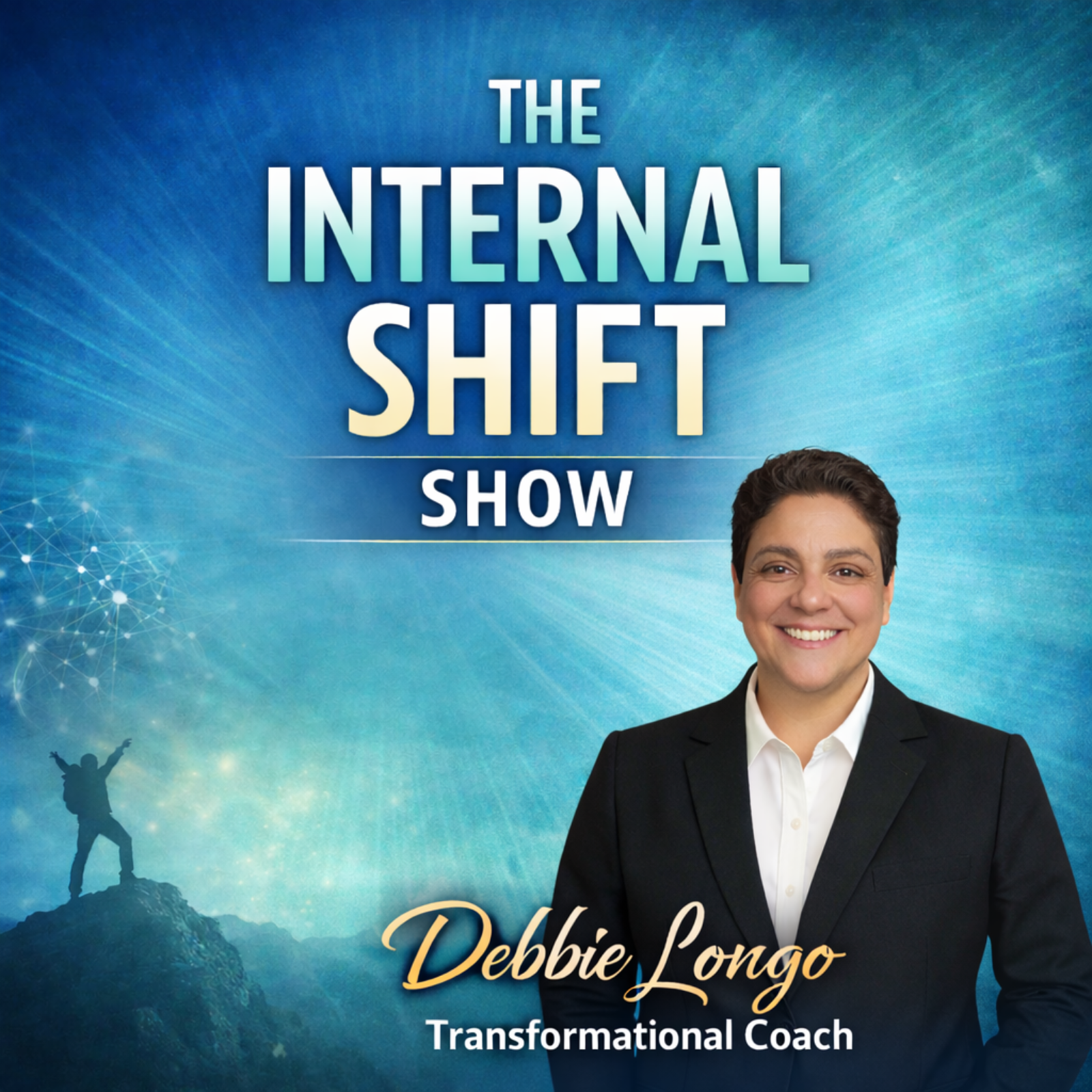
In this episode of The Internal Shift Show, Debbie Longo sits down with Monica Kaufman, Certified Financial Planner and founder of Harmony Wealth Academy, to explore how identity shapes financial behavior and long-term success. Monica explains how early programming influences our decisions, why lasting change requires an identity shift, and how money reflects internal alignment rather than external status.
The conversation dives into inherited “money scripts,” resilience, responsibility as the flip side of freedom, and why sustainable change happens through small, repeatable actions that build self-trust. Monica also shares practical strategies for building financial steadiness, strengthening adversity quotient, and creating systems that support growth without urgency or pressure.
This episode is for anyone who appears competent on the outside but knows there is unfinished internal work asking for attention.
Contact Information:
Debbie Longo, Transformational Coach
LinkedIn: https://www.linkedin.com/in/debbie-longo-life-in-bloom-ny/
Contact Monica Kaufman:
Welcome to the internal shift show where we slow
the conversation down and explore the moments
that quietly change how we see ourselves, our
lives in our direction. This isn't a show about
quick fixes or polished success stories. It's
about the internal shifts that happen long before
external change becomes visible. The pauses,
the uncertainty. The re -collaboration that happens
when old patterns stop working and clarity hasn't
arrived yet. These are the moments that shape
who we become, whether we acknowledge them or
not. Today I'm joined by Monica Kaufman. Monica
is a certified financial planner and the founder
of Harmony Wealth Academy, but her work goes
far beyond numbers and spreadsheets. At the core
of what she does is identity, responsibility,
and the international steadiness required to
make meaningful decisions, especially when life
feels uncertain or unresolved. Monica has lived
inside prolonged ambiguity, building a demanding
career, raising a family, and navigating years
alongside a spouse with severe clinical depression.
These experiences reshaped how she understands
control, responsibility, and what it means to
move forward when answers aren't clear. a calm
grounded perspective to conversations about money,
identity and personal agency without urgency,
pressure or performance. This conversation isn't
about advice. It's about reflection awareness
and the internal shifts that quietly change everything.
Good afternoon, Monica. Welcome to the show.
Thank you. I'm happy to be here. Very good. Thank
you. I really appreciate you being here. We're
talking a little bit about These seasons that
when you're carrying responsibility without having
some clarity, you're doing what needs to be done.
But internally, something is shifting before
you have language for it. Now, I realize that
the quiet shift often changes how you see yourself
long before anything changes on the outside.
Absolutely. You can't create. lasting change
without changing the core identity. So if I want
to simplify that a little bit and let me know
if you agree with me on this. But I look at this
as sort of like programming. It's like an operating
system and you don't realize it, but you get
one or psychologists say you get the basic framework
of it by age six and you get it from your family.
You get it from the environment and the culture
around you. Now. You're not a potted plant, you
can shift, you can move. But basically you will
default back down to that operating personality.
And it's how you see yourself. It's how you learn
how to control your body and who your body is.
It's how you learn that you are worthwhile of
being responded to. That's why it's so important
for parents to respond to a crying baby. And
then you get that loving message and you learn
these messages and who you are. And you develop
a core identity and it's. Anything you do where
you try to change action without understanding
that you have to change a key piece of who you
are based on that programming doesn't work it
doesn't last. And frequently the impetus for
change is usually pain. You're going through
something is painful it's scary. There's some
sort of emotion or negative emotion connected
to that. And that's the impetus for you to actually
look at that piece of the identity and say, does
that serve? Does that serve me? Does that fit
me? Does that reflect reality? And when it comes
to finance, you can see it kind of clearly because
money is nothing more than a set of tools in
your hands. What you do with it is a reflection
of who you are. It's just an extension of your
arm. And so if you don't like what you're doing
with money, you have to look at why you're doing
it and what the messages were. And that's where
I start with my work. I start with those money
scripts that we've inherited. And you can look
at that and you say, okay, so here's where this
is showing up. This is what this is. What do
I then do? And you do have to do an identity
shift. And the why has to be big enough. The
pain or the desire has to be big enough to get
you there. It's hard. Yeah, and I agree with
that. This is another thing that I talk about
a lot, and this is a big thing that I teach that
when I have a computer, the little bit of old
language is there's a hard drive and a soft drive,
a ROM memory and a RAM memory. We don't, a lot
of computers have chips now. So the point is
that everything is on the computer. Now that
is my, the big drive, or everything that's on
the chip is in my brain. And what I want to bring
up, what I do is I type something in, if I want
like a Word doc, I bring in, I type in something,
a search, and then it comes up. So it comes out
of that big, all that information. So what I'm
doing is, when my brain is, my unconscious part
is the ROM, and then my conscious part is the
RAM. So I'm constantly bringing memories up from
my memory bank. To me, that is just, well, first
of all, that's basic psychology. I'm not a psychologist.
I don't have a degree in that, but this is just
knowledge that I have gotten from 25 years of
working. And so that was the first thing. So
the second thing is that these things that are
all tools, like you said, money and whatever
physical thing I have in my hand, the mind controls
the body. So what do I do with these things?
I could do something negative. I could do something
positive. I could use it. I could not use it.
So that's going to depend on me. So the mind
controls everything, every single thing. And
there is proof now that we have that the mind
controls diseases that we get, whether you're
depressed or not. I mean, there's there's so
many physical ailments, just that alone. that
is controlled by our minds. And that is what
is going to affect a lot of this that we're talking
about here today. I agree with that 100%. But
I would also add that the mind and the body,
it's one set of biochemical processes. So you
can't expect optimal brain performance when you
don't take care of what you feed it, how you
rest it. You can't improve anything unless people
get enough sleep. You can't improve anything
if people are dehydrated. You can't feed someone
garbage food and expect optimal performance,
whether physically, emotionally, or intellectually.
You just can't do it. And you have to see yourself
as somebody who takes care of herself. And that
for some people is a shift. Like they didn't
see it, they didn't experience it, and they didn't
see it modeled, and they have to aspire to it.
want it and you can see when people do it or
you can see when people make that shift because
all of a sudden something changes all of a sudden
they get something done and for me there are
so many times when I look back and I'm like why
am I resistant to that change because I don't
want to see myself as someone who did this and
it's hard it's really truly truly hard and sometimes
it's unpleasant like We're all going through
this moment in the country on politics and we
have been for the past 20 years and we've become
so divided as a country and why because Part
of our politics has been part of our personal
identity and that's kind of dangerous And so
it's very very very hard as it gets polarized
and more oppositional To say hey, wait a second.
I don't have to agree with this person Because
it it's like saying oh my god There's a part
of me that I have to let go of because there's
a belief here. That's that's difficult and It's
unfortunate. It's like that's the one thing that
I regret on all of that There's no reason for
us to not get along because we disagree on some
of the stuff. There's just no reason I don't
have to agree with everybody but when I look
at I Look at everything that I've been through.
I've had to shift how I see myself There have
been moments that I look back at that. I'm not
proud of But I've had to shift to see myself
and in order for me to give myself permission
to do what I've done It was like I saw during
the pandemic during the first time we got 42
appointments. I've never had that many appointments
in one week the second week I had 44 and these
were people who were making good money and they
were Financially just absolutely petrified. I
never want to see that degree of fear in my life
I've felt that fear before I've gone through
that being around that was just painful. I was
it was awful and so for me when I look at this,
it's like Responsibility is the flip side of
freedom everybody. I believe everybody was created
to be free which means response of all and if
you don't take responsibility for your health,
your emotional health, your financial health,
your social health, any of those key parts of
who you are, somebody else will. I don't want
that in somebody else's hands. I want that in
your hands. And in order for you to do that and
to have the courage to step into a role that
maybe you weren't encouraged to learn, let me
back up a little bit. We have a problem in this
country when it comes to money in that The industry
estimates that about 80 % of the American public
does not understand how to use the financial
system 80 % But this is not new it's been going
on for about four to five generation depending
on how you calculate this So people don't know
the system and then they go and they look for
somebody to help them and they're scared They're
feeling vulnerable. They're having an issue.
I spoke to a couple about a year ago They're
elderly and they needed to get some documents
done and they were really resisting an attorney's
effort to get them to move. So I was talking
to them and both of them had had bad experiences
with lawyers in the past. And one of them in
particular, both of them had grown up during
the depression and their families had been hit
hard by the depression. So they've got that programming.
Their adult experiences with attorneys was not
positive. They're going, why do we need to do
this? And I looked them in the eyes and I said,
ultimately it's about you. exercising control,
you saying what you want and what you don't want,
you actually giving a roadmap to your family
so that they can paint by the numbers and do
only what you want them to do. And people have
this sort of naive wish, which I'm a mom, I get
it. Oh, everything's going to be fine. They'll
work together. Well, the biggest gift you can
give them is the roadmap so that they know what
they need to do so that they don't fight so that
they You enable that by giving them structure.
And so the only way you shift the identity is
actually set the boundaries and create systems
around you that nudge you in the right direction.
And you can't do it overnight. You can't undo
years of programming in one night. You just can't
do it. The whole system collapses. Yes, I agree
with that. Also, another thing I noticed that
a lot of people are highly competent on the outside
while feeling unsettled on the inside. And the
gap between performance and steadiness often
shows up quietly, especially around money and
control, which was something that we talked about.
It's not a lack of intelligence or effort. It's
a lack of internal alignment. So think about
it this way. I remember I walked into a chamber
of commerce meeting. And I wound up talking to
one of the women there. She said, oh, I know
that this is a good financial advisor. Why? Because
this person who has money told me that they're
a good advisor. Well, how do you know that they
have money? Oh, I know that they have money.
How? And I got a little aggressive about this
for a reason. And she said, well, I know where
they live. I know what they drive. Have you ever
heard the phrase, all hat, no cattle? And that's
a phrase that was made popular in my head when
they were quoting in The Millionaire Next Door,
a multimillionaire down here in Texas. He said
that people who have money are usually not the
ones who flaunted. They're not the ones wearing
the labels. They don't care. They're not looking
for approval. They're not looking for you to
say this is a successful person. I have known
very successful professionals who spent all their
money on the appearance and the trappings of
wealth without actually building wealth. And
then the other pieces people forget. Income isn't
wealth you use income to build wealth and that
is a different process and it takes the adult
self -control to say you know what I value future
me as Much if not more than I value present me
present me is future me is not What do I need
to do to take care of future me and that's another
thing was like, you know You are valuable you
matter and your future you matters So I want
you to take care of future you and that that
also requires an identity shift that requires
a massive identity shift. No one should care
more about your outcome than you. So, yeah, so
a lot of that, too, I got out of that is building
self -esteem and do I build self -esteem from
the inside or from the outside? And wealth is
considered. To me, a lot of, yeah, it's considered
making a lot of money and having a lot of money
in the bank and being able to buy a nice car,
a nice house, but it means something different
to other people. Some people who are very, very
wealthy do not have nice cars and they have a
regular car and a regular house and you would
never know. You would never know that they have
like tons of money. And then the other thing
too is if you have money, does that make you
happy? We don't know that because it might not.
Am I happy on the inside? And that's building
self -esteem to me. So the way I look at this
and the transfer that I ask people to make is
I ask them to see money as the tool with which
you build your life. It's not positive. It's
not negative. It reflects your decisions. Even,
and I realize this, I'm facing some difficult
things I need to get done in the past next six
months or so. And I realized that I was making
some bad, impulsive decisions. Because I was
under stress and it was emotionally difficult
for me to make an identity shift. So I was reverting
back to some bad inherited habits. So it's a
lifetime journey of saying, all right, if I fall,
I'm going to get right back up. I'm going to
become aware and I'm going to make the shift
that I'm going to do what I need to do. But the
other pieces that when you understand that money
is nothing more than a tool with which to take
care of yourself. it allows you to say, yeah,
I'm gonna buy the nice house and yeah, I'm gonna
buy the nice car, but maybe I'll buy the nice
car and take care of it for the next eight years.
There are certain habits that the millionaire
next door demonstrates that people do. Yes, they
buy nice houses. Yes, they take care of them.
Part of having the nice house and having it stay
the nice house is that you take care of it. One
of the things that people who are financially
successful and build out well do is they They
take care of themselves. They take care of themselves
and it's it's not because they want approval
from anybody else. That's the whole question.
Are you doing it because you want other people's
approval or an acknowledgement? Are you doing
it because you're looking for status? You're
looking for acceptance. You're looking for is
you're filling some other need or you doing it
because you value yourself. And if you value
yourself, it's a hell of a lot easier to sustain
me. Ultimately, if I walk in to a room. I want
the people who are there for me to want me because
of me, not because of how I'm dressed. That doesn't
mean I don't want to be appropriate for whoever
I am, if that makes sense. Yeah, I agree 100
% with that. Going in another direction, talking
about planning and positive things that we can
do for ourselves, which is what we're talking
about here. Eventually, planning loses its power.
Because when I plan, right? Why am I planning?
What am I planning for? And then action, which
is part of the planning, only becomes possible
when it's rooted in self -trust, not urgency,
pressure, or fear of falling behind. Without
that internal grounding, even the best plans
tend to stall. Absolutely. So here's the thing.
Have you ever written out a bunch of New Year's
resolutions? Have you ever had a plan for the
New Year's resolutions? How long did you stay
on the plan for the New Year's resolutions? Two
weeks? Got it. You did better than the average
American. The average American doesn't make a
past January 9th, I believe is National Quitting
Day. So we talk about goals and we talk about
them the wrong way. And the science shows this.
It's kind of funny. It's like, all right. You're
going to only sustain the action if you believe
this is the person you are meant to be and that
you are coming now we didn't talk about this
before but. The mind is not there to make you
happy the mind is there to keep you alive and
the mind is a phenomenal prediction machine based
on prior behavior and prior observation so your
subconscious is not gonna let you feel confident
until they believe you're actually doing it.
So how do you build it. You have to build evidence
that the subconscious will accept. So one of
the things that I will say to people is I have
a bunch of whiteboard dry erase boards, calendar
boards, and I will put it in there and I will
put in, I did this, I did this, whatever the
goals are, like whatever the, whether it's prayer,
whether it's exercise, whether it's journaling,
and I'll put it down so that I can see that I
got it done on that day. And it's right there.
If I'm looking at change on my money, I had one
client tell me that many years ago he got himself
into credit card debt and he got himself into
a problem where his credit was absolutely in
the sewer and makes a lot of money. So he turned
around and what he did was every morning the
first thing he did when he got up was he logged
online and he checked his bank accounts. Where
were they? He knew when each bill was going out,
he set it up on automatic payment and he mentally
grounded himself about his finances by looking
at it every day. And initially that wasn't pleasant
because the numbers were not good, but they didn't
get better until he focused on them as painful
as they were and he embraced the sock to do it.
So he created that system and that pattern and
he said he still gets up every morning and he
starts that way. And because of him, I set it
up so that I have a calendar that shows up like
on my wall as I walk out of my bedroom, you can
see this is when this is going out. This is when
this is going out. And that way I know and I
see it. And it makes me stop and look and say,
hey, I need to make sure there's enough money
in that account to make sure that that gets paid.
So it's really just a question of knowing yourself
and the more you do it the more your subconscious
accepts Hey, this is who this person is. This
is who I am so if you give charity and you set
this up on a regular basis and say I'm a charitable
person and You see yourself doing it and you
automate it and you acknowledge it. You say hey,
I did it. I got it done It's easier for your
subconscious to believe you And then the other
piece that I do is, and this is something that
I walk through with people, is it's very difficult
to overcome fear when you're, when you have legitimate
fears about getting knocked off track. So the
first thing I do with people while we're working
on the emotional pieces is I take them through
and we build what I call defenses. So imagine
you're on a path and what we're doing is we're
setting up guardrails so that you can't get knocked
off the path. She may get knocked down or you
may slow down and you may stop, but you're not
going to get knocked off. So I think of that
like, what's the old phrase about resilience?
What's resilience? You get knocked down five
times, you get back up six. So by doing that,
you build in resilience, you build up defenses
and we talk about what those defenses are. And
then once you know, you have those defenses.
And you have some of the emotional groundwork
of, hey, I've got some wins here. I've done this.
I can start taking on the bigger ones. We start
taking them on one at a time and build up what
we call adversity quotient. So dopamine is our
goal acquisition chemical. It makes it possible
for us to do hard things. And the more hard things
we do, legitimately do, you can't lie to your
subconscious. the more hard things we can do.
The dopamine resets at a higher level. That's
part of the reason why gambling and some of the
other things like promiscuity, porn, all that
other stuff, what it does is it resets your dopamine
lower. So you feel worse at the end of the day.
And that's what that addiction thing is. So when
you want to feel better and more confident, By
building up your adversity quotient, taking on
the hard stuff, whether it's taking on the credit
card debt, whether it's building up the emergency
fund, whether it's, oh my goodness, I don't want
to work forever. How do I start saving for retirement?
I once saw a couple many years ago, they were
working with another advisor and I was new to
the industry and they let me sit in. And they,
in their 50s, in their early 50s, realized they
were in debt up to their eyeballs. Their last
child graduated from college. They said, you're
on your own for grad school. And they said, oh
my God, we don't have enough money for retirement.
So they redid their lifestyle. She went back
to work. They saved one income. They lived off
the other while also increasing his retirement
savings. And they cut back their spending. And
what happened was, and they invested. pretty
intelligently, they wound up 12 years later in
a position where they could retire comfortably.
So you can turn it around. You have to decide
that you want to turn it around. Conversely,
I know somebody who in his late 40s wound up
in the 70s. He was an architect and he started
a business with a business partner, partner developed
a gambling problem. And this was way back when,
when they didn't have the limited liability company,
you had partnerships. and your personal debts
became the partner's debts. And the partner's
debts from gambling took both of them down and
took the business down. So he wound up getting
divorced, wound up having to go through bankruptcy,
came out of that, rebuilt and retired comfortably.
He has succeeded. Everybody gets knocked down.
The question is, how quickly do you get back
up? Do you learn from it? And how strong do you
allow yourself to become? Yeah thank you for
that so these are all very good suggestions examples
things that we're talking about here but. These
things will eventually make me positive and that
will change my life completely change my life
totally around. But how do I get there? And some
of these different examples and stuff that you're
talking about is how you're going to get there.
But I need a solid plan about exactly how to
do this because I could say, let's do this and
this. But how is the person going to know exactly
how to get to that point? Because that is a process.
So first I do A. How do I get to C? First I do
A and B. I don't go from A to C. So another thing
that I teach is not only that, but what is my
goal? What is my ultimate goal in life? What
do I want to succeed? What is my goals and dreams?
Where do I want to get to? So I'm here and I
want to get to there. So maybe I'm a housewife.
And i want to get like a part time job and i've
never worked before never so that's a whole process.
to get from a housewife just to get to a part
-time job or even maybe I want to have a child
and I just got married I never had children before
that's a whole process so this is the thing so
how do I want to go into that do I want and this
is a question for the listener or whatever I
mean we can answer but the point is that I like
to leave things with questions because that way
it kind of gets the listener to really think
about what we're talking about here Because the
solutions are in this discussion, what we're
talking about. So now I want to know, how do
I get to these places? And like I said, that's
a process. But do I want to go through this process?
Do I have the willingness to understand that
I really want to get there? Or am I going to
get there on my own and jump into it and not
know what's going to happen and just push the
process forward? And then when that happens,
we don't know what's going to happen. We don't
know what the result is going to be because there's
no preparation. There's no understanding of the
process. There's nobody helping me that has the
experience and everything. So I'm just going
to push forward and I've never done this before
and I don't ask nobody. And we don't know what's
going to happen. People do this all the time
and then they fail. And then they say, oh, I
failed at that. I'm no good. Let's try something
else. They do the same thing over. They do the
same thing again. And then they say, oh, I failed.
Let's try something else. And then, oh, I'm no
good at anything. I'm not going to accomplish
anything in my life. And that's going to be the
end of the discussion. And this stuff I hear
all the time. And I know I hear it. And I hear
it all the time. And it drives me a little bit
crazy. And my usual response to that is, so are
you willing to accept your inevitable road into
despair? Do you really just want to live? Do
you really want to be where you are? Is being
where you are, being stuck where you are, good
enough for you that you are willing to stay there?
And one of the things that i do with people and
it's funny that you mention this is i'll look
at people say okay she you don't think you can
handle this because up until now you haven't
been able to. Why and i'll start with the beliefs
because identity creates beliefs which shape
your emotions which then create your thoughts
and your actions and it becomes a biofeedback
loop. So to get out of the loop, let's identify
what went wrong with that identity, that OS that
was given to you. And I don't think there's any
malice from the people that gave it to you. Maybe
there was, but let's assume there wasn't. Maybe
it reflected their lived experience. Maybe it
reflected their exposure. Maybe it reflected
just a combination of things. So we don't have
to be negative about the people who gave it to
you, but whatever it is, you need to decide whether
it's serving you or not. And if you look at it,
you say, you know what, I really hate this about
me. Do you hate it enough to look it in the eyes
and say, I'm ashamed of it and I'm never going
back to it. And I don't have to live like that.
There's nothing morally valuable in living like
that. You were not meant to sit there and suffer
and then fail and think it's inevitable. I guess
we're supposed to refine ourselves. Like I think
we're supposed to strive to be better. It's not
gonna be an overnight thing and it's okay when
you fall as long as you learn somebody once said
to me I play to win and if I don't win I Learn
and then I get up and I play again and I win
so I always win So as long as there's still life
as long as you don't quit So maybe path a didn't
work or maybe you weren't prepared for path a
what about path B C and D? Just because road
a doesn't work doesn't mean you change the destination
It means you change either yourself your tools
your companions or your path or sometimes it's
a combination I am with you. I'm so with you,
but I just sort of I get a little frustrated
with this too And when I start with people we
start with the mindset What is that OS and where
is it not serving you and then we talk about
the antidote? And that's sort of a workshop where
it's like, look, this is the millionaire narc
store. These are the antidotes to the inherited
belief systems, the archetypes that you inherited.
And you get to decide what you keep and what
you leave by the wayside. I said to somebody
a long time ago, we were talking, and I said,
sometimes you need to tell the six -year -old
version of you lovingly. But hey, I appreciate
what you're trying to do, but you're not in charge
today. And what I really mean by that is your
program, that's what you were given at six, if
you succeed in other areas of your life, but
you haven't succeeded here, the adult you is
in charge in those other areas. Let's take the
adult you and put the adult you in charge of
the money, teach you the system to make it work
for you, and then let you figure out how you
wanna make it work for you. Think people need
to give themselves permission to succeed and
so many people think it's it's There's virtue
in not there's virtue in staying stuck that they
don't deserve it you need to forgive yourself
for your mistakes and Allow yourself to do better.
Yes agreed and this was an Excellent excellent
excellent conversation. I hope somebody Somebody
out there got something out of it And these will
land as reflections, not directives. And they
leave Monica complete freedom to enter the conversation
where it feels most real to her. This conversation
is a reminder that real change doesn't announce
itself loudly. It often derives quietly through
awareness, discomfort, and the courage to stop
pretending we're fine when something inside has
already shifted. What i think people also need
to do is when they feel that sense that something
is shifting inside. Look very carefully at the
people around you and say do these people want
me to succeed or do these people have a conception
of me where they feel better about me if i stay
where i am you don't. Overshare you need to do
it very quietly and share very carefully Because
when you change a dance your dance partner is
going to want you to change back and it will
take being very intentional to decide Who has
the right to still be your dance partner? I mean
there are people that are no longer a part of
my life Because I made changes that I had to
make that I wanted to make You don't have to
make a big deal. It's not open for discussion.
It's not an argument It's just who I was becoming
who I am becoming and then when I see myself
differently inside I see myself differently outside.
So it's all perspective. Everything is perspective
I could say your shirt is black and then you
say no my shirt is blue, but I see it as black
So so that's the thing and everything this is
everything that you're talking about this is
really a good way to sum it up because if I want
to do something and I have a goal or whatever,
I want to achieve it. And we talked about how
do we get there? And these are all the different
ways and stuff that we get there. But the result
is going to be, how is it going to work out?
How is the end result? What is the end result
really going to be? and I could think about that,
I could plan that, and that is ultimately gonna
be part of my process. But to me, when something
shifts, literally, is when my mind does a shift,
I can really feel that part of that process working.
Whether it's moving forward, or moving backward,
because I'm a human being, I go forward and backward,
I'm not a perfect person. But when I feel that,
I know that it's working and people a lot of
times can see it before I see it. So I think
that they should tell me. I should ask them.
I'm helping myself do something. Tell me if you
see it before me. Tell me how I'm doing. Let
me know. Then I could really be like, oh, I'm
really, really doing something good for myself.
But if I can feel that, then that's like a no
brainer. That's what's happening. And one of
the things that I'm learning to do is to trust
in myself enough That I don't I want to give
myself permission I'm accountable at the end
of the day to God for my behavior and I care
about the people around me and I do not want
to hurt them and I'm accountable to them, but
ultimately I can't subcontract out my self -worth
to anybody else There's a limit there. There's
a boundary that I am with you. I'm I you you
really have to feel like the people around you
see and appreciate the changes you're making.
Yes, definitely. And your perspective speaks
to anyone who looks capable on the outside, but
knows this unfinished internal work asking for
attention. I mean, that's we've talked about
this the whole entire time. I mean, this is just
one thing that everything on this podcast can
help us with that, whether we think it's we want
to change or whatever. If today's conversation
resonated with you, you can learn more about
Monica's work at HarmonyWealthAcademy .com. And
as always, take what landed, leave what didn't,
and trust that internal clarity arrives on its
own timeline. Sometimes the most powerful shift
is simply being willing to pause and listen.
That's awesome. Thank you, Monica. Thank you
for being on the show. I really appreciate it.
Thank you for having me, and I've really enjoyed
this. I wish everybody the best of luck.