
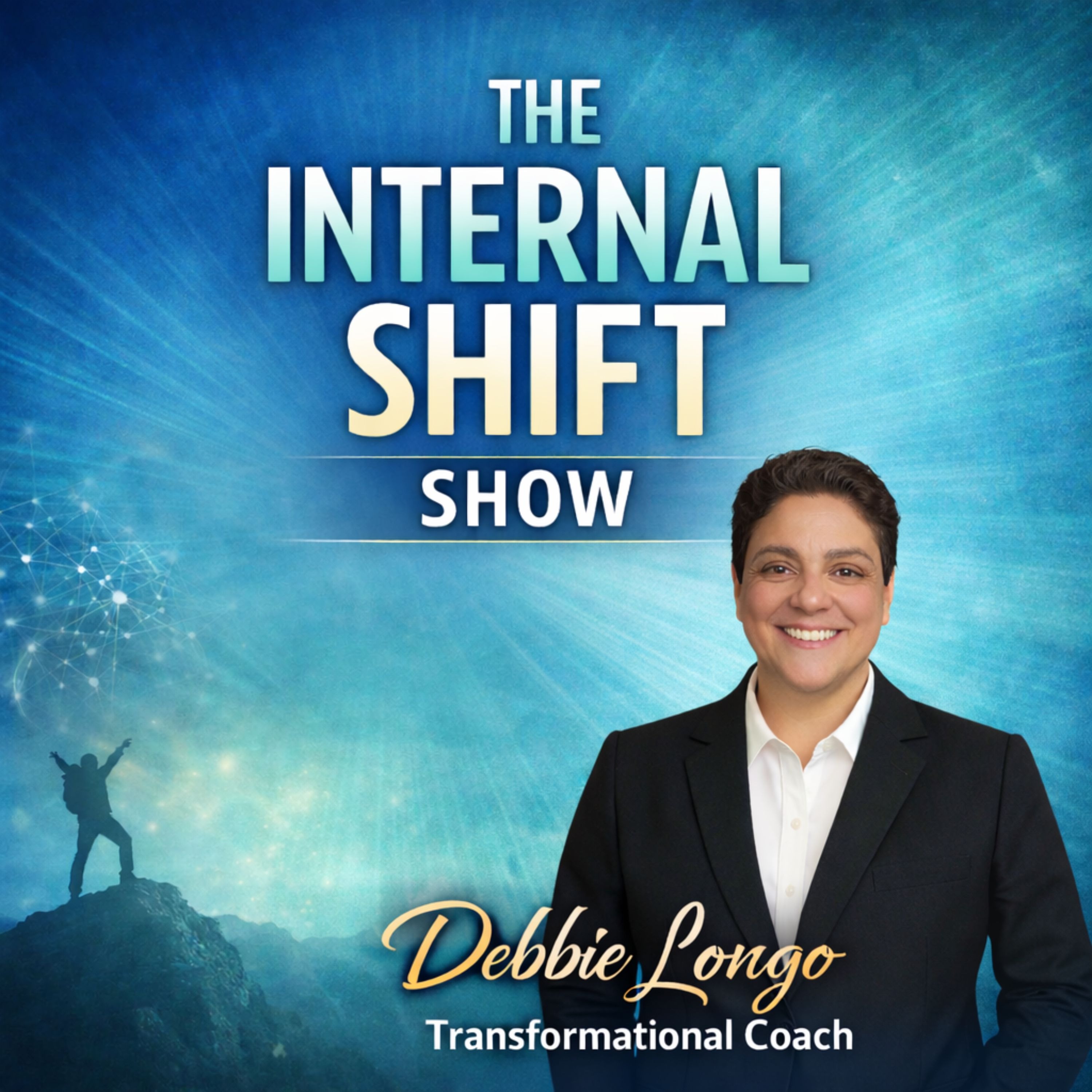
In this episode of The Internal Shift Show, Debbie Longo speaks with Olaolu (Lou) Ogunyemi about how rejection, adversity, and personal challenges can become the foundation for leadership and growth.
Lou shares how early experiences in childhood shaped the way he viewed rejection and personal worth. As one of six children, he learned how perceptions formed early in life can influence confidence, decisions, and direction. Over time, those experiences pushed him to develop resilience, discipline, and a stronger understanding of how internal beliefs affect external outcomes.
During the conversation, Lou explains how setbacks and uncomfortable moments can become turning points when people choose to rethink their perspective and respond differently. Instead of allowing rejection to limit opportunity, he learned to use it as motivation to grow, adapt, and lead.
Debbie and Lou discuss how internal choices, mindset, and self-awareness shape personal and professional success. The episode highlights how people can shift from reacting to circumstances to intentionally directing their path forward.
Listeners will hear a thoughtful discussion about resilience, leadership, personal development, and the quiet internal decisions that ultimately shape long-term outcomes.
Contact Debbie Longo – Transformational Coach
Email: info@lifeinbloomny.net
Website: https://lifeinbloomny.net
LinkedIn: https://www.linkedin.com/in/debbie-longo-life-in-bloom-ny/
Contact Olaolu (Lou) Ogunyemi
Website: https://Parent-Child-Connect.com
LinkedIn: https://www.linkedin.com/in/olaolu-ogunyemi-465ba453
YouTube: https://youtube.com/@olaoluogunyemi?si=zL0_VWAq81g2B5hK
Welcome to the Internal Shift Show. I'm Debbie
Longo, Transformational Coach. This show looks
at how the internal choices we make influence
the direction our lives and work take. Today's
conversation brings real experience into that
space, exploring how internal shifts quietly
change outcomes over time. We have a very special
guest today, Lou Oganami. Good afternoon, Lou.
Welcome to the show. Hey, thanks so much for
having me, Debbie. I'm very excited to be here.
Thank you. Thank you for being here. I would
just like to start with explain to me something
or a few things that happened in your life that
were negative, either a traumatic experience,
maybe at a job or home life or whatever the situation
is where you took that and you turned it into
a positive. So now you are a place and now you're
not there anymore. Now you're at this place.
So the end result should be how you came out
on the other side. And what's in between that,
what you say in between that is your story, is
how you put that all together, compile that all
together. Yeah. So thank you for that question.
One of the biggest things that I recognized is
that I was, I just, I hated rejection and I still
hate rejection to this day, but I've learned
how to deal with it better. And the reason I
say that, I start there, is because I was the
fifth to sixth children. It seemed like to me
growing up as a child, and I know this isn't
true now, but as a child, I had my two older
sisters who were close in age. I had my two brothers
who were close in age. Then there's me, and then
there's the little baby, my baby brother. And
I felt like the baby brother's in his protected
class, but he's like four years younger than
me. And then the other two were grouped up. And
so for me, I felt like I needed to almost like
find myself. and sort of explore ways that I
can grow and develop as an individual myself.
But one of the things I found is when I went
out growing up, number one, because of my name,
Olalu Okunyemi, out there in Ruston, Louisiana,
it wasn't necessarily something to help me fit
in. So the first thing that you have right off
the bat when I'm going to introduce myself, I'm
not even portraying confidence because I don't
really like my name. I don't really want to tell
people my name because I'm embarrassed. So when
I do tell them my name, now they're they're making
fun of me. And it just started this this weird
downward spiral, if you will, because. It was
my name at one point, then it was the gap in
my teeth at another point, and then it was my
weight at another point. It was always something
that was going on that caused me to feel like
I was a reject. started to pick up on and started
to learn is that because I felt rejected, I was
willing to almost do anything to fit in. And
that's where all the mischievous things came
from. That's why I was getting in trouble in
school. And quite honestly, if it weren't for
an assistant principal who decided that she wasn't
going to kick me out for something she could
have kicked me out for, I would have been kicked
out of expel from school. for something I knew
I shouldn't have done. My parents and my family
would never have approved of it, but I was doing
it anyway because I just wanted to fit in. And
I think that was a dangerous spot I was in as
a child, just trying to figure out how to grow
through not fitting in, feeling rejected, feeling
insecure in the person you are, not being able
to project any kind of confidence. And all those
days really resonated with me. And the hardest
part about it is that no matter how much people
were to encourage me at home, Anytime somebody
said it outside the home, especially adults,
would like sort of double down on some of the
things that people were saying. Were they making
fun or not? Or were they just saying something
they didn't think about it? I think when adults
said something that I heard my friends and my
buddies or the people I went to school with,
it really hit me in the heart, man. And that's
when I started trying, I started to believe some
of the things people were saying about me. That's
when they were making fun of me or the things
that they said that Maybe now you're not, you're
mischievous. You're bad. You're not, you're not
the good Ogden Yemen. You know, the rest of them
are going to be successful, but you're not going
to be one of the ones successful. When adult
tells you that is sort of weighed on me. And
quite frankly, I felt like I needed to start
living up to the standard that they were portraying
for me. One thing I will say though, and the
way I was able to sort of work through that,
this is specifically talking about my childhood.
Number one, one thing happened that was fortunate.
One of the guys that I was, best buddies with
that I was showing out to be be friends with,
he ended up dropping out of school in eighth
grade, really eighth going into the ninth grade.
So that's the first thing. And I say that's that's
fortunate. I put that in air quotes because obviously
it's not fortunate, but it happened to now leave
me a void, leave a void in my life. And what
filled that void was sports for me. It was coaches,
it was other teammates and things of that nature
that came in and started surrounding me and helping
me to point in a positive direction. And so I
think that really, when you think about the turnaround
and what happened, how did I take my life from
feeling like a reject and trying to do anything
to fit in to where I am or where I was, at least
through. high school and college. I truly believe
that turnaround point was having that extracurricular
activities and things like adults actually now
speaking positively in my life. Having parents
that, because it's one thing to hear it at home,
it's another thing when you get out of the home
to hear something else. And I think one of the
hardest parts for us, and really it's not just
me, it's my siblings as well, is when we were
growing up, I think the hard one of the hardest
parts when you're thinking about rejection is
to watch my parents separate. And that truly
did that hit that hit a home for me because I
think that when it when it hit that point, that's
about when I felt like, OK, now this is like
the this is the true ultimate test or confirmation
that you know what? My life is just not that
good. It sort of sucks. You know, you watch your
parents that you thought this thing was really
good and you watch them separate. And one of
the things that I had to learn, number one, is
that life happens. And when I started learning
about that and really started to accept the things
that I can't change, it became a little bit more
easy for me to adjust to. And so that's really
what I will say. That's a huge part of my story,
a huge part of who I am today. It's my childhood
and learning how to grow through some of those
adverse situations and learning how to really
grow through my insecurities that were causing
me or I was allowing them to have me do things
to just try to fit in. Yes, very good. So how
was your self -esteem during this whole scenario?
Yeah, my self -esteem was shot. And that's something
I practice today. And sometimes I look myself
in the mirror and I start to tell myself, allow
positive things, because I remember I recall
looking in the mirror and telling myself so many
negative stuff, you know, telling myself, dog,
look at you, who you think you are. And I smile.
Somebody will tell me my smile is beautiful.
You have a bright smile, man. You can light up
a room. And then another person would be like,
hey man, that smile is ugly. And I'll go in the
mirror and I will repeat that over and over.
So really my self -esteem was extremely low.
And I just didn't, I wasn't confident. I mean,
you can look at pictures starting off as, I used
to wear a cowboy hat when I was little, about
five or six, they used to be my thing, hat and
boots. I don't know, I was in that phase. But
if you were to look at the pictures as you transition
through the years, you'll see like this huge
smile where people are like, man, this guy smiles
big. And then you start going to those middle
school, junior high, maybe even early high school
years. And that smile is gone. That smile is
almost faded with just like this blank stare.
And in some cases, almost like it looked like
a mugshot, to be honest with you. And so, yeah,
that self -esteem was just it wasn't there. And
I just had to learn. So one of the things thank
you for that that was very very good. So one
of the things that I Teach is to look internally
within yourself Because I need to see not only
the things that are wrong right or I need to
see what I need to improve because if I'm not
feeling good or I'm negative or things are not
going the way that I want in my life because
I have a tendency to look outside of myself,
my environment. Am I happy at work? Am I happy
in my marriage or with my spouse? And so I have
the habit, I guess, of looking at that. And when
I see these things that I don't like in any way,
you gave a few examples of that. I want to be
able to create some type of willingness or just
a desire to look at myself? Is there something
that I could change? Is there something that
I could do in order to make my life and my surroundings
or whatever the situation is a little bit better
than what it is? So am I very negative? And one
of the things that is very, very big that a lot
of people don't even realize that they're in
is low self -esteem. Now, I'm going to tell you
a little secret. We have something called the
ego self -esteem ladder. So when my self -esteem
is low, my ego is high. I always want people
to say good things about me. I'm looking for
that that feedback where I constantly because
I want. to have somebody say something to me
or do something with me that's going to make
me feel good because I can't do it on my own.
And that's a big ego. But here's the thing. When
my self -esteem is high, then my ego is low.
And that's the whole thing. And guess what happens
then? I become more of a giving person. Because
when I have a high ego, I'm very, very selfish
and self -centered. 100%. Because I want people
to be nice to me. To say things that are nice
to me, right? In order to make me feel better.
So it's all about me, me, me. But if I have a
high self -esteem, I don't need anybody to say
anything to me. It doesn't matter if people like
me or not. I don't really care. I'll tell you
the truth. I just dismiss it. It doesn't matter.
That's another thing, too. I want to be liked.
I want to be liked. And like I said, when I have
a high self -esteem, it doesn't matter whether...
I just use this as one example. I mean, there
are tons of examples of this. No, it doesn't
matter. And then my ego is low. So now not only
do I need the recognition, recognition is one
word, but there's another word I'm thinking of.
I can't get it into my head, but not only do
I not need the recognition, right? Then everything
around me is fine. So welcome to the world of
perception. My perception now is completely different.
There's nothing wrong because my self -esteem
is high and my ego is low. There's nothing wrong
with anything. Because whatever is wrong or if
I feel upset or whatever negative feeling I have
it does not matter It does not matter and this
is a big big thing that a lot of people don't
know about They're not familiar with they don't
know what how to do it or they just don't understand
it. That's it What did you do? How did you know
to do this like you're talking about your positive
now? and the things that you did to become this
way. How did you know to do this? Did you have
any type of help, professional help, or you just
knew it yourself or self -help or books or something
like that? How did you just become this way?
Yeah, so definitely professional help. That was
not something that I was able to come to on my
own because one of the things that you talked
about, was important to me, and that was learning
how to control the things that I can't control,
looking internal and saying, man, I can make
some adjustments. And I'll give an example. Between
seventh grade and eighth grade year, I started
waking up at five in the morning. That's how
long I've been doing it. Because I said, OK,
I can control the perception, or I can at least
control my physical fitness. I control being
ready for a basketball season when it comes around,
a track season when it comes around. One of the
things that I will say that that did to me, though,
is it gave me this almost overconfidence. And
I think that goes exactly to what you're saying.
It gave me an overconfidence. And that is when
my self -esteem truly became low. Because now
that I've done this thing, I have now started
to say that, OK, well, now people are starting
to compliment me. And everybody's starting to
say, oh, look at you. You look great. You look
in shape and all this. And now I'm eating this
up. I'm eating this up. And now in my mind, I'm
now associating this thing I can do, this great
idea, this great exercise or whatever it is,
I can implement this. And because I can implement
this, I control all these things around me. And
in a way, I can almost control the people around
me in a way that I couldn't in the past. And
what that gave, as I said, it gave me a little
bit of overconfidence. And the problem with that
is now I have this perception that I can almost
control everything. And that was something that
I think it didn't come to a screeching halt until
my adult years. And that again, this goes back
to your question. How did I figure this out?
Well, I had external help and I had life circumstances
that taught me that there are certain things
that you can't control. For example, my son was
diagnosed with complex partial epilepsy. And
the way that we found out about this was quite
literally, I came home from work early one day
and I got a call that they couldn't wake my son
up. And at this point he's three years old, he's
at daycare. And luckily I was right down the
street. So I rushed down the street and he's
having, it wasn't even like a seizure I've ever
seen before. It was one that was just, it was
abnormal. And I'm sitting there like now trying
to get everybody. I'm telling the teachers, I
need you to do this, call the ambulance. And
I'm like working all these things out. And I
remember getting home and I think at that time
we had just had, we'd already suffered a miscarriage.
My AC had broken down. There's just a lot of
things going on. And I think at that moment I
had like this deep sob, this deep well. And in
some cases, I believe it was because I finally
was realizing that, dude, all these years you've
been fooling yourself to think that you actually
had control of these things. That there's nothing
I could have done to control my son from having
seizures. You could see it coming. That was a
hard part. You literally could see it coming.
You could feel it. You know it's coming. It's
something we never could place our hand on it.
what it was but we could see it coming but all
of a sudden it's like there's nothing I can do
to stop it I can tell they go lie down and relax
or hey man let's get the medicine ready and all
these other things, but it never did anything.
And I think once I realized that I had to let
go of control of some things, I think that's
when my self -esteem truly began to increase,
as you described. Instead of me looking and saying,
hey, my ego's so big, I'm overconfident, I have
all the control of the things going around me,
I began to understand that life circumstances
have now taught me that there's things that you
can't control. And once you learn to say, okay,
let those things go, that now you truly don't
have to worry about that external influence and
that external validation that people are giving
you. But to your point, it did start with people
coming and talking to me. It started with me
going to professional counseling. at through
my church actually we had counseling at there
and talk sitting down talking to people about
things going on it came with even my my brother
he's the one who called me and talked to me and
asked me a simple question which was hey man
how are you doing after all these things are
happening in my adult life yeah how are you doing
and i was like oh yeah i'm doing this i'm taking
care of the family i'm doing blah blah blah blah
i'm good man i'm taking care of it he's like
now now you're not going to convince me that
you just went through this traumatic event with
your son you just went through this miscarriage
with your child and now you're going to tell
me that you're good that don't even try man like
you're you're now you're trying to project this
this confidence and you and you wanted me to
come back to you and say man you you're powerful
man you're strong i know you're going to do it
but instead he came to me and said man there's
nothing wrong with crying dude there's nothing
wrong with letting it go because good and well
that you're not you're not good and if you continue
you put on this persona I think that you end
up breaking before you're able to completely
heal. And that was one of the things that truly
helped me over time as a child to understand
that these are things that you have to grow through
and these are things that you will learn now
as an adult that you can't control everything.
And I think that's really what happened is both
counseling and life circumstances that sort of
guided me in this direction. Yeah, so that was
good. So like I said, a lot of times people don't
know. People think that ego is good. They don't
know the difference. And they and now also another
thing when you were talking, I was thinking of
was that sometimes people that have low self
-esteem, sometimes when people say good things
to them, it makes them feel good. And that's
a good thing because they don't have the ability
to do it themselves. They don't want to or don't
have the willingness to look at themselves to
raise their self -esteem. But that's only going
to be temporary. That will not be a permanent
fix. So I'm looking for something permanent.
But another thing too is in your life and in
my life too, the cards are aligned where things
happened at a certain time. You were low point
in your life. You weren't feeling good. And that
is when you realize you created the willingness
and you were able to pick yourself up and reach
out for help and. different things, professional
help and different things and whatever else you
did, you could say it doesn't matter. But the
point is that you did things to help yourself.
You searched inside of yourself and you knew
that something was wrong and you knew that you
could do it. You could come out the other side
and not only did you think you actually took
the action, you took the action and you said,
I'm going to do this. This is going to happen.
It's going to be a good thing. And this is one
of the reasons why I have this show. This is
a big reason because I want people to see that
there is the light at the end of the tunnel,
that they could come out the other side, that
everything is not going to be doom and gloom
for the rest of their life. And if they think
that and they want that and they want to sit
in negativity for their whole entire life and
be horrible and sick and suffering, then that's
perfectly fine with me. I'm not looking for people
that I can't help. I'm looking for people who
want help. And this is just, I'm just saying
one example. There are tons of examples of this.
I'm just using this one example and elaborating
on that. So if I want the help, I'm gonna have
the willingness to get it right. And then I'm
gonna seek it out. That's the thing. So, I mean,
this is very, very good. Yeah, this is very good.
So how do you feel today? based on everything
that's happened, everything that you've told
me and the positive, how you came out the other
side. How do you feel this exact day to day as
a result of all of that? Yeah, I feel much more
prepared to deal with negative circumstances.
One of those negative circumstances are things
that I can't control, like things that happen
with my family or something like rejection. I
feel much more prepared to deal with it. And
one example is I actually got my first one -star
review at a children's book that I have. And
man, at first I was like, wow, and it almost
struck me here. But because I've dealt with that
sting of rejection, because I've learned that
I can't control other people, I started to think,
you know what? That's just one opinion. And the
only reason I was able to get there is by practice.
Going over and over rehearsing these things in
my mind rehearsing these scenarios and that was
one thing that I will say that that so right
now I think I believe that I can deal with adverse
situations a lot more Easier easily and at least
without doing without breaking down without saying
are taking a negative output life without going
and as you're talking about sulking and saying
well life is just hard and it's never going to
improve and If my parents did this and I'm doomed
to this, I don't ascribe to that because I truly
believe that I have the ability to control my
perception of what's happening, because that's
the only thing I truly can't control. I can't
control all circumstances, but I definitely can
control my perception and my reaction to what's
happening around me. And I think in that case,
it made me a lot more resilient and a lot better,
a lot more able to deal with these situations.
And quite frankly, I look forward to adverse
situations, because it gives me an opportunity
to practice. And more importantly, it gives me
an opportunity to look back at the old me and
say, man, look how far you've grown. And in some
of these circumstances, and some of these ways
that you would have reacted 10 years ago, or
even a year ago, this is how you would have reacted.
Now look where you're acting and you can see
the growth that it truly does. And as you're
talking about you learn to now encourage yourself
and not rely on somebody else to look at you
and say, man, you've grown. Now you're looking
at yourself and saying, man, I've grown in such
a way that I'm truly proud of myself. And that's,
I truly believe that's where I am right now.
It's just, it's not pride in an arrogant or boastful
way, but it's proud to say that I've now seen
the growth in myself and I'm excited about that
growth and I'm excited to share. and hopefully
help somebody else who knows who's in the same
predicament or have been through circumstances
to know that you're going to look back at your
old self and say, man, I'm happy that I grew
up. I'm proud of where I am. And I knew I could
deal with life's. uncertain circumstances. Very,
very good. Thank you very much. I appreciate
that. As we wrap up, this conversation highlights
how small internal shifts can create meaningful
change. If something from today stayed with you,
take a moment to reflect on how it connects to
your own direction and decisions. This has been
the Internal Shift Show. Thank you for listening.
Thank you, Lou, for being on the show. Thank
you so much for having me. It was a pleasure.