

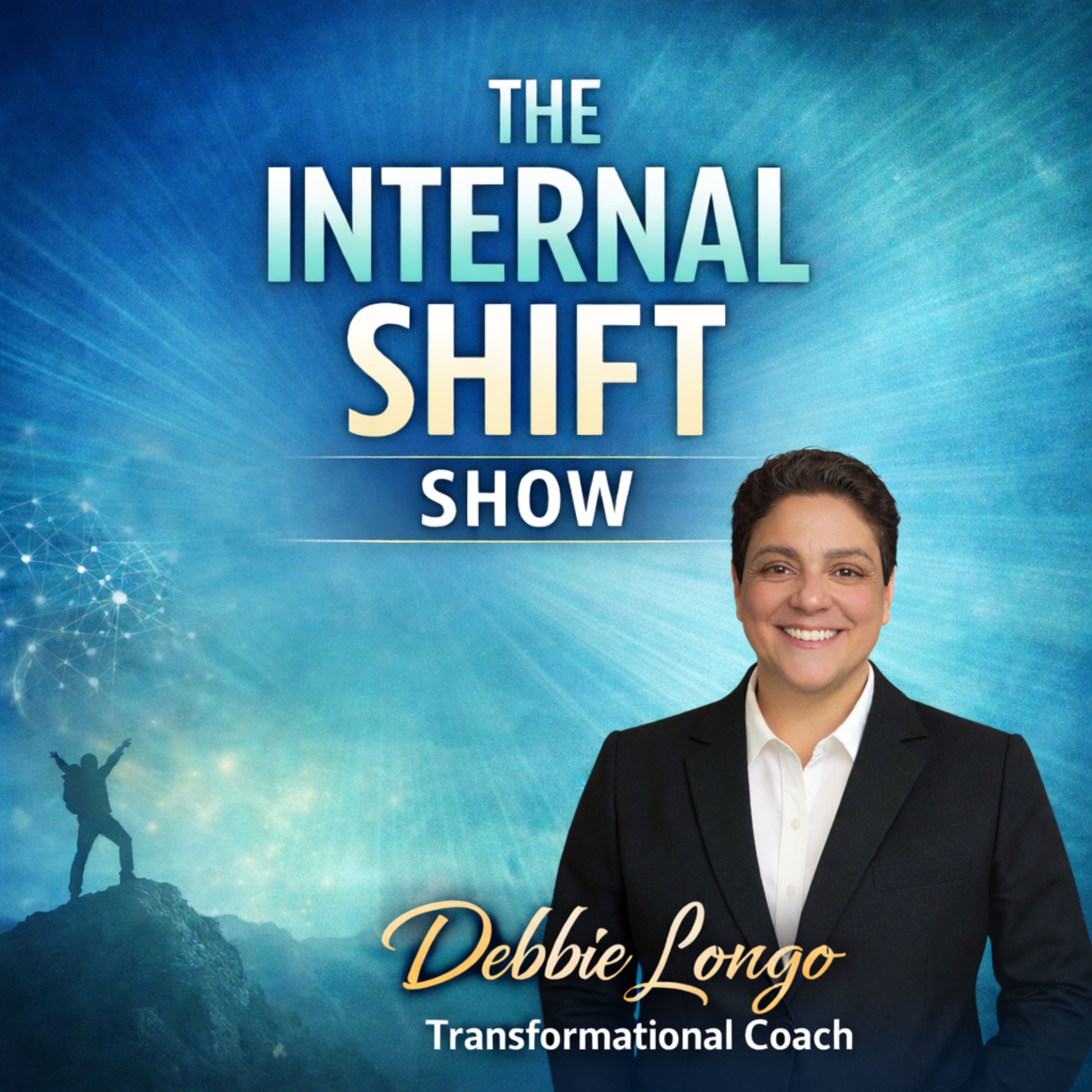
In this episode of The Internal Shift Show, Debbie Longo, Transformational Coach speaks with Rebecca Mullen about a moment that seemed small on the surface but carried deeper meaning that was quietly shaping her relationship and decisions.
What started as frustration over something as simple as an unmade bed revealed deeper assumptions, fears, and patterns rooted in past experiences. Rebecca shares how she moved from frustration and miscommunication to clarity by challenging her own thinking and changing how she communicated.
The turning point came when she stopped expecting others to think and respond the same way she did and instead focused on taking responsibility for her own thoughts, feelings, and communication. By shifting from indirect, emotionally charged requests to clear, honest, and direct communication, she changed the dynamic of her relationship completely.
This conversation breaks down how small internal shifts, questioning assumptions, and taking personal responsibility can create meaningful change in relationships and everyday life. It reinforces that the situation itself is not the problem—it is the interpretation and response that determines the outcome.
Contact Debbie Longo, Transformational Coach:
https://www.linkedin.com/in/debbie-longo-life-in-bloom-ny/
Contact Rebecca Mullen:
Welcome to the Internal Shift Show. I'm Debbie
Longo. This show focuses on how internal decisions
shape direction, progress, and long -term outcomes.
Today's conversation uses real -world expertise
to examine how subtle internal shifts can influence
the way people move forward. I'm joined today
by a very special guest, Rebecca Mullen. Good
afternoon, Rebecca. Welcome to the show. Hi,
Debbie. Thank you so much for having me. You're
welcome. Thank you for being here. I'm going
to ask you to tell your story today and point
out a life change that happened to you or traumatic
experience or something like that. And what was
your process and the end result? And the end
result should always be positive. So basically
we're just going from a negative to a positive.
And I do the show for a few different reasons.
And one reason is because people, maybe somebody
is stuck in a negative situation. in something
that they don't want to be in, or just even negative
thinking or something. And they might not know
how to get out of that, or they might stay in
it and they might think that it's normal, or
they might just not know. that it's not normal.
If they think that it's okay, right, there's
always a way out. I don't believe that there's
any negative situation at all because anything
can be turned into a positive. So if I don't
think that it's a problem or a negative situation
or whatever, then it will not be. And this is
really what we're trying to do here because everybody
has their own individual story. But there are
parts to people's stories that other people can
relate to. And this is what we're trying to accomplish
here. So if you could do that for me, I would
appreciate it. Thank you. Absolutely. And thanks
for the invitation, because it's such a great
premise to have us all share stories about a
really negative thing in our life that we were
able to turn around, because our humanity, we
all have things in common. So what makes me laugh,
Debbie, is you're asking for this big, traumatic
thing that made my life so difficult. And you're
going to laugh when I tell you it is that I couldn't
get my husband to make the bed. But I actually
have talked to a lot of people that struggle
similarly, and they're like, oh, I can relate.
I can relate. But here's the thing. If you, if
you understand where I was coming from, I was
this little five year old girl whose parents
divorced and it was a messy divorce and my parents
didn't talk. And, and I grew up thinking surely
one day I will be getting divorced. And somehow
unconsciously I had pinned this bed making to
the that's the signal. See, I told you someday
we're gonna get divorced. Here it is, front and
center in my bedroom. I can't get my husband
to make the bed. And it wasn't for lack of trying.
I felt like I asked him over and over and over.
Now, here's the thing though, Debbie, is I wasn't
asking clean. I was asking dirty. But I didn't
know that at the time. That's the transformation
I'm forecasting. So while I'm in it, I feel like
I'm begging, honestly begging with the earnestness
of please help me save our marriage. I'm begging
my husband to make the bed and he doesn't. And
I come and I get up early and he gets up later
and I would walk into our bedroom and there was
this rumpled pile of sheets and blankets and
I would just die a little bit inside. think it's
so goofy that I attached so much meaning to this
rumpled pile of sheets and blankets. But there
it was. And there were, if you want to hear more
about why I was lonely, the desperation that
I felt, I can go into that. But if I've set it
up well enough, I'd love to tell you how I got
myself out of that. Honestly, I'm embarrassed
to tell you that It was probably 17 years because
when we got married, I'm very crafty and I made
all these gorgeous linen pillowcases. Decorate.
This was when Laura Ashley was big and like three
deep stacks of pillows on the bed to make it
just this princess bed. That's what my bed looked
like. And so to come in and it was just this
rumpled pile. I felt like we could be living
like prince and princess. And yet you're just
leaving all these pillows scattered on the floor.
But one day I came across the work of Byron Katie.
Byron Katie asks the question, is it true? And
the thought that I found that was floating around
inside my head was my husband should want to
make the bed. That really is what He should want
to make the bed to prove he cares about our marriage.
He should want to make the bed to make me happy.
He should want to make the bed because he wants
the Prince bed too. He should want to make the
bed because our romantic life is the core of
our marriage. I had all these thoughts, but I
got that beautiful question from Byron Katie,
is it true? And the instant, Debbie, the instant
I asked that question, I laughed because I was
like, no. David shouldn't want to make the bed.
David doesn't care about a made bed. And that
was where my freedom began. I had to do some
work beyond that, but that was the transformational
moment for me when I began to think about it
differently, that it wasn't, he should want what
I want because Dave Davis, like Mr. gear guy
and outside man. And he doesn't, he just, thought
those pillows were a hassle. So then I began
to notice how I talked to him about the bed.
And I like to think of it that I was asking dirty.
So when I, all those years, when I thought I
was begging him, Debbie, this is what it sounded
like. David, you never make the bed. Well, that's
not the same as saying it's really important
to me. Could you make the bed? I mean, you can
tell that's a really different kind of That's
not a request. That's really me shaming my husband.
I would say things like, I would go into the
room and try to demonstrate in front of him how,
you know, isn't this great how I'm making the
bed, but he would just watch me. So all these
hints that I thought I was leaving, he was completely
oblivious until one day I realized, OK, I'm just
going to ask super clean. And for me, this is
the transformation that carried into my life.
For me, a clean ask is that I'm going to state
my feelings. How do I feel when I see this unmade
bed? Then I'm going to make it clear what I want.
I want us to care about our bed because we care
about our marriage. And then the third element
of a clean ask is to give the agency to my husband.
Somehow. I want to ask the question so there's
a yes or no implied. So it could be, would you
be willing to make the bed, Dave? Or what would
it take, blankets and sheets wise, that you would
be interested in making this bed? So my three
steps became, first, I'm talking about my feelings.
Dave, I don't know why this is, but for some
reason, I have attached the success of our marriage
to this unmade bed. And because my parents divorced,
I feel scared that if we don't have a maid bed,
if we can't agree on this, then our marriage
is doomed. And the look on my husband's face,
Debbie, it told the whole story. He was like,
what? This was such a newsflash to him. And then
secondly, I asked, you know, I said clearly what
I would want. I said, it would mean a lot to
me if I always saw our bed made. And if you tended
it, then I would feel like you were tending our
marriage. And then step three, I asked in a way
that he could say yes or no. That was the scary
part because he might say no. So I said, what
would it take blankets and sheets wise for you
to deal with this bed? Would you be willing to
do that? And Debbie, not a day since that day
has he missed making the bed. Isn't that crazy?
Oh my gosh. So. For me, that little encapsulation
of how scared I was at something happening, the
assumptions I made that Dave knew how I was feeling
inside, and really importantly, asking cleanly
with agency so that my husband could be invited
to say yes or no, that changed the trajectory
of our marriage. And just with that made bed,
unmade bed, I have changed the way I ask about
everything. If I'm asking if he wants to join
us, you know, for dinner with some friends, I'll
say I would really love to do this. I also know
that you get really tired after work. Would you
be willing to meet at a restaurant? So trying
to bring that three step clarity all the way
into our relationship, our communication has
cleaned up enormously. And I don't even think
my husband has changed the way he asks. Well,
he has now because he's heard me do this over
and over. Yeah, that's my story. Very interesting.
I like it. It was explained very well and I thank
you for that. What was the process where you
got upset because he wasn't making the bed and
repeatedly you asked him different things? And
then you thought or you knew that something should
really be done about this because the reason
why I'm asking this is because it seemed like
you kind of thought that that was one of the
reasons why you could have potentially got a
divorce because you thought about that when you
were younger or whatever, you know, that because
your parents got a divorce, you were gonna get
one. that you were thinking because sometimes
I have that, and this is kind of normal because
we kind of program ourselves without us even
realizing it. That's just really the way the
brain works, but that's another conversation
for another day. So you kind of thought that,
but you were able to overcome that. So what did
that process look exactly like? And then when
you got to those three points that you've been
talking about. So, how did you feel? Did you
have extra help? Did somebody tell you something?
What was that process exactly? How did it go?
Well, I think you really nailed it on the head
when you said, I was making assumptions. I was
telling myself stories in my head that weren't
based in reality. They were just in my head.
And so it took me time to disentangle the assumptions
from because... Debbie, it actually felt honestly
linked that if we didn't have a maid bed, if
my husband wasn't the one to tend it, that meant
that equaled he doesn't care about our marriage.
And that really was the thought I had to find
and question it. And it was that that beautiful
phrase from Byron Katie. Is that true? Just that
I got to tell you, I think. That's why it took
me so many years to unravel it because I had
to get practiced asking, is it true with lesser
things in my life? This one, the roots were deep,
like a failed marriage was the most hurtful thing
I could imagine. And so I had to practice with
asking myself, is it true with other things in
my life? Like he expects me to have dinner ready
and waiting like that was so not true, but I
bought into that cultural message stuff like
that. Does that make any sense? Yeah, it definitely
does. And I thank you for explaining it that
way. So did you really think that the problem
with your marriage was really going to continue
if you didn't change and you didn't get him to
understand that he needs to make the bed because
You said that when you use those three points
and different things that changed the whole entire
relationship with everything he thought and then
you did and everything because once you do that
and those three points are just an example of
many different ways to do it. But once you did
that, you changed your mindset, which now changed
his mindset instead of changing his mindset first.
Absolutely. And then you change your mindset,
which that's not how it works. And this is one
thing that I teach. Because what goes around
comes around. So I have to change my thinking.
Yes. And my process and my outcome in order to
change people around me. Because I'm not really
changing anybody because I'm really not controlling
it, but I'm just doing it so I can make my life
easier. Right now. Also, another thing, too,
is that when you were talking, I was thinking
about that. People have many different paths
that they could go on. So some people believe
you live and then you go through your life and
then there's one path and then you die and you
either go on it or not. I don't believe that.
I believe that there's many different paths that
we could choose. So, like, you did this, and
that was great when you fixed your relationship,
but you could have gotten a divorce. You could
have not fixed it. You could have not listened
to whatever it was, the help and stuff that you
got from this gentleman that you were speaking
about, the speaker, and then you got the three
points and all these different things. That didn't
have to happen. And you could have gotten a divorce.
So there are other points because then whatever
else that it was you were thinking I don't know
what you were thinking But the point is that
there's still there's always different paths
that you could have went on But you didn't do
that and this is the message. This is the whole
point right to this podcast This is what we talk
about here, right? Is how this negative situation
happened. It doesn't matter what it is. It doesn't
have to be like this big thing. I just say it's
a thing, whatever it is. I don't know what it
is because he couldn't make the bed. That was
a big thing for you because that changed your
marriage and your thinking or whatever. And that
is just it could people think it's a little thing.
It's not little or big. It's the way that you
went through this thing. So people have many
different paths. But the point is that whatever
path I choose is going to determine what the
outcome is to be. And that's the path that I
choose. That's not the path that anybody else
chooses, because I'm a human being and I have
the ability to make decisions for myself. And
that's really the bottom line. So what I choose
is what you know what I mean? That's why we don't
want to continue the negative. We always want
to go into the positive. I think your. claiming
that personal agency of what am I going to choose?
That is at the heart of this transformation for
me because I just kept asking myself, and I'm
going to own the fact that early on I was maybe
a little codependent in the, well, what else
can I do? What else can I do? What else can I
do? However, I was asking the question earnestly
and along the way I sort of tripped. into this
realization that when I asked what else can I
do, what I'm really doing is saying the only
person whose behavior I can change is my own.
So what can I do in this situation to change?
And then I got introduced to Seth Godin introduced
me to to the idea of the inner lizard. And he
has this blog. He's been doing it for decades.
And this was a long time ago. He called that
inner fear our inner lizard. And I grabbed onto
that and I sort of began to connect the dots.
We have all these seeds that are planted in our
life. And for me, thinking about I have this
inner lizard, which is triggering my amygdala
to have this fight or flight response. And I
began to get curious about why does the unmade
bed make me so upset? Being able to ask that
helped me unravel it. You know, and then I could
say then, like you said, claiming that agency
piece of, well, what can I do in this moment?
I can look at it from David's point of view.
When I looked at it from David's point of view,
it wasn't personal. It was just his taste. And
it eased everything inside of me. But then, and
this is what happens with our fears, those inner
lizard fears. that make us feel unsafe. I somehow
had told myself I will be unsafe if our marriage
fails. If we get a divorce, that's it for me.
And so I was so trepidatious because of that
high stakes. And as soon as I looked at it from
Dave's point of view, it was no longer high stakes.
It was just He has a preference for not dealing
with blankets and sheets. And I have a preference
for this gorgeous bed. And it wasn't personal
anymore. So that helped enormously. So that was
good. Thank you very much. I appreciate that.
So I feel that you are kind of going into your
feelings a little bit, not only about what happened
in the process, but how you felt when all of
these things were happening. at all the different
points of your process and everything that we're
talking about. And that is something to me that
the listener should really pay attention to.
You know why? Because when somebody's in a negative
situation, it doesn't matter what it is, to them,
it's a big thing. You know what I mean? To them,
it's something where they wanna change their
life. They don't have to think about anything.
They don't, because a lot of people like when
I've been doing this a long time and when I work
with people, that's the first thing they say
is, am I gonna feel upset? Am I gonna lash out
on somebody? Am I gonna start screaming and yelling?
We don't know. They automatically go to the most
negative thing. that could happen as they process.
And then what do they do? Then they talk themselves
out of it. And then they say, screw it. I don't
want to be in that situation. And then I'm just
going to stay where I am now because it's comfortable.
You know, that's the whole thing. So this is
why what a feeling is not only like sometimes
you have to work a little hard in order to get
to a place that you really in order to get really
good results. So like if I go to the gym and
I work hard, I'm going to lose weight and I'm
going to build muscle. But if I go to the gym
and I look at the weights and I don't do any
work and I walk out, what's going to happen?
Am I going to lose weight? Am I going to build
muscle? No. So this is the thing. And that's
painful. Building muscle and going to the gym
and all this stuff. It's not it's a daunting
task. It's not something that easy. It's easy.
But the rewards I get from that. is a lot, you
know, so this is why the way that you explained
is very good. So how do you feel now? How do
you you can say something? How do you feel today
as a result of everything we just talked about
in this podcast and say whatever you want to
say also? So before we talk about how I feel
today, I want to piggyback on your idea of it's
daunting at the gym because. I think as I'm talking
with you today, I'm recognizing that there was
a moment right before I made that very vulnerable,
clean ask to my husband. I sort of had to face
this moment of what's the worst thing if David
never wants to make the bed and that Debbie just
finding that question to ask was so hard because
I was so certain for so many years. Well, it
means the end of our marriage. But I really said,
come on, Rebecca, if Dave never makes the bed,
what will happen? What's the worst thing that
could happen? And I kind of realized, well, I
guess we would not have a made bed and something
quieted inside of me. And I think that's the
daunting thing of going to the gym and you see
all those weights. What's the worst thing if
I just walk out of here? Well, I'm not going
to lose weight. I'm not going to get strong.
But if I do stay, if I do lean in and I pick
up the weights, I'll get a little stronger, even
if I only do it for 10 minutes. And so for me,
it was being willing to ask, what's the worst
case scenario? And then remind me, you said,
how do I feel today? Was that the question? So
based on everything that we talked about in this
podcast, the end result, how do you feel? Like
I said, that being able to ask cleanly became
a template. in our marriage. And Dave's been
making the bed for years and years and years.
But that ability to identify the three parts
of a difficult question. How do I feel? What
is it I really want? And then how do I give the
agency to my sweetheart? That has slowed me down
because there are so many times that assumptions
fill my head and I want to speak loudly and quickly
and you know, but if I slow myself down and say,
what am I afraid of or what feeling am I having
that might, I might be feeling anxious. I might
be feeling lonely. I might be feeling sad. If
I get in touch with that feeling, then I've stopped
that what Seth Godin calls the inner lizard.
I've stopped that automatic response of fight,
flight, freeze. And then I can thaw and be just,
I can show up really authentically, slowly, full
of curiosity instead of assumption, and just
say, this is what I want. Do you want to do it
with me? Or this is what I want. What do you
want? And not feel threatened if Dave doesn't
want the same thing I want. I just want him to
be able to welcome my authentic feelings, desires.
I mean, he doesn't have to agree. I want to feel
seen, and then I want him to make choices. Yes,
and that was very, very, very good. And that
was a very good way to close. And also, I would
like to say in closing that anybody could get
through anything. There is no such thing as a
negative situation, and everybody can meet their
goals and dreams. It's just a matter of, am I
willing? Can I create the willingness? And then
just take a mini step. a baby step and see what
the results of that baby step is gonna be. Whether
you get a coach, I'm a coach, but I'm not promoting
myself, or a therapist, or read a book, or all
the things that we talked about today. And if
you take that baby step and then you say, well,
wow, this is really, really good, then take another
one. Don't go backwards, back to where you are.
And that's how you take a negative situation
and you turn it into a positive. It doesn't matter
what it is, because to the individual, that's
happening. To somebody else, it could be something
else. But we're talking about the individual
changing, the listener. Love it. Yeah, so thank
you very much. So what stands out from this conversation
is the meaningful change that built through consistent
internal decisions and traumatic moments. If
something resonated with you, consider where
those internal decisions are already shaping
your path. This has been the Internal Shift Show.
Thank you for listening and thank you, Rebecca,
for being on the show. I really appreciate it.
Thank you for having me, Debbie. It's been wonderful
talking with you. Thank you.