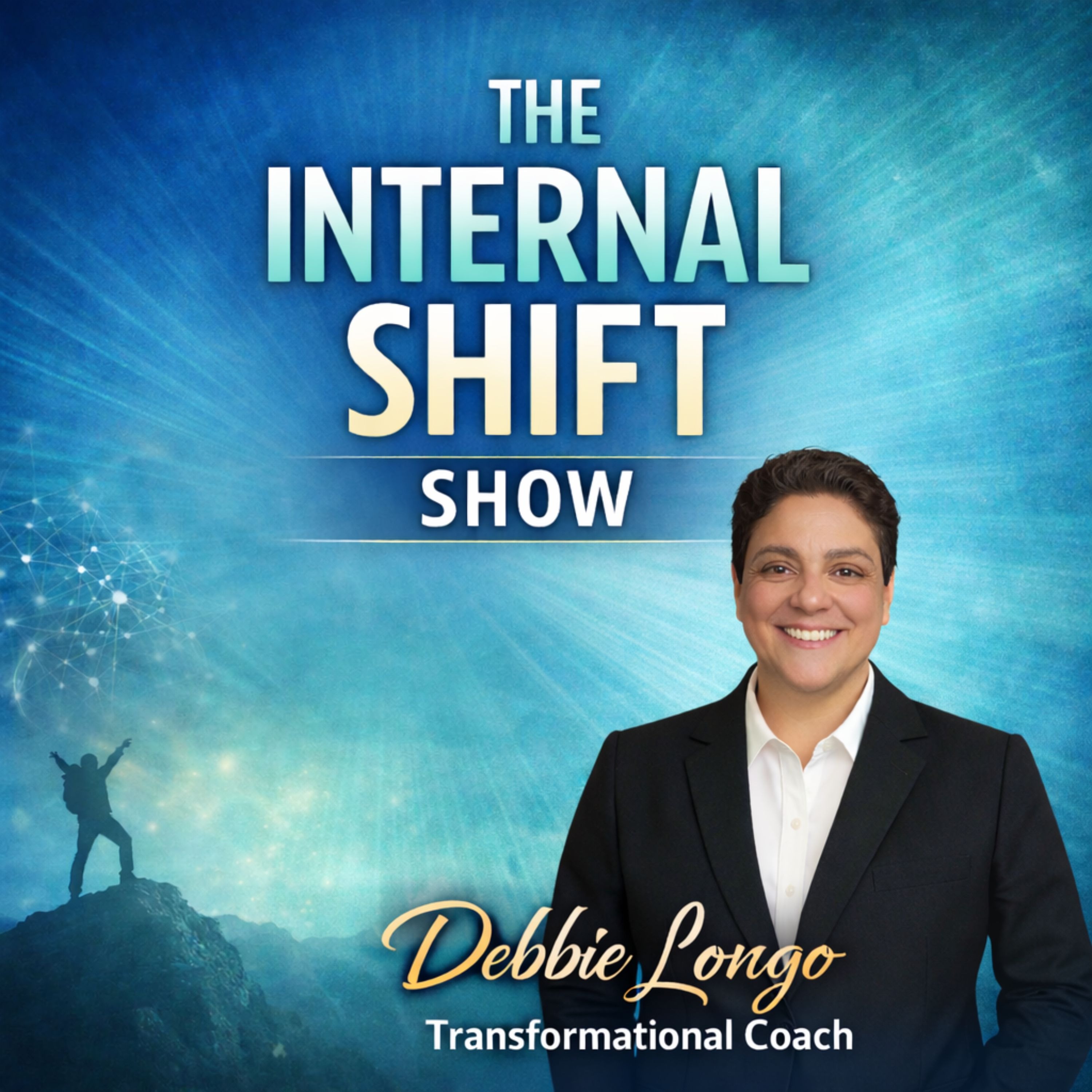
In this episode of The Internal Shift Show, Debbie Longo speaks with Zulma Williams, also known as The Swearing Therapist, about overcoming breast cancer, changing careers later in life, and refusing to let setbacks define her future.
Born and raised in Buenos Aires, Argentina, Zulma moved to the United States at age 31 and spent years working in accounting before realizing she wanted a completely different life. At 42 years old, she decided to return to school pursue her passion for helping others through therapy.
Just six weeks after graduating with her bachelor’s degree and preparing to begin her master’s program, Zulma was diagnosed with breast cancer. Instead of remaining in a victim mindset and asking “Why me?”, she made a powerful internal shift and began asking “Why not me?” That mindset change transformed the way she approached both her treatment and her future.
Throughout the conversation, Zulma explains how discipline, support systems, self-advocacy, and action helped her move through one of the most difficult periods of her life. She discusses the importance of taking one step at a time, continuing to move forward even without having all the answers.
Zulma also shares how she advocated for herself medically by questioning treatment options, researching alternatives, becoming an active participant in her healthcare decisions. She emphasizes the importance of combining professional guidance with personal responsibility and reminds listeners that asking questions and speaking up for yourself matters.
Now cancer-free for 14 years, Zulma uses her experience to help others recognize their own resilience and ability to overcome challenges. She believes growth begins when individuals decide to take action.
This episode explores resilience, mindset shifts, self-advocacy, emotional healing, discipline, personal growth, trauma recovery, and the importance of taking small consistent steps forward.
Contact Debbie Longo, Transformational Coach:
Website: https://lifeinbloomny.net
Email: debbie@lifeinbloomny.net
LinkedIn: https://www.linkedin.com/in/debbie-longo-life-in-bloom-ny/
Zulma B. Williams: The Swearing Therapist LCSW, ACSW, CTMH
Certified Master ART® Practitioner Motivational Speaker, Podcaster
Serving AZ, CO, NV, TX & UT
Improving tomorrow by changing today
Website: www.dragonflytherapyservices.net Phone: 702-903-4944
Host of Keeping It Real with Zulma The Swearing Therapist Podcast
https://open.spotify.com/show/62zkFh5mzb5mkScrew0HCX?si=521679a994ad492e
https://www.dragonflytherapyservices.net
https://www.instagram.com/theswearingtherapist/
https://www.facebook.com/DragonflyTSLV/
Welcome to the Internal Shift Show. I'm Debbie
Langeau, a transformational coach. This show
explores how the way we think, decide, and respond
internally influences where we end up over time.
Today's conversation draws on real experience
and expertise to look at how small internal shifts
can change direction, momentum, and outcomes.
We have a very special guest today, Zuma Williams.
Good afternoon, Zuma. Welcome to the show. Thank
you so much for having me. How are you? Good,
I'm good. Thank you for being here. I am going
to ask you to tell your story today and point
out a situation or a life change or a traumatic
experience or something where you were in a negative
and you went through a process and then you came
out on the positive. So the end result should
always be positive. So I do this show for a few
different reasons. And one of the main reasons
is that everybody has their own individual story.
But there are things in other people's stories
that they can relate to. And sometimes people
are stuck. or they stay stuck or they're uneducated
or they don't know that there's a light at the
end of the tunnel. So they don't see that this
negative situation or whatever it is that they're
in the negative with can turn into a positive
and they could get through it. And there's a
lot of different reasons why they stay this way
and why they think this way. So this podcast
is really just an education also to try to motivate
somebody so the person can see that they don't
have to be where they are now. They can make
a decision right now, right this second. Forget
about the past. The past is the past. It's done.
I could put my foot down. right this second,
and I can say, I listened to this podcast, and
Zuma went through this, and I think that's awesome.
And I have the same situation. And right now,
I can make a change. And that is another motivational
thing also. So these are some reasons why I have
this podcast. So this is very important in these
different ways. So if you could do that for me,
I would appreciate it. Thank you. Of course.
So I was born and raised in Buenos Aires, Argentina.
I moved to the United States. at age 31. At 42,
I was working in accounting and I was reflecting
about my future and I was like, I'm not sure.
I want to continue to do this for another 25
years. So I always had this passion for helping
others and I wanted to be a therapist. So I was
like, okay, what do I need to do in order to
be a therapist? I need to go to school. So I
enrolled myself. in the Bachelor of Social Work
program while I continued to work in accounting.
I graduated at 46 and six weeks after graduation,
I was on track to do my master's and six weeks
after graduation, I was diagnosed with breast
cancer because life is what happens when you
have other plans. So I moved back to Argentina
to take care of my health and then I wanted to
celebrate my 50th birthday back in the state,
so I moved back. I asked God for a sign, and
I received an email from the university saying,
hey, we have the advanced program back. Do you
want to enroll? So I moved back. I celebrated
my 50th birthday, and I started my master's at
that age. I graduated at 51. What I want to reinforce
is the concept of like, when I was diagnosed
with breast cancer, my first reaction was, why
me? I don't have children of my own, but at that
time my mom was alive, so I have a mom, I have
a sister, I have nieces, I have girlfriends,
and I started thinking like, oh, if it wasn't
me, would I prefer that it was one of them who
got the diagnosis? And the answer is no. I changed
the question from why me to why not me, which
took me away from the victim mentality of why
me to why not me. And now I have a decision to
make. I can sit in the corner and wait to die
or I can stand up and fight. Spoiler alert, here
I am 14 years later. One of the things that cancer
came to show me was how bad I wanted to be a
therapist, because nobody would have blamed me
if I didn't continue my education. Oh, you had
breast cancer, like, okay, it's okay, go back
to accounting. But it came to show me how bad
I wanted to be a therapist. And my motto is I
had cancer, cancer didn't have me. And that can
be applied for any challenge that anybody is
facing, because we all go through challenges.
But the thing is, I invite the listeners to,
they have, we all have a hundred percent track
record of being successful at overcoming challenges.
How do I know? Because you are here. So whatever
you've been through could not take you out. Why
is this particular challenge that you are confronting
different than all the other million of challenges
that you overcame? And one of the things that
I like to reinforce is that at the time that
we overcame those challenges, we didn't have
all the answers. Because a lot of times we get
stuck in like, OK, when I have everything in
front of me, I make the decision. No, no, it
doesn't work that way. You make the decision
and then the path opens. But it's like if I invite
everybody to reflect back at their own challenges
and how they didn't have all the answers. The
secret is not in not falling, is in not remaining
on the ground. So you follow seven times, you
get up eight. So as far as we continue to put
one foot in front of the other, we're going to
make it on the other side of the challenge. So
it's not like don't allow. any challenge that
you are confronting, to keep you stuck. Just
even in the dark, even if you don't know where
you are going, the important thing is that you
keep putting one foot in front of the other because
like you want to be here and you are here. As
far as you continue to move, eventually you're
going to make it here. But if you get stuck,
you're going to remain here. So reflecting on
your own journey. Don't even believe me. Like,
oh, we consume. No, don't. Me reflecting to your
own journey and realize that you had overcame
a lot of challenges without having all the answers
at the time that the challenge was sent it itself.
OK, yeah, that was very good. Thank you. So what
was your feelings and thoughts as when you were
diagnosed with breast cancer and the time? in
between that and you going to college and getting
your degree. So whatever time that was and the
events that happened in between that, what did
that process look like for you? Just as I said,
like I was like, why me? Then I switched to why
not me? And I saw the treatment as my way. of
fighting because standing up for myself. So from
the cancer diagnosis until I went back to do
my master's, it was about three years, but that
was the most intensive part of my treatment.
But I continued my treatment way after I was
in the master's program and after I graduated.
But I think that a lot of times we are waiting
for motivation. You know, when I feel motivated
and I personally think the motivation is overrated.
We've been doing stuff that we were not motivated
to do our entire lives. So you think that the
secret is discipline, not motivation, because
motivation goes away. But discipline is like
what made me. attend the appointment, although
the last thing that I wanted to do was get up
at five o 'clock in the morning to go to the
hospital to see the doctor. And so it's like
the entire process was a decision that was made
one day at a time, one decision at a time. I'm
happy to report 14 years of being cancer -free,
but those 14 years would achieve one treatment
at a time, one pill at a time. one doctor visit
at a time. So it's like, let's not get lost in
the bigger picture. It's like how we get there
is remaining in the present moment. Yeah, that
was good. Thank you. So what made you pursue
this treatment of cancer? Did you have professional
help? Did a doctor tell you that you needed to
do it or a therapist? Or did you just want to
do it like you were talking about putting one
foot in front of the other? Did you basically
motivate yourself or did somebody really reinforce
that you needed to do it? Was it a life or death
situation? How did you get to that thought that
you knew solid that you were going to get this
treatment and you needed it and you knew it was
going to help? So I had a community. It was,
I didn't do it alone. I had my therapist, I had
my doctor, and I have my own research done where
I was asking a lot of questions because they
wanted to do conventional chemotherapy. And I
asked, okay, what are the chances that by all
means it's not medical advice. If you are going
through health challenge, please inform yourself
and ask the questions. I'm sharing my own experience.
They wanted to do a conventional chemotherapy
and I said, okay, what are the percentages? And
they say 50 -50. I said, no, you're going to
do better than that. You're going to give me
an 80 -20. I'm not going to poison my entire
body just in case a one cancer cell got missed.
But I advocated for myself based on my own research.
So it's not more than the doctors, but the doctors
are not more than me. We are a team. So I was,
I am a very active member of my medical team
because you are the expert in cancer, but this
is my body. We had to meet in the middle. Do
the treatment and i will do my part we need to
talk about why is this the best option so after
a lot of back and forth with the hospital the
hospital attorneys i sign releases i'm not gonna
sue you if the cancer comes back like blah blah
blah all of a sudden they have a different treatment
to offer me. Oh really but why because i refuse
like i refuse because it's like. No this is not
what is best for my body so my oncologist at
that time she is a woman and she said if he was
me i will do it and i said we all do respect.
It's not you this is my body so when you get
your own diagnosis of breast cancer and i hope
that doesn't happen you make your your decisions.
So they presented me with an alternative treatment
that make a lot more sense. And it's like, oh,
see that there was another option. And I think
that is so important that we learn how to advocate
for ourselves. This is not telling the doctor
like you are nobody, but it's like, this is like,
I am the patient and you have a job because I
have an issue. So we are going to meet in the
middle. Like we have to be a team. So I have
like the doctor's information. I have my therapist,
my mental health therapist providing support.
I have my family support. I have friends support.
I have cancer group support, which I think that
are so important because group is like we, I
don't like we connect differently because we
are going through the same stuff. So it's like
we have that bond that is like in a lot of my
The group members were like, oh, have you considered
blah, blah, blah, or did you ask this or did
you ask that? We don't have to do it alone. Whatever
challenge we are facing, there is a lot of help
out there and it's up to us to be willing to
not only look for it, but also accept it when
we find it. Yeah, that was very good. Thank you.
A few things I was thinking about when you were
talking and in the beginning, you know, you explained
about what you had just said. If you are someplace,
you just keep doing, taking the next step forward
and then you get to the goal or becoming positive
or changing whatever it is that you want to change.
But and you just said it also is that The first
thing I need to do I can want to do. I mean,
I can think about doing it. The first thing I
need to do is create the willingness to actually
do it. So if I want to go to the store and I
sit on my couch and I'm watching TV and I say
I'm going to go to the store, it doesn't happen
until I actually get up and get in my car and
go to the store. So because saying it now, now
I'm creating the willingness. And all's I need
is a little, little, little bit. But if I say
it and I don't do anything about it, then nothing's
gonna happen. And I could start with any step.
I could start with baby steps because it only
creates, I only need a little bit. I don't need,
this is not an impossible, we're not in impossible
scenarios here. A lot of times, life is very
easy. It shouldn't be as difficult as we make
it. And I am part of this also, because I struggled
with my life a lot. But when I see where I am
now... and how much easier my life is. I knew
that if I didn't change where I was at, my life
wouldn't be this easy and I wouldn't have everything
that I have today. Because now that I see that,
I personally feel, and this is all stuff that
I teach, bottom line, I personally feel that
everybody's life, as long as they really want
it and they put in actual work, whether it's
thinking, to me, thinking and planning is work.
whether they put in the actual work or they do
something physical or whatever it is that however
they're going to get through it, that will make
their lives so much easier and then it will not
be difficult to meet my goals and dreams and
do whatever I want because I feel that I am holding
myself back. Life does not hold me back. And
the things that I want to do, whether some people
think they're planned or not, or it just happens
as I go through life, whatever that person believes.
But the bottom line is my life doesn't have to
be difficult. Things come very, very, very easy.
And I wouldn't understand why my life would be
easy and somebody else's life would be difficult
because they make it that way, just like I made
it that way. So this is the thing. So I think
that everybody has an opportunity to get through
any problem or issue or any negative situation
that they could get through, and their life will
be easy. And you are not only easy, but just
better. They're happier. And your story, what
you were just describing, is a very, very, very
good example of that. It's an excellent example.
Because these things, I mean, this is a matter
of life or death. I know people that have died
from breast cancer. I know people that have died
from all kinds of cancer. This is not an easy
thing that you went through. We're talking, and
you're saying, I did this, I did that, I went
through treatment and all this stuff. But you're
explaining to me a little bit about how you're
feeling. and what your process was. And I can
get a little bit of an idea, but the fact is
I didn't really go through that. I never had
breast cancer, any type of cancer. So I didn't
really go through that. I don't wish it on anybody.
But a lot of times I don't know what that's gonna
be like until I go through the process myself.
Because everybody has their own individual story.
everybody has their own individual process. But
we are showing that you had breast cancer, you
went through the treatment, now you don't have
it anymore, or your life is happier. So that's
a big thing for me. And I'm talking about this
from my experience with 20 -something years,
23 years, 24 years of coaching people. And that's
exactly what because i've been all through this
with people and like i just said myself also
and this is just this is reality. This is not
stuff that i'm making up this is not that i have.
seen, experienced. And execution is, so taking
action is so important because like if, as you
said, if I'm sitting on the couch, I'm not going
to make it to the store. So it's like literally
when we are executing, when we are taking action,
we are literally getting out of our heads and
into the present moment. So it's like, stop believing
your brain who's been lying to you your entire
life. You cannot do this. This is, oh my God,
we're always going to be like this. It's like,
yeah, no, we are not. We are always going to
be like this until we make the decision to create
a different reality. I think that we don't see
things as they are. We see things as we are.
A knife can be used to, it could be a good element
accessory for your kitchen, or it could be a
little force. You can kill somebody with a knife,
but we are not, like when I grab the knife to
cut the steak, I'm not thinking of killing anybody,
but it can be a weapon. And it's the same knife.
So it's like, it's not about the knife, it's
about how the meaning that we are giving it to
the knife. And it's like, and that is for any
experiences that we confront in life. It's like,
okay, we can ask why until we're blue in the
face, or we can change the question and ask,
what can I learn from this? I learned that I'm
resilient. I learned that life continues. Like
when I have a client telling me that I'm too
old to go back to school. I love, I started at
42, I started my masters at 50 and English is
not my first language. You are barking at the
wrong tree. Don't tell me it cannot be done because
I did it. And that's the other thing too is that
the negativity controls me. So it keeps feeding
me these negative thoughts and it will if I keep
listening to it because that's what it wants
me to do. But if I don't... And like we're all
talking about this whole entire podcast is basically
what this is about. If I don't feed into it and
I say I'm going to get through this, I'm going
to get do something positive, then it will go
away because it has nothing to feed from. That's
another thing that there's a lot of things here.
I mean, we just mentioned two things. I compare
the brain to a two -year -old throwing a temper
tantrum. It's like, oh, my God, we are always
going to feel like this. We're never going to
get better. Like, focus on something else. Focus
on what is positive in your life, because the
brain is thinking like, oh, my God, this is the
end of the world. And yet you are here. So that
means that your mission in life is not complete.
Yeah, very, very good. So how do you feel? Today
right this minute based on everything that we've
spoke about your story Everything that you've
described in this whole entire podcast. How do
you feel as a result of all of that? I feel great.
I feel excited to Share my story. I think that
we go through things that can potentially be
a blessing to someone else. So I am super excited
to be able to share my story through these interviews.
I have my own show where I share a lot about
like everyday things, because it's like everything
that we are going through is not for us to keep,
it's for us. to transform it and give it away
to others. Very, very good. And that was a very
good way to close. And in closing, I would also
like to say that as we just spoke about in the
beginning, right, which I want to reiterate again,
is that anybody could get through anything as
long as they put the next foot forward, create
the willingness, and they actually take that
step. But sometimes, not all the time, But because
you also talked about this, but sometimes we
need help. We need somebody to tell us that something
is wrong. OK. And if I know, then I need the
help that I can get, because I don't really believe
that people can really do anything alone. And
they really don't have to, because there's always
somebody out there that will help them. Most
of the time, multiple people. So as we close,
this conversation is a reminder that progress
really comes from one big decision, but from
the internal choices we repeat. If something
from today's discussion connected with you, take
a moment to notice how those internal shifts
showed up in your own life. This has been the
Internal Shift Show. Thank you for listening
and thank you, Zuma, for being on the show. I
appreciate it. Thank you for having me.